Vagn Holmboe
19 products
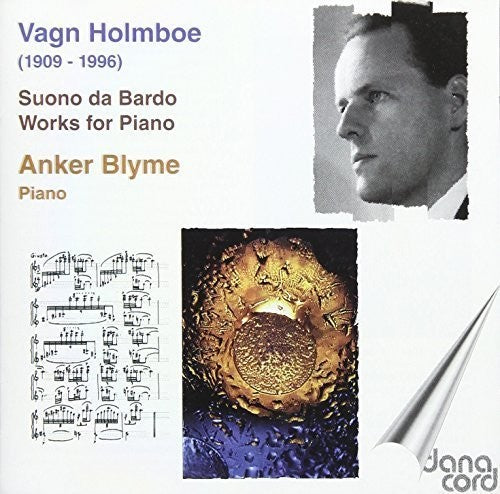
Vagn Holmboe: Piano Music
Holmboe: String Quartets, Vol. 3 / Nightingale String Quartet
Holmboe: Chamber Music, Vol. 1
Holmboe: Chamber Music (II) / Ensemble MidtVest
HOLMBOE Eco. Aspects. Sonata for Cello Solo. Quartetto Medico. Sextet • Ens MidtVest • DACAPO 8.226074 (70:28)
The music of Vagn Holmboe (1909-1996), in addition to these chamber works (of which this is Vol. 2), extends to more than 370 pieces including 13 symphonies. His music is generally described as neoclassical but operating within the parameters of an organic form of development. Holmboe described this as a process of gradual but evident change in the music “interrelated with many things that slowly seep in through a life lived with nature.” Thus his music tends to be quite serious, despite occasional moments of jocularity, but never off-putting. His earlier style was based on the music of his mentor, Carl Nielsen, then developed through years spent in the Balkans studying the folk music there.
These five works come from the latter stages of his career, the earliest of them being the Quartetto Medico of 1956. This piece was written for friends of his who were amateur musicians and professional doctors, which explains its lack of difficulty as well as the humorous titles of the movements (such as Andante medicamento, Allegro quasi febrile and the two “Intermedicos”). The wind quintet Aspects dates from 1957, but the other works are all later: the Solo Cello Sonata from 1968-69, the Sextet from 1973, and Eco from 1991.
The liner notes claim that there is a “Zen-like balance between intellect and nature” in his music, and I would concur. Oddly enough, however, I found that his slow movements were much more emotionally affecting to me than his fast ones. Either the Ensemble MidtVest doesn’t play these with enough good-humored brio, or it just isn’t in there to be brought out, but in either case I find his Allegro s to be peppy but lacking the boisterous good humor of Nielsen’s.
Of course, in the case of the solo cello sonata—played with tremendous feeling and elegance by Jonathan Slaatto—this is serious music indeed, thus the fast passages in the first movement are more in the nature of exposition and spinning out of the theme rather than an attempt at humor. Indeed, I found this to be the most interesting, and certainly the deepest, work on this disc, alternating its moods quickly but always logically. The primary key of the sonata is G Minor, but true to his proclivity for using Balkan folk music, Holmboe works primarily in modes and not in Western keys. Either Slaatto has a somewhat light and airy tone or the microphone placement makes it sound thus, but in either case I felt that the overly reverberant soundspace did not flatter the instrument in this work. That being said, there is little or nothing one can quibble of in either the work’s construction (I wonder if Holmboe was ever more mercurial in his change of moods than he is here) or its emotional impact.
Despite the overall lightness of tone (and texture) in the Quartetto Medico, this music is not really very jocular either. Rather, it floats like a cloud within the universe of Holmboe’s mind, to some extent like Debussy’s early chamber music. This is particularly true of the second “Intermedico,” marked Poco largamente , which is played by the solo pianist in a dreamy style and manner, while the finale ( Allegro con frangula ) starts with piano but is soon joined by the winds. The tempo is more of an Allegretto , not terribly fast, though the music soon doubles in speed as it swirls to a conclusion.
Holmboe’s Sextet begins with the solo cello, which is a bit deceiving, as well as in a slowish tempo that soon picks up. Again, the music is slightly jocular but not really humorous, yet as in the case of all his music it makes a good impression. The Andante cantabile second movement seems to suspend time and place as the music simply hangs above one’s ears while listening, while the final Allegro molto coalesces musical moods into a typically quirky finale.
If this disc is your introduction to Holmboe’s musical world, as it was for me, I think you’ll be intrigued and charmed by it. If you haven’t gotten around to Holmboe’s chamber works but like his other music, this one is a must.
FANFARE: Lynn René Bayley
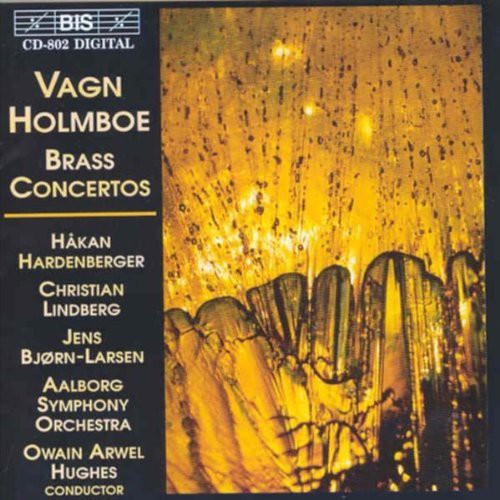
Holmboe: Brass Concertos
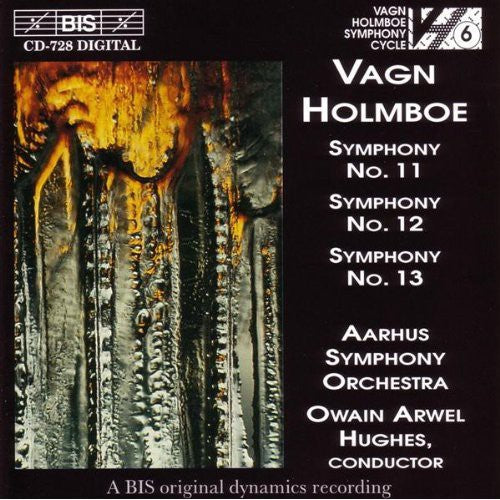
Holmboe: Symphonies No 11, 12, 13 / Hughes, Aarhus Symphony
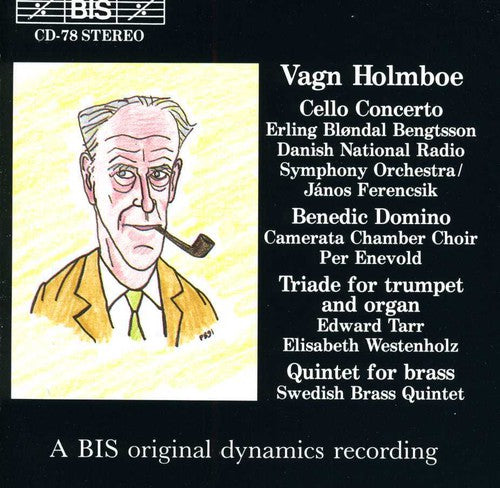
Holmboe: Cello Concerto / Benedic Domino / Quintet
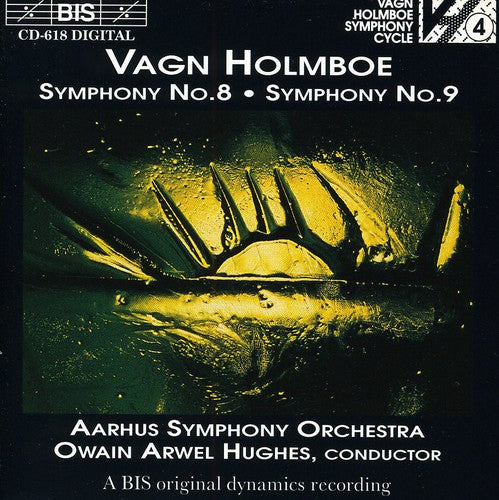
Holmboe: Symphonies No 8 & 9 / Hughes, Aarhus So
-- Ates Orga, BBC Music Magazine
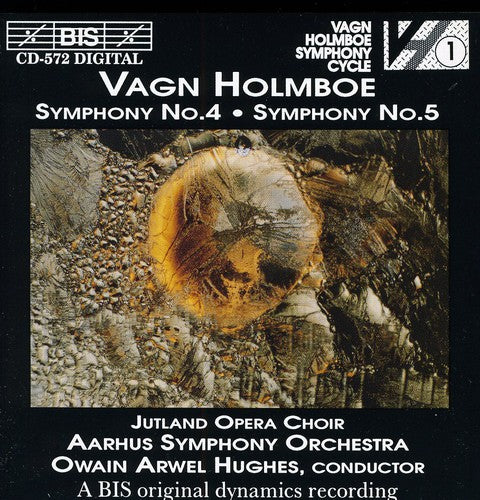
Holmboe: Symphonies Nos. 4 And 5
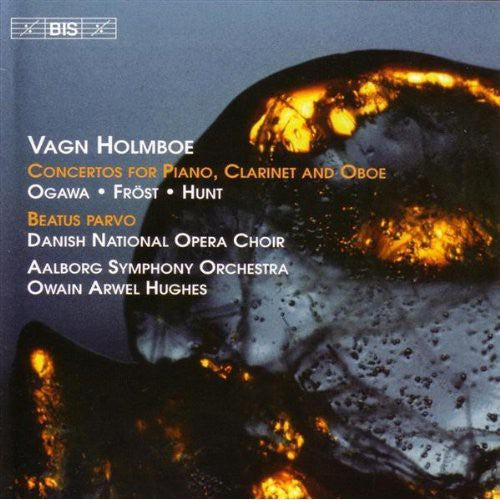
Holmboe: Chamber Concertos, Beatus Parvo / Arwel Hughes
The prolific Danish composer Vagn Holmboe (1909-1996) has been a major concern of BIS for quite some time now. In all we have released 12 CDs dedicated to him and in particular to his orchestral works, including the complete cycle of 13 symphonies (re-released in a 6-CD box, BIS-CD-843/46). Besides the symphonic genre, Holmboe also favoured the concerto form. In his catalogue there are 21 works for solo instrument(s) and orchestra, and with this disc we have recorded a total of 11 of these works. The three concertos on the present CD are all part of the series that Holmboe initially called 'chamber concertos', reverting to the more conventional title 'concertos' mid-way. But still, the format is smaller than a full-blown, romantic concerto - both in terms of scoring (the Piano Concerto is scored for piano, strings and timpani only) and in duration. Written over a period of six years (1939-1945) the concertos for piano, clarinet and oboe show the various influences (Bartók, neo-classicism etc) that the composer integrated in his own music - music that The New Grove Dictionary of Music describes as being of 'a rare continuity and quality of thought.' In order to guarantee the continuity of the BIS Holmboe series, the task of recording these works has been entrusted to conductor Owain Arwel Hughes and the Aalborg Symphony Orchestra; the same team that has been so highly praised for earlier instalments. (About BIS-CD-917, International Record Review wrote: 'As his BIS cycle of the symphonies has shown, Owain Arwel Hughes and his fine Aalborg musicians are completely attuned to Holmboe's world... Recommended with all possible enthusiasm.') The soloists Noriko Ogawa, Martin Fröst and Gordon Hunt will be known for their many and varied BIS recordings. And to round off the disc is a rarity: a setting of Psalm 32, Beatus Parvo, for choir and orchestra, composed in 1972 and an example of the composer's important choral output. (According to the Grove article quoted above, Holmboe is 'one of the few post-World War II Scandinavian composers to possess a natural feeling for vocal line and for polyphony.')
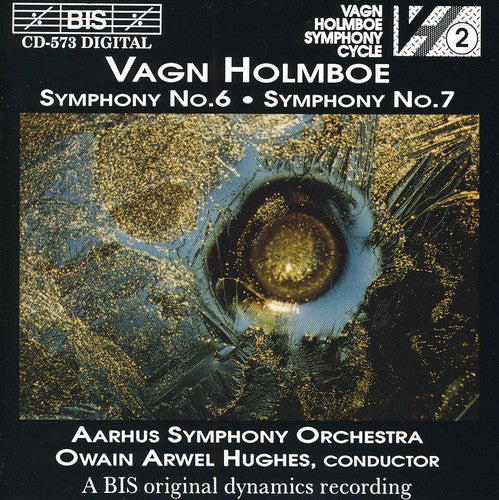
Holmboe: Symphonies Nos. 6 And 7
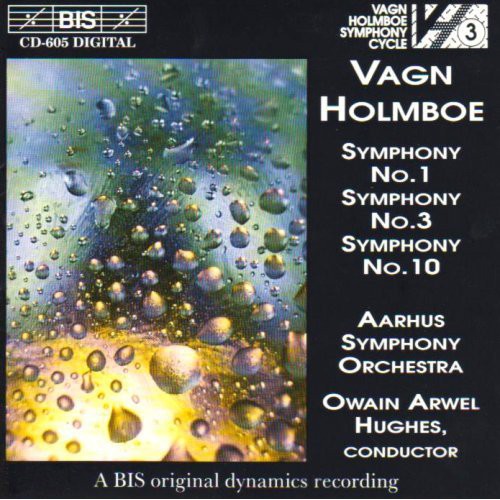
Holmboe: Symphonies Nos. 1, 3 And 10
Holmboe: Recorder Concerto / Flute Concertos Nos. 1 And 2
Holmboe: Concertos Nos. 8 & 10; Concerto Giocondo E Severo / Hughes, Aalborg SO
Thomas Jensen Legacy, Vol. 14: Nielsen, Henze, Prokofiev, Berg & Beyond
This new release, the 14th volume in the esteemed Thomas Jensen series, includes previously unpublished broadcasts of 20th-century music, not only by figures closely associated with Thomas Jensen such as Carl Nielsen and Niels Viggo Bentzon, but also Ole Schmidt and Gunnar Berg, who wrote outside the Danish mainstream. Jensen's catholic taste and sympathy with diverse strands in European modernism is attested by his careful shaping of masterpiece by Henze, Honegger and Prokofiev.
Vagn Holmboe: Solo & Chamber Works For Guitar
HOLMBOE Sonatas for Guitar: No. 1; No. 2. Five Intermezzi for Guitar. Duo Concertato for Violin and Guitar. Parlare del più e del meno. Canto e Danza for Recorder and Guitar. Seven Folk Ballads for Recorder and Guitar • Jesper Sivebæk (gtr); Johannes Søe Hansen (vn); Bolette Roed (rcr) • DACAPO 8.226143 (71:20)
Danish composer Vagn Holmboe began writing for the guitar late in his career, at the age of 70, and then continued to create works for the instrument for another 13 years. It’s not clear what drew him to the instrument. He said little about it other than to comment that he wanted to write for it, and so he did. He first composed more formal works—two sonatas—to avoid folk associations. Each is a suite of thematically related pieces, worked out in the organic way that he typically developed his material, and very concise, especially the second of these. Folk qualities were impossible to avoid, however, as a quick listen to almost any of the works here will demonstrate. Still, this is hardly Holmboe taking up “light music” at the end of his life, for there is much complexity and sophistication of invention, as well. The Five Intermezzi , which followed two years later in 1981, are of a similar character, but the composer is starting to actually embrace the folk connections, using a folk-like melody of obvious Spanish flavor as a unifying theme, and adding characteristic rhythmic percussive effects and shifting meters as well.
In 1983, he went further with Seven Folk Ballads , employing actual folk tunes from England, Israel, France, Ukraine, and his native Denmark. The original intent was to create duos for balalaika and guitar, but eventually the composer opted for the more complementary sound of the recorder. The setting of each tune, beginning with the familiar The Three Ravens from England, captures the character of the folk melody with simplicity and grace. In the Duo Concertato for Violin and Guitar (1986) the violin adds an Eastern European quality as the two instruments engage in a witty and sometimes dramatic conversation. In the last solo work, the introspective Parlare del più e del meno (1988), the conversation becomes a monolog, internalized in five very short movements of great density, rhythmic freedom, and centered calm, while the last chamber work for guitar, Canto e Danza , written in 1992 when Holmboe was 83, is a set of variations on a Spanish harvest song, in three contrasting movements, followed by a lively baroque dance movement which sounds like the work of a much younger man. His exploration of the instrument was thorough, to say the least.
The stylistic rather than strictly chronological structuring of the CD program, working from the more serious sonatas to the encore-like folk ballads, works beautifully. The performers, all outstanding Danish musicians, capture the delicate personality of each work perfectly, most especially guitarist Jesper Sivebæk. The engineering is first-rate, with a palpable sense of those performers in a real space. There are fine notes on the music. The music has charm and substance. I really can’t think of a better way to invest 70 minutes, whether for heart or head.
FANFARE: Ronald E. Grames
Vagn Holmboe: Works For Violin & Piano / Hansen, Bjorkoe
Recording information: Carl Nielsen Academy of Music (08/16/2008-08/17/2008); Carl Nielsen Academy of Music (09/20/2008).
Holmboe: String Quartets, Vol. 2 / Nightingale String Quartet
Holmboe: String Quartets, Vol. 1 / Nightingale String Quartet
-----
REVIEW:
Vagn Holmboe’s 20 numbered string quartets constitute one of the 20th century’s most substantial and rewarding bodies of work in the genre. Collectors have come to know these compositions largely through the Kontra Quartet’s complete recorded cycle on Dacapo. The label now launches a new Holmboe project with the young Nightingale Quartet, whose Rued Langgaard quartet cycle set reference standards. In every way they match the Kontra’s technical polish, ensemble discipline, and textual integrity. Yet their interpretations sometimes differ.
For example, the Nightingale’s leaner spelling out of the gorgeously dense chords in the third-movement introduction of the First quartet contrasts to the Kontra’s massive and fuller-bodied impact. On the other hand, the second movement’s slithery Presto passages gain from the Nightingale’s faster tempo and lighter articulation.
Although the Third quartet’s five-movement “arch” form (slow-fast-moderate-fast-slow) owes an obvious debt to Bartók’s own Third quartet, Holmboe’s somewhat sunnier harmonic language goes its own way. It’s a toss-up between the Kontra’s intensely expansive, dynamically varied opening Lento and the Nightingale’s cooler temperament, brisker pace, and precisely calibrated attacks and releases. Some listeners may prefer the Nightingale’s supple scampering in the Allegro assai to the Kontra’s slightly heavier reading, yet the latter’s broader tempo allows the occasional “droning” bass lines to resonate more effectively.
My colleague David Hurwitz describes Holmboe’s late quartets as more complex but also more personal and concentrated, and that’s especially true of his three-movement No. 15. The Kontra’s slower unfolding of the fourth-movement introduction conveys a sense of mystery and otherworldliness that I feel digs deeper than the Nightingale’s drier reserve. But once the Allegro kicks in, the Nightingale’s gaunter, crisper approach better enlivens Holmboe’s knotty contrapuntal writing.
If this first volume is any indication, the Nightingale Quartet Holmboe cycle will complement rather than supersede the Kontra Quartet, and that’s all to our advantage. And to Holmboe’s advantage, of course!
– ClassicsToday (Jed Distler)