Conductor: Alfred Walter
17 products
J. Strauss Jr.: Famous Overtures / Walter, Slovak State
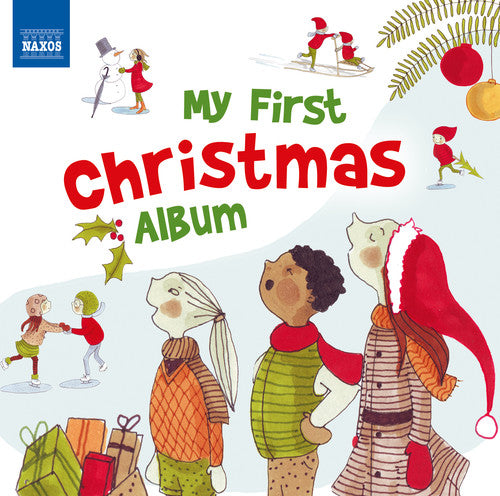
My First Christmas Album
Can you imagine Christmas without music? No singing, no jingling. Only Scrooge would be happy with that! It is a time for music to fill the air. Part of the fun is hearing things that are only played at Christmas and at no other time of year - carols that make you think of the end of term, or the holidays or bobble hats - songs that make you think of food, or snow, or stockings. Here are some of the most popular carols, as well as some other surprises...Merry Christmas!
REVIEWS:
I have always been a great believer in the importance of presenting music of the highest possible quality regardless of the potential audience. This is done here — for the adult listener there is real interest and fascination in hearing such a wide range of choral styles.
I loved the predictably fine Lutoslawski/ Antoni Wit Polish National RSO & Choir Hurrying to Bethlehem. Again quite a different choral tone. Otto Kotilainen’s Finnish Kun Joulu on is something of a discovery beautifully performed—a lighter tone than the Polish choir but very expressive by the Finnish choir Chorus Resonus. Another virtuoso vocal group prove to be La Petite Bande de Montreal who contribute a brief but virtuosic Carol of the Bells. Jeremy Summerly’s Oxford Camerata are suitably vigorous in the Medieval Gaudete Christus est natus. As indeed is For Unto us from the Messiah from Edward Higginbottom, the Academy of Ancient Music and Oxford New College Choir. This is a delightfully sprung and sprightly version of an old favourite. Most of the carols are sung with little or no accompaniment other than the expected organ or keyboard. This makes the full orchestral version of Vaughan Williams’ Wassail Song particularly enjoyable.
So all in all a disc of palpable hits in terms of music and performance, and certainly something for the stocking of a young relative. No texts or translations are included. Well done to Naxos for producing a disc of great entertainment value but without compromising the artistic merit of it either.
-- MusicWeb International
If you’re looking for a Christmas album that the kids will like but won’t drive you up the wall, try this. It’s one of a series of Naxos CDs that try and introduce children to classical music...
Most of your favorite Christmas carols are on here, along with Rudolph the Red-Nosed Reindeer and the Sugar Plum Fairy. For a Christmas album, it gets high praise: it’s not annoying, and only Scrooge could really find fault. It also introduces the small ones to classical playing.
-- The Chronicle
Strauss: Ritter Pásmán / Wallberg, ORF Vienna Radio Symphony Orchestra
When the Court Opera Director Wilhelm Jahn commissioned the by no means unvain Johann Strauss Jr. to write a ‘genuine’ opera, he readily accepted. So, he wrote Ritter Pásmán, a work the Waltz King himself regarded as his only one in this genre, although the plot is basically like an operetta. The source was the narrative Pázmán lovag by the Hungarian writer János Aranyi (1817-1882). It deals with jealousy and a kind of tit-for-tat. The premiere of the comic opera at the Vienna Court Opera on New Year’s Day 1892 was a major society event, but its artistic success lagged somewhat behind. The reviewers of the premiere were distanced towards the work. On the one hand, they unanimously elevated the ballet music at the beginning of Act III to the status of an absolute masterpiece. (By the way, this was the first time that a cimbalom could be heard in the orchestra of the Court Opera). The present live recording was captured at the Vienna Musikverein on 27 October 1975, with the ORF Vienna Radio Symphony Orchestra under the baton of Heinz Wallberg, Eberhard Waechter as Ritter Pásmàn, Sona Ghazarian as Queen, Josef Hopfwieser as Hungarian King, and Truedeliese Schmidt as Eva as main cast. The recording includes the complete ballet music as bonus tracks, performed by the Slovac State Philharmonic Orchestra under the baton of Alfred Walter.
The Best Of Grieg
Suppé: Famous Overtures / Walter, Slovak State Philharmonic
Lachner: Symphony No 8, Etc / Robinson, Walter, Slovak Po
J. Strauss Jr. Edition Vol 49 / Alfred Walter, Et Al
The Best Of Weber
The Best Of Operetta Vol 2
Spohr: Symphony No. 4 / Walter, Budapest Symphony Orchestra
Beethoven's friend Louis Spohr was one of the most significant symphonists of his day and his nine works in the genre divide fairly evenly into those which follow classical traditions and four which have titles. Symphony No. 4 in F major, Op. 86 is subtitled Die Weihe der Tone (The Consecration of Sound) and is a programmatic work, based on an eponymous poem by Carl Pfeiffer, that offers both a novel symphonic form and a powerful musical narrative. Spohr was also a hugely influential figure in the development of German opera, as the two overtures clearly demonstrate.
Spohr: Symphonies Nos. 7 & 8 / Walter, Slovak State Philharmonic
Louis Spohr's innovative approach to symphonic writing began with the programmatic Symphony No. 4 (8555398) and was further broadened by Symphony No. 7 in C major, Op. 121 which he subtitled "The Earthly and Divine in Human Life". Jettisoning traditional symphonic form, this work is in effect a daring symphonic poem in three movements with a small orchestra representing the "divine" and the full orchestra the "earthly". The more traditional Symphony No. 8 in G major, Op. 137 - enshrining both tragic lament and sweet serenade - enables us to compare Spohr the innovator with Spohr the formalist.
Spohr: Symphonies Nos. 3 & 6 / Walter, Slovak State Philharmonic
Spohr: Symphonies Nos. 2 & 9 / Walter, Slovak State Philharmonic
Composed in London, Spohr's Second Symphony was received with real enthusiasm at its premiere, the audience responding to the work's tasteful Haydn-esque flourishes, wide emotional palette and delightful writing for wind instruments. Written in 1850, a year after the re-imposition of authoritarian rule in Germany, Symphony No. 9 "The Seasons" is no mere programmatic work but a symbolic journey from the winter darkness of political oppression through the "Garden of Eden" imagery of Spring and the vibrant colors of Summer, ending with Autumn whose positive finale is a celebration of the composer's belief in the political rebirth of Germany.
Spohr: Symphonies Nos 1 & 5 / Walter, Slovak State Philharmonic
Virtuoso violinist, conductor and composer, Louis Spohr wrote ten completed symphonies. The first five demonstrate a remarkable creative growth inaugurated by Symphony No. 1 of 1811 which took the music of Spohr’s idol, Mozart, as a model. Whilst retaining individuality, classical precedents infuse it with festive vitality. “Truly beautiful and masterly” was Robert Schumann’s judgement of Symphony No. 5 in C minor, a work both expansively melodic and quintessentially Romantic – and possibly Spohr’s greatest symphonic statement.
Romantic Violin Concertos - Bériot / Nishizaki, Et Al
Discover The Classics Volume 2
This set also comes with a sixty-page booklet. It provides an introduction to classical music and the various national styles, complete texts for all vocal pieces, and recommended listening grouped by country and composer.