Conductor: George Szell
19 products
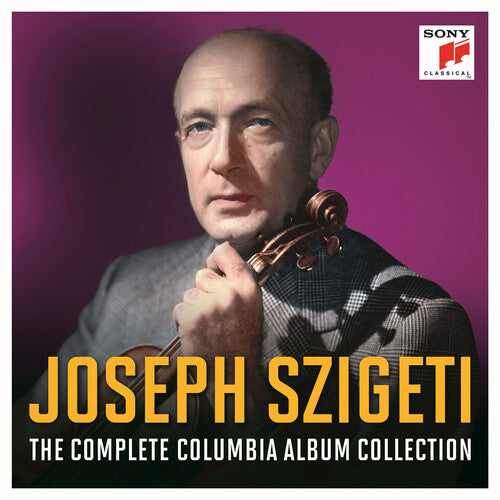
Joseph Szigeti: Complete Columbia Album Collection
Sony Classical is pleased to announce the release of a 17-CD box set collecting the recordings made between 1940 and 1956 for American Columbia by the renowned Hungarian violinist Joseph Szigeti.
Szigeti had a remarkable career. Born in 1892 in Budapest, where he studied with Jenő Hubay, one of most celebrated virtuosos and teachers of that golden era of violin playing, he was praised by the iconic German violinist Joseph Joachim at his Berlin debut in 1905; lived in London for several years following his acclaimed 1907 debut and played chamber music with, among others, Myra Hess and Ferruccio Busoni; was a frequent visitor after the war to the Soviet Union, where he introduced Prokofiev’s First Violin Concerto; made his triumphant American debut at Carnegie Hall under Stokowski in 1925; toured the world during the 1930s before finally settling in the US in 1940.
It was in that year that Szigeti renewed his friendship with fellow Hungarian émigré Béla Bartók, and in April the two gave a now-legendary recital in Washington which featured Bartók’s First Violin Rhapsody of 1928 – a work dedicated to and premiered by Szigeti in Europe. In May 1940, Columbia recorded their interpretation of this “vehicle for Szigeti’s biting and wholly magnificent fiddling” (MusicWeb International) in New York. That performance appears here for the first time on CD, along with another important work by Bartók, the classic first recording of his Contrasts for clarinet, violin and piano, written for and performed with Szigeti and Benny Goodman.
The rest of the new collection displays many more treasures of Szigeti’s passionate dedication to chamber music: in Bach, Handel, Tartini, Mozart, Beethoven, Schubert, Brahms, Dvořák, Debussy, Ravel, Bloch, Busoni, Prokofiev, Stravinsky and Henry Cowell, collaborating with such artists as Andor Foldes – another Hungarian émigré – as well as with Mieczyslaw Horzowski, Myra Hess, Pablo Casals and Igor Stravinsky.
There are, of course, major orchestral works represented in the new Szigeti edition, including two towering concertos in D major – the Brahms, recorded in 1945 with Eugene Ormandy conducting the Philadelphia Orchestra, and the Beethoven, recorded in 1947 with Bruno Walter and the New York Philharmonic (“an account of impassioned grandeur” – MusicWeb International) – along with Busoni’s early Violin Concerto in D major, recorded in 1954 with Thomas Sherman conducting the Little Orchestra Society. Szigeti’s numerous Bach concerto recordings for Columbia are here as well, conducted by Casals, Fritz Stiedry and George Szell.
As Nathan Milstein, one of his great colleagues, said in a touching tribute to Szigeti, who died in 1973: “He was an incredibly cultured musician. Actually, his talent grew out of his culture. … I always admired him, and he was respected by musicians.” In his late years, Joseph Szigeti finally got the appreciation he deserved from the general public as well. Sony Classical’s new collection his Columbia recordings, many never before released on CD at Sony Classical, can only further enhance that appreciation.
REVIEWS:
Joseph Szigeti (1892-1973) was the violinistic equivalent of a “kunst diva”, just as Gidon Kremer is today. He never had a particularly beautiful tone, while his bowing and intonation grew less dependable with age. Yet Szigeti never put a wrong musical foot forward. His phrasing communicated form, character, architecture, and astute harmonic awareness, with musical considerations always taking precedence over physical expediency.
Sony/BMG’s 17-CD collection of Szigeti’s complete Columbia Masterworks recordings stands out for exemplary remasterings that stem from the best possible source material. His intense yet thoughtful collaborations with Mieczyslaw Horszowski in Beethoven’s Sonatas Nos. 1, 5, 6, and 10 have never sounded so full-bodied and detailed as they do here. The same goes for the 1947 Beethoven Concerto, where the New York Philharmonic turns in firm and insightfully aligned playing under Bruno Walter’s direction. It contrasts to the conductor’s relatively casual and deferential backing in Szigeti’s 1932 recording, which, however, finds Szigeti on far better form.
Rehearing Szigeti’s 1949 Bach Sonata No. 3 in C major for violin solo reminded me just how much more fluent and controlled this performance is in comparison to the violinist’s relatively tenuous Vanguard remake. Likewise, his masterful 1940 account of the D minor concerto based on Bach’s keyboard concerto BWV 1052 is technically, musically, and sonically superior to the bloated 1950 reading under Pablo Casals’ direction. Szigeti’s Casals Festival contributions are admittedly uneven.
His collaborations with Béla Bartók, Igor Stravinsky, and Henry Cowell are both historically important and musically illuminating. Somehow the older Szigeti’s wiry tone imparts welcome character and tension to sonatas by Hindemith, Ravel, and Busoni, as well as the rarely heard Prokofiev solo sonata and Busoni concerto. It must be said, though, that the latter’s final scherzando-like passages are heavy going for the veteran violinist, as are the Busoni sonata’s overextended fugal sequences.
Listeners expecting suaveness and elegance in Brahms’ G major Op. 78 and D minor Op. 108 sonatas with Horszowski may wince at Szigeti’s tremulous and effortful execution. Still, he makes every note count, and the aching fragility that emerges from Op. 78’s outer movements and Op. 108’s deliberately unfolding third movement compels my undivided attention. Yet this Brahms D minor pales next to the power and authority of Szigeti’s great 78 rpm edition with pianist Egon Petri. As for the short encore-type pieces favored in the shellac era, Szigeti plays them dutifully rather than lovingly; he wasn’t a charmer like Kreisler, Elman, Milstein, or Ricci. Or Heifetz, for that matter.
The booklet includes full discographical data, an informative essay by Tully Potter, and Szigeti’s own notes for a 1970 Japanese reissue of his Schubert recordings. Even if just half of this collection represents Szigeti at his best, Sony/BMG’s comprehensive and meticulous production values deserve the highest accolades. In the meantime, a complete edition of Szigeti’s pre-war European 78s is long overdue.
-- ClassicsToday.com (Jed Distler)
The 31 works, from sonatas to chamber works to concertos, span Bach and Beethoven to Debussy, Ravel, Busoni and Henry Cowell. Bartók is pianist in his own Rhapsody No 1 for Violin and Piano. All the Brahms, including the Trio No 2 in C major with Hess and Casals, is to treasure. Szigeti plays Dvořák with grace and melancholy, and gives bite and attack to Stravinsky. The style may be redolent of another era, yet still this playing speaks to us.
– Guardian (UK)
This is a quite wonderful set, one of the highlights being an all-Busoni disc, the Second Sonata with Mieczysπaw Horszowski and the Violin Concerto with the Little Orchestra Society under Thomas Sherman. No one listening could fail to grasp the profound level of Szigeti's musical understanding.
– Gramophone
SET CONTENTS
DISC 1:
Bartók: Violin Rhapsody No. 1, Sz.87 (Remastered)
Bartók: Contrasts for Clarinet, Violin and Piano, Sz.111
Bloch: Three Pictures of Chassidic Life for Violin and Piano (Remastered)
Milhaud (arr. Lévy): Saudades do Brasil, Op. 67: No. 9, Sumare (Remastered)
Falla (arr. Levy): El Sombrero de Tres Picos, Parte I, Danza de la molinera (Remastered)
Mozart: Divertimento No. 15 in B-Flat Major, K. 287, "2. Lodronsche Nachtmusik" (Remastered)
DISC 2:
Mussorgsky-Rachmaninoff: Sorochintsy Fair, Act III: No. 5, Gopak (Remastered)
Dvorák (arr. Kreisler): Slavonic Dance in E Minor, Op. 46, No. 2 (Arr. in G Minor) (Remastered)
Dvorák (arr. Kreisler): Slavonic Dance No. 3 in A-Flat Major, Op. 46, No. 3 (Arr. in E Minor) (Remastered)
Hubay: Scènes de la Csárda No.4, Op. 32, "Hejre Kati", I. Lento ma non troppo. Allegro moderato (Remastered)
Hubay: Scènes de la Csárda No.4, Op. 32, "Hejre Kati", II. Allegro molto (Remastered)
Kodály (arr. Szigeti): Háry János Suite, IZK 26: V. Intermezzo (Remastered)
Brahms: 21 Hungarian Dances for Orchestra, WoO 1: No. 5 in G Minor (Remastered)
Debussy: Violin Sonata No.3 in G Minor, L. 140 (Remastered)
Hubay: The Zephyr, Op. 30, No. 5 (Remastered)
Schubert, Francois: Bagatelle Op. 13, No. 9, "Die Biene" (Remastered)
Stravinsky: Duo Concertant for Violin and Piano
Stravinsky: Pastorale, Song without Words for Violin & Woodwind Quartet
Stravinsky: Russian Maiden's Song
DISC 3:
Beethoven (Cadenza: Joseph Joachim): Violin Concerto in D Major, Op. 61
DISC 4:
Brahms: Violin Concerto in D Major, Op. 77
Brahms: Violin Sonata No.3 in D Minor, Op.108: II. Adagio
DISC 5:
Beethoven: Violin Sonata No.1 in D Major, Op. 12, No. 1 (Remastered)
Schubert: Violin Sonata in D Major, D.384
Schubert (arr. Friedberg): Piano Sonata No.17 in D Major, D.850: IV. Rondo. Allegretto moderato (Remastered)
Beethoven: Violin Sonata No.7 in C Minor, Op. 30, No. 2 (Remastered)
DISC 6:
Prokofiev: Violin Sonata No.1 in F Minor, Op. 80 (Remastered)
Prokofiev: Violin Sonata No. 2 in D Major, Op. 94bis (Remastered)
DISC 7:
Bach, J.S.: Violin Sonata No. 3 in C Major, BWV 1005
Bach, J.S. (arr. Reitz): Keyboard Concerto No. 1 in D Minor, BWV 1052
DISC 8:
Schubert: Fantaisie for Piano & Violin in C Major, Op.Posth. 159, D. 934
Corelli (arr. H. Leonard): Violin Sonata in D Minor, Op.5 No.12 "La Folia" (Variations Serieuses)
Debussy (arr. Roelens): Suite bergamasque, L. 75: No. 3. Clair de lune
Lalo (arr. Szigeti): Aubade from "Le Roi d'Ys" (Act III)
Tchaikovsky: 6 Pieces, Op. 51: No. 6, Valse sentimentale
Bach, J.S. (arr. Szigeti): Violin Partita No.3 in E Major, BWV 1006: VI. Bourrée (Remastered)
DISC 9:
Bach, J.S.: Concerto for Flute, Violin and Keyboard in A Minor, BWV 1044 (Remastered)
Bach, J.S.: Violin Concerto No. 1 in D Minor, (arr. BWV 1052/1056) (Remastered)
Bach, J.S.: Brandenburg Concerto No. 5 in D Major, BWV 1050
DISC 10:
Schubert: Rondo in B Minor for Piano and Violin, D.895 (Op.70) "Rondeau brillant"
Beethoven: Violin Sonata No.10 in G Major, Op. 96 (Remastered)
Schubert: Violin Sonata in A Major, Op. 162. D. 574 "Grand Duo" (Remastered)
DISC 11:
Brahms: Piano Quartet No. 3 in C Minor, Op. 60
Brahms: Piano Trio No. 2 in C Major Op. 87
DISC 12:
Cowell: Sonata No. 1 for Violin and Piano (1945) (Remastered)
Shapero: Sonata for Piano Four Hands (1941) (Remastered) (Harold Shapero, piano; Leo Smit, piano)
Cowell: Celestial Vision: How Old Is Song? (Remastered)
DISC 13:
Beethoven: Violin Sonata No.5 in F Major, Op. 24 "Spring"
Beethoven: Violin Sonata No. 6 in A Major, Op. 30, No. 1
DISC 14:
Bach, J.S. (arr. Szigeti): Violin Concerto in G Minor, BWV 1056 (Remastered)
Handel: Violin Sonata in D Major, HWV 371 (Remastered)
Tartini (Cadenzas: Szigeti): Violin Concerto in D Minor, D. 45 (Remastered)
Tartini: Violin Sonata in G Major, B. G19 (Remastered)
DISC 15:
Ravel: Violin Sonata No.2 in G Major, M. 77
Hindemith: Violin Sonata in E Major (1939)
Prokofiev: Sonata for Solo Violin in D Major, Op. 115 (Remastered)
Prokofiev: Five Melodies for Violin and Piano, Op. 35bis (Remastered)
DISC 16:
Busoni: Violin Concerto, Op.35a, BV 243
Busoni: Violin Sonata No.2, Op.36a, BV 244
DISC 17:
Brahms: Violin Sonata No.1 in G Major, Op. 78 "Regen" (Remastered)
Brahms: Violin Sonata No.3 in D Minor, Op.108 (Remastered)
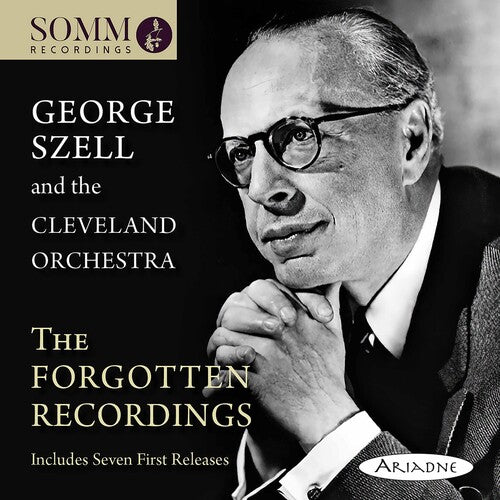
George Szell - The Forgotten Recordings / Cleveland Orchestra
SOMM RECORDINGS announces the first release of never before available performances by one of the defining partnerships of modern American music in the specially priced two-album set George Szell and the Cleveland Orchestra: The Forgotten Recordings. Long considered one of America’s “Big Five” orchestras, the Cleveland Orchestra entered its second century in 2018 and earlier this year was hailed by The New York Times as “America’s finest [orchestra] still”.
The Forgotten Recordings features eight historic performances made for the Book-of-the-Month Club in 1954 and 1955 – seven of which are first releases – that have been restored and remastered by the multi-award-winning audio restoration engineer Lani Spahr, who also provides extensive and informative booklet notes. Three works – Bach’s Third Orchestral Suite (BWV 1068), a revealing engagement by Szell with a composer he is not usually associated with, Smetana’s The Moldau and Strauss’s Till Eulenspiegel (with an early spotlight on legendary horn player Myron Bloom) were recorded in mono in a remarkably productive session on Christmas Eve, 1954.From October 1955 in stereo recordings are two works by Brahms – his Haydn Variations and the Academic Festival Overture, two symphonies – Mozart’s No.39 and Schumann’s Fourth – and a Stravinsky Firebird Suite that “crackles with energy”. “Here”, says Spahr, “we can appreciate that the orchestra was well on its way to becoming, in Szell’s words, ‘this glorious instrument... that perfectly reflects my musical ideals’.”
REVIEW:
George Szell’s tenure as music director of the Cleveland Orchestra began in 1946 and ended with his death in 1970. He can be credited for transforming the orchestra into a first class ensemble, with its own characteristic sound and style. When he first accepted the position, he vowed to "dedicate all [his] efforts…to make The Cleveland Orchestra second to none in quality of performance." Musicians were hired and fired in an effort to achieve this goal – a warm, refined sound, clarity and technical perfection, demanding total commitment from the players. His lofty goal was eventually achieved.
These ‘Forgotten’ recordings were made for the Book-of-the-Month Club (BOMC), a mail order outfit that dealt with popular books sold by subscription. In 1954 it made the decision to branch out into classical LPs, with accompanying analysis of the works by such noted writers as Thomas Scherman and Deems Taylor. Many of the issues were licensed from labels such as Vanguard, Vox and Decca, conducted by some notable names - Max Rudolf, Alfred Wallenstein, Fritz Stiedry and Leonard Bernstein. George Szell was also approached by the company and was happy to accept, considering it a means of supplementing his musician’s income.
On December 24 1954, the first recording session took place at the Masonic Auditorium, Cleveland, with the Bach, Smetana and Richard Strauss works, music that had recently featured in subscription concerts. The session was recorded in mono. The rest of the works featured in the set date from 1955 and are in stereo.
Bach is not a composer one usually associates with Szell. Though HIP had a long way to go, Szell pares his orchestra down, and employs a harpsichord continuo. Tempi throughout don’t drag, with the dance movements being quite animated. The ubiquitous Air is nicely paced. There’s some wonderfully refined woodwind playing in Smetana’s Moldau (Vitava), and the recording balance enables the river’s rippling undercurrents to form a vivid backdrop. Szell never overdoes it with the brass, which lets down some performances, but steers everything along maintaining balance and proportion. The quieter moments are quite magical. Strauss’ Till Eulenspiegel features the renowned horn player Myron Bloom in one of his first appearances on record. A year later he became the orchestra’s principal horn. The performance captures the very essence of the witty, light hearted, mischievous prankster, and reveals the discipline and virtuosity of the Cleveland players, especially in the brass and woodwind sections.
Over three days in October 1955, five more works were recorded for BOMC, this time in the new stereophonic sound. Szell takes a rather more relaxed view of Mozart’s Symphony No.39, which is free-flowing, refined and eloquently phrased. The Menuetto is lively with a distinct spring in its step, and the finale is truly exhilarating. There’s a bracing account of Brahms’ Academic Festival overture, infused with spirit and celebration. Szell’s approach is warm-hearted in the composer’s Variations on a Theme by Haydn. The performance is well-paced and the variations are deftly-characterized.
There’s a purposeful reading of Schumann’s Fourth Symphony, soused throughout with drama and tension. The Romanze excels for its tender moments. Szell injects plenty of energy into the fourth movement, and the orchestra respond with gusto and panache. Stravinsky’s Firebird is heard in the 1919 version. It’s an atmospheric account of many moods. There’s the captivating lyricism of the Round of the Princess, which contrasts strikingly with the Infernal Dance of King Kastchei, where Szell invests the music with an extra ounce of punch and sizzle. I certainly concur with Lani Spahr that this is the highlight of the set.
Comparing the three mono recordings with those taped in stereo, the latter have a degree more bloom to the sound and register more presence. All the works featured are making a first appearance on CD, with the exception of Brahms’ Variations on a Theme by Haydn. These compelling aural documents have been expertly restored by Lani Spahr, who has also contributed the booklet notes, running to 19 pages. All in all, the entire project is an unmitigated success.
– MusicWeb International (Stephen Greenbank)
Antonin Dvorak: Symphony No. 7; Carnival Overture; Smetana: The Moldau
Beethoven: Symphonies 4 & 7 / Szell, Cleveland Orchestra
For some reason, when Sony withdrew its Essential Classics catalogue from circulation and began to reissue the range in a newly generic livery, this disc from Szell's classic Beethoven cycle never managed to find its way back onto the shelves. Why Sony would have reissued the rest of the cycle and left these performances out is a mystery. It is certainly not a question of quality, as these recordings are among the best in Szell's cycle. Perhaps it was overlooked in the course of the merger of Sony and BMG. Perhaps it was a ploy to frustrate collectors into forking out for the "Original Jackets" box of the symphonies. Whatever the reason, if you began collecting the Essential Classics releases and missed this disc while it was still available, then you owe it to yourself to snap it up now.
Often when listening to Beethoven recordings from the past, one needs to adjust one's mindset slightly. Beethoven, in those days, tended to be a heavy and heroic establishment figure, rather than reinvigorated revolutionary we are accustomed to hearing today, thanks to the efforts of the period performance movement. Not so with Szell. His cycle may be roughly contemporary with Karajan's set with the Berlin Philharmonic, but he elicits a lighter, crisper sound from his Clevelanders that is much more in line with the Beethoven we are now used to.
There is a received wisdom that Szell's lighter and pacier approach to Beethoven was essentially Toscanini's approach in stereo sound. This is not at all the case. Szell was certainly particular when it came to precision and clarity of articulation, but he also balances the power of Beethoven with the composer's humour and delicacy.
Both the fourth and the seventh symphonies receive excellent performances here, shaped with characteristic thought for structure, rhythmic pulse and close attention to dynamic contrasts. Tempi are superbly judged in both performances. Szell is never too quick, and never drags. The final movement of the fourth is the only place where I felt a little more pace was warranted, though it remains rhythmically pointed and precisely articulated.
There is plenty of mystery to the atmosphere of the introduction to the fourth's first movement. It almost sounds like Berlioz. Then the allegro vivace that follows explodes into joyful existence. The Cleveland Orchestra bring considerable brio to this performance and you cannot help being dazzled as they point up contrasts between the lyrical and the rambunctious in Beethoven's score. The adagio has great beauty but remains rhythmically taut. In Szell's hands it is delectably dance-like. The scherzo is actually quite funny, with the questioning woodwinds quizzing the cavorting strings.
Of modern readings of this symphony, I find Vänska's to be the most satisfying and the one which, more than any other I have heard, makes this symphony sound like an integrated whole, fully the equal of – though very different to – the fifth, rather than a brilliant experiment in rhythmic contrasts and orchestral colouring. Haitink's dancing account with the LSO is also superb – one of the best recordings of his cycle on LSO Live. Szell's performance is just as good, and any sonic reservations are amply offset by the excellence of his orchestra.
The opening of the first movement of the seventh again demonstrates Szell's ability to balance the power of these symphonies with sensitivity. He hits the accents hard, though, and once past the poco sostenuto introduction, the vivace is terrifically exciting. As in the fourth, he brings gravitas and integrity to the “slow” movement (if a flowing allegretto can be said to be slow). The scherzo sparkles and the final allegro con brio dances. This is a wonderful performance, and the playing of the Cleveland Orchestra is incredible. The whooping of the horns and the buzz of the strings at the symphony's close is exhilarating.
Of course there are many other great sevenths in the catalogue. Carlos Kleiber's recording with the Vienna Philharmonic remains unique in it power and drive, and of recent recordings Haitink's recent effort on LSO Live, like his fourth, is one of the highlights of his cycle – exciting and involving from first note to last. Szell is worth hearing, though. More than that, in bringing out Beethoven's lyricism without sacrificing anything in power, he has something distinctive to say.
The overture to King Stephen makes an excellent encore. Szell's reading has plenty of sparkle and is never rushed, though the recorded sound is a bit flat and brash. To be honest, all of these recordings are beginning to show their age, but the slightly dry acoustic is no great hindrance and helps the precision of the orchestra hit home all the harder.
In short, these performances are excellent. There are others in the catalogue that match the individual readings, but as a coupling of symphonies 4 and 7, this disc is unbeatable.
-- Tim Perry, MusicWeb International
Beethoven: Piano Concerto No 5, Triple Concerto / Stern
Dinner Classics - Romance
This CD contains both analogue and digital recordings.
Bruckner: Symphony No 7 / Szell, Wiener Philharmoniker
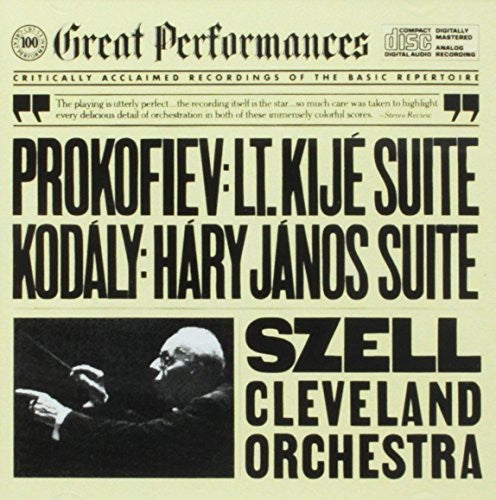
Kodaly: Hary Janos Suite; Prokofiev: Lt Kije Suite / Szell
Janácek: Sinfonietta, Etc; Kodály: Dances / Szell, Ormandy
Brahms: Piano Concerto No 1; Strauss: Burleske / Szell, Serkin
Serkin is said to have disliked recording and his legacy is mixed, technically and artistically. Yet, at best, his driving energy, his fierce intelligence, his quick mind, and (until comparatively recently) his unfailing lucidity of touch often produced recordings that do that rare thing: they transcend the medium.
One such recording is his 1968 Cleveland account of Brahms's D minor Piano Concerto which Sony have recently reissued...coupled with another Serkin speciality, Richard Strauss's Burleske for piano and orchestra. Serkin "at the peak of his form, emotionally, intellectually, and technically" is how Trevor Harvey described the performance in these columns in May 1969 and I wouldn't disagree with that. From the piano's first entry it is evident that we are in the presence of a musical plain-dealer who is something more besides. The touch is plain but never monochrome, resolute but never harsh. There are miracles of dynamic shading yet dynamic changes that are elementally swift and steep. Above all, there is a revelatory way with rhythm, full of potency and drive in quicker music, and turning the more reflective passages into slow sustained acts of transcendental enquiry. As a reading this has something of Arrau's weight and profundity (Philips D 420 702-2PSL, 11/87) matched to Curzon's lyricism and sense of forward drive (Decca D 417 641-2DH, 10/87, also conducted by Szell). It is not better than either but it has some of the best qualities of both. There are those, it must be said, who are distracted by Serkin's stamping pedalwork and by breathing that has Serkin, like Arrau, cross-hatching the lie of a phrase with his own peculiar form of musical emphysema. Such things don't worry me unduly. You can't expect a man to go up the north face of the Eiger, silently, in carpet-slippers; and, in the slow movement, I find the counterpointing of Serkin's stressful breathing, with the sublimely conjured and spun melody that floats from it, to be a moving re-enactment of the composer's own recalcitrance in the face of the brute marble out of which this concerto is sculpted.
Szell and the Cleveland Orchestra are, needless to say, superb accompanists, and the sound is excellent in an appropriately forthright way, with pianissimos that are not so much pianissimo as properly hushed and innig. I don't agree with the reviewer who found Serkin's account of the Strauss Burleske to be lacking in poetry. Rather, it glints; it is sharp and witty. Above all, the performance redeems the work from its principal failing: the sense it can give of being marginally but fatally over length... [I]f you want a truly worthy memorial of this great pianist from the current batch, there is absolutely no doubt that the Brahms/Strauss disc is the one to have.
-- Gramophone [7/1991]
Beethoven: Triple Concerto - Brahms: Double Concerto
Mozart: Violin Concerto K 219 / Grumiaux, Morini, Milstein, Schneiderhan
Mahler: Symphony No 4; Mozart: Exsultate, Jubilate / Szell
Heritage Prokofiev: Symphony No 5; Bartok / George Szell
Bartók's Concerto for Orchestra was commissioned by the Koussevitsky Foundation and premiered in 1944. Szell leads a dazzling performance of this colorful work. The orchestra's soloists shine in the tricky second movement, while the mysterious elegy that comprises the third movement is brilliantly realized. Szell also brings true Hungarian spirit to the fiery finale, with the Cleveland Orchestra's brass playing grandiosely.
Prokofiev's Symphony was written towards the end of World War II and is considered by many to be one of his finest works. The work is filled with soaring melodies, a touch of melancholy, and an epic finale. Szell and the orchestra deliver a virtuoso performance, brilliantly communicating the piece's shifting moods and grand nature.
Brahms: Symphony No 1 / George Szell, Cleveland Orchestra
Beethoven: Symphony No 9, Etc / Szell, Addison, Lewis, Et Al
Beethoven: Piano Concertos Nos 1 & 3 / Fleisher, Szell
Like his teacher and mentor Artur Schnabel, Fleisher underlines Beethoven's harmonic tension by either distending or slightly speeding up certain runs and arpeggiated sequences, yet rarely at the expense of accuracy...although he's not one to slave over making every long trill perfectly even and tapered. Under George Szell's eagle-eye, the Cleveland Orchestra members achieve staggering unanimity in regard to articulation and marcato phrasing, but with more heart and singing impulse than in Szell's relatively stiffer Beethoven accompaniments for Emil Gilels eight years later...
--Jed Distler, ClassicsToday.com [reviewing the Third Concerto, Sony 78767]
Beethoven: Piano Concertos 2 & 4 / Fleisher, Szell
Like his teacher and mentor Artur Schnabel, Fleisher underlines Beethoven's harmonic tension by either distending or slightly speeding up certain runs and arpeggiated sequences, yet rarely at the expense of accuracy (the Fourth Concerto finale's rapid left-hand figurations are uncommonly clear), although he's not one to slave over making every long trill perfectly even and tapered. Under George Szell's eagle-eye, the Cleveland Orchestra members achieve staggering unanimity in regard to articulation and marcato phrasing, but with more heart and singing impulse than in Szell's relatively stiffer Beethoven accompaniments for Emil Gilels eight years later...
--Jed Distler, ClassicsToday.com [reviewing the Fourth Concerto, Sony 78767]
Annie Fischer & Leon Fleisher Play Schumann
Released for the first time in their entirety, these remastered live recordings document two piano icons in their Lucerne Festival debuts. The Hungarian-born Annie Fischer concertized more than she recorded, and as a result perhaps enjoys a greater reverence amongst pianists than the public, a cultural injustice this recording assists in resolving. In what was her sole performance in Lucerne in 1960, Annie Fischer performs the Schumann Piano Concerto to rapturous reaction with Carlo Maria Giulini and the Philharmonia Orchestra. The American Leon Fleisher was at the peak of his career in his 1962 Lucerne debut in a Brahms-Beethoven program with George Szell and the Swiss Festival Orchestra, but only a few months after this performance he developed a condition making the use of his right hand impossible. Though Fleisher remained active as a specialist of left-handed repertoire and in his elder years regaining the use of both hands, thanks to undergoing innovative medical procedures; this recording stands as an essential milestone in Fleisher’s discography. Includes a sumptuous 32 page booklet in three languages providing extensive background information on Annie Fischer and Leon Fleisher.