Conductor: Leonard Bernstein
40 products
Bernstein Century - The Age Of Anxiety, Serenade
-- Ivan March, Gramophone [12/1998]
Bernstein Century - Mozart: Piano Concertos No 15 And 17
Bernstein Century - Mahler: Symphony No 8, Kindertotenlieder
Bernstein Century - Mahler: Symphony No 6 / New York Po
The Sixth Symphony was called "the only Sixth symphony despite Beethoven's 'Pastorale'" by composer Alban Berg. Oddly, the work never was very popular with audiences and didn't receive its American premiere until 1947. The work is scored for an enormous orchestra, with exotic percussion that includes cowbells, xylophone, chimes, and celesta. Mahler also asked for "a short, powerful, heavy-sounding blow of un-metallic quality, like the stroke of an axe." This "axe blow" is a dramatic effect used in the work's finale that enhances the work's sense of doom.
Bernstein captures every ounce of drama in the work. His reading is devastating in its cumulative power. This music tells a tale of suffering, and thus makes heavy demands on the listener, but it ultimately provides sublime catharsis.
Bernstein Century - Debussy: Le Martyre De Saint Sébastian
This is a one-of-a-kind recording of a strange work. The lurid legend of Saint Sebastian, the beautiful young man who spurned the advances of Emperor Diocletian and was summarily tied to a tree and executed by a firing squad of archers, has attracted the more prurient attentions of artists for centuries. When Claude Debussy and writer Gabriele d'Annunzio decided to present the myth in a gigantic, five-hour multimedia extravaganza with singing, recitation, mime and dance, something weird was bound to happen. Two weeks before the premiere, the Vatican banned D'Annunzio's works, and the Archbishop of Paris forbid Catholics from attending. 'Le Martyre de Saint Sebastian' was a tremendous flop, has not been staged since and is only heard in various fragmentary forms which reveal some of Debussy's more interesting and forward-looking music. This disc contains an oratorio treatment with translation by Leonard Bernstein himself and the spoken part of the Saint taken by Bernstein's wife, Felicia Montelegre.
Bernstein Century - Bach, Vivaldi /Gould, Stern, Nypo, Et Al
Bach: Concertos For 1 & 2 Violins / Stern, Zukerman, Et Al
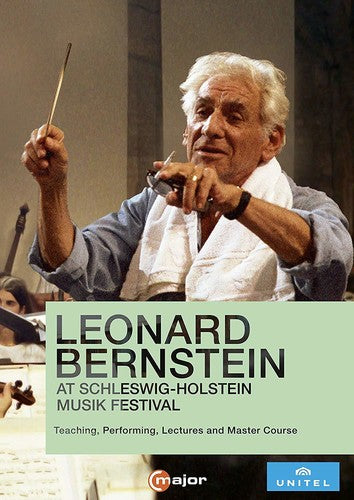
Leonard Bernstein at Schleswig-Holstein Musik Festival
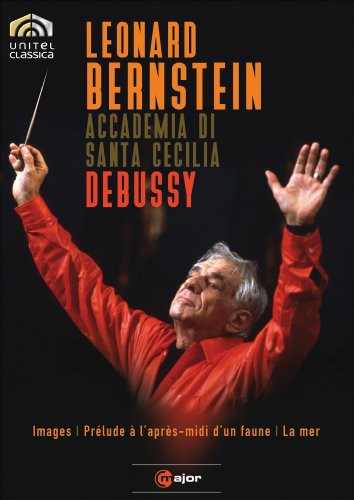
Debussy: Image, La mer, Prelude a l'apres-midi d'un faune / Bernstein
Claude Debussy: Images, Prélude à l'apres-midi d'un faune, La Mer
Orchestra dell'Accademia Nazionale di Santa Cecilia
Leonard Bernstein, conductor
Recorded live from the Accademia Nazionale di Santa Cecilia, Rome, 1989.
Picture format: NTSC 4:3
Sound format: PCM 2.0 / DTS 5.1
Region code: 0 (worldwide)
Booklet notes: English, German, French
Running time: 86 mins
No. of DVDs: 1 (DVD 9)
------------------------------------------------------------------------------------------------------
DEBUSSY Images pour orchestre. Prélude à l’près-midi d’un faune. La Mer • Leonard Bernstein, cond; Santa Cecila Natl Academy O • UNITEL 701608 (DVD: 86: 00)
Although Debussy did not figure largely in Bernstein’s repertoire, the conductor had an innate affinity for the composer’s music. We are therefore fortunate to have this concert, from scarcely a year before Bernstein’s death, preserving his interpretations of this repertoire in digital sound. Bernstein’s older Columbia recordings with the New York Philharmonic from 1960–63 are also still in print, although to duplicate this particular program one must acquire two different CDs (one from Sony, the other an ArkivMusic reissue). Those performances, however, are completely superseded by the present ones, both sonically and interpretively. In his later years Bernstein became decidedly self-indulgent, and his performances sometimes assumed bloated dimensions, as in the famous (or notorious) 1989 Christmas Day Berlin performance of the Beethoven Ninth. (I was blessed to attend that concert in person, being resident in East Berlin for my doctoral dissertation research at the time. As an interpretation it verged on the preposterous, but I still wouldn’t have missed it for all the world.) Here, however, he is in top form, eliciting performances with superb clarity of line, pellucid orchestral color and instrumental balance, and moderate tempi that are convincingly right at every point. Debussy is not the first thing I, as someone partial to Romantic German and Slavic orchestral repertoire, think to take off the shelf for personal listening pleasure, but Bernstein leaves me marveling at the sheer genius of these masterworks, providing a joy of rediscovery.
There are of course many performances of these works available on CD; most readers will already have their favorites, so I will not assay a broader discussion that in any case would exceed the bounds of this review. Regarding performances on DVD, this is the only complete performance of Images available. (For whatever reason, Bernstein altered the order of its three movements and placed Iberia in third position.) The Naxos issue with Alexander Rahbari and the Belgian Radio Symphony, which also has the Prélude and La Mer , omits Iberia in favor of the Nocturnes ; those are solid performances but not in the same class as these. The only other DVD to feature both the Prélude and La Mer is with Herbert von Karajan and the Berlin Philharmonic, reviewed negatively by Christopher Abbot in Fanfare 26:2 and positively by Colin Clarke in 32:3. I do not intend to enter the lists of the debates between champions and detractors of the German and American maestros; suffice it to say that in these works I prefer Bernstein’s clarity and sense of motion to Karajan’s lushness and perfumed languor. His DVD has more interesting camerawork to boot, with better lighting and more varied and better close-ups of the instrumentalists. The sound quality is excellent, the recordings having been made for commercial issue at the time. For those with more slender wallets, or who are uninterested in the visual aspects of an orchestral concert, these same performances were issued on CD by DG and are still in print as an ArkivMusic reissue. Strongly recommended.
FANFARE: James A. Altena
Isaac Stern Live, Vol. 7 [2 CDs]
Isaac Stern's career as a solo artist, chamber musician, and much else (he led the movement to save Carnegie hall) was remarkable. These albums of his live performances are an eloquent testament to his musical insights, technical command and his gorgeous, luminous tone. Isaac Stern was born in 1920, in Krzemieniec, now in Ukraine. A year later his parents came to San Francisco. Violin lessons began at eight, with Naoum Blinder. Two years later he made his debut, playing Bach double concerto with his teacher. His Town Hall debut in 1937 was followed by a Carnegie Hall debut in 1943. He was the first American artist to tour the former Soviet Union-and as a result became a deeply respected figure there. The campaign to save Carnegie Hall began in 1960. The Six-Day War of 1967 saw his iconic performance of the Mendelssohn Violin Concerto with Leonard Bernstein on Mount Scopus. His involvement with Hollywood, which began in 1948 with his performance in Humoresque, was followed up in 1971, when he played on the soundtrack of Fiddler on the Roof. His travel to China in 1979 led to a resurgence of classical music in that country. He recorded prolifically and received countless honors and tributes. Isaac Stern passed away at the age of 81 in 2001.