Conductor: Nils Schweckendiek
5 products
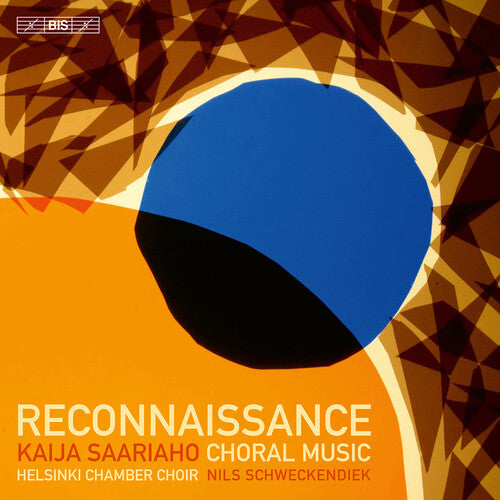
Saariaho: Reconnaissance / Schweckendiek, Helsinki Chamber Choir
The album Reconnaissance was, of course, never intended as an epitaph. Nonetheless, It is difficult to imagine a more fitting summary of, or introduction to, the character, spirit and life’s work of Kaija Saariaho (1952-2023) on a single disc, especially where her choral repertoire is concerned.
This recording presents Kaija Saariaho’s works for choir, a cappella and with electronics, and displays her virtuosity in the treatment of texts, which she endows with the full range of verbal expression. Nuits, adieux, presented here both in its a cappella version and with electronics, could be described as a lullaby, not so much for a sleeping child as for an elderly person sleeping out of our world. Funny and very serious at the same time, Horloge, tais-toi was conceived for a children choir.
Écho! deals with the myth of Echo and Narcissus, with the idea of echo being naturally extended with electronics that process and reverb the voices of the singers. Based on poems by German poet Friedrich Hölderlin, Tags des Jahrs display an archaic choral treatment expanded by sounds of the human voices, birds, wind and other natural phenomena. Überzeugung engages with medieval music and treats the contrast between light and dark as a trance-like interplay between past and present. Finally, Reconnaissance can be seen as a ‘science-fiction madrigal’.
Nils Schweckendiek and the Helsinki Chamber Choir initially performed this program in concert in August 2022 as part of the celebrations surrounding Saariaho’s 70th birthday.
REVIEW:
The album Reconnaissance was, of course, never intended as an epitaph. Nonetheless, it is difficult to imagine a more fitting summary of, or introduction to, the character, spirit and life’s work of Kaija Saariaho on a single disc, especially where her choral repertoire is concerned. To quote her artistic statement on choral music from the booklet, ‘the entire range of verbal expression is available to be woven into a multi-layered and heterogeneous whole’. The remarkable array of works showcased here – and mostly in recording premieres, no less – demonstrates just how dedicated she was to this principle over the course of so many decades.
In addition, by presenting two contrasting versions of the same piece (Nuits, adieux) together, the album provides a rare example of a composer’s process of revisiting the same material for different times and places, allowing us a glimpse into a whole other dimension of Saariaho’s musical thinking. Lastly, the album is a testament to her ongoing collaboration with other members of the musical community, including high-profile colleagues and young family members alike. How fortunate we are to have this one last gift from Saariaho, a document that not only expands the discography of her critically important oeuvre but also serves as a testament for future generations to the example of a composer’s life exceptionally well lived.
-- Classical Music Daily
The opening work, Nuits, adieux, is as good an illustration as any of the manifoldness of Saariaho’s sound-world. It exists in two versions: the original (with electronics) from 1991, and the a cappella version from 1996. Together, they bookend this delectable programme...A particular attraction is the recurring solos by the marvellously beautiful soprano voice of Linnéa Sundfær Casserly. In the a cappella version, the electronics are replaced by eight-part chorus, while the solo parts are practically identical with the original. It is a special treat to return to the work in that modified version at the end of the programme.
Écho! from 2007 for eight voices and electronics, was inspired by a double-choir motet by Claude Le Jeune (c. 1528/30–1600), which deals with the Echo myth...It is immensely beautiful.
To me, [the title work, Reconaissance] is the most important choral work composed on this side of the turn of the millennium, and in harness with the rest of the programme, which is just as valuable, this is an indispensable disc for all lovers of choral music. The performances are tremendous. It is also a worthy memorial to Kaija Saariaho.
-- MusicWeb International
Pärt: Passio / Schweckendiek, Helsinki Chamber Choir
Composed in 1982, Arvo Pärt’s Passio has retained its place as one of the foremost works of sacred music of the late 20th century. It has been called a minimalist masterpiece, and is a seminal work in the composer’s oeuvre – the culmination of his so-called tintinnabuli style, and the first in a line of large-scale choral works on religious themes. Passion settings have a long history, with polyphonic settings for choral performance beginning in the 15th century and continuing up until the high baroque and the monumental works by Johann Sebastian Bach. In his Passion, Pärt looks back to an older tradition, however – the medieval one of a single voice chanting the text. As a result, the narrative – chapters 18 and 19 of the Gospel of St. John – becomes the basis for sustained spiritual contemplation rather than the drama of Bach’s Passions. Another important distinction from earlier Passion settings is Pärt’s treatment of the Evangelist, who narrates the story. Rather than a single voice, he employs a quartet: soprano, alto, tenor and bass, accompanied by an ensemble of four instruments. The only other instrument used in the work is the organ, again in contrast to the larger instrumental forces of the Bach Passions. This contemplative work is here performed by the Helsinki Chamber Choir under Nils Schweckendiek.
REVIEW:
Arvo Pärt's Passio (1982), also known as the St. John Passion, is sometimes grouped with the large pieces of the time in which Pärt developed his tintinnabuli technique. The technique is present in the work, but Passio is unlike anything else Pärt ever wrote. The Passio has rarely been recorded, and that's reason enough to welcome this reading by the Helsinki Chamber Choir. More reason is provided by the performers, who offer expressive interpretations with a fine sense of the functions of the many pauses in the music. This performance diverges somewhat from the stark version by Paul Hillier and the Hilliard Ensemble some years ago, and BIS' sound, from a Helsinki church, is warmer than that of ECM on the Hillier version, allowing in some ambient noise such as organ machinery. This is an extraordinary performance of an underrated work by one of the major composers of our time.
-- AllMusic.com (James Manheim)
Freeman: Under The Arching Heavens / Schweckendiek, Helsinki Chamber Choir
The Finnish-American composer Alex Freeman has been described as being ‘as comfortable in the realm of the pop ballad as in that of the concert hall’ and yet his songs ‘are imbued with the craftsmanship and care one would expect of a composer of his formidable academic training, just as his concert works carry the emotional immediacy of popular music.’ Himself a choral singer, Alex Freeman has written a number of works for choir: music that aims to be sonorous and melodic, but is carefully crafted to avoid the clichés that can burden conventional tonality. Freeman’s requiem Under the arching heavens was commissioned by Nils Schweckendiek and the Helsinki Chamber Choir to commemorate the 100th anniversary of the 1918 Finnish civil war. The work incorporates poems in Finnish, Swedish and English, reflecting both the specific reason for the commission and the universality of human suffering caused by war. In the non-liturgical texts chosen by Freeman, birds are a recurring image, as is that of a mother and child. The work ends with lines by Walt Whitman from a poem written in the aftermath of the American Civil War. Also included on the album is A Wilderness of Sea, another recent choral piece which draws on works by Shakespeare, and the poet’s images of the sea, and of mankind’s relationship with it.
Riemuitkaamme!: A Finnish Christmas / Schweckendiek, Lehtola, Helsinki Chamber Choir
Riemuitkaamme! is an imaginative and unconventional selection of choral music associated with Christmas as it is celebrated in Finland. Several of the pieces are by Finnish composers – Sibelius, Rautavaara and Madetoja, to name a few – while others have become part of the Christmas traditions of the country despite their international background. Among these Berlioz’ The Shepherds’ Farewell and Tchaikovsky’s Christ, when a Child… are quite late additions compared to the medieval hymns Puer natus in Bethlehem, Ecce novum gaudium and Angelus emittitur. All three of these were included in the collection Piae cantiones from 1582, the oldest Finnish music publication. Here, they are performed in settings by various composers from different countries and eras – forming a kind of soundtrack of Christmases past and present, distant and close. Contemporary music forms an important part of the activities of the Helsinki Chamber Choir and Nils Schweckendiek, and true to form, the team includes a world premiere recording in their celebrations: Aattoilta, by the Canadian-born composer Matthew Whittall.
Furrer: Works for Choir & Ensemble / Helsinki Chamber Choir, Uusinta Ensemble
Beat Furrer is no stranger to the attention he receives for his subtle exploration of the possibilities of the human voice. Furrer's six Enigmas, a cycle of a cappella settings of Leonardo da Vinci, demonstrates a striking emotional range, from rich, almost romantic tonal warmth to dramatic avant-garde expressionism. All eight works on this new release accentuate Furrer's fondness for exploring sonority, timbre and texture.