

Conductor: Sir Adrian Boult
19 products
-
![]()

-
![]()

-
 On Sale
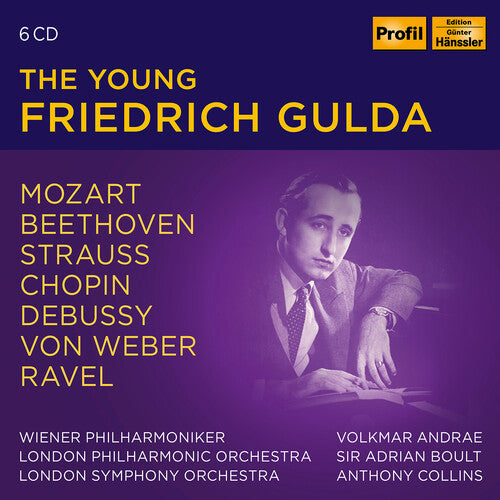
The Young Friedrich Gulda
CD$27.99$20.99Profil
Sep 02, 2022PH19017 -
![]()

-
![]()

-

Holst, Vaughan Williams, Walton, & Butterworth / Works for Orchestra
$26.99CDICA Classics
Sep 22, 2023ICAC5173 -
![]()

-
![]()

-

Andrian Boult Conducts Beethoven, Schubert, & Brahms
$26.99CDICA Classics
May 24, 2024ICAC5179 -
![]()

-
![]()

-

British Piano Concertos
$32.99CDLyrita
Sep 01, 2014SRCD2345 -
![]()

-
![]()

-

Boult Conducts Ireland / Boult, London PO
$20.99CDLyrita
Jan 01, 2007SRCD240 -
![]()

-
![]()

-

Finzi: Severn Rhapsody, Nocturne / Boult, Handley, Katin
$20.99CDLyrita
Feb 01, 2007SRCD239 -
![]()

-
![]()

-

British String Concertos
$32.99CDLyrita
Sep 01, 2014SRCD2346 -
![]()

-
![]()

-

Boult Conducts Butterworth, Howells, Hadley, Warlock
$20.99CDLyrita
Apr 01, 2007SRCD245 -
![]()

-
![]()

-

Holst: St Paul's Suite; Warlock: Capriol Suite/ Sir Adrian Boult, Vernon Handley
$20.99CDLyrita
Nov 01, 2007SRCD336 -
![]()

-
![]()

-

Boult Conducts Ireland - Legend, Etc / Boult, London Po
$20.99CDLyrita
Feb 01, 2007SRCD241 -
 On Sale
Vaughan Williams Live, Vol. 2
CD$20.99$15.99SOMM Recordings
Nov 04, 2022ARIADNE 5018 -
![]()

-
![]()

-

Boult Conducts Holst - Fugal Overture, Scherzo, Beni Mora, Etc
$20.99CDLyrita
Oct 01, 2006SRCD222 -
![]()

-
![]()

-

Bax: Tone Poems / Boult, London Philharmonic
$20.99CDLyrita
Nov 01, 2006SRCD231 -
![]()

-
![]()

-

Vaughan Williams: Symphony No 8, Job / Boult
$26.99DVDICA Classics
Oct 25, 2011ICAD 5037 -
![]()

-
![]()

-
 On Sale
Stanford: Irish Rhapsody No 4, Piano Concerto No 2 / Boult
CD$20.99$15.99Lyrita
Aug 01, 2006SRCD219 -
![]()

-
![]()

-

Moeran: Rhapsody No 2, Violin Concerto, Etc / Boult, Handley
$20.99CDLyrita
Mar 01, 2007SRCD248 -
![]()

-
![]()

-

Legendary Treasures - Artur Schnabel Plays Bach
$20.99CDDoremi
Mar 23, 1999DHR-7740 -
![]()

-
![]()

-

Brahms: Symphony No. 1; Elgar: Enigma Variations
$14.99CDICA Classics
May 31, 2011ICAC 5019 -
![]()

-
![]()

-

Boult Conducts Bridge & Ireland / London Philharmonic
$20.99CDLyrita
Apr 01, 2007SRCD242


The Young Friedrich Gulda
Friedrich Gulda was born in Vienna on May 16, 1930. He began his musical education at the Grossmann Conservatory and subsequently took private lessons from Felix Pazofsky. From 1942 to 1947 he studied piano at the Vienna Academy of Music under Bruno Seidlhofer and Music Theory and Composition under Joseph Marx. He gave his first public performance in 1944 and, two years later when just 16 years old, won the Geneva International Music Competition. Starting after the Second World War, as a 20-year-old, Gulda established himself as a piano soloist with an excellent international reputation and even performed at Carnegie Hall in New York City in 1950. In the 1950s he was celebrated and considered the leading interpreter of Beethoven in his generation. He founded his own Klassische Orchester Gulda for chamber music with members of the Vienna Symphony Orchestra.
In addition to Beethoven, Gulda’s repertoire encompasses works by Johann Sebastian Bach, Wolfgang Amadeus Mozart, Franz Schubert, Frédéric Chopin, Claude Debussy, Maurice Ravel and Richard Strauss, whose Burleske in D minor and lieder are included in this release, with Gulda accompanying soprano Hilde Güden. Gulda was essentially an out-and-out contrarian who showed that a great genius can sometimes be only a step away from a certain madness. While Karl Böhm or Rubinstein admired him as a magnificently talented interpreter of Bach, Mozart and Beethoven, Gulda could also be provocative – including inciting his fellow concert pianists. Asked about Vladimir Horowitz, Gulda once responded: “Horowitz is a master. Because he is able to do – whatever he wants,” but also added: “But what he is after doesn’t interest me” (Joachim Kaiser).
REVIEW:
Friedrich Gulda (1930-2000) was certainly never a conformist pianist. But he was less flamboyant in his youth than in his later years, and he did present new perspectives at the beginning of his career, which helped to provoke a change in thinking. The recordings in this CD box set date from this period.
He recorded the freshly perky Mozart Sonata K. 576 in 1948, and both Concertos K. 503 and 537 in 1955 with the New Symphony Orchestra under Anthony Collins. Gulda’s fresh yet nuanced playing compensates for the weak orchestra’s playing. The Beethoven sonatas Nos. 4, 7, 8 and 19 show the still searching Gulda of 1955 on his way to the 1967 complete recording. The 3rd CD includes the concerto piece by Carl Maria von Weber and the Strauss Burlesque, as well as a set of Strauss songs that Gulda recorded with Hilde Güden in 1956. These are wonderful interpretations of rare freshness and suppleness. Güden’s silvery timbre and her confidently controlled, light vocal line coupled with Gulda’s spontaneous and sensitive playing make for an uncommonly natural performance.
Recorded in 1954, Chopin’s compositions, the 4 Ballades and the 1st Piano Concerto, are among Gulda’s ‘immortal’ recordings. In the 1st Piano Concerto, Gulda collaborates with the more traditional Adrian Boult, but it is precisely the contrast in temperament that leads to special tension and dynamics. This recording has been available several times on various labels, but here it definitely sounds in the best quality so far. Also very exciting are the four ballads, which he plays dramatically and narratively.
Debussy and Ravel, the composers represented on CDs Nos. 5 and 6 of this box, have been Gulda’s recurring preoccupation. The early recordings from 1953 and 1955 may not yet be as stylistically tested on the hard, sharp and pithy of jazz as the late recordings, but their analytically modern style, with clear, precise lines and contours and good transparency, shows the intellectual brilliance of these interpretations.
The bottom line is that this encounter with the young Gulda is a very important one that should help one understand the older musician and could help bring respect to Gulda among those who did not appreciate his later work as much.
-- Pizzicato


Holst, Vaughan Williams, Walton, & Butterworth / Works for Orchestra
Sir Adrian Boult (1889–1983) was probably Britain’s most authoritative interpreter of the music of Gustav Holst and Ralph Vaughan Williams. He formed close relationships with both composers; particularly with Vaughan Williams; giving premieres of three of his symphonies.


Andrian Boult Conducts Beethoven, Schubert, & Brahms
In addition to Sir Adrian Boult’s (1889–1983) masterly conducting of Beethoven’s and Schubert’s symphonies, these live stereo performances include several new additions to the conductor’s illustrious discography: Rossini’s La scala di seta and Beethoven’s Die Weihe des Hauses Overtures, as well as Weber’s Euryanthe Overture which he last recorded in 1937.


British Piano Concertos
The freshly written liner-notes are by the authoritative and accessible Paul Conway and run to ten pages. These are not a simple retread of the original notes by other authors.
There is provocative variety to be found in this Piano Concerto box, serving up Stanford's least neglected piano concerto which is both Brahmsian and yet has a dash of Rachmaninov about it. The Finzi Eclogue is a peaceful spiritual essay - it causes no offence and imparts a blessing as it passes. The Foulds and Bridge pieces are not concertos. The former is a fantastic display of brilliance of imagination and technique while the Bridge parallels his own Oration - which is not included in these sets - in its tension and bleak expressive power. It does have its heroics but they are bitter indeed. The Vaughan Williams concerto recalls the world of his Fourth Symphony while the Rawsthorne is softer and more yielding than we may be accustomed to from this source. The Scott Poem, with its roundabout convolutions and folksong game-play, contrasts with the Busch Piano Concerto. Ireland's Legend is another Sussex ancient sorcery, quite different in its subtlety to the crowd-pleasing romantic heroics of the Moeran Rhapsody, which plants its confident feet in 1940s film piano concerto pastures; it’s very enjoyable. The last disc lets us hear again three piano concertos: early, accessible and not fully characteristic in the case of the Hoddinott and Berkeley; and fully mature in the case of Williamson’s joyously clangourous and angular Third Piano Concerto.
Generosity is the order of the day. No CD plays for less than 72:00. The price point is attractive and may well make this suitable for the intrepid and open-minded soul as Christmas presents, if the original CDs are not already on the intended receivers' shelves.
– Rob Barnett, MusicWeb International


Boult Conducts Ireland / Boult, London PO
The recordings here first appeared on various LPs from what was then known as the Lyrita Recorded Edition. Richard Itter’s Lyrita label was, from the very outset, a steadfast champion for Ireland. Overall he was the composer who had the largest number of LPs in the Lyrita listing. There were mono LPs of the piano music from Alan Rowlands, Eric Parkin’s stereo series, the chamber music and the songs. The orchestral LPs from Lyrita were from the period 1966-1971 and all were Boult-conducted:
SRCS32 Prelude: The Forgotten Rite; Mai Dun; Legend for piano and orchestra; Overture Satyricon
SRCS36 These Things Shall Be for baritone solo, chorus and orchestra; Piano Concerto in E flat
SRCS31 London Overture; Concertino Pastorale; Epic March; The Holy Boy; Minuet and Elegy (A Downland Suite)
SRCS45 Symphonic Prelude: Tritons; Two Symphonic Studies; Suite The Overlanders; Scherzo & Cortege (Julius Caesar)
The cover design for the CD booklet is taken from the Keith Hensby design for one of the original LPs and is based on an engraving of the Wren churches- clearly picking up the London reference.
Tritons is an early piece – which has curiosity value rather than anything else. The 40+ years since the recording session have lent the sound for this track a slight tubbiness but once the ear adjusts the brass sounds splendid with all the requisite grate and bite. Turning to a work of undoubted mastery, the effect in The Forgotten Rite is sumptuous - an object lesson in transparent scoring, sensitive interpretative choices and complementary recording technique. This is extraordinarily magical and fey music – gentle, dreamy and enigmatically beautiful. I noted at 6:10 a low key squeak.
The dream is blasted away by Mai-Dun. The title is taken from Thomas Hardy’s Wessex name for the earthworks known as Maiden Castle. It’s a dramatic piece which happily accommodates other influences including, in the aggressive French Horns at 1:20, Tchaikovsky’s 4th Symphony. This is mixed with Delian complexity (3:40). The horns sing out over top of searching forte strings at 4:20 and there are Baxian touches aplenty with at 6:18 a typical brass and percussion dance. As a performance this has more bite than Bryden Thomson on the even more splendidly recorded Chandos collection. However it is Barbirolli who gives this the best outing compromised only by 1940s mono sound on Dutton.
Both London and Epic March have also been recorded by Richard Hickox on Chandos. Hickox is in both cases more expansive than Boult. Boult’s London has sappy rhythmic bite and a glorious wide-stage orchestral image. The Epic March has full breadth and the splendour of a truly Elgarian nobilmente. In fact Ireland must surely have had the older composer’s warlike echoes of the Pomp & Circumstance No. 4 in mind. Lyrita missed a trick by not ending the disc with this piece. The recording misses not a detail: ‘ting’ of the triangle, the zesty side drum in left channel and rolling brass in the right; not to mention that affirmative warble from the brass benches at 5:41.
Rather like Bax, his flirtations with commissioned incidental music were invariably painful. He did not enjoy the BBC commission but on the evidence of Geoffrey Bush’s editorial work we can enjoy a stuttering Holstian scherzo full of jerky activity and a cortege of brooding epic melancholy. The cavernously sonorous clarity at 3:10 for brass and side drum is memorable.
Ireland sole foray into film music was for The Overlanders. Here the mediation between film and concert suite was done by Charles Mackerras – very appropriate given the Australian locale for the film. Scorched Earth has a Rawsthorne-like lyrical acidity – recalling the younger composer’s music for The Cruel Sea. The Intermezzo has a steady-as-she-goes swing in an open natural acoustic. In Brumbies Boult drives the music forward with muscular brusqueness. Note the fast flutter-tonguing from the trumpet. Night stampede has those magnificently burred and rolling horns and there is a majestic blast with which to end the suite.
The Lyrita reissue programme for the orchestral Boult-conducted Ireland will be completed in February and April 2007 with SRCD.241 and SRCD.242. The first will have Legend; Satyricon; Piano Concerto; These Things Shall Be and Two symphonic studies. The second is a mixed anthology: Ireland: Concertino Pastorale; The Holy Boy; Minuet & Elegy (Downland Suite) and Bridge: Rosemary; Suite for Strings; Sally in our Alley; Cherry Ripe; Lament; Sir Roger de Coverley.
The liner-notes for this issue are by three pillars of the Ireland quarter Julian Herbage, Harold Rutland and Geoffrey Bush.
A classic John Ireland collection – magically done. Not the essential Ireland apart from Forgotten Rite - for that you must go to SRCD.241 – but full of vitality and imagination.
-- Rob Barnett , MusicWeb International


Finzi: Severn Rhapsody, Nocturne / Boult, Handley, Katin
Boult is in his element – the Butterworth one, that is – in the Severn Rhapsody which was clearly written under thrall of George Butterworth’s A Shropshire Lad and Bridge’s Summer. Blue skies, birdsong, sunny fields, cool coppices and shaded brooks – all these breathe through the pages of this Finzi score. It remains a prentice work and although a gentle yet irresistible melancholy is there its identity is not yet strongly Finzian. That was to come … and soon. It is to be heard in the intense Nocturne which in its melodic contours - their rise and fall – is unmistakably Finzi. Years later there came the music for Love’s Labours Lost and rather than the full suite (which you can hear on Nimbus ) we have here the Three Soliloquies – peaceable children all and with a touch of the miniature Elgar about them. The Romance for strings inhabits the same world but with an even stronger and personal melodic horizon and smilingly coaxed along by Rodney Friend’s solo violin. Then comes the Prelude op.25, also for strings, which in its idyllic warmth always reminds me of Josef Suk’s Ripening. In The Fall of the Leaf we also detect another preoccupation – transience and the passing of time – a preoccupation explicitly reflected in Dies Natalis and Intimations of Immortality. The earnest sweetness of Introit for solo violin and small orchestra is touching, elegiac, fragile and plaintive – a most beautiful piece. Chandos and Tasmin Little let us hear the whole violin concerto from which this work was extracted. The flanking movements are little more than busy and are dramatically outclassed by this Introit middle movement. Eclogue in its first commercial recording has a repose equalled or exceeded in no other version. Handley and Peter Katin established the gold standard for a work that was carried the Finzi standard worldwide and propagated his musical orchards on an international stage. The Grand Fantasia and Toccata is a disconcerting diptych. Its first section opens with a momentary flourish for full orchestra which then drops away for a full six minutes while the piano explores a strongly Bachian fantasy before a majestic Purcellian re-entry enriched by grandly curvaceous themes. A Waltonian syncopation enters at 9:20 reminding us in its carefree abandon of similar writing in Intimations and recalling for me Walton’s Sinfonia Concertante. Indeed at 13:41 one can hear the rearing up of a true symphonic spirit also there in the first movement of the Cello Concerto. In his final years he intended a Symphony but it was not to be.
Lyrita’s orchestral Finzi shelves will be cleared in May 2007 when SRCD.237 appears: Let us Garlands bring; Two Milton Sonnets; Farewell to Arms; In terra Pax (Carol Case/Partridge/Manning/RPO/New Philharmonia/Handley). After that, perhaps some time in 2008, we can hope for several CDs of Finzi’s Hardy song cycles in which the pianist was Howard Ferguson, an influential Finzi champion and sympathetic editor and a composer in his own right. These were issued on LPs: SRCS 38 and 51. These versions compare extremely well with their much later Hyperion counterparts and preserve John Carol Case’s voice in better fettle than it was in his tremulously recorded Let Us Garlands Bring made in the early 1980s. The LPs were SRCS-38 Before and After Summer and Till Earth Outwears and on SRCS-51 A Young Man’s Exhortation and Earth and Air and Rain.
This is a most generously timed collection - essential Finzi in many respects. It allows the listener all the short classics but holds back from the bigger works. Among the shorter pieces all the major popular items are there: Eclogue, Introit, Romance and Prelude. Intriguingly the sense of a striving for major ambitious statements is also present. It can be sensed in the Grand Fantasia and Toccata not only in its final uproarious Waltonian vivacity but also in the Bachian gravitas of the Grand Fantasia. It can also be glimpsed in part-achieved major statements such as the chamber symphony The Bud, The Blossom and The Berry of which Prelude and The Fall of the Leaf as movements.
The readable and enriching notes are by the eminent Finzi authority and biographer Diana McVeagh. They are in English only as is true of all the Lyrita releases.
-- Rob Barnett, MusicWeb International


British String Concertos
The freshly written liner-notes are by the authoritative and accessible Paul Conway and run to ten pages. These are not a simple retread of the original notes by other authors.
The String Concertos range far and wide. The Coleridge-Taylor is a treasure - full of Dvo?ákian melody and incident. The Holst Invocation is almost as moody as the Rubbra Soliloquy, the dark-clouded atmosphere of which you could cut with a machete. Finzi's Introit was salvaged from a disowned Violin Concerto, and it's the best thing in it by a long chalk. The two Holst works are from his appealingly chattery neo-classical years although the lovely Lyric Movement for viola has a yearning core. Busch's Cello Concerto is from the other half of the CD that yielded the Piano Concerto on SRCD2345. The Moeran Violin Concerto has been following me around this year. I have heard it three times live and several times recorded. Its touching slow-fast-slow movement scheme is most adroitly handled by Georgiadis and Handley in what was the work's first commercial recording from circa 1979. CDs 3 and 4 require stiffened sinews for the modernistic Violin Concertos by Gerhard, Fricker, Morgan and Banks. Even the Serenata Concertante for violin and orchestra by Maconchy will not let you off the hook lightly. We end with a roar and a flourish in Hoddinott's typically titled and expressed Nocturnes and Cadenzas for cello and orchestra from 1969.
– Rob Barnett, MusicWeb International


Boult Conducts Butterworth, Howells, Hadley, Warlock
Includes work(s) by various composers.


Holst: St Paul's Suite; Warlock: Capriol Suite/ Sir Adrian Boult, Vernon Handley
Michael BALFE (1808-1870)
The Bohemian Girl: Galop (1843) [1:26]
Philharmonia Orchestra/Nicholas Braithwaite
Sir Edward ELGAR (1857-1934)
Variations on an Original Theme ‘Enigma’ Op. 36: X. Dorabella (1899) [2:41]
Pomp and Circumstance March No. 5 in C Op. 39 (1930) [5:41]
New Philharmonia Orchestra/Andrew Davis
Frederick DELIUS (1862-1934)
A Village Romeo and Juliet: The Walk to the Paradise Garden (1905) [10:49]
London Philharmonic Orchestra/Myer Fredman
Percy GRAINGER (1882-1961)
Shepherd’s Hey; The Immovable Do (1908-13; 1933-42) [2:11; 5:04]
London Philharmonic Orchestra/Nicholas Braithwaite
Sir Hamilton HARTY (1879-1941)
An Irish Symphony: The Fair-Day (1904) [3:01]
New Philharmonia Orchestra/Vernon Handley
Peter WARLOCK (1894-1930)
Capriol, Suite for full orchestra (1926-28) [9:47]
London Symphony Orchestra/Nicholas Braithwaite
Lord BERNERS (1883-1950)
The Triumph of Neptune: Hornpipe (1926) [1:50]
London Philharmonic Orchestra/Nicholas Braithwaite
Gustav HOLST (1874-1934)
St. Paul’s Suite for strings Op. 29 No. 2 (1913) [13:28]
English Chamber Orchestra/Imogen Holst
Ralph VAUGHAN WILLIAMS (1872-1958)
Fantasia on a theme by Thomas Tallis (1910) [16:08]
rec. Jan 1979, Kingsway Hall (Balfe); Jan 1974, Walthamstow Assembly Hall (Elgar); Jan 1970, Walthamstow Assembly Hall (Delius); Aug 1978, Kingsway Hall (Grainger; Berners); April 1976, Kingsway Hall (Harty); Sept 1978, Watford Town Hall (Warlock); Jan 1968, Walthamstow Assembly Hall (RVW)
R E V I E W:
A fine introduction to Musical Britain
When I first saw the advert for this CD I assumed that it was the ‘sweepings up’ from the floor of the Lyrita studios: it was all the bits and pieces from their vinyl pressings that could not find a home elsewhere. Yet two things made me modify that view. Firstly I know that there is a vast amount of material awaiting re-release (the mono recordings of Jacob, White, Ireland and Wordsworth, for example) and secondly, as I listened to this CD I realised that it made a fine introduction to Musical Britain. I remember as a child books called the ‘Boy’s Guide to’ … Field-craft, Trains, Racing Cars et al. Perhaps this, in a more PC age, could be referred to as the "Individual’s Guide to British Music"?
The CD opens with a piece that was written when Great Britain was a ‘land without music.’ The Galop is probably the most famous excerpt from Michael Balfe’s best known opera: The Bohemian Girl. And of course it was once a Tommy Beecham ‘Lollipop’. Perhaps Balfe’s twenty-nine operas do not signify in the early 21st century when compared to G&S, Tippett or Benjamin Britten, but in his day he was a seriously popular composer. And Ireland – Balfe was born in Dublin - was at that time part of the United Kingdom!
I usually baulk at excerpting from Elgar’s Enigma Variations. My exception is the annual outing of Nimrod at the Cenotaph: I can forgive anything in those circumstances. So I suppose I am not really happy about one short variation being given here. Yet here it is - Dorabella which follows on from Nimrod and is a complete change of tone, mood and emotion. We hear the ‘stammering lightness’ and ‘merry chatter’ of Elgar’s helper and admired Dora Penny. It is a lovely piece that actually does stand alone … just about … although I feel that it is much more telling and effective following that great Beethovenian variation in the complete work.
And how often do we hear the P&C March No.5? Even enthusiasts of ‘Grunge’ cannot have avoided ‘Land of Hope and Glory’ in their lives’ journey. But how many know the other four (five)? I guess most people over the age of thirty-five will recall No. 4 in G being played as the recessional at the Prince and Princess of Wales’s wedding. The rest are little known and rarely heard. But please note that this late - it was composed four years before Elgar’s death - march is rather good. And the interesting thing is that most of us come to it afresh. It has not accrued the baggage - good, bad and indifferent - of being an alternative National Anthem played at the Proms.
I am not an opera fan, but I have always loved The Walk to Paradise Garden by Fred Delius. I know the opera A Village Romeo and Juliet and realise that it has a tragic context in that work. However, I got to know the piece on an old Beecham release of Delius orchestral works on Decca Eclipse and have had my own programme for this work ever since! So I suggest that listeners dump the libretto and see this piece as a nature poem – descriptive of whatever landscape or mindscape moves them most.
Percy Grainger is a rare personality. He wrote a vast amount of music that is little played these days. I am not a fan of his, yet I do appreciate that he was probably a wayward genius. And a few of his works do have the capacity to move me: most I find entertaining. The majority of listeners will know his ubiquitous Country Gardens which was arranged for just about every instrumental combination possible. Yet Shepherd’s Hey and the Immovable Do presented here deserve greater popularity. The latter piece was inspired by a leaking harmonium which continually sounded a ‘high C’ throughout the performance of whatever Grainger was playing. Shepherd’s Hey is based on the folk tune ‘The Keel Row’. Incidentally, the score was dedicated to Edvard Grieg. Both miniatures are worthy additions to the repertoire and would make excellent encores - if given the chance.
Our musical exploration moves back to Ireland. This time it is the second movement of Sir Hamilton Harty’s fine Irish Symphony – subtitled The Fair-Day. Most people will associate Harty with the Hallé Orchestra which he conducted between 1920 and 1933. Yet he was also an accomplished composer who wrote not only the present work but a wonderful piano concerto, a violin concerto and a number of other excellent pieces. Fortunately, most of these were released on Chandos a number of years ago and are still available. Additionally, Naxos has contributed their recordings of the Symphony and the Piano Concerto. Harty is a composer well worth investigating. The present piece is a fine evocation of a ‘Fair Day’ in Ireland that must have been familiar to the composer as a young man. Look out for the fiddler tuning up and the fine reel!
Everyone knows that Peter Warlock was a pseudonym. His real name was Philip Heseltine. He took the name of Warlock after some involvement with occult mysteries after time spent in Ireland during the Great War. More often noted for his superb songs, Warlock composed a mere handful of works for orchestral forces – including An Old Song, the Serenade for Frederick Delius and the Capriol Suite. Best known in its string orchestra incarnation, this latter work was originally given as a piano duet. Latterly it was arranged for full orchestra – this is the version we hear on this CD. The Suite is based on tunes found in an antique dissertation called ‘Orchesography’ which was supposedly penned by a certain ‘Capriol’. The programme notes inform us that the Suite was rejected by a number of publishers: this is hard to imagine since we now regard the work as one of the minor masterpieces of 20th century music. Apparently Warlock sold the work for a mere 25 guineas!
Lord Berners’ real name is much more impressive – Gerald Hugh Tyrwhitt-Wilson: it sounds as if it were straight out of a P.G. Wodehouse novel. He was an artist and a ballet producer whose day-job appeared to be that of a diplomat. Moving in the rarefied atmosphere of the Sitwells it is not surprising that he was an eccentric. The Triumphs of Neptune was conceived by Sacheverell and eventually became a successful feature for the Ballets Russes. The Hornpipe does not press on to the limits of musical invention, but it is attractive and does justice to its nautical origins. It is well worth discovering other music by this fascinating, if somewhat odd, composer.
Gustav Holst’s St Paul’s Suite surely needs no introduction or recommendation to readers of these pages. Yet sometimes it is easy to forget that this work comes from the same pen as The Planets. The work is conducted here by the composer’s daughter Imogen: to my ear it is one of the best recordings of this work in the repertoire. It is a Suite that must be listened to in its entirety and not excerpted.
The last piece is a major masterpiece. Along with Tippett’s Double Concerto and Elgar’s Introduction and Allegro it is one of the most important essays in string writing in British musical literature. The Tallis Fantasia is a work that seems to gather up the whole tradition of England – its landscape, its literature and its religion. It is impossible to listen to this work without being aware of the whole sweep of history – both musical and otherwise. In one sense it is a timeless work, yet in another it is as much a part of twentieth century music as Gershwin’s Rhapsody in Blue or Berg’s Violin Concerto. The Fantasia is a visionary score which marked its composer out as a major figure in the British musical scene.
Most cognoscenti of British music will have all these works in their CD collections. This release is a bit of a pot-pourri. Yet consider this. It is good to take the opportunity of listening to a variety of pieces played end to end - now and again; it reminds us of our whole musical heritage. And lastly if you know anyone who is edging towards an appreciation of the native music of the British Isles – this is the present for them. In either case – Buy it!
-- John France, MusicWeb International


Boult Conducts Ireland - Legend, Etc / Boult, London Po
The remainder of the program is scarcely less attractive. These Things Shall Be is an optimistic choral paean that packs a lot of musical material into 20 scant minutes. Satyricon, an overture that for some reason never gets played these days, once again reveals Ireland's high level of melodic inspiration and sheer craftsmanship in those few works he composed with orchestra. The Legend for piano and orchestra has Parkin once again in top form, and all of this music benefits from Adrian Boult's authoritative but unobtrusively sensitive podium guidance. So many of these Lyrita discs are true "building a collection titles"--the one disc you must have if you want the best and most representative selection of its respective composer's work. Here is another in that distinguished line.
--David Hurwitz, ClassicsToday.com


Vaughan Williams Live, Vol. 2
SOMM Recordings’ celebration of the 150th anniversary of Ralph Vaughan Williams’ birth continues with Volume 2 of Vaughan Williams Live, featuring historic performances by the BBC Symphony Orchestra and Chorus and the Boston Symphony Orchestra conducted by Sir Adrian Boult in new, signature remasterings by Lani Spahr with authoritative booklet notes by Vaughan Williams’ biographer Simon Heffer. Two works featuring the BBC Symphony Orchestra and Chorus include a 1945 BBC radio broadcast of the first performance of the wartime masterpiece Thanksgiving for Victory – with soprano Elsie Suddaby, organist George Thalben-Ball and Valentine Dyall as the speaker – and the rapturous Serenade to Music from the opening night of the BBC’s Third Programme (now Radio 3) in 1946. First performed in 1938 in celebration of Henry Wood’s jubilee as a conductor and originally composed for 16 solo singers, it appears here in its version for orchestra, chorus and four soloists – Isobel Baillie (soprano), Astra Desmond (contralto), Beveridge White (tenor), and Harold Williams (baritone). Its dedicatee, Boult, conducts a performance of Job: A Masque for Dancing in 1946 by the Boston Symphony Orchestra before he made his four studio recordings of the work. Volume 1 of Vaughan Williams Live (SOMM Ariadne 5016) was hailed by All About the Arts as “beautifully remastered [and] sounding like pure gold” and was The Symphonist’s Record of the Week. SOMM’s other Vaughan Williams recordings include the Gramophone Award-winning Symphony No.5 and Dona Nobis Pacem with the LPO/BBCSO (SOMMCD 071), and The Piano Music of Ralph Vaughan Williams by Mark Bebbington and Rebecca Omordia (SOMMCD 0164), described by International Piano as “compelling”.


Boult Conducts Holst - Fugal Overture, Scherzo, Beni Mora, Etc

Adrian Boult brought tremendous authority to any recording he made of 20th century British works, having known the composers and often having conducted the premiere performances. These recordings, made in the early 1970s, demonstrate that age took not a bit of his musical command or energy on the podium. Boult was particularly associated with Gustav Holst (he conducted the public premiere of The Planets). Since this compilation presents some of the crown jewels of Lyrita's history, anyone with any interest in British music of the first third of the 20th century should consider this CD a mandatory acquisition. Beni-Mora is unusually picturesque and passionate; the Fugal Overture's wit and lyricism belies the impression of stodginess its title suggests; and the virtually unknown Japanese Suite charms and invigorates. The 30-year-old sound is still better--cleaner, clearer, and more natural--than most of the stuff major labels are putting out in standard CD sound today.
--Joseph Stevenson, ClassicsToday.com


Bax: Tone Poems / Boult, London Philharmonic
I still remember how exciting it was to discover these marvelous tone poems: the mysterious darkness of November Woods, the watery depths of The Garden of Fand, and of course the magnificent vistas revealed in Tintagel. This last was the most familiar, from a classic Barbirolli recording for EMI of English overtures and symphonic poems, but I suspect that this was the next Bax disc that most collectors added to their libraries, assuming they could find it. The performances remain all that one could want: atmospheric, very well played, and beautifully engineered. We've come a long way in our knowledge of this fine composer since the days when Lyrita alone carried the torch for Bax, but these recordings wear their years very lightly and still offer as much listening pleasure as when they were new. For a single-disc collection of the major tone poems, you can't do better than this. [1/10/2007]--David Hurwitz, ClassicsToday.com


Vaughan Williams: Symphony No 8, Job / Boult
To my knowledge, this is the first time this entire concert has been issued intact. Previously the Eighth Symphony appeared on a DVD (now out of print) with a performance from a concert eight months earlier of the Beethoven Violin Concerto with these same forces and violinist Nathan Milstein. That disc was given a very tepid review by Jerry Dubins in Fanfare 31: 1, criticizing the Beethoven as “off skew” due to intonation lapses by Milstein and lack of proper synchronization between the audio and visual tracks, and a “solid but less than rafter-ringing” rendition of the Eighth Symphony. Here the symphony opens the concert, given to mark the centenary of the composer’s birth. While I would agree that it does not equal Boult’s own studio recording with the same orchestra for EMI made almost four years before, it is still an estimable reading in Boult’s distinctive style, which in this particular work is far more low-key and introspective than in the hands of some other conductors. A significant factor in the lesser degree of impact is the recorded perspective, which is rather distant; even turning up the volume knob on my stereo receiver could not give it a presence equal to the studio version. A remarkable feature is that this performance differs notably in conception from that set down by EMI, as can be seen by the respective timings—11:09, 3:55, 8:35, and 4:44 for the studio account versus 10:44, 4:11, 7:26, and 5:47 here, with the 10:44 of the first movement including almost a minute of introductory applause. The change in proportions—significantly faster in the first and third movements, and markedly slower in the fourth—gives the piece a rather different feel, though even after several hearings I am not sure how to describe it, as the variations between the two do not follow a consistent pattern. That there is a substantial difference is a sufficient point of interest in and of itself for admirers of this conductor’s art.
With Job the competition between the 1970 EMI studio version and this live performance is much closer; the overall timings and conceptions of the two are virtually identical, and here the live performance has more presence. This video version does offer one advantage its studio counterpart lacks; at the start of each section, it displays for several seconds the corresponding (and striking) drawings from William Blake’s Illustrations of the Book of Job that inspired the composer. Boult had a unique and authoritative association with this work; in 1934 the composer dedicated the work to him, and he made four studio recordings of it before any other conductor made even one. That alone would make this an invaluable historical document; that value is increased by the fact that, apart from the aforementioned Beethoven concerto and a Beethoven romance for violin and orchestra with Yehudi Menuhin, this disc contains what are to my knowledge the only commercially released filmed performances of the man who ranks alongside Thomas Beecham as one of the two greatest British conductors of the last century.
The film quality itself is excellent for its vintage; images and colors are as sharp and clear as the analog film technology of the periods allows, and there are no signs of film deterioration. Camerawork is discreet, appropriate in focus, and free from the jittery itch of some current film producers to jump about every few seconds. Boult himself, 83 at the time, comes on stage slowly but not at all stiffly. Like Charles Munch he favors a fishing-pole length baton, but unlike the French maestro his movements are restrained, economical, and graceful rather than feverishly energetic, the very image of English patrician nobility. But do not mistake a lack of theatrical demonstrativeness for artistic dullness; this is music-making of great integrity and conviction. To fans of Vaughan Williams and Boult alike, this release is unhesitatingly recommended, particularly for the fine account of Job.
FANFARE: James A. Altena


Stanford: Irish Rhapsody No 4, Piano Concerto No 2 / Boult


Moeran: Rhapsody No 2, Violin Concerto, Etc / Boult, Handley
Ernest John Moeran (1894-1950), still the least-known significant English composer of his generation, composed in his prime three large-scale works with orchestra, a symphony (1937), a violin concerto (1942) and a cello concerto (1945). Part of Moeran’s neglect may perhaps be attributed to his derivative musical style. Yet the positive individuality of Moeran’s music, which grew in strength as he became older and is finally shorn of all props in the masterly cello concerto, overrides these derivations in nearly all his works. He is a composer with something to say and an unwavering judgment about the way in which it must be said.


Legendary Treasures - Artur Schnabel Plays Bach


Brahms: Symphony No. 1; Elgar: Enigma Variations
BRAHMS Symphony No. 1. ELGAR Enigma Variations 1 • Adrian Boult, cond; 1 George Thalben Ball (org); BBC SO • ICA 5019 (78:21) Live: London 1 3/29/1971, 7/17/1976
& John Douglas Todd interviews Sir Adrian Boult (1974)
When EMI, at the instigation of producer Christopher Bishop, issued recordings of the four Brahms symphonies in the early 1970s, Sir Adrian Boult’s 20 years with the BBC and the steady broadcast reminders of the catholicity of his tastes and skills were well past. Bishop was troubled that the aging conductor’s reputation as an English music specialist, built on years of service to the composers of his homeland, had resulted in an insufficient recorded legacy of his art. The Austro-German and Russian Romantics had been an important part of his repertoire throughout a career that stretched back to his conducting debut with a professional orchestra in 1914. He had performed Bartók, Shostakovich, Mahler, and the Second Viennese School when most conductors wouldn’t.
The opportunity to address that presented itself when the always efficient Boult left open two sessions originally scheduled for the recording of Elgar and Vaughan Williams. Brahms was the perfect choice, as he had been an early favorite, the Tragic Overture counting among the first recordings that Boult made in the early 1930s with his newly formed BBC Symphony Orchestra. He had recorded the symphonies for Pye/Nixa in the 1950s (could First Hand Remasters make these a Volume 3?), and now thanks to a producer with vision, some of his last recordings were to be of Brahms, as well as Wagner and Schubert. Lucid, weighty but never heavy, dramatic without histrionics, Boult’s approach to Brahms was classical and objective in the style of Hans Richter and Brahms disciple Fritz Steinbach, both of whom he had heard perform. Ever the self-effacing (though hardly diffident) artist, Boult let the music speak for itself, and his skill at revealing important events without ever losing sight of the long line creates an ineffable sense of rightness in all of his Brahms recordings.
This is certainly true of this recording of the Brahms First Symphony from the conductor’s penultimate Proms season, but there is, in addition, an uncharacteristically stormy intensity. The brass, Boult’s favored horns in particular, respond with enthusiasm. The timpani drive the opening of the Un poco sustenuto with energy, and Boult builds the climax with a vigor that belies his 87 years. The Andante sostenuto is lilting, with enchanting, unsentimental solos from the oboe and violin. The horn soloist occasionally crosses the line into crudeness in the Adagio segue into the Allegro non troppo ma con brio finale, but the trombone/bassoon chorale is neatly balanced, the transition to the big tune delivers a breath-catching moment, and that noble melody is presented and developed with great spirit. Only the third movement is anything less than inspired, lacking, as did the 1973 recording, the full measure of gracefulness. Still, it is a wonderful reading of the work, most deserving the roar of approval that greets its conclusion.
Edward Elgar’s Enigma Variations was also a staple of Boult’s repertoire, admired by him even when he did not care for others of the composer’s creations. Of course, he came to revere Elgar’s work and to become one of the composer’s leading exponents. The Enigma Variations has been recorded many times, and more than a few times quite well. Boult recorded the work at least four times. Each is an exemplar of this conductor’s art, but never more so than in this 1971 live performance. In it, Boult captures Elgar’s essential yearning melancholy, without slighting the high spirits or the humor. Heeding again Richter’s example, he maintains the arch of the work, creating a unity where many offer a series of vignettes, and still, within that flow, sharply drawing every characterization. The tone is autumnal, though the tempos remain fairly swift. The C.A.E portrait of Elgar’s wife is restrained but affecting. The Nimrod variation is beautifully paced, the heart-stopping climax perfectly judged. Dr. George Sinclair sends his bulldog splashing into the river most amusingly, Dora Penny stutters charmingly, Lady Mary Lygon’s leave-taking is appropriately bittersweet, and the final E.D.U. variation is all nobility and optimism, somewhat larger in scale than usual with the inclusion of the optional organ part suggested by friend A. J. Jaeger (Nimod).
Recommendation? Easy: No admirer of this conductor or student of the conductor’s art will want to be without this marvelous release. The sound is good, yielding little to the cavernous space of Royal Albert Hall. The playing isn’t perfectly tidy, but certainly not bad for one-off recordings. In any case, technical perfection was never as important to Boult as finding the heart of the work. That he achieves twice here.
FANFARE: Ronald E. Grames
"...These are fine, wise performances, which act as welcome supplements to Sir Adrian’s studio versions of these works. Even if you have those recordings this CD is well worth your attention for the frisson of a live occasion is definitely present. The recordings have come up pretty well and there’s a characteristically good note by Boult’s biographer, Michael Kennedy."
- John Quinn, MusicWeb International


Boult Conducts Bridge & Ireland / London Philharmonic
Includes work(s) by Frank Bridge. Ensemble: London Philharmonic Orchestra. Conductor: Sir Adrian Boult.
