

Conductor: Sir Georg Solti
10 products
-
 On Sale
The Early Domingo
CD$22.98$11.48Sony Masterworks
Jan 01, 201488691975792 -
![]()

-
![]()

-
![Solti - Journey Of A Lifetime [blu-ray]](//arkivmusic.com/cdn/shop/files/2059125.jpg?v=1761756245&width=800) On Sale
On SaleSolti - Journey Of A Lifetime [blu-ray]
Blu-Ray$37.99$18.99C Major Entertainment
Oct 30, 2012711804 -
 On Sale
The Royal Opera: A Collection
DVD$71.99$53.99Opus Arte
May 27, 2016OA 1213BD -

Verdi: Requiem / Solti, Brouwenstijn, Dominguez, Zampieri, Zaccaria
$10.99CDAndromeda
Jan 01, 2012ANDRCD9045 -
![]()

-
![]()

-
 On Sale
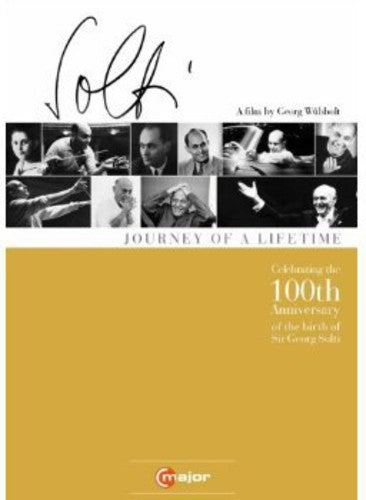
Solti - Journey Of A Lifetime
DVD$26.99$13.49C Major Entertainment
Oct 30, 2012711708 -

Legendary Treasures - Michael Rabin Collection Vol 3 - Violin Concertos
$20.99CDDoremi
Mar 09, 2010DHR-7970-1 -
![]()

-
![]()

-

Elgar: Symphony No 2, Enigma Variations / Solti, LPO
$26.99DVDICA Classics
Feb 22, 2011ICAD 5011 -

Immortal Beloved - Original Soundtrack
$11.99CDSony Masterworks
Mar 02, 201088697608612 -
![]()

-
![]()

-

Solti Conducts Wagner Strauss & Beethoven
$26.99DVDICA Classics
Jun 28, 2011ICAD 5024 -
![]()

-
![]()

-

Mozart, Tchaikovsky, Debussy / Solti, Chicago
$26.99DVDICA Classics
May 28, 2013ICAD 5100

The Early Domingo
Sony Masterworks
Available as
CD
Selections from the star tenor's early recital recordings, including music of Verdi, Puccini, Bizet, and more.


Solti - Journey Of A Lifetime [blu-ray]
C Major Entertainment
Available as
Blu-Ray
Note: This Blu-ray Disc is only playable on Blu-ray Disc players and not compatible with standard DVD players.
Also available on standard DVD
SOLTI – Journey of a Lifetime
Celebrating the 100th Anniversary of the birth of Sir Georg Solti (Blu-ray Disc Version)
Featuring:
Valerie Solti
Valery Gergiev
Christoph von Dohnányi
Sir Peter Jonas
Clemens Hellsberg
Ewald Markl
and many more as interview partners as well as several musical excerpts conducted by Sir Georg Solti
Bonus:
Dmitry Shostakovich: Symphony No. 1 in F minor, Op. 10
Sergey Prokofiev: Symphony No. 1 in D major, Op. 25, “Classical”
Modest Mussorgsky: Khovanshchina: Prelude
Chicago Symphony Orchestra
Georg Solti, conductor
1977 Video Production
Picture format: 1080i High Definition (documentary) / 4:3 (bonus)
Sound format: PCM Stereo
Region code: 0 (worldwide)
Languages: English, German
Subtitles: French, Spanish, Korean
Running time: 52 mins (documentary) + 55 mins (bonus)
No. of Discs: 1 (BD 25)
Also available on standard DVD
SOLTI – Journey of a Lifetime
Celebrating the 100th Anniversary of the birth of Sir Georg Solti (Blu-ray Disc Version)
Featuring:
Valerie Solti
Valery Gergiev
Christoph von Dohnányi
Sir Peter Jonas
Clemens Hellsberg
Ewald Markl
and many more as interview partners as well as several musical excerpts conducted by Sir Georg Solti
Bonus:
Dmitry Shostakovich: Symphony No. 1 in F minor, Op. 10
Sergey Prokofiev: Symphony No. 1 in D major, Op. 25, “Classical”
Modest Mussorgsky: Khovanshchina: Prelude
Chicago Symphony Orchestra
Georg Solti, conductor
1977 Video Production
Picture format: 1080i High Definition (documentary) / 4:3 (bonus)
Sound format: PCM Stereo
Region code: 0 (worldwide)
Languages: English, German
Subtitles: French, Spanish, Korean
Running time: 52 mins (documentary) + 55 mins (bonus)
No. of Discs: 1 (BD 25)
![Solti - Journey Of A Lifetime [blu-ray]](http://arkivmusic.com/cdn/shop/files/2059125.jpg?v=1761756245&width=800)

The Royal Opera: A Collection
Opus Arte
Available as
DVD
This outstanding collection contains 6 discs and features some of the most memorable performances by The Royal Opera. The works included in this set include Verdi’s Aida, Otello, and Stiffelio, Strauss’s Salome, Gounod’s Romeo Et Juliette, and Mozart’s Mitridate, re di Ponto. These discs bring together incredible conductors Paul Daniel, Edward Downes, Charles Mackerras, and Georg Solti with world-class stage directors Elijah Moshinsky, Nicholas Joel, Peter Hall, and Graham Vick. These recordings, all taken between 1992 and 1994, are preserved here in Standard Definition and 4/3 picture format.


Verdi: Requiem / Solti, Brouwenstijn, Dominguez, Zampieri, Zaccaria
Andromeda
Available as
CD
$10.99
Jan 01, 2012
Classical Music


Solti - Journey Of A Lifetime
C Major Entertainment
Available as
DVD
Also available on Blu-ray
SOLTI – Journey of a Lifetime Celebrating the 100th Anniversary of the birth of Sir Georg Solti A film by Georg Wübbolt
Featuring:
Valerie Solti
Valery Gergiev
Christoph von Dohnányi
Sir Peter Jonas
Clemens Hellsberg
Ewald Markl
and many more as interview partners as well as several musical excerpts conducted by Sir Georg Solti
Bonus:
Dmitry Shostakovich: Symphony No. 1 in F minor, Op. 10
Sergey Prokofiev: Symphony No. 1 in D major, Op. 25, “Classical”
Modest Mussorgsky: Khovanshchina: Prelude
Chicago Symphony Orchestra
Georg Solti, conductor
R E V I E W:
SOLTI: JOURNEY OF A LIFETIME • Georg Solti, cond; Chicago SO • C-MAJOR 711708 (DVD: 106: 00) A film by Georg Wübbolt
MUSSORGSKY Khovanshchina: Prelude. PROKOFIEV Symphony No. 1, “Classical.” SHOSTAKOVICH Symphony No. 1. Live: Chicago 1977
What is Georg Solti’s place in the pantheon of podium titans? He gained celebrity when he led the first complete recording of Wagner’s Ring to be issued. He created a comparable sensation when he took over the Chicago Symphony and led that orchestra in concerts and recordings that dazzled with their brilliance, virtuosity, and tonal splendor. In the 1970s Harold C. Schonberg, the influential chief music critic of the New York Times , pronounced Solti and Karajan the two most significant conductors of the age, characterizing Solti’s sonority as “molten gold,” in contrast to the “silvery” Karajan sound. As is usual, extravagant acclaim soon led detractors to weigh in, and Solti’s recordings began to be criticized as crude, unyielding, over-driven, excessively muscular, and lacking in nuance and refinement. Although he holds the record for the number of Grammy awards, his many recordings of standard symphonic repertoire rarely turn up today on lists of preferred versions, and he did not make BBC Music magazine ’s list of the 20 greatest conductors, as selected by a poll of 100 currently active conductors. (Nor, astonishingly, did Otto Klemperer or Bruno Walter.)
The centennial of Solti’s birth in 2012 saw the release on DVD of two documentaries about his life and career. The other one, which I have not seen, was reviewed by Lynn René Bayley in Fanfare 36:3. It is nearly three times as long as the one under review here and apparently more thorough and detailed, with a lengthier supplement of complete performances. The C Major release combines a 52-minute documentary with 54 minutes of performances by the Chicago Symphony. Filmmaker Georg Wübbolt was also responsible for a documentary on Carlos Kleiber that I reviewed in 35:1. As in that earlier effort, he follows the standard technique of interspersing commentary by those who knew the conductor, worked with him, or followed his career, with clips from rehearsals and performances. Solti himself is much more of a participant in the commentary than was Kleiber, who stopped giving interviews early in his career. Wübbolt also follows his earlier practice of shifting rapidly from one commentator to the next, which generates a fast-paced narrative but also leaves loose ends and unanswered questions. As in his earlier documentary, there are issues one would like to have discussed in greater detail. It is also sometimes hard to keep track of the identities of the commentators and their connection to Solti, since they are often not again identified when they reappear. They include Solti’s widow, Valerie, Christoph von Dohnányi, who served as his assistant in Frankfurt, Valery Gergiev, and the critic Norman Lebrecht, along with musicians and officials of the Chicago Symphony, the Vienna Philharmonic, the Frankfurt and Munich opera houses, the Bayreuth Festival, and others. Considering the importance of opera in Solti’s career, the absence of singers with whom he worked from the ranks of commentators is surprising and regrettable. The film is mostly in German, with English subtitles, although there is some narration and comment in English. Solti himself speaks in German.
The documentary provides a succinct overview of Solti’s career: his musical training in his native Budapest under Bartók, Ernö Dohnányi, and Leo Weiner; his 1937 visit to Salzburg, where he met Toscanini and was recruited to serve as a repetiteur; his second meeting with Toscanini in Lucerne in 1939, on the eve of World War II, which resulted in his being stranded in Switzerland for the duration of the conflict. In postwar Germany, he finally had the opportunity to begin a conducting career, since most German conductors were temporarily barred by the victorious Allies from performing. He first headed the Bavarian State Opera in Munich, where life for him was very difficult. The opera orchestra (“all Nazis” according to Solti) did not take kindly to being led by a young Hungarian Jew and showed it. In 1951 he moved to the somewhat friendlier territory of Frankfurt. His career took a giant step forward when producer John Culshaw selected him for the Ring project over more senior and established figures, perceiving him as someone who was more amenable to the demands of the recording studio and capable of achieving the results Culshaw envisioned for this ground-breaking effort. The Decca Ring is said to have led to Solti’s appointment to head London’s Royal Opera, although most of Ring operas had not yet been released when this selection took place. After his successful although controversial tenure at Covent Garden (1961-71), where he brought the company to “the highest international standards,” he had had enough of presiding over opera houses and wished to devote himself to symphony orchestras. As music director of the Chicago Symphony (1969-91), he perhaps reached the peak of his career, bringing the orchestra to a level of world-wide acclaim it had never before approached. Not so successful was his brief tenure with the Orchestre de Paris (1972-75), described in the film as “a terrible orchestra” where “no one goes…except for the money.” Curiously, the documentary does not mention his involvement with the London Philharmonic, which he led in the years 1979-83 and with which he recorded Elgar’s symphonies and several Mozart operas, among other works. When Karajan died in 1989 prior to the Salzburg Festival, Solti was urgently requested to take over the production of Verdi’s Un ballo in maschera, which he did with some reluctance. Up to then he had never been invited to conduct at Salzburg or at the Berlin Philharmonic. There was no love lost between the two conductors, but they did listen to each other’s recordings to find out how the other was approaching a work. In Solti’s final years, he renewed his ties with Munich in guest appearances with the Bavarian Radio Symphony and returned to his homeland to lead the recently founded Budapest Festival Orchestra in a recording of works by his three teachers.
When the commentators attempt to characterize Solti’s style as a conductor, words like energy, vitality, and fire crop up repeatedly and are underscored by images of his abrupt, even violent movements on the podium. These movements, according to one observer, provoked orchestras to play loudly, and he had difficulty getting them to play more softly. In addition to fire, according to Gergiev, he possessed “icy control.” Other commentators mention his perfectionism, focus on detail, and special concern for rhythm, which are reflected in his practice of singing, or rather chanting, a passage to demonstrate how it should go. The Vienna Philharmonic cellist Werner Resel emphasizes and, I think, exaggerates the role of recordings in establishing Solti’s reputation, arguing that Solti “didn’t make a career by conducting concerts and delighting audiences but by making records that turned out to be great.” This gentleman apparently missed the decades in which Solti was thrilling audiences with his Chicago Symphony concerts, in Europe as well as the U.S. Peter Schmidl, another VPO musician, makes the surprising and demonstrably false claim that “Solti’s great career as a conductor became possible only when Böhm had stopped conducting and Karajan had died…and when Bernstein was no longer around,” in other words, in the last seven years of Solti’s life. The same observer, however, expresses regret that Solti was not called earlier to Salzburg, where he could have achieved great results.
The concert performances included as a supplement are drawn from a 1977 telecast featuring Russian music. The Khovanshchina Prelude is performed in Rimsky-Korsakov’s smoothed-out and comparatively bland revision. In the Prokofiev “Classical” Symphony, Solti’s weighty approach and the massive sound of the Chicago Symphony are perhaps not the best fit for this light and frothy music, but the piece is brilliantly played and enjoyable to hear. The fast-paced, forceful, and once again brilliantly played Shostakovich is the most satisfying item on the program. As was his practice, Solti tends to set a tempo and stick to it, without much inflection for expressive purposes, and with the solid, steady rhythmic underpinning that was one of his hallmarks. Others may bring more mystery and sense of underlying menace to this work, but with Solti the menace is quite overt. The sound is free from distortion, brilliant in tutti, and wide in dynamic range, if a bit opaque and lacking in spaciousness.
Returning to the question I posed at the beginning of this review, I have no definitive answer. Solti’s Ring , which has just been reissued in an expensive, hefty “super deluxe” edition and is said to be by far the best-selling classical recording of all time, retains its status, as does his Mahler Eighth, although even they are not without their detractors, as witness Lynn René Bayley’s unfavorable comments in 36:3. Solti’s legacy as an opera conductor, in Wagner, Strauss, Verdi, and, somewhat surprisingly, Mozart, seems to me secure. Although he was never one of my favorite conductors, he was one who engaged my interest, and I have a good many of his recordings of Beethoven, Brahms, Bruckner, Mahler, and others on my overburdened shelves. I will retain these performances as having enduring value, even if they would not necessarily be among my first choices for the works in question. Solti remains a worthy contributor to the almost infinite variety of performance that enriches our experience of music. For those interested in his life and career, the Wübbolt documentary, despite the shortcomings noted, offers a concise overview with many insights.
FANFARE: Daniel Morrison
1977 Video Production
Picture format: NTSC 16:9 (documentary) / 4:3 (bonus)
Sound format: PCM Stereo
Region code: 0 (worldwide)
Languages: English, German
Subtitles: French, Spanish, Korean
Running time: 52 mins (documentary) + 55 mins (bonus)
No. of DVDs: 1 (DVD 9)
SOLTI – Journey of a Lifetime Celebrating the 100th Anniversary of the birth of Sir Georg Solti A film by Georg Wübbolt
Featuring:
Valerie Solti
Valery Gergiev
Christoph von Dohnányi
Sir Peter Jonas
Clemens Hellsberg
Ewald Markl
and many more as interview partners as well as several musical excerpts conducted by Sir Georg Solti
Bonus:
Dmitry Shostakovich: Symphony No. 1 in F minor, Op. 10
Sergey Prokofiev: Symphony No. 1 in D major, Op. 25, “Classical”
Modest Mussorgsky: Khovanshchina: Prelude
Chicago Symphony Orchestra
Georg Solti, conductor
R E V I E W:
SOLTI: JOURNEY OF A LIFETIME • Georg Solti, cond; Chicago SO • C-MAJOR 711708 (DVD: 106: 00) A film by Georg Wübbolt
MUSSORGSKY Khovanshchina: Prelude. PROKOFIEV Symphony No. 1, “Classical.” SHOSTAKOVICH Symphony No. 1. Live: Chicago 1977
What is Georg Solti’s place in the pantheon of podium titans? He gained celebrity when he led the first complete recording of Wagner’s Ring to be issued. He created a comparable sensation when he took over the Chicago Symphony and led that orchestra in concerts and recordings that dazzled with their brilliance, virtuosity, and tonal splendor. In the 1970s Harold C. Schonberg, the influential chief music critic of the New York Times , pronounced Solti and Karajan the two most significant conductors of the age, characterizing Solti’s sonority as “molten gold,” in contrast to the “silvery” Karajan sound. As is usual, extravagant acclaim soon led detractors to weigh in, and Solti’s recordings began to be criticized as crude, unyielding, over-driven, excessively muscular, and lacking in nuance and refinement. Although he holds the record for the number of Grammy awards, his many recordings of standard symphonic repertoire rarely turn up today on lists of preferred versions, and he did not make BBC Music magazine ’s list of the 20 greatest conductors, as selected by a poll of 100 currently active conductors. (Nor, astonishingly, did Otto Klemperer or Bruno Walter.)
The centennial of Solti’s birth in 2012 saw the release on DVD of two documentaries about his life and career. The other one, which I have not seen, was reviewed by Lynn René Bayley in Fanfare 36:3. It is nearly three times as long as the one under review here and apparently more thorough and detailed, with a lengthier supplement of complete performances. The C Major release combines a 52-minute documentary with 54 minutes of performances by the Chicago Symphony. Filmmaker Georg Wübbolt was also responsible for a documentary on Carlos Kleiber that I reviewed in 35:1. As in that earlier effort, he follows the standard technique of interspersing commentary by those who knew the conductor, worked with him, or followed his career, with clips from rehearsals and performances. Solti himself is much more of a participant in the commentary than was Kleiber, who stopped giving interviews early in his career. Wübbolt also follows his earlier practice of shifting rapidly from one commentator to the next, which generates a fast-paced narrative but also leaves loose ends and unanswered questions. As in his earlier documentary, there are issues one would like to have discussed in greater detail. It is also sometimes hard to keep track of the identities of the commentators and their connection to Solti, since they are often not again identified when they reappear. They include Solti’s widow, Valerie, Christoph von Dohnányi, who served as his assistant in Frankfurt, Valery Gergiev, and the critic Norman Lebrecht, along with musicians and officials of the Chicago Symphony, the Vienna Philharmonic, the Frankfurt and Munich opera houses, the Bayreuth Festival, and others. Considering the importance of opera in Solti’s career, the absence of singers with whom he worked from the ranks of commentators is surprising and regrettable. The film is mostly in German, with English subtitles, although there is some narration and comment in English. Solti himself speaks in German.
The documentary provides a succinct overview of Solti’s career: his musical training in his native Budapest under Bartók, Ernö Dohnányi, and Leo Weiner; his 1937 visit to Salzburg, where he met Toscanini and was recruited to serve as a repetiteur; his second meeting with Toscanini in Lucerne in 1939, on the eve of World War II, which resulted in his being stranded in Switzerland for the duration of the conflict. In postwar Germany, he finally had the opportunity to begin a conducting career, since most German conductors were temporarily barred by the victorious Allies from performing. He first headed the Bavarian State Opera in Munich, where life for him was very difficult. The opera orchestra (“all Nazis” according to Solti) did not take kindly to being led by a young Hungarian Jew and showed it. In 1951 he moved to the somewhat friendlier territory of Frankfurt. His career took a giant step forward when producer John Culshaw selected him for the Ring project over more senior and established figures, perceiving him as someone who was more amenable to the demands of the recording studio and capable of achieving the results Culshaw envisioned for this ground-breaking effort. The Decca Ring is said to have led to Solti’s appointment to head London’s Royal Opera, although most of Ring operas had not yet been released when this selection took place. After his successful although controversial tenure at Covent Garden (1961-71), where he brought the company to “the highest international standards,” he had had enough of presiding over opera houses and wished to devote himself to symphony orchestras. As music director of the Chicago Symphony (1969-91), he perhaps reached the peak of his career, bringing the orchestra to a level of world-wide acclaim it had never before approached. Not so successful was his brief tenure with the Orchestre de Paris (1972-75), described in the film as “a terrible orchestra” where “no one goes…except for the money.” Curiously, the documentary does not mention his involvement with the London Philharmonic, which he led in the years 1979-83 and with which he recorded Elgar’s symphonies and several Mozart operas, among other works. When Karajan died in 1989 prior to the Salzburg Festival, Solti was urgently requested to take over the production of Verdi’s Un ballo in maschera, which he did with some reluctance. Up to then he had never been invited to conduct at Salzburg or at the Berlin Philharmonic. There was no love lost between the two conductors, but they did listen to each other’s recordings to find out how the other was approaching a work. In Solti’s final years, he renewed his ties with Munich in guest appearances with the Bavarian Radio Symphony and returned to his homeland to lead the recently founded Budapest Festival Orchestra in a recording of works by his three teachers.
When the commentators attempt to characterize Solti’s style as a conductor, words like energy, vitality, and fire crop up repeatedly and are underscored by images of his abrupt, even violent movements on the podium. These movements, according to one observer, provoked orchestras to play loudly, and he had difficulty getting them to play more softly. In addition to fire, according to Gergiev, he possessed “icy control.” Other commentators mention his perfectionism, focus on detail, and special concern for rhythm, which are reflected in his practice of singing, or rather chanting, a passage to demonstrate how it should go. The Vienna Philharmonic cellist Werner Resel emphasizes and, I think, exaggerates the role of recordings in establishing Solti’s reputation, arguing that Solti “didn’t make a career by conducting concerts and delighting audiences but by making records that turned out to be great.” This gentleman apparently missed the decades in which Solti was thrilling audiences with his Chicago Symphony concerts, in Europe as well as the U.S. Peter Schmidl, another VPO musician, makes the surprising and demonstrably false claim that “Solti’s great career as a conductor became possible only when Böhm had stopped conducting and Karajan had died…and when Bernstein was no longer around,” in other words, in the last seven years of Solti’s life. The same observer, however, expresses regret that Solti was not called earlier to Salzburg, where he could have achieved great results.
The concert performances included as a supplement are drawn from a 1977 telecast featuring Russian music. The Khovanshchina Prelude is performed in Rimsky-Korsakov’s smoothed-out and comparatively bland revision. In the Prokofiev “Classical” Symphony, Solti’s weighty approach and the massive sound of the Chicago Symphony are perhaps not the best fit for this light and frothy music, but the piece is brilliantly played and enjoyable to hear. The fast-paced, forceful, and once again brilliantly played Shostakovich is the most satisfying item on the program. As was his practice, Solti tends to set a tempo and stick to it, without much inflection for expressive purposes, and with the solid, steady rhythmic underpinning that was one of his hallmarks. Others may bring more mystery and sense of underlying menace to this work, but with Solti the menace is quite overt. The sound is free from distortion, brilliant in tutti, and wide in dynamic range, if a bit opaque and lacking in spaciousness.
Returning to the question I posed at the beginning of this review, I have no definitive answer. Solti’s Ring , which has just been reissued in an expensive, hefty “super deluxe” edition and is said to be by far the best-selling classical recording of all time, retains its status, as does his Mahler Eighth, although even they are not without their detractors, as witness Lynn René Bayley’s unfavorable comments in 36:3. Solti’s legacy as an opera conductor, in Wagner, Strauss, Verdi, and, somewhat surprisingly, Mozart, seems to me secure. Although he was never one of my favorite conductors, he was one who engaged my interest, and I have a good many of his recordings of Beethoven, Brahms, Bruckner, Mahler, and others on my overburdened shelves. I will retain these performances as having enduring value, even if they would not necessarily be among my first choices for the works in question. Solti remains a worthy contributor to the almost infinite variety of performance that enriches our experience of music. For those interested in his life and career, the Wübbolt documentary, despite the shortcomings noted, offers a concise overview with many insights.
FANFARE: Daniel Morrison
1977 Video Production
Picture format: NTSC 16:9 (documentary) / 4:3 (bonus)
Sound format: PCM Stereo
Region code: 0 (worldwide)
Languages: English, German
Subtitles: French, Spanish, Korean
Running time: 52 mins (documentary) + 55 mins (bonus)
No. of DVDs: 1 (DVD 9)

Legendary Treasures - Michael Rabin Collection Vol 3 - Violin Concertos
Doremi
Available as
CD
$20.99
Mar 09, 2010
Creston:
Violin Concerto No. 2, Op. 78
(World Premiere) November 17, 1960
Los Angeles Philharmonic Orchestra, Georg Solti
Engel, Carl:
Sea-Shell
arr. Zimbalist. Australian tour, Sydney Town Hall. July 1952
Glazunov:
Violin Concerto in A minor, Op. 82
March 3, 1968
Radio-Orchester Beromester, Zurich, Erich Schmid
Godowsky:
Triakontameron No. 11 'Alt Wien'
arr. Heifetz
Kreisler:
Tambourin Chinois, Op. 3
Mendelssohn:
Song without Words, Op. 19b No. 1 in E major 'Sweet Remembrance'
arr. Heifetz. Australian tour, Sydney Town Hall. July 1952
Mozart:
Violin Concerto No. 4 in D major, K218
February 9, 1960
The Denver Symphony Orchestra, Saul Caston
Paganini:
Caprice for solo violin, Op. 1 No. 9 in E major 'The Hunt'
January 20, 1970, New York WQXR Radio (The listening room)
The Bell Telephone Hour Orchestra, Donald Voorhees
Caprice for solo violin, Op. 1 No. 21 in A major
Caprice for solo violin, Op. 1 No. 11 in C major
Caprice for solo violin, Op. 1 No. 16 in G minor
Prokofiev:
The Love for Three Oranges: March
arr. Heifetz. Australian tour, Sydney Town Hall. July 1952
Ravel:
Tzigane
Saint-Saëns:
Etude en forme de valse Op. 52 No. 6
Violin Concerto No. 2, Op. 78
(World Premiere) November 17, 1960
Los Angeles Philharmonic Orchestra, Georg Solti
Engel, Carl:
Sea-Shell
arr. Zimbalist. Australian tour, Sydney Town Hall. July 1952
Glazunov:
Violin Concerto in A minor, Op. 82
March 3, 1968
Radio-Orchester Beromester, Zurich, Erich Schmid
Godowsky:
Triakontameron No. 11 'Alt Wien'
arr. Heifetz
Kreisler:
Tambourin Chinois, Op. 3
Mendelssohn:
Song without Words, Op. 19b No. 1 in E major 'Sweet Remembrance'
arr. Heifetz. Australian tour, Sydney Town Hall. July 1952
Mozart:
Violin Concerto No. 4 in D major, K218
February 9, 1960
The Denver Symphony Orchestra, Saul Caston
Paganini:
Caprice for solo violin, Op. 1 No. 9 in E major 'The Hunt'
January 20, 1970, New York WQXR Radio (The listening room)
The Bell Telephone Hour Orchestra, Donald Voorhees
Caprice for solo violin, Op. 1 No. 21 in A major
Caprice for solo violin, Op. 1 No. 11 in C major
Caprice for solo violin, Op. 1 No. 16 in G minor
Prokofiev:
The Love for Three Oranges: March
arr. Heifetz. Australian tour, Sydney Town Hall. July 1952
Ravel:
Tzigane
Saint-Saëns:
Etude en forme de valse Op. 52 No. 6


Elgar: Symphony No 2, Enigma Variations / Solti, LPO
ICA Classics
Available as
DVD
$26.99
Feb 22, 2011
This performance of Elgar's Enigma Variations forms an historic account of the first concert Sir Georg Solti conducted as Chief conductor of the LPO in 1975. It is also the first DVD release with Solti performing Elgar's Symphony No.2. Solti, who prepared new works by listening to Elgar's own recordings, identified closely with his music. The virtuoso playing of the orchestra combined with his fresh, energetic approach make for an exciting, uplifting experience. The ICA Classics Legacy series presents a collection of historic performances by some of the world's greatest artists. These performances are released on DVD for the first time, incorporating rare archive footage that has been expertly and lovingly restored.
Edward Elgar:
Symphony No. 2 in E flat major, Op. 63
Variations on an Original Theme, Op. 36, "Enigma"
London Philharmonic Orchestra
Georg Solti, conductor
Recorded at the Royal Festival Hall, London, 13 February 1975
(Symphony No. 2), and 25 September 1979 (Enigma)
Picture format: NTSC 4:3
Sound format: LPCM Mono
Region code: 0 (worldwide)
Menu language: English
Running time: 84 mins
No. of DVDs: 1
Edward Elgar:
Symphony No. 2 in E flat major, Op. 63
Variations on an Original Theme, Op. 36, "Enigma"
London Philharmonic Orchestra
Georg Solti, conductor
Recorded at the Royal Festival Hall, London, 13 February 1975
(Symphony No. 2), and 25 September 1979 (Enigma)
Picture format: NTSC 4:3
Sound format: LPCM Mono
Region code: 0 (worldwide)
Menu language: English
Running time: 84 mins
No. of DVDs: 1


Immortal Beloved - Original Soundtrack
Sony Masterworks
Available as
CD
$11.99
Mar 02, 2010
IMMORTAL BELOVED


Solti Conducts Wagner Strauss & Beethoven
ICA Classics
Available as
DVD
$26.99
Jun 28, 2011
Bonus:
- Don Juan rehearsal and interview with John Culshaw
Picture format: NTSC 4:3
Sound format: Enhanced Mono, Ambient Mastering
Region code: 0 (worldwide)
Menu language: English
Subtitles (bonus): French, German
Running time: 96 mins
No. of DVDs: 1
- Don Juan rehearsal and interview with John Culshaw
Picture format: NTSC 4:3
Sound format: Enhanced Mono, Ambient Mastering
Region code: 0 (worldwide)
Menu language: English
Subtitles (bonus): French, German
Running time: 96 mins
No. of DVDs: 1


Mozart, Tchaikovsky, Debussy / Solti, Chicago
ICA Classics
Available as
DVD
$26.99
May 28, 2013
MOZART Symphony No. 39. TCHAIKOVSKY Symphony No. 4. DEBUSSY Trois Nocturnes: Fêtes • Georg Solti, cond; Chicago SO • ICA 5100 (DVD: 131:00) Live: London 2/2/1985
This concert was the last one presented by the Chicago Symphony under Georg Solti during its fifth European tour. If the orchestra’s first appearance in Britain (in Edinburgh in 1971) was something of a vindication for Solti following the stormy tenure he endured at Covent Garden, this one was now part of a well-practiced drill for both conductor and orchestra as conquering victors making a triumphal appearance to receive duly awaited laurels. By this time, only the orchestras of Berlin, Vienna, and the Concertgebouw could seriously presume to contest the claim of the CSO to be the world’s greatest orchestra. If the latter two could at least boast of having a more beautiful sheen of sound, none of them could match the CSO under Solti for sheer precision and brilliance of execution.
Given that, it is a bit of a surprise to encounter in Mozart’s 39th Symphony that opens this program some metrical imprecision in the downward cascading runs of the introduction to the first movement, which lack a clear sense of where the downbeat is. After that minor slip, the performance rights itself under Solti and moves forward with great efficiency. While Solti uses a reduced orchestra with a 12-10-8-6-4 string section deployment, the sound is still quite full compared to those from present-day period instrument ensembles. The interpretation is stylish and well proportioned, though a bit straightforward and lacking the extra lyricism and warmth that a Bruno Walter or Karl Böhm would have brought to it. In short, it is a good performance but not a great one.
The Tchaikovsky Fourth is another matter. In a previous review in 34:4 of a DVD featuring Kurt Sanderling, I complained of both the paucity and quality of available Tchaikovsky Fourths in the DVD medium. This performance corrects the problem in spades. Solti was a superb Tchaikovsky interpreter, one who brought a great tensile strength to the composer’s scores that minimized their structural lacunae and did not overindulge their heart-on-sleeve emotionalism. Here the first movement, with its “Sword of Damocles” motif of Fate, which in lesser hands can seem overly prolix or mawkish, is channeled with a propulsive fury that at the same time does not slight the contrasting interludes of almost balletic grace, the latter being rendered with a delicacy that belies critics who accuse Solti of insensitively running roughshod over every score. Even more surprisingly, the succeeding Andantino is taken at a quite leisurely tempo, with noticeably more rubato and ritards than Solti was wont to employ. The Scherzo likewise is taken at a pace a bit slower than I would have expected, with just a touch of rhythmic stiffness that is my only and minor criticism of this performance. The Allegro con fuoco Finale is indeed fiery, if not taken at quite the hell-for-leather pace of Yevgeny Svetlanov, my benchmark for this work, and the main section dovetails nicely into the coda with the return of the “Damocles” motif. The audience quite properly goes wild immediately after the closing chord, vociferously yelling its approval over tumultuous applause.
“Brilliant” and “sizzling” are not normally the first adjectives that come to mind for performances of Debussy’s music, but they certainly apply to this encore performance of “Fêtes” from the Trois Nocturnes. I for one would never have pegged Solti as a Debussy conductor of the first rank, but he is absolutely terrific here. This rendition positively crackles with drive and bounce; every note, every instrumental part is detailed with stunning clarity and gleaming color, with an unexpectedly witty close to boot. Once again, the audience roars its approval. What a shame not to have the complete Trois Nocturnes from Solti here!
The DVD opens with a three-minute spiel from ICA Classics touting its series of releases from British archives and the Boston Symphony archives. The camerawork is sensible, and the visual resolution is fine; the one drawback is that the recorded sound is very dry, which robs the Tchaikovsky Fourth in particular of some desirable tonal luster. Highly recommended, then, for the Tchaikovsky and Debussy items.
FANFARE: James A. Altena
