Conductor: Vladimir Ashkenazy
8 products
Shostakovch: Execution of Stepan Razin; Zoya Suite / Ashkenazy, Helsinki Phiharmonic
• The Execution of Stepan Razin, premiered in Moscow in 1964, got a mixed reception. The execution scene and the final, tragic vision is simply spine-chilling: Stepan Razin’s bloody head rolls to the ground and bursts out laughing at the Tsar. Capturing rich intonations and melodies of the text, the bass soloist and the chorus engage in a multi-layered dialogue of this very theatrical work.
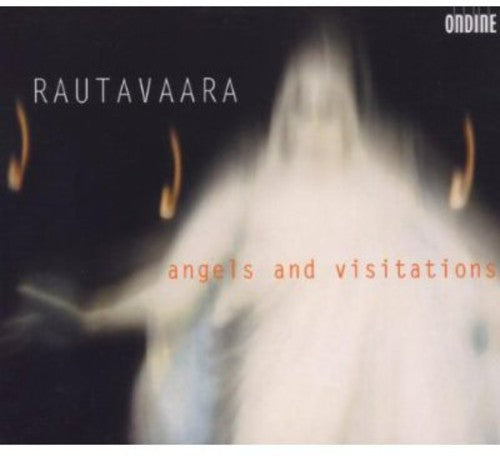
Rautavaara: Angels & Visitations
The magical world of Einojuhani Rautavaara is one that evokes other realms. Angels figure particularly heavily, especially those angels that deal with death and destruction. As Rautavaara himself says, “My angels are not those like in the altarpieces of Raphael...my angels are powerful.”
As well as with angels, many mystics have been preoccupied with the language of the birds (Messiaen in music, but think also of Saint Francis of Assisi preaching to the birds). One of the most popular Finnish works of recent years has been the Cantus arcticus, for prerecorded bird sounds and orchestra. It is a hugely impressive three-movement soundscape marked by a timeless feel and by beautiful, glowing lines. The taped birds could easily have sounded like a cheap effect, so it is telling that they emerge as an integral part of the work’s emotional vocabulary. Segerstam’s performance is excellent, as one would expect from this fine musician.
The very title Autumn Gardens seems to invite comparison with Takemitsu—all we need is a descending flock of the birds from the Cantus arcticus. It is certainly easy on the ear, so much so that the acerbic, percussive dissonances of the third movement of the First Piano Concerto come as something of a relief. Gothóni is an excellent pianist here; his way with some rhythms makes me suggest he has links to jazz. Back to pure atmosphere for the Clarinet Concerto, though—truly excellently played by Stoltzmann.
The second disc begins with an Adagio celeste for string orchestra. The strings of the Belgian National Orchestra play really sumptuously in this gently pulsating score; the much more abrasive Flute Concerto excerpt that follows (complete with agile low bassoon and menacing percussion) acts as a necessary corrective, although it is not long before it, too, shows its delicate side.
True and False Unicorn is a reminder of Rautavaara’s stature as a composer of choral works. The second movement, “Young Sagittarius,” is full of delightfully light rhythmic play, as is In the shade of the willow. Anadyomene , subtitled “Adoration of Aphrodite,” evokes more of a sense of the massive, using expansive, coloristic writing and including moments of real light.
The final work, Angels and Visitations , has a deliberately ambiguous title. “Visitations” may indeed refer to the Annunciation, but it may equally invoke something more sinister. Climaxes, therefore, tend towards the darkly hued. There are shades of Sibelius during the course of the piece, but Rautavaara transforms the material so that it glows in a most un-Sibelian way. This tense score (with its Pétrouchka -like mêlée of sounds) is one of the most impressive on either disc here, and is an apt way to close.
Although other companies are championing the Rautavaara cause, most notably Naxos, Ondine has a certain authority. Both sides of Rautavaara’s personality—the meltingly beautiful and the near violent—are given a chance to make their mark here.
-- Fanfare
Rachmaninov: Symphony No. 1 / Ashkenazy, Philharmonia Orchestra
As pianist as well as conductor, Vladimir Ashkenazy has had a love affair with fellow Russian Rachmaninov for more than half a century. Ashkenazy’s authority is one attraction of this performance of Symphony No 1, as he knows how to shape detail and soar in the big melodic moments. The Philharmonia sound is muscular and alert, from the opening woodwind solos to the mighty, stirring symphonic tutti of the finale.
– Guardian (UK)
Symphony No.1 is great piece, jam-packed with personality (with leanings to Tchaikovsky), the music—often powerful—exudes thrills, beauties, much atmosphere and stirring pomp. Vladimir Ashkenazy, as a pianist and a conductor, is a veteran Rachmaninov interpreter and here brings his experience and devotion to bear on every bar, the Philharmonia Orchestra (with which Ashkenazy has a time-honoured association, forty and more years) fully responsive. The first movement is shot-through with much excitement and lyrical passion, the second is spectral and wistful, the third introspective and heart-touching, and the Finale (the ceremonial opening of which used to be the music for BBCTV’s Panorama) is an exhilarating roller-coaster journey until the music descends to Hell, something very graphically realised here.
– ClassicalSource.com
Rachmaninoff: Monna Vanna, Act I Songs / Isokoski, Ashkenazy
Sergei Rachmaninoff’s (1873-1943) rarely heard, unfinished opera Monna Vanna was the only major score he took with him into exile in the USA after the 1917 revolution. + This new recording is based on Gennadi Belov’s new edition and conducted by an iconic artist and Russian music expert Vladimir Ashkenazy. The second part of this disc features Finnish soprano Soile Isokoski singing seven Rachmaninov songs (including the hauntingly beautiful Vocalise), accompanied on the piano by Mr. Ashkenazy.
Antonioni: My River - Music for Strings / I Solisti Aquilani
The legendary pianist and conductor joins his clarinettist son and Italian musicians in music by one of Italy’s most powerfully individual living composers. Born in 1971, Francesco Antonioni studied in Rome with Azio Corghi and then in London with Julian Anderson and George Benjamin: a formidable pedigree of teachers testifying to the strength of both his technique and his creative voice, which became internationally known in 2001 with a string quartet written for the Venice Biennale. Since then, Antonioni has gone on to assemble a substantial catalogue of fastidiously crafted works for both the stage and the concert hall.
This collection features two pieces for string orchestra, Ballata and Sull’ombra, alongside his concerto for clarinet and viola, Lights after the Thaw. Premiered in 2009, Ballata arose from a commission of the Birmingham Contemporary Music Group, to be conducted by Benjamin, and takes its initial inspiration from an anonymous lullaby, and a ballad by the 14th-century composer Francesco Landini. These are songs about love, seen from two opposite points, near the beginning and the end of life, and their meeting-point in this modern Ballata is bittersweet and charged with tension.
The origins of Sull’Ombra are no less distinguished. Yuri Bashmet conducted the Moscow Soloists in the premiere in 2014. Antonioni found himself moved to write it by lines of John Donne, which themselves reminded him of poetry by Eugenio Montale. The shadows here are dark indeed, though always lit with imagination, and harmony that leads the listener on, just as the concertante Lights after the Thaw draws out the intrinsically songful character of both solo instruments, in search of a point of reference amid a pervasive melancholia. There is a refined ear for harmony and texture evident in all three works, which reward attentive listening by anyone interested in the music of today.
Lidstrom: Rigoletto Fantasy - Shostakovich: Cello Concerto No. 1 / Lidstrom, Ashkenazy
-----
REVIEW:
Swedish cellist Mats Lidström’s cleverly-constructed Rigoletto Fantasy descends from the tradition of opera potpourri. What is markedly different here is the presence of Lidström’s cello, which embodies the personalities of the dissolute Duke, hapless Rigoletto, and demure Gilda with a dramatic flair that rivals even these roles’ most charismatic singers. The drama of Shostakovich’s Cello Concerto No. 1 is more abstract and austere, but Lidström, Ashkenazy, and the Oxford Philharmonic, deliver a full-blooded performance that conjures an equally ominous sense of tragedy.
– WQXR.org (WQXR-FM, 105.9)
Flint Juventino Beppe: Remote Galaxy
Artyomov: On the Threshold of a Bright World / Ashkenazy, Russia National Philharmonic
Vyacheslav Artyomov is considered by many to be Russia’s greatest living composer. After the fall of the Soviet regime his music has travelled the world to great acclaim. It is deep, ultimately spiritual and brilliantly crafted, with influences from the Russian symphonic tradition colored by Mahler, Honegger and Messiaen to name a few- but melded into a unique voice. This is one of a pair of related albums and contains a Symphony which is the second of his gigantic symphonic tetralogy “Symphony of the Way,” commissioned by Mstislav Rostropovich to whose memory the release is dedicated. The symphony is accompanied by another major work, Ave Atque Vale for percussion and orchestra, and the much more traditional Ave, Crux Alba- a setting of the Hymn of the Knights of Malta. The conductor, Ashkenazy, needs no introduction, being one of the most lauded and accomplished figures in music today. Overall, this is a disc of high importance in the symphonic repertoire. These are all world premiere recordings.