Haenssler Classic
391 products
Strauss: Zwischen Himmel und Erde
Pärt, Rachmaninoff & Ustvolskaya: Reflections / Inbal-Bogensberger, Liakh
What do you associate with the term “reflection”? Do you think of the physical phenomena in the “rebound” of light, sound, and warmth, or do you define the word as a psychological process of mental consideration and critical review? Kathrin Inbal-Bogensberger and Tatiana Liakh take inspiration from the reflective observation of a musical work’s structure and genesis and from biographical features of its composer’s life. At the same time, the physical aspects of reflection are important to the work’s exponents if the acoustics of the performance venue are to bring out the full effect of a composition. Notably, the mirror image or inversion as a fully developed form of reflection is a frequently employed musical technique at all periods. The space of time in which this recording was made was shaped by the continuing Covid pandemic and the early stages of the Ukraine war and demanded self-reflective qualities of its performers in their identity as interpretative artists. The two artists accordingly saw the title of the recording, “Reflections,” as a guiding thread governing the players of the works, the works themselves, and the works’ composers.
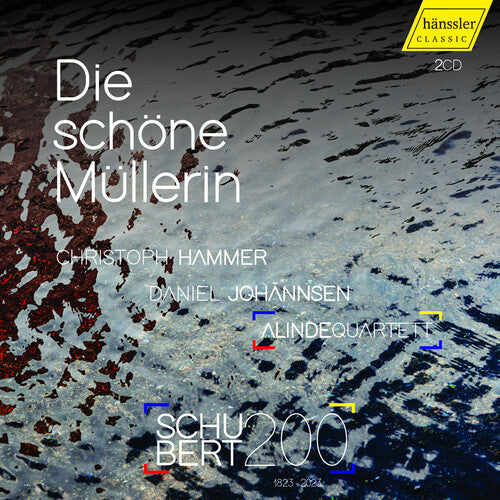
Schubert: Die schone Mullerin / Hammer, Johannsen, Alinde Quartet
With his song cycle, Die schöne Müllerin op. 25, published in Vienna in August 1824, Franz Schubert created one of the first song cycles in music history. It is a real cycle, not just a loose collection, because all the poems united in it hang firmly on a narrative thread: a narrated story, presented in 20 individual songs. It is clear that the most appropriate instrument for Die Schöne Müllerin is not the modern concert grand piano, but rather the fortepiano of Schubert's time, with its delicate, transparent sound and enormous richness of color. This makes for a completely different listening experience. But the arrangement that Tom Randle wrote for the ALINDE Quartet in 2022 can also open one's ears in a completely new way.
Cespo, Gardel, Gardelin & Villoldo: Porteno - Works for Tuba
Suder: Dona Nobis Pacem & Symphonic Music / Koch, Albert, Thuringia Philharmonic Suhl
Joseph Suder´s great festival mass complements the series of great sacred works from Bach to Bruckner in which tonal expressive means exhibit what are in polyphonic and in part homophonic traits. Suder´s work offers, in keeping with his stylistic will, a synthesis of strict contrapuntal thought with what would have to be termed a Romantic tone coloration, a combination of clear construction with eminent expressive power in the form of an intelligible musical language. Joseph Suder (1892 – 1980), active in Munich from 1911 on, did not bequeath a very extensive symphonic oeuvre to posterity. He composed his first major work of this type, the Chamber Symphony in A major, in 1925, and it was this work that brougth him his first international successes. In it he also formulated an important as well as interesting principle of design that would play a decisive role in almost all his later major works: the synthesis.
Zieritz: Japanese Songs; Le Violon de la Mort etc. / Brenner, Robert-Schumann-Philharmonie
This CD - significantly only the second CD dedicated exclusively to von Zieritz - presents a longitudinal section of her oeuvre. It begins with the Japanese Songs, written in 1919, here in the version for soprano and chamber orchestra from the 1980s. The centrepiece is Le Violon de la Mort, composed in 1953 for violin and piano and arranged for violin, piano and orchestra in 1957, as well as the trumpet double concerto of 1975, the final piece and, as it were, a satyr play. Like Hans Bethge's collection Die chinesische Flöte (The Chinese Flute) from 1907, the poetic model of the Japanese Songs belongs to the context of interest in exotic art of the fin de siècle. Gustav Mahler made Bethge's poems the basis for a large symphonic work; Grete von Zieritz took the opposite approach with the Japanese Songs. These are a kaleidoscopic sequence of the briefest miniatures. It would hardly be possible to do otherwise, since the Japanese models are not song texts in the European sense, but poetically condensed sayings that defy conventional song settings. Aphoristic brevity was the order of the day.
Liszt
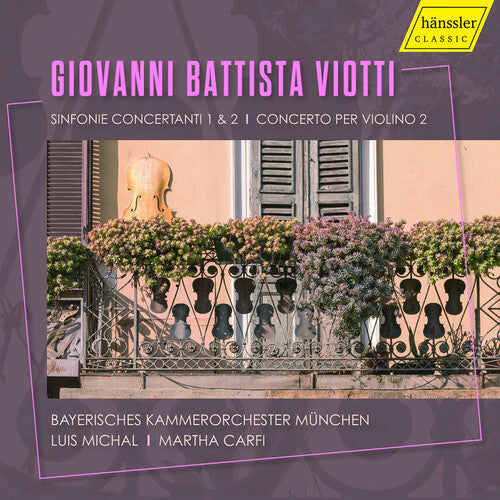
Viotti: Sinfonie concertanti 1 & 2; Violin Concerto no. 2 / Carfi, Michal, Bayerisches Kammerorchester Munchen
In June 1878 Johannes Brahms wrote to Clara Schumann: "The A minor Concerto by Viotti is my very special passion. It is a splendid piece with a remarkable freedom of invention: it sounds as if he were fantasizing, and everything has been designed and executed with such mastery …" Already during his lifetime Viotti was regarded as one of the most brilliant violin virtuosos, and his violin concertos also enjoyed special renown. As a composer Viotti brings in the schemes of the Italian School but also weaves in romantic motifs far ahaead of their times.
Romberg: The Song of the Bell / Guido Knüsel
Friedrich Schiller no doubt reckoned his Lied von der Glocke (The Song of the Bell) among his best poetic creations. He is supposed to have been inspired to write it by a 1788 visit to a bell foundry in Rudolstadt, Thuringia, and carried the idea for his bell founder´s song around with him for years. When Schill failed to finish it on time for the Musenalmanach in 1797, Goethe, the alamac´s editor, gave him the good advice and encouragement that „The bell will now have to sound all the better since the ore has been kept longer in the flux and has been rid of all slag“ (Goethe´s letter of 14 October 1797). The poem was published three years later in the Musenalmanach of 1800. Andreas Romberg set the whole long poem of 424 verses at one go - it was published by Simrock in 1809.
The composer Andreas Romberg, who certainly did not know Schiller´s wishes, made this idea a reality and set the whole long poem of 424 verses at one go. A bass part is assigned to the honest bell-founder master. His ten strophes all have the same design and the same simple melody, with the latter being varied or modulated now and again in what is a well-crafted composition. As the master directs the casting of the bell, so too the bass moves from station to station of the poem. The master´s big hour comes at the conclusion, when the bell is inaugurated. His solemn word of inauguration (Und dies sei fortan ihr Beruf) has him sing tones reminiscent of Sarastro.
Dvořák: Complete Works for Violin & Orchestra / Pochekin, Raiskin, Slovak Philharmonic
"I sense a deep humanity in Dvorák's music. He was a great master of orchestration, and he composed unusually beautiful melodies and harmonies. But at the forefront he always presents honesty and generosity. And when we listen to this music, this penetrates deep into our hearts. I consider Dvorák's Violin Concerto to be unique, and it occupies a very special place among all of the violin concertos of this period. Behind its creation lies a very unusual story. The composition dates back to 1879, but its premiere did not take place until 1883, exactly four years later. The reason for this was that the concerto was dedicated to Joseph Joachim, who repeatedly requested a number of changes in the piece. The story subsequently ended in such a way that Joachim, despite the changes and his years of collaboration with Dvorák, ignored the piece when it was completed, leaving it to be premiered instead by Czech violinist František Ondrícek."
-Mikhail Pochekin
Ruzicka: Benjamin Symphonie; Elegie / Frankfurt Radio Symphony
With BENJAMIN, Peter Ruzicka presents his own subjective, musical"reenactment" of Benjamin's thoughts and life. A narrative unfolds in seven stages which reflects Walter Benjamin's flight in suggestive images in which dream sequences and reality interweave. Benjamin's encounters with Hannah Arendt, Bertolt Brecht, Gershom Scholem and Asya Lacis - the woman who tried to persuade him for many years to embrace historical materialism - became the cornerstones of this rhetorical arc."These stages", says Ruzicka,"may represent a unique life story in the 20th century, whereby in view of the devastation of that century, it is inevitable that the wounds that are thought to have healed are made to bleed again".
Defying Destiny
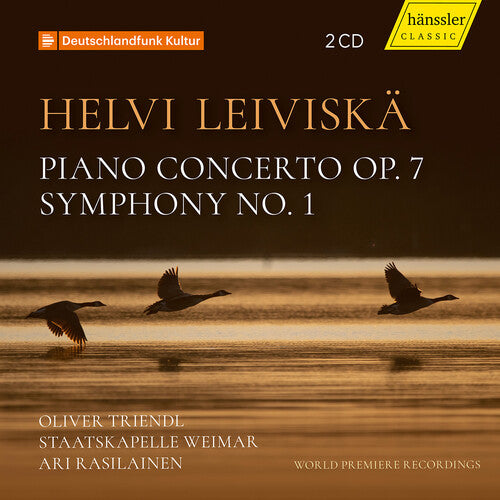
Leiviskä: Piano Concerto; Symphony No. 1 / Triendl, Rasilainen, Staatskapelle Weimar
The piano concerto in D minor was composed between 1931–1935 and premiered on November 23, 1935, by the Helsinki Philharmonic Orchestra conducted by Toivo Haapanen, with Ernst Linko as the soloist. The concerto is preserved only as a piano reduction and instrument parts, but the original score is lost. The piano part contains several cuts and facilitations by the 1935 soloist, while the instrument parts show no omissions. The most probable result was that the orchestra played some passages without the soloist.
For this recording, Leiviskä’s original solo part was restored. Several reviews, mostly under pseudonyms, discussed the symphony after its first performance. The reviews were mostly favorable. It was both praised and criticized for its structure and the inclusion of the waltz motive, and comments of the themes and melodies were also ambiguous. After 1948, the symphony was performed three more times until 1951. After 70 years of silence, the symphony was resurrected in 2022.
Gal: Concertinos
As a young man, the composer Hans Gál witnessed an artistic turning point, for it was during the First World War that late Romanticism met the modern musical era. Everything was in motion. He himself was however critical of many musical initiatives and admitted: “I had too little in common with my contemporaries”. Indeed, the orchestral surges of the Wagnerites were just as alien to him as the atonality of the Second Viennese School championed by Alban Berg and Anton Webern. The pared-down sounds of Neoclassicism and the “new objectivity” of the likes of Paul Hindemith were likewise of little use to Gál. Therefore, in his adherence to tonality and use of sophisticated formal progressions, he created a distinctive style of his own that he steadfastly embraced throughout his life.
J.S. Bach, Busoni, Mason, Nicoara & Sitsky: Polyphonic Dream
Boulanger, Debussy, Francaix & Ravel: Reflexions - French Pi
Vision Bach 9
Vision Bach, Vol. 7
Vision Bach - The First Cantata Year, Vol. 8
Vision Bach, Vol. 5 - The First Cantata Year
Vision Bach, Vol. 6 - The First Cantata Year - BWV 243.1, 40
Vision.Bach, Vol. 2 / Rademann, Gaechinger Cantorey
The Internationale Bachakademie Stuttgart is performing all these cantatas in chronological order exactly 300 years later. The 23 concerts in all are taking place in and around Stuttgart; the refined live recordings are being released in this CD series on the Hänssler Classic label. The performances follow the latest state of Bach research documented in the new 2022 catalogue of Bach’s works BWV 3.
The ensemble of the Bachakademie, the Gaechinger Cantorey, plays under the direction of Hans-Christoph Rademann. For this purpose it comprises the instrumentalists and up to four vocalists per voice, including the soloists (details on the performers via QRCode), all specialists in their field, as Bach himself wished it. This is a vision that only now can be fulfilled in its ideal form. To this day the music will inspire its audience to devotion, challenge them to reflect and make them glad. It addresses questions of faith and comes to terms with particular situations of human life.
Vision Bach, Vol. 3
Vision Bach, Vol. 4 - BWV 138, 95, 48, 162.2, 109, 89 & 163
Vision.Bach, Vol. 1 - The First Cantata Year / Gaechinger Cantorey
The ensemble of the Bachakademie, the Gaechinger Cantorey, plays under the direction of Hans-Christoph Rademann. For this purpose it comprises the instrumentalists and up to four vocalists per voice, including the soloists, all specialists in their field, as Bach himself wished it. This is a vision that only now can be fulfilled in its ideal form. To this day the music will inspire its audience to devotion, challenge them to reflect and make them glad. It addresses questions of faith and comes to terms with particular situations of human life.