Orchestral and Symphonic
8450 products
-
-
-
-
-
-
-
-
-
-
-
-
-
-
-
-
-
-
-
-
-
Emporium - Music of Aldo Lopez-Gavilan
$24.99SACDReference Recordings
Mar 13, 2026RR-154SACD -
Symphonies 5 & 6
$18.99CDCPO
Oct 03, 2025555558-2 -
-
The Royal Danish Brass & Anders Johnsson
William Sterndale Bennett: Complete Piano Concertos
Tchaikovsky: Symphony No. 5 - Schulhoff: Five Pieces / Honeck, Pittsburgh Symphony
Raff: World's End, Judgement, and New World / Meyer, camerata lipsiensis
Towards the end of his life, Joachim Raff began a project that could not have been expected from this artist, who was all too often labeled (and misunderstood) as a prolific writer – an oratorio on the 'World's End, Judgement and New World', as depicted in the vision of St. John. It was a mighty undertaking, with which he wanted to produce an opus magnum to complete his already huge oeuvre – and succeeded in doing so. The musical course of events is focused on the Book with Seven Seals, the apocalypse interwoven with blistering, seemingly inexplicable images, which the composer reveals primarily through the character of John; occasionally an angelic soprano voice joins in, as do grand choral scenes, suggestive orchestral interludes and psalm chants – the last judgement on Joachim Raff puts an end to old prejudices.
Delius: Hassan - Complete Incidental Music / Phillips, Britten Sinfonia
Although he had initially declined the commission, Delius was persuaded to write the incidental music for Hassan by the actor and director Basil Dean in July 1920, for performances he was planning for His Majesty’s Theatre, London, the following year. Much of the music was drafted within a few weeks, and the score would eventually prove one of the greatest successes of Delius’s career. Dean’s plans for the project encountered significant obstacles and delays, however, and he had to commission additional music from Delius to cover the production’s complex scene changes. The London première eventually took place on 20 September 1923 and was a critical sensation.
Flecker’s play is a sinuous double-narrative that intertwines the twin stories of the lovelorn but worldly-wise Hassan, confectioner at the court of the cruel and vindictive Caliph Haroun al Rashid (called Haroun ar Rashid in Flecker’s play), and the young lovers Pervaneh and Rafi, caught up in the aftermath of a failed uprising and condemned to a terrifying and brutally protracted death. In tone and setting, Flecker’s text drew on nineteenth-century English translations of One Thousand and One Nights as well as other heavily fictionalized accounts and travel literature. Very much a product of the racial and class-based attitudes of its time, the play revels in imaginary scenes of a despotic Eastern court and its gruesomely barbaric practices.
Roussel: Violin Sonatas Nos. 1 & 2; String Trio / Bowlin, Docter, Kouzov, Tony Cho
Albert Roussel’s chamber works are relatively unknown, yet he composed a significant body of masterful works. The majestic Violin Sonata No. 1 and the dynamic neo-Classical Violin Sonata No. 2 are coupled with the String Trio, Roussel’s last completed work. Violinist David Bowlin and pianist Tony Cho are both highly regarded soloists and faculty members of Oberlin Conservatory of Music in Ohio, where the album was recorded.
REVIEW:
All three chamber music works are characterized by skillful craftsmanship. The First Sonata is the most extensive of all Roussel's chamber music works and is markedly serious. The Second Violin Sonata is only about half as long, but just as determined. The String Trio, his last completed work, is a striking example of his late style.
The musicians offer the works with an extremely positive commitment that immediately engages the listener. Each of the three pieces has its own character that makes it unmistakable and the performers bring this out skillfully. They form lively narratives in tones that breathe life into the largely unknown in a delightful way. In terms of design, they explore the music in all directions and know how to integrate the details into the overall picture, creating a cohesive form from the first to the last note. We can be grateful that they have taken on the works in such a convincing way.
-- Pizzicato
Bruckner: Symphony No. 7 - Bates: Resurrexit / Honeck, Pittsburgh Symphony
Robert & Clara Schumann: Works for Oboe & Piano / Daniel, Drake
Lloyd: The Piano Works, Solo & Duo
Boccherini: Complete Duets for 2 Violins
Falla: The Three Cornered Hat; Nights in the Gardens of Spai
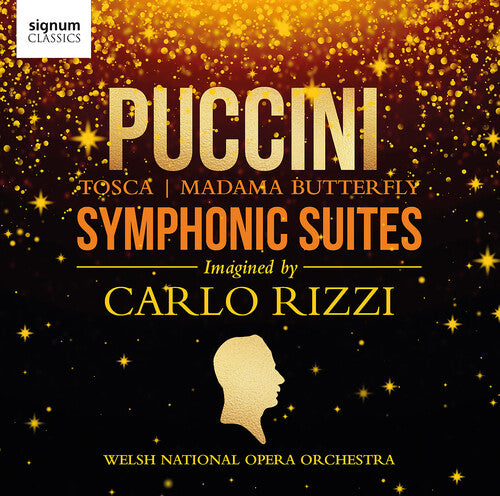
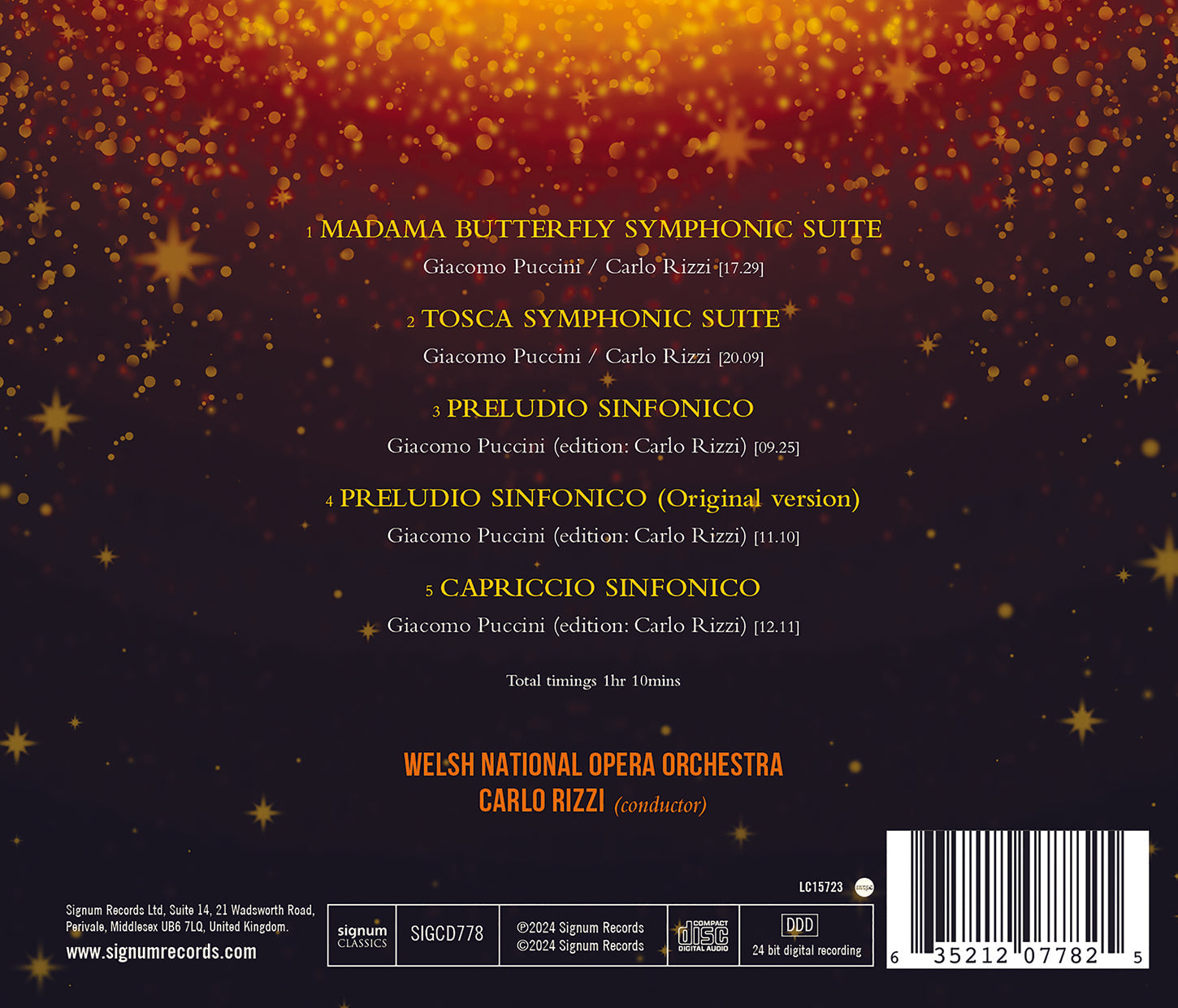
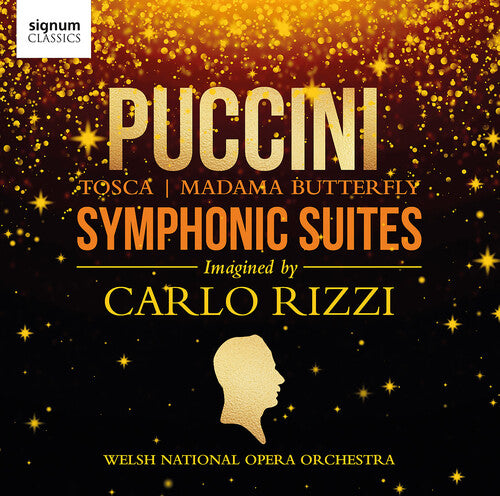
Puccini: Symphonic Suites / Rizzi, Welsh National Opera Orchestra
In Puccini’s anniversary year, Chief Conductor of Welsh National Opera Carlo Rizzi has created new, purely orchestral versions of some of his most well-known and beloved works. Staying pure and faithful to Puccini’s original orchestration without anything added to ‘cover’ any perceivable lack of vocal line the brilliance of Puccini’s Madama Butterfly, Tosca and other works shine through in this album of world premiere recordings.
REVIEW:
This fabulous album of world premiere recordings is just exhilarating from start to finish. I do hope that by the end of the year Maestro Rizzi will give us other orchestral suites, say, from La bohème or Turandot. I am sure they will be welcomed most enthusiastically.
This is an irresistible programme full of shimmering melodies that help us to really discover Puccini’s orchestral mastery which is often overshadowed by the singing and heartwrenching drama of the stories. This exceptionally innovative music that strongly enhances the total mastery of Puccini’s art is not to be missed.
-- Classical Music Daily
Jenkins: The Armed Man (A Mass for Peace) / London Orchestra da Camera
Their third release on Signum Classics, David Temple and Hertfordshire Chorus present Karl Jenkin’s The Armed Man. This is the first recording of the ensemble version of The Armed Man: A Mass for Peace. It was conceived by the composer as an alternative where performances of the full symphonic version are not possible. The work loses none of its impact, retaining the same big sound with driving rhythms, thundering climaxes, fearful moments and tender, memorable melodies. This recording features celebrated mezzo soprano Kathryn Rudge as well as muezzin Osama Kiwan and cellist Jamal Aliyev.
Lloyd: The Piano Concertos
Lloyd: A Litany & A Symphonic Mass
Conceived on a grand scale, Lloyd’s late choral works build fruitfully upon his previous experience in other genres. They share with his operas an innate lyricism, natural affinity with the human voice, and feeling for the long line, while their structural balance, intensive working out of motifs, and rich orchestral palette owe a significant debt to his prolific symphonic output. Chris de Souza, writing in The Independent in 1998, described the Brighton Festival commission of A Symphonic Mass as ‘perhaps the climax’ of Lloyd’s ‘astonishing career’. In his review of the original release of the present recording, Ivan March was moved to describe the Mass as ‘one of the finest pieces of English choral writing of the twentieth century’.
Meetings with Bach
Lloyd: The Violin & Cello Concertos
Coates: Orchestral Works, Vol. 4 / Wilson, BBC Philhamonic
Mignone: Concertos & Concertinos / Thomson, Guerrero, São Paulo Symphony
Santoro: Symphony No. 4 & 6 / Thomson, Goiás Philharmonic
Webenau: Piano Quartet; Cello Sonata; Miniatures
Saint-Saens: Music for Two Pianos
Emporium - Music of Aldo Lopez-Gavilan
Symphonies 5 & 6
Lloyd: The Symphonies Nos. 7-12
Lloyd became a symphonist despite himself. When he was in his twenties he seemed destined to be a composer of operas and it is likely that, had the vicissitudes of war not intervened, he would have written music for the stage exclusively. In an article for the June 1939 issue of the Musical Monthly Record, Harry Farjeon wondered why music for Lloyd was ‘not centred in the concert hall but in the theatre’ and quoted the young composer as being ‘interested only in opera’. There are strong traces in the symphonies of what might have been: the intensely lyrical, cantabile nature of the writing, the intermezzo-like movements, the opera buffa qualities of the finales and the feeling for the long line which runs through those supple and sweeping melodies all denote a born opera composer. In the event his operatic aspirations were cruelly cut short and it is to his courageous, life-affirming twelve symphonies that we must look to chart his development, recovery and eventual triumph.