Performer: Ben Davies
4 products
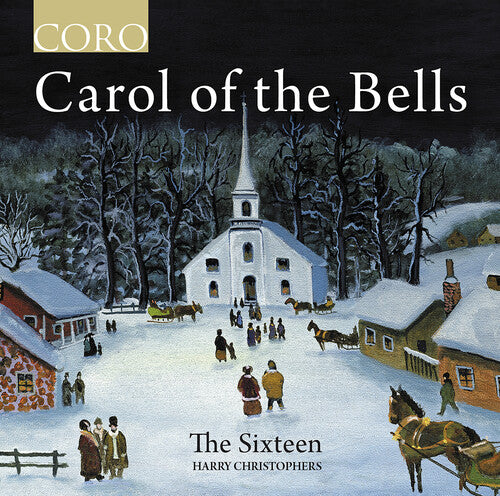
Carol of the Bells / Christophers, The Sixteen
Christophers elegantly mixes traditional carols, 20th century British standards, and contemporary works, and at every turn, there is something new.
The Sixteen contrasts traditional with contemporary in this choral feast of festive music. Bob Chilcott's sumptuous Advent Antiphons based on plainsong melodies anticipate the coming of Christmas and feature alongside Mykola Leontovich's much-loved Carol of the Bells, Richard Rodney Bennett’s stunning Susanni and Eric Whitacre’s shimmering Lux aurumque. Interspersed with the beautiful simplicity of traditional carols, this is a Christmas collection to savor.
Harry Christophers stands among today’s great champions of choral music. In partnership with The Sixteen, the ensemble he founded almost 40 years ago, he has set benchmark standards for the performance of everything from late medieval polyphony to important new works by contemporary composers. His international influence is supported by more than 150 recordings and has been enhanced by his work as Artistic Director of Boston’s Handel and Haydn Society and as guest conductor worldwide. The Sixteen’s soundworld, rich in tonal variety and expressive nuance, reflects Christophers’ determination to create a vibrant choral instrument from the blend of adult professional singers. Under his leadership The Sixteen has established its annual Choral Pilgrimage to cathedrals, churches and other UK venues, created the Sacred Music series for BBC television, and developed an acclaimed period-instrument orchestra. Highlights of their recent work include an Artist Residency at Wigmore Hall, a large-scale tour of Monteverdi’s Vespers of 1610, and the world premiere of James MacMillan’s Symphony No. 5, ‘Le grand Inconnu’; their future projects, meanwhile, comprise a new series devoted to Purcell and an ongoing survey of Handel’s dramatic oratorios.
REVIEW:
The title Carol of the Bells might suggest a greatest Christmas hits collection, and that Ukrainian standard is indeed present, but most of the material is a good deal less familiar. Christophers elegantly mixes traditional carols, 20th century British standards, and contemporary works, and at every turn, there is something new. Some of the traditional carols come from an old Oxford publication; Christophers notes that several, such as All in the Morning, have fallen out of use, and his case for their revival is persuasive. The Sixteen's reading of Eric Whitacre's much-recorded Lux aurumque is top-tier, and from the opening Pilgrim Jesus of Bob Chilcott, the program just flows unusually naturally. This is a holiday album that adds new subjects to the conversation even as it upholds some long traditions.
-- AllMusic.com (James Manheim)
Bach, Handel, Tallis: Agnus Dei / The Sixteen
| There are certain texts which inspire composers more than others but there is one in particular that has provided us with sublime music ever since it appeared centuries ago—the Agnus Dei. This collection from The Sixteen celebrates some of the finest settings from the Renaissance through to the 20th century. Let time stand still whilst listening to the arching melismas and subtle imitation of settings by Tye and Sheppard; delight in the genius of Bach’s setting in the Mass in B minor; and revel in Poulenc’s soaring soprano solo at the opening to his Agnus Dei—so poignant, ethereal and effortlessly beautiful. Of course no collection of this type would be complete without Samuel Barber’s Agnus Dei—probably one of the most famous settings ever written, certainly in recent times, and which rarely leaves a dry eye. From Tallis to Scarlatti and Rubbra to Britten, the variety of settings and musical language featured here is quite astounding and you may even discover an Agnus Dei that you haven’t heard before! |
Purcell: Royal Welcome Songs 4 / Sixteen
Despite only living until the age of 36 Purcell is undoubtedly one of the most remarkable musical geniuses of all time. The Sixteen continues its exploration of his music written for royalty illuminating two more of Purcell's Welcome Songs - Swifter, Isis, swifter flow and The summer's absence unconcerned we bear. In his music for Nathaniel Lee's tragedy Theodosius we witness the young Purcell displaying his playhouse wares in strokes of astonishing versatility some ten years before he made a serious impact as a master of music for the stage.
Bach: Lutheran Masses, Vol. 2
BACH Mass in G , BWV 236. Gott der Herr ist Sonn’ und Schild , BWV 79. Mass in A , BWV 234 • Harry Christophers, cond; The Sixteen • CORO 16120 (73:52 Text and Translation)
A Lutheran Mass consists of just the Kyrie and Gloria, which were still sung in Latin more than a century after the Reformation began. (The Credo was sung in German and the last two movements were optional parts of the service.) Bach wrote five settings, but the Missa 1733 eventually gained the rest of its movements to become the Mass in B Minor. The other four have now been recorded by The Sixteen, though I have not received the other disc containing BWV 233, 235, and another cantata (BWV 102). Cantata 79 was chosen for inclusion because each of these Masses includes one movement that is a parody of the cantata, the “Gloria” of BWV 236 and the “Quoniam” of BWV 234. In fact, 20 of the 24 movements of the four Masses have been drawn from cantatas, reworked in various degrees. In each case the Gloria is divided into five movements with choruses framing the three inner movements. The Masses have not been regarded favorably by commentators, who seem to prefer the music in its original form as cantata movements, and Christophers calls them “seldom heard.” Perhaps they are not often heard in concert, but the “Qui tollis” from BWV 234 was recorded (twice) in the shellac era, and Hans Grischkat recorded an integral set of the four Masses in the earliest days of LP (he added the four settings of the Sanctus, BWV 237 to 240). Beginning around 1970 more sets began to arrive from Helmuth Rilling, Michel Corboz, Martin Flämig, Richard Hickox, and Hans-Martin Linde. After that I lost track, but sets have been more common than recordings of single Masses.
The performances are up to the ensemble’s expected high level. The group, always flexible in makeup, consists here of eight singers and an ensemble of 22 players. The cantata, written for Reformation Sunday of 1725 (the composer’s third cycle of cantatas), is especially well done. It is nice to hear the Mass movement that was singled out in the shellac era, a soprano solo with flute obbligato. The long lines require a voice capable of a sustained legato line, elegantly realized here by Julia Doyle. This is characteristic of the high level that Christophers has brought to this endeavor. I cannot compare this with the competition, but it can stand on its own for a favorable recommendation.
FANFARE: J. F. Weber