Performer: Ben Johnson
8 products
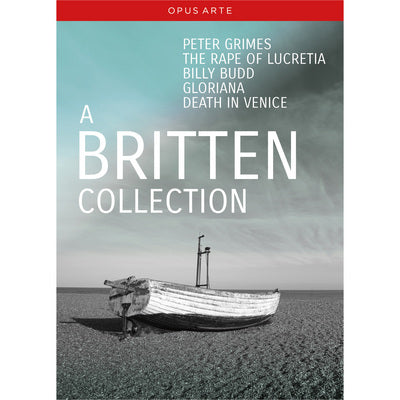
A Britten Collection
Outstanding singers, conductors and directors come together in five diverse but compelling operas by Benjamin Britten. The turbulent, inward fishing community of Peter Grimes is transposed to a merciless 1980s society in Richard Jones' production. An 'outstanding' Sarah Connolly (Guardian) stars in The Rape of Lucretia, navigating the difficult tale with superb poise. Billy Budd is grippingly staged aboard the claustrophobic MS Indomitable, with Jacques Imbrailo portraying the troubled sailor in the 2010 Glyndebourne Festival Opera production by Michael Grandage. More light-hearted is the Royal Opera House staging of Gloriana, penned by Britten to celebrate the Coronation of Queen Elizabeth II and featuring Susan Bullock as the monarch. Finally, Edward Gardner conducts the English National Opera in Deborah Warner's highly acclaimed production of Death in Venice, In which John Graham-Hall stars as the ageing Gustav von Aschenbach. These productions from some of the world's best opera houses offer five masterful performances that are an ideal way to experience Benjamin Britten's music. Filmed in High Definition and recorded in true Surround Sound.
A BRITTEN COLLECTION
(7-DVD Box Set)
PETER GRIMES
Peter Grimes - John Graham Hall
Boy - Francesco Malvuccio
Ellen Orford - Susan Gritton
Captain Balstrode - Christopher Purves
Auntie - Felicity Palmer
First Niece - Ida Falk Winland
Second Niece - Simona Mihai
Bob Boles - Peter Hoare
Swallow - Daniel Okulitch
Mrs. Sedley - Catherine Wyn-Rogers
Rev. Horace Adams - Christopher Gillett
Ned Keene - George von Bergen
Milan La Scala Chorus and Orchestra
Robin Ticciati, conductor
Richard Jones, stage director
Recorded live at the Teatro alla Scala, June 2012
THE RAPE OF LUCRETIA
Lucretia - Sarah Connolly
Tarquinius - Christopher Maltman
Bianca - Catherine Wyn-Rogers
Lucia - Mary Nelson
Junius - Leigh Melrose
Collatinus - Clive Bayley
Female Chorus - Orla Boylan
Male Chorus - John Mark Ainsley
English National Opera Orchestra
Paul Daniel, conductor
David McVicar, stage director
Recorded live at the Aldeburgh Festival, The Maltings, Snape, 2001
BILLY BUDD
Captain Vere - John Mark Ainsley
Billy Budd - Jacques Imbrailo
Claggart - Phillip Ens
Mr. Redburn - Iain Paterson
Mr. Flint - Matthew Rose
Lieutenant Ratcliffe - Darren Jeffery
Red Whiskers - Alasdair Elliott
Donald - John Moore
Dansker - Jeremy White
Novice - Ben Johnson
Squeak - Colin Judson
Bosun - Richard Mosley-Evans
Glyndebourne Chorus
London Philharmonic Orchestra
Mark Elder, conductor
Michael Grandage, stage director
Recorded live at the Glyndebourne Opera House, 8 and 11 June 2010
GLORIANA
Queen Elizabeth I - Susan Bullock
Earl of Essex - Toby Spence
Countess of Essex - Patricia Bardon
Lord Mountjoy - Mark Stone
Lady Rich - Kate Royal
Sir Robert Cecil - Jeremy Carpenter
Sir Walter Raleigh - Clive Bayley
Ballad Singer - Brindley Sherratt
Royal Opera Chorus
Royal Opera House Orchestra
Paul Daniel, conductor
Richard Jones, stage director
Recorded live at the Royal Opera House, June 2013
DEATH IN VENICE
Gustav von Aschenbach - John Graham Hall
Traveller / Elderly Fop / Gondolier / Barber / Hotel Manger / Player / Dionysus - Andrew Shore
Apollo - Tim Mead
Tadzio - Sam Zaldivar
The Polish Mother - Laura Caldow
Two Daughters - Mia Angelina Mather / Xhuliana Shehu
The Governess - Joyce Henderson
Jaschiu - Marcio Teixeira
English National Opera Chorus and Orchestra
Edward Gardner, conductor
Deborah Warner, stage director
Recorded live at the London Coliseum, June 2013
---
Bonus:
- Cast gallery (all)
- Introduction to the opera (Billy Budd, Gloriana)
- Introduction to the designs (Billy Budd)
- Interviews with the cast and crew (Peter Grimes)
- Comments from the director (The Rape of Lucretia)
- Britten’s Aldeburgh (Gloriana)
Picture format: NTSC 16:9 anamorphic
Sound format: DTS 5.1 (all) / + LPCM 2.0 (The Rape of Lucretia, Billy Budd, Gloriana) / + Dolby Digital 2.0 (Peter Grimes, Death in Venice)
Region code: 0 (worldwide)
Audio Language: English
Menu Language: English
Subtitles: English, French, German (all) + Japanese (Peter Grimes, The Rape of Lucretia, Gloriana) + Korean (Death in Venice) / + Spanish (Billy Budd)
Running time: 13 hrs 10 mins (opera) + 27 mins (bonus)
No. of DVDs: 7 (DVD 9)
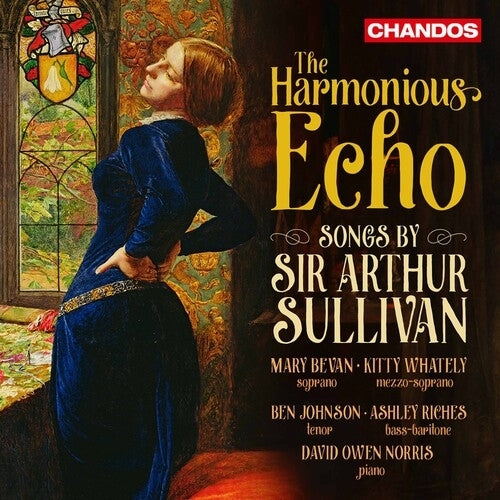
The Harmonious Echo - Songs of Arthur Sullivan / Bevan, Whately, Norris
Although most widely remembered for his operettas in partnership with W.S. Gilbert, Sir Arthur Sullivan was the most famous of all British composers of the nineteenth century. He was revered as a composer of oratorios, and was urged by Queen Victoria to compose a grand opera. The result, Ivanhoe, achieved 155 consecutive performances (in an opera house especially built for it). Achieving equal success in his lifetime, his substantial legacy of songs fell into neglect in the twentieth century, but as this album demonstrates Sullivan's endlessly fertile melodic gifts withstand comparison with those of any other song composer. David Owen Norris and his quartet of outstanding young British singers deliver this fascinating programme with terrific style and panache.
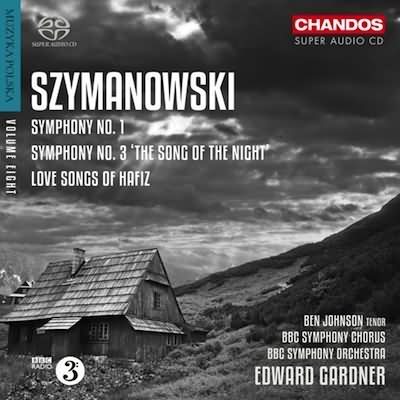
Szymanowski: Symphonies No 1 & 3 / Gardner, BBC SO
Reviews:
The performances are particularly cosmopolitan. And why not? The works here reflect influences from many nationalities. Johnson, whose relatively lean voice (in contrast with the Eastern European sopranos sometimes heard in this piece) is very much responsive to the text's meaning.
– Gramophone
“The BBC Symphony Chorus sings with languid exaltation, yet it is the orchestral detail that impresses most here, right from the still, mystery-laden opening. Gardner conducts with such conviction that it is impossible not to find beauty in [Love Songs'] potentially dense Reger-meets-Scriabin soundworld.
– BBC Music Magazine
Verdi: Macbeth [in English] / Simonetti, Keenlyside, Sherratt, Moore
My feelings about this release are many and complicated. It is the last in the long-running Opera in English series made and compiled by Chandos, as funding from the philanthropic Peter Moore’s Foundation ends this year. If nothing else this is a fine studio recording of Verdi’s Macbeth , well sung and conducted, and special praise goes to Chandos for shoehorning the whole work on to two discs with the ballet and both the 1847 and 1865 endings. If you want Verdi’s youthful masterpiece sung in English, there is no competition (and I doubt there will ever be). But are there many of us who still want Verdi in English? Did we ever?
I am surprised the series lasted as long as it did, to be honest. Studio sets of Italian opera in German ended in the late 1980s (with EMI-Electrola’s La bohème , I believe) and if people sneered that Verdi in German sounded like a grotesque Bavarian drinking song, then singing it in English only makes Joe Green sound like Gilbert and Sullivan. Whereas a theater can argue a case for producing opera in the vernacular (a sense of immediacy, or “relevance” and “inclusivity” if you want to sound like every marketing department), listening to opera in translation on CD only emphasizes two fallacies: The original sound the composer had in mind has gone and diction remains too murky to forgo the printed libretto. Diction is a contentious issue especially with regard to the English National Opera, whose remit was rendered pointless ever since it put in surtitles. In the singers’ defense, the crisp enunciation of the Golden Age was due to the drier acoustic of their former home at Sadler’s Wells. The airy Coliseum is a tough venue to project text, yet in the case of John Tomlinson, Lisa Milne, or even Lesley Garrett, not impossible. Some blame also has to go to the post-Julie Andrews fashion for favoring a smooth, creamy vocal line ahead of clear text. It is a problem that neither the Coliseum nor Chandos ever resolved.
My personal view is that the ties between Chandos and the ENO were not tight enough. The gems of this catalog (The Goodall Ring , Janet Baker’s Massenet and Handel) tend to be live from the theater or, like Richard Hickox’s fabulous Britten recordings, in the original language. What amazes me is how little of the English National Opera there is on DVD, especially when its reputation hangs more on provocative visuals rather than ultimate casts. A phenomenal show like Richard Jones’s technicolor Lulu would be highly desirable on DVD, yet again and again the Peter Moores Foundation thought it better to spend money and record the opera in the studio.
Although the studio sets wisely paired familiar stars with the younger ensemble names, there is a palpable feeling of redundancy when there is no production to link it to. The English National Opera still struggles (although it is currently having a terrific run of hits, be it accessible new opera from Julian Anderson or celebrity-led stagings such as Terry Gilliam’s Benvenuto Cellini ) and with the demise of this series, London’s second opera company has lost yet another media outlet. With its reputation as the youthful, funky alternative to Covent Garden, the English National Opera “Power House” years were at a time when a terrestrial TV station was prepared to broadcast these “sexy,” Postmodern stagings at prime time, so the idea of a corresponding opera set still made sense. I can’t help feeling sad, but times have changed, and Chandos would be better off producing DVDs from the Coliseum.
Anyway, enough of my polemic. How good is this new Macbeth ? With no corresponding audience who want a memory of what they saw, this new studio recording hangs on the star casting of Simon Keenlyside, a welcome but again slightly redundant choice given that you can hear and see his troubled psychopath (in the original Italian) on a fine DVD from Covent Garden conducted by Antonio Pappano. Good as he is here, I do think Keenlyside is best when seen and heard (I don’t say that about many singers) as he is one of opera’s few truly visceral actors. In the cold glare of the studio he gives us a carefully modulated reading, text aware and utterly precise, but just a little bland and unvaried. I do like his creepy chuckle when plotting Banquo’s demise, and such diligence and caution fits the weak and corruptible Thane. Although a bit small for Verdi, his sense of line is good, and he knows his vocal limits, although the tone is getting gritty when pushed.
Nevertheless, he is a good foil to Latonia Moore’s gleaming Lady Macbeth, a fine portrayal which is really worth getting excited about. There’s the she-devil steel to her voice, but she sings her runs cleanly and is equally fearless in the more soaring passages. Her sleepwalking scene, here taken much faster than usual, is especially chilling and fanatical. Only her diction under pressure is wanting, otherwise she holds her own against such luminaries as Fiorenza Cossotto and Shirley Verrett. The rest of the cast are generally fine. In the comfort of the studio Brindley Sharratt’s lightish bass makes enough impression as Banquo, with a very fine account of his aria and Gwyn Hughes Jones is an adequate Macduff. Comprimario roles are well taken, creating a tight, well dramatized ensemble. Having both endings really is a selling point, but I’m personally torn between which I prefer. Verdi’s reworked version has a much better battle but ends with that ludicrous, jaunty, “everything’s fine” chorus, and we lose Macbeth’s chilling final aria, here sung as “I have sinned.” Listeners will find themselves flitting between the two.
Edward Gardner gets superb work from his ENO forces. In the barn-like Coliseum, this young charismatic figurehead has failed to live up to his initial promise, as his readings have often been sluggish, if polished, so this urgent, propulsive account of Macbeth is a real surprise. His tempos go to both extremes, galloping through the jaunty choruses, or giving a deliciously creepy, lugubrious account of the overture, but he understands the overreaching arc of the opera. Ensembles are built up to thrillingly and there is no sense of a static studio run-through. There is good work too from the pickup chorus (The English National Opera chorus must have been busy elsewhere), full of young London-based names, great and good.
Recorded at the Blackheath Halls, the sound is full but cavernous. It lends the production a suitably empty feel for the bleak setting, but some orchestral detail is lost to the closely miked singers. Documentation is up to the usual, thorough standard of this series, with a typically fine essay from Mike Ashman. So, this is worth buying, if only to mark the end of an era. It is a very good performance with a standout Lady Macbeth, but ever so slightly redundant in an age of surtitles, live recording, and at a time when London’s opera in the vernacular struggles to show its face in this harsh multimedia world. It is hard not to feel sad when every new opera set on CD feels like a penultimate nail in the coffin, but this set announces two demises, and I’m not really talking about Verdi’s multiple endings.
FANFARE: Barnaby Rayfield
The Complete Songs of Faure, Vol. 2

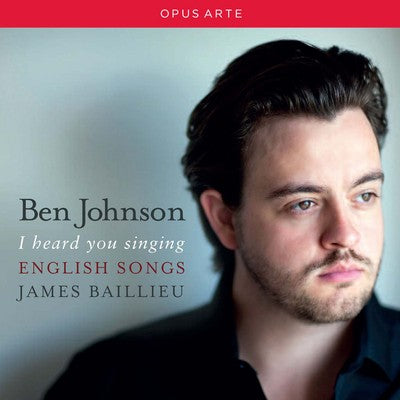
I Heard You Singing / Ben Johnson, James Baillieu
Presenting the major singers of today and the stars of tomorrow, the Rosenblatt Recitals are London's only world-class season of opera recitals.
Britten: Billy Budd / Elder, Ainsley, Ens, Paterson, Imbrailo
Glyndebourne has a proud association with the operas of Benjamin Britten, however until 2010 had never staged Billy Budd. The all-male opera with a libretto co-written by EM Forster, is based on the battle between pure good and blind evil, and is set on a British man-‘o-war ship. Michael Grandage, Artistic Director of the Donmar Warehouse, chose this work to make his long-awaited operatic debut. Sir Mark Elder returned to conduct the production, marking the 100th opera production in his illustrious career.
Benjamin Britten
BILLY BUDD
Captain Vere – John Mark Ainsley
Billy Budd – Jacques Imbrailo
Claggart – Phillip Ens
Mr. Redburn – Iain Paterson
Mr. Flint – Matthew Rose
Lieutenant Ratcliffe – Darren Jeffery
Red Whiskers – Alasdair Elliott
Donald – John Moore
Dansker – Jeremy White
Novice – Ben Johnson
Squeak – Colin Judson
Bosun – Richard Mosley-Evans
The Glyndebourne Chorus
London Philharmonic Orchestra
Mark Elder, conductor
Michael Grandage, stage director
Bonus:
- Introducing Billy Budd
- Designs on Billy Budd
Picture format: NTSC 16:9 Anamorphic
Sound format: LPCM Stereo 2.0 / DTS 5.1
Region code: 0 (worldwide)
Menu language: English
Subtitles: English, French, German, Spanish
Running time: 200 mins
No. of DVDs: 1
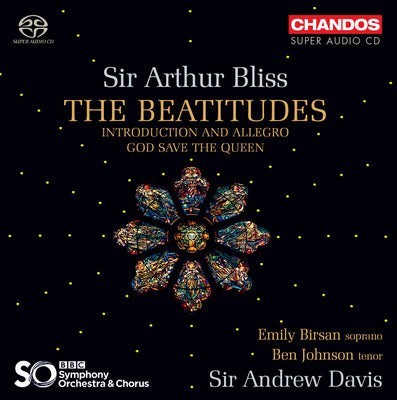
Bliss: The Beatitudes / Birsan, Johnson, Davis, BBC Symphony
-----
REVIEWS:
There is no doubting Sir Andrew Davis’s grasp of The Beatitudes, and he steers a broadly authoritative performance, with incisive, committed playing from the BBC Symphony Orchestra. Davis’s punchy, urgent account of the Introduction and Allegro is useful as this is another piece not easy to come by on record.
– BBC Music Magazine
Andrew Davis clearly has a peculiar empathy for this music and the clean edges of Bliss’s orchestral palette, complemented by some lovely playing from the BBC SO and the two soloists, Emily Birsan and Ben Johnson.
– Gramophone