Performer: Michael McHale
5 products
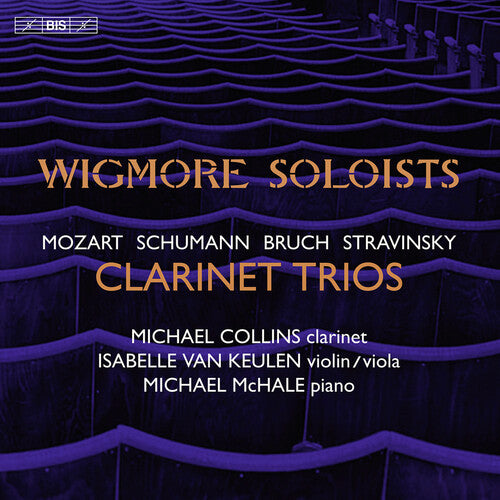
Bruch, Mozart, Schumann & Stravinsky: Clarinet Trios / Wigmore Soloists
As core members of the ensemble Wigmore Soloists, Michael Collins, Isabelle van Keulen and Michael McHale present four works for clarinet trio composed over a period of some 130 years. Mozart’s Kegelstatt Trio was long believed to have been composed during a game of bowling. The writing is reminiscent of a conversation between three friends in which contrasts are not excluded: we hear affection, divergences and even disagreements. This atmosphere of friendly, playful, and sometimes very intimate exchange also pervades Schumann’s Märchenerzählungen (Fairy Tales). While its spirited conviviality might give the impression that this work was the product of idyllic times, it was actually composed during Schumann’s last full year of sanity before his final mental collapse in 1854. There is a similar atmosphere of warm intimacy in Max Bruch’s Eight Pieces, written in 1910. Four of them are presented here, giving not a single hint of the approaching First World War. Based on a Russian folk tale, Stravinsky’s stage work L’Histoire du Soldat may be less good-natured than the preceding works. But the music is wonderfully entertaining, borrowing from various genres, including jazz. The composer’s trio version consist of five movements and has deservedly become his most frequently performed chamber composition.
REVIEW:
As expected, the performances are excellent. The Mozart is wonderfully lyrical; the Stravinsky crackles with energy; and the Schumann and the Bruch have the intensity and heartfelt phrasing the composers require. Collins leads with his clear and resonant timbre, dazzling fingers and articulation, and superb musicianship; and McHale lends splendid tone, touch, technique, and sensitivity. Van Keulen demonstrates terrific versatility all through, from warm contralto utterances to spunky fiddle playing, though sometimes her viola lines are a little thin and scrappy. Even so, the profound devotion to each score makes this album very worthwhile.
-- American Record Guide
The Key Collection: 3 Centuries of Rare Keyboard Gems
The Grand Piano label is dedicated to exploring undiscovered piano repertoire by unfamiliar composers, producing high quality, often world premiere recordings, performed by virtuoso authorities in their chosen field. Marking the label's 5th anniversary, this collection is a comprehensive guide through the history of keyboard music from the invention of the fortepiano to today's living composer's, as well as taking the listener on a musical adventure thorugh a geographically global range of rare musical gems, with all of their new and exciting sounds and fresh perspectives.
Portraits / McGill-McHale Trio
The McGill/McHale Trio, an international all-star ensemble of flute, clarinet, and piano, makes its recording debut with Portraits, featuring world-premiere recordings of new compositions and arrangements for this captivating combination of instruments. Trio flutist Demarre McGill, a Chicago native, has served as principal flute of the Metropolitan Opera Orchestra and the Dallas, Seattle, and San Diego Symphony Orchestras. His brother, Anthony McGill, is principal clarinet of the New York Philharmonic and former principal of the Met Orchestra. Michael McHale, one of Ireland's leading pianists, has performed as soloist with the Minnesota, Halle, Moscow, and Bournemouth Symphony Orchestras and all five of Ireland's major orchestras. The ''title track'', Valerie Coleman's Portraits of Langston is a six-movement suite inspired by Langston Hughe's poetry. Oscar-winning actor Mahershala Ali reads a Hughes poem before each movement. Chris Rogerson's ''A Fish Will Rise'' evokes rippling water and sparkling sunlight. Pianist McHale's arrangement of Rachmaninov's ''Vocalise'' splits the original vocal line between flute and clarinet, supported by Rachmaninov's original piano accompaniment. Paul Schoenfield's spirited ''Sonatina for Flute, Clarinet and Piano'' springs surprises on the Charleston, rag, and jig dance forms. Philip Hammond's ''The Lamentation of Owen O'Neil'' and McHale's arrangement of ''Parade'' channels the spirit and energy of electronic pop.
REVIEWS:
The Trio has masterfully blended the narrated and purely instrumental tracks of the recording. We also believe the three musicians succeed in unifying a wide array of contemporary compositions into a coherent program which has a great deal to offer the listener.
– AfriClassical
The concert is beautifully performed, from simple folk tunes to wistful Americana and from playful jazz to thunderous modernism. The McGill brothers boast stunningly clear and resonant woodwind timbres, exquisite balance and blend, sensitive phrasing, and expert technique; and McHale matches them with superb touch, voicing, pedal work, and musical instinct, including a good sense of when to go for broke.
– American Record Guide
The Lyrical Clarinet Vol. 2 / Collins, Mchale
This new collection of pieces for Lyrical Clarinet follows Michael Collins’ first volume which included sonatas by Poulenc and Saint-Saens. This varied repertoire ranges from short, cheerful numbers to romantic and enchanting, and brilliantly displays the incredible technical and dynamic range of the instrument. Clarinetist Michael Collins has won multiple awards for his performance, namely the Royal Philharmonic Society’s Instrumentalist of the Year Award in 2007. He has also become increasingly regarded as a conductor, and currently serves as Principal Conductor of the City of London Sinfonia.
Reger: Clarinet Sonatas / McHale, Collins
The legend goes that Reger walked in on a private performance of one of Brahms’s clarinet sonatas opus 120, and was so taken by the work that he decided to compose two himself. Within a few months, the fruits of his labour resulted in his opus 49, a glorious evocation of the romantic idiom. But, as I stated in my review of Claudio Conti’s recording for Brilliant (95258), these three sonatas are individualistic works, tempered by the later romantic tradition. In that review, I felt that the tempi were a little too brisk; in my opinion the performance of Janet Hilton and Jakob Fichert for Naxos (8.572173) was my preferred recording. So I intend to compare this new recording with the latter.
My favourite among Reger’s clarinet sonatas is the B flat Major Op. 107. Unlike Hilton and Fichert, who present the three sonatas in order, Collins and McHale choose to make a bold statement by presenting this sonata first. In this sonata, and indeed throughout this disc, Collins and McHale choose a tempo which forms a happy medium between the Brilliant and the Naxos recordings. They can present the beauty of Hilton’s performance and some of the excitement of Conti’s. In Collins’s hands the work comes alive. It lives up to Reger’s description of the sonata as “a very light and friendly piece, not long at all, so that the character of the sound of the wind instrument does not tire”.
Collins and McHale’s performance of the two Sonatas Op. 49 are equally as good. Again, their tempo choice helps bring out the gaiety of the A flat Major, and the beauty and tenderness of the F sharp minor. These are very fine works. In Collins and McHale’s hand they are given a new lease of life. I now feel that there is little to choose between the three sonatas. I can see why they chose to present the sonatas in the order that they did. In these two sonatas Collins and McHale shine. Their performance quickly became my preferred recording of the few I have and I cannot see it being bettered soon.
Throughout this new recording, Collins and McHale are excellent. As already stated, their choice of tempi is an important factor. Not only does it help the listener get to the spirit of these three sonatas. It also means that their articulation of particular phrases and the changes in speed that these require are sharper and more precise. They are helped by the acoustic and the recorded sound, both excellent—as are Nicholas Marston’s booklet notes.
– MusicWeb International (Stuart Sillitoe)