Russell Malone is one of the most commanding and versatile guitarist performing today. His newest release LIVE AT JAZZ STANDARD features Martin Bejerano, Tassili Bond and Jonathan Blake. The lineup for LIVE AT JAZZ STANDARD includes a number of original compositions and several classics including "Blue Daniel" and "Heartstrings". Malone's blues-infused encore highlights the exceptional set of music.
2022 release. Send For Me is a follow up to Russell's 2019 release Alone Together, which received a Grammy nomination for Best Jazz Vocal Album, and landed on the JazzWeek year-end radio chart as the #1 most played album. Send For Me features a baker's dozen of newly recorded tunes on her eighth album as a leader, meeting a simple exacting standard. "Songs that inspire or touch me in some way. When I find a song I like, it haunts me until I learn it." Her mission is finding songs that you might not have heard but deserve attention. Russell's deep connection to her chosen material is part of a calling. As the daughter of pioneering and legendary musicians, pianist/orchestra leader/composer/arranger Luis Russell, and bassist/guitarist/vocalist Carline Ray, Catherine Russell was born into jazz royalty. In culling material for her new album from the likes of Billie Holiday, Nat King Cole, Luis Russell, Betty Carter, Kay Starr, Joe Liggins, Earl King, Jack Teagarden, Helen Humes, Frank Sinatra, Dakota Staton, Henry Red Allen, and Louis Armstrong, the vocalist swims in familiar waters. She sings a language that comes naturally, furthering a profound legacy.
This superb recording features a reunion of two of jazz's finest - tenor-saxophonist Coleman Hawkins and clarinetist Pee Wee Russell. At the time of this session, the two had not been on a recording date together in 32 years. Here they revisit "If Could Be With You One Hour", a song they first recorded in a classic version back in 1929.
These 22 rare tracks capture a creative highpoint in Pee Wee Russell's unique career. Features Lionel Hampton, Fats Waller, Eddie Condon, Jack Teagarden and others. Digitally restored, this material makes it's first time ever appearance on CD. Deluxe booklet features rare photos.
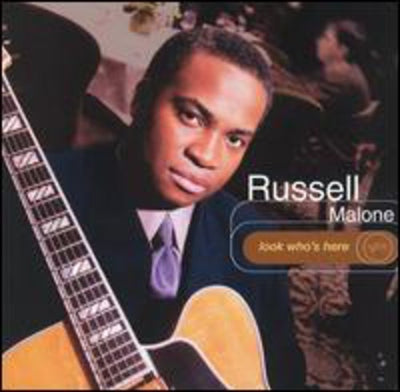
Following up the criticall-acclaimed Impulse release "Sweet Georgia Peach," guitarist Malone paints an enlightening musical self-portrait with his debut release under the Verve imprint. This new outing captures every bit of the soulfulness, warmth, and, above all, guitar mastery for which he is internationally known.
2024 release. Dot Time Records is thrilled to announce the release of My Ideal, a breathtaking album from acclaimed Grammy-nominated vocalist Catherine Russell and prodigious pianist Sean Mason. This modern classic marks a significant milestone in both artists' careers, capturing a powerful and intimate musical dialogue. My Ideal is a very special project even in the very rarified strata where Catherine works; this is not only her first complete set of voice-and-piano duets, but her partner on this project is a remarkable piano prodigy whose technical skill is only rivaled by his soulfulness. This collaboration represents a unique convergence of experience and youthful virtuosity, offering a fresh yet timeless sound. "Singing with the great pianist Sean Mason allows for the freedom to have fun and be in the moment. We understand each other," says Catherine Russell. This synergy is palpable throughout My Ideal, as the duo effortlessly blend their talents to create a compelling musical experience. My Ideal tells the history of the jazz art form, from the early beginnings of the music with homages to James P. Johnson and Fats Waller, to the confluence of jazz and popular music with tributes to Ray Charles and Frank Sinatra. The adept duo imbue each piece with nuanced authenticity, sincerity and originality.
Colin Hancock's Jazz Hounds ft. Catherine Russell - Cat & the Hounds - "With Catherine and I both having Caribbean roots and ties to Panama, the story of the Panama Limited had to make an appearance somewhere in this project. Add to that the fact that Luis Russell, Catherine's dad, was present on the original recording of this tune and that I am a scholar on Ada Brown, the tune's original vocalist, and you have the perfect storm for the blues."
EARLE BROWN—A LIFE IN MUSIC—VOL. I • Paul Price, cond;1–3,5 John Cage, cond;4,7 Manhattan Percussion Ens;1–8 Christoph Caskel (perc);9–11 Aloys Kontarsky (pn, wood blocks);10 Bernhard Kontarsky (cel, cymbals);10 David Tudor (pn);11 AMM;12 Musica Elettronica Viva13 • WERGO 6928 (3 CDs: 116:15)
Though born in Massachusetts, Earle Brown was a young composer living in Denver in 1950 when Merce Cunningham and John Cage came to perform and lecture at the McLean School. His wife at that time, Carolyn Rice Brown, was a dancer who attended Cunningham’s master class. Almost immediately, the four realized they had much in common, and Cage persuaded the Browns to move to New York in 1951—Carolyn was one of the founding members of Merce Cunningham’s dance company (where she was to remain for 20 years as a featured performer) and Earle eventually collaborated with Cage at the Project for Music for Magnetic Tape. This experience with electronic equipment allowed Brown to work as a recording engineer—recording and editing pop, jazz, and classical music—for Capitol Records from 1955–1960. In 1960 he began producing records for Bob Shad’s Time label, having convinced the well-established jazz and pop maven to allow him to record a series of avant-garde compositions. The first of these remarkable documents was issued on Time, but after that label folded in 1966, Brown continued to produce the series for Shad’s larger Mainstream imprint. All 18 of these recordings were reissued on LP in the 1970s, but have not appeared on CD until now.
Brown’s broad knowledge of new music, along with his professional connections, resulted in a groundbreaking collection of music that had been largely unheard—indeed, in some cases, all but unknown—at the time. Represented, of course, were Brown himself and his friends in the “New York School”—Cage, Morton Feldman, Christian Wolff, and their foremost interpreter, pianist David Tudor. But Brown also included what was for the most part the first American documentation of composers from Europe like Nono, Berio, Maderna, Scelsi, and Boulez; Maxwell Davies and Birtwistle from London; an album devoted to South American composers; and one featuring the next, post-Cage generation of American radicals, Ashley, Mumma, Lucier, and Behrman. Equally important, however, was Brown’s understanding that this unfamiliar, often shocking new music needed the best possible performances in order to convince listeners of its merits, as well as the best possible sound quality to capture its tonal subtleties and extravagances. By recording performers like Tudor and pianist Yuji Takahashi, flutist Severino Gazzelloni, violinist Paul Zukofsky, vocalist Cathy Berberian, and experienced ensembles often under the direction of the composers themselves, Brown helped to establish a tradition of new-music performance styles and techniques that would stand as a model for subsequent generations of interpreters.
This long-awaited release (collectors have been paying big bucks for the precious Time and Mainstream LPs) initiates Wergo’s two-year schedule of the reissue of all 18 albums, in six three-CD sets. Eagle-eyed readers will have noticed that the total playing time listed above averages out to less than 40 minutes per CD. Wergo has decided to maintain the integrity of the original releases’ production by reproducing the cover art, reprinting the original liner notes, and yes, limiting each CD to a single LP’s worth of music. Their digitalization of the original sound quality, which was excellent to begin with, has been handled with care (although some lingering tape hiss is inevitable)—the proof is the first CD, where the percussion timbres are clean, crisp, and vivid. I did notice one new production error in this CD release—on disc 3, the two pieces have been mislabeled; AMM is the first piece on the disc, and Spacecraft the second, not the other way around, as listed on the CD cover and in the booklet.
What about the music, then? The first disc, “Concert Percussion for Orchestra,” reminds us that adventurous composers, looking for new sounds and timbres in the days before electronics, turned to percussion in order to expand the available palette of colors, and with them began to explore the rhythmic intricacies of other, non-classical, ethnic musics. Cuban composer Amadeo Roldán’s works for percussion ensemble date from 1930, William Russell’s Three Dance Movements and Three Cuban Pieces from later that same decade. Henry Cowell’s Ostinato pianissimo (1934) has become one of the repertoire’s classics. John Cage plays the prepared piano solos in his Amores (1943). Though for the most part concise exercises in unusual rhythms and timbres, many of which sound commonplace and simplified today, these pieces nevertheless were highly influential for their time, and display a charming sense of exploration, atmosphere, and, yes, even swing.
The Stockhausen and Kagel works on the second disc were hot off the press in 1960, and they receive gripping readings. The solo percussion score Zyklus, once so jolting, now has an almost meditative feel to it, and this version of Refrain emphasizes its delicacy and spontaneity, offering a constellation of Webernesque detail. Mauricio Kagel’s Transición II surveys a wider range of attacks and rhythms, with previously recorded and live taped components increasing the complexity of tonal relationships. Tudor and percussionist Caskel (who works directly inside the piano) pay sharp attention to the task at hand, briskly aligning the aleatoric elements of the score. (Alternate versions may be heard from the ensemble L’Art pour L’Art on the cpo label and Aldo Orvieto, Dmitri Fiorin, and Alvise Vidolin on Mode.)
Finally, we have what is probably the most unusual album released in the series, recordings of group improvisations by the British band AMM (which at this time included composer Cornelius Cardew) and the Rome-based group of American expatriates including Frederic Rzewski, Alvin Curran, and Richard Teitelbaum (and one Hungarian, Ivan Vandor), Musica Elettronica Viva. Both ensembles featured live electronics as a major part of their instrumental arsenal, and both gleefully embraced noise as a confrontational device and a link to the ritualistic musical activities that, without benefit of a predetermined compositional design, produced their truly spontaneous structures. Drones—frictional, layered, and ambient—are the source for much of their aural environment, and acoustic instruments—pianos, saxophones, even cello—are played with pseudo-electronic timbres or mixed into the fray so as to be all but unrecognizable.
AMM’s contribution is an edited excerpt from a longer, live performance (which may be heard in its entirety on “The Crypt—12 June 1968: The Complete Session” on the Matchless label). In addition, silences of various lengths were edited into the performance after the fact, interrupting the music according to some unexplained, Cagean provocation. Interestingly, these silences still contain several small tics and pops, suggesting that rather than edit in fresh, totally silent digital silence, Wergo decided to use the analog silence taken from an LP (the master tapes may have been unavailable), thus once again maintaining the integrity (albeit flawed) of the original release. MEV’s live activity, Spacecraft, was an open improvisation that they performed a number of times in their early years—other versions may be found on the Alga Marghen label, and in the valuable four-CD set “MEV 40” on New World. The AMM and MEV improvisations have less-than-optimal sound, and are difficult to listen to without flinching, but as examples of controlled chaos they project a raw, immediate catharsis unmatched by any other music of their time. Earle Brown’s decision to include them as representation of the cutting-edge of new music’s new repertoire, giving improvisation a platform equal with composition, was gutsy and prophetic. The remaining releases in this most welcome series will afford further examples of the breadth of Brown’s vision.
Tried & True is music with a big, beating heart. Two first cousins and sons of two members of the Nitty Gritty Dirt Band, HM play country music with electric and rock influence. They are also joined onstage by former "Hot Band" member, Albert Lee. This DVD-Audio/Video disc contains bonus features including 40 minutes of additional live concert video, small club performances and a bus trip to Vegas.
Vaughan Williams: Symphonies 7 & 8 / Bakels, Bournemouth So
Naxos
CD
$19.99Jun 30, 1998
Naxos has very intelligently included the spoken superscriptions for each movement of the "Antartica" at the end of the disc, so those who want them (a minority, to be sure) can program them in. Kees Bakels and his Bournemouth forces lead excellent performances of both works, and it's particularly gratifying to be able to report that both the conductor and the recording engineers seems to have taken pains to ensure that the special percussion effects in both symphonies are well caught. Of course, the music itself is splendid. The Sinfonia antartica (a.k.a. the film score to Scott of the Antarctic) takes up where Holst's Planets left off, and fans of that work will love this icy-sounding sequel. The Eighth Symphony, with its fabulous finale employing "all the 'phones and 'spiels known to the composer," deserves to be much more popular than it is. That last movement is a humdinger! So while you're waiting to hear these two masterworks of the composer's old age in a live concert, why not shell out a few bucks and enjoy them at home? --David Hurwitz, ClassicsToday.com
Call Me Madam / Dinah Shore & Original Broadway Cast
RCA
CD
$17.99Jul 31, 2012
Call Me Madam is a pure adrenalin shot of circa-1950 zeitgeist, a screwball comedy pulled from the headlines with impeccable timing. The show was conceived as a vehicle for Ethel Merman, at that moment arguably the biggest star in Broadway musicals, and reunited her with Irving Berlin, composer/lyricist of her blockbuster 1946 hit Annie Get Your Gun. A red-hot ticket when it opened on October 12, 1950 at the Imperial Theatre, Call Me Madam proved to be the blockbuster Merman and Berlin hoped for. They were in the very best of hands: George Abbott directed, Jerome Robbins choreographed and the casting was supervised by Abbott’s new young assistant, Harold Prince. The cast included an Oscar-winning leading man (Paul Lukas), the bright new presence of Russell Nype as Mrs. Adams’s lovelorn attaché and – as Merman’s underutilized understudy – the young Elaine Stritch. The capitalization for the entire show came from NBC and its record division, RCA Victor. Unfortunately a big problem loomed as Merman was under contract to Decca Records who refused to release her to star in what was sure to be a hit record. Ultimately, RCA Victor turned to one of its hottest singers, Dinah Shore, to step into Merman’s shoes for the original cast recording. It rose to No. 6 on the Billboard album chart but by the late 1950s, it had been deleted from the catalog. The recording got an LP reissue in 1977 but it disappeared again until this Masterworks Broadway release, and is the first and only authorized CD version of RCA Victor’s Call Me Madam digitally remastered from the original tapes.
Voyage is the newest release from the Cincinnati Pops conducted by John Morris Russell and features the world premiere recording of the title track by Academy Award-winning composer Michael Giacchino, written to commemorate the 50th anniversary of the Apollo 11 Moon Landing and the historic “giant leap for mankind.” This 96th Cincinnati Pops album draws inspiration from the stars and also features selections from Holst’s The Planets, as well as science fiction favorites from both the big and small screens.
Jazz icon, pianist and composer Dave Brubeck wrote this cantata in an attempt to heal the rift between the Jewish people and American blacks that emerged after the assassination of Martin Luther King, Jr. in 1968. Based on biblical and Hebrew liturgical texts, together with quotations from Dr. King’s speeches, Negro spirituals and the Jewish sage Hillel, with lyrics by Brubeck’s wife Iola, it was intended to underscore and resurrect the spiritual parallels between Jews and blacks. The work draws on their shared history of enslavement and dispersion, their ongoing quest for social justice, and similarities in their forms of musical expression.
Click here to view all available releases in the Milken Archive Series at ArkivMusic.
American Originals: 1918 is the newest release from the Cincinnati Pops conducted by John Morris Russell and features iconic American songs interpreted by a diverse array of acclaimed musical collaborators including MacArthur “Genius” Fellow Rhiannon Giddens, Grammy-winning Steep Canyon Rangers, Americana artist Pokey LaFarge, and tap dancer Robyn Watson. The follow-up to the Pops’ innovative American Originals album, American Originals: 1918 reimagines songs first brought to life in the first third of the 20th century as well as American popular standards from World War I and some of the first well-known tunes from the advent of jazz. The 95th Cincinnati Pops album includes fresh new renditions of “Over There,” “God Bless America,” “Swing Along,” “Memphis Blues,” “I’m Just Wild About Harry,” “How Ya Gonna Keep ‘em Down on the Farm,” and “I Ain’t Got Nobody,” among many other classic tunes. In addition, the collection includes the world premiere of Grammy-nominated composer Peter Boyer’s “In the Cause of the Free,” commissioned by the Pops to commemorate the 100th Anniversary of the end of World War I.
Home For The Holidays / Russell, Cincinnati Pops Orchestra
Fanfare Cincinnati
CD
$9.49$18.99Save 50%Sep 25, 2012
With over 10 million recordings sold around the world, no orchestra has had more albums on the Billboard charts than the Cincinnati Pops Orchestra! Home for the Holidays is the culmination of a year-long celebration of the inaugural season of Pops Conductor John Morris Russell. Featuring an exceptionally diverse collection of Yuletide classics including "Deck the Halls," "O Holy Night" with powerhouse tenor Rodrick Dixon, and New York Voices' jazzy twist on "Santa Claus is Comin' to Town," alongside Gounod's "Ave Maria" and "Yes, Virginia, There is a Santa Claus," which cleverly combines Edward Elgar's "Nimrod" from Enigma Variations with text from an 1897 editorial in the New York Sun, narrated by Broadway star Brian Stokes Mitchell expressing the child-like wonderment felt during the holiday season.
Langston Hughes (1902–67) was an American poet, novelist, social activist and playwright whose work showcased the dignity and beauty in ordinary black life. His African-American themes made him a primary contributor to the Harlem Renaissance of the 1920s. The hours he spent in Harlem clubs affected his work, making him one of the innovators of “Jazz Poetry.” Hughes’ poetry is still powerful and contemporary today. The Langston Hughes Project came from jazz guitarist Larry Simon, who is the founder of JazzMouth, unique festival in Portsmouth, New Hampshire that combines jazz and spontaneous music with readings by some of the finest poets. Hughes’ texts are brought to life by the rich, soulful delivery of Eric Mingus, son of Charles Mingus. For some years he worked as a session musician and backing singer, playing on dates with artists such as Carla Bley, Bobby McFerrin and Karen Mantler. He has also performed with the Mingus Big Band, Elliott Sharp’s Terraplane, Todd Rundgren, Elvis Costello, Nick Cave, Catherine Sikora and Levon Helm, and a featured performer in many of Hal Willner’s projects. Simon also brought David Amram — composer, conductor, multi-instrumentalist, and author — to the project. As a classical composer and performer, his integration of jazz, folk and world music led him to work with Dizzy Gillespie, Lionel Hampton, Willie Nelson, Charles Mingus, Levon Helm and Betty Carter. Amram has composed more than 100 orchestral and chamber music works, and written many scores for Broadway theater and film, including the classic scores for the films Splendor in The Grass and The Manchurian Candidate. Amram collaborated with Hughes on the cantata "Let us Remember." Importantly, in the 1950s Amram collaborated in clubs with Langston Hughes and Jack Kerouac on the spontaneous creation of words and music which came to be known as “jazz/poetry.” And jazz/poetry is what “Langston Hughes: The Dream Keeper” is. Half of the poems find Mingus with Amram on piano, as a duo. The instrumentally varied balance of the album are Mingus duos with electric guitar or Hammond organ; with woodwinds and percussion or larger ensembles.
Brahms' fascination with music of the 16th to the 18th centuries was nurtured during his appointment in Vienna as conductor of the Singakademie. His own choral compositions had gradually moved from an almost pastiche Renaissance style towards a fully mature, Romantic approach, culminating in his large-scale choral masterpiece Ein deutsches Requiem. This performance is sung in a new English translation prepared by Lara Hoggard that fits the original German declamation and with the piano four-hands accompaniment written by Brahms himself.
This superb recording features a reunion of two of jazz's finest - tenor-saxophonist Coleman Hawkins and clarinetist Pee Wee Russell. At the time of this session, the two had not been on a recording date together in 32 years. Here they revisit "If Could Be With You One Hour", a song they first recorded in a classic version back in 1929.