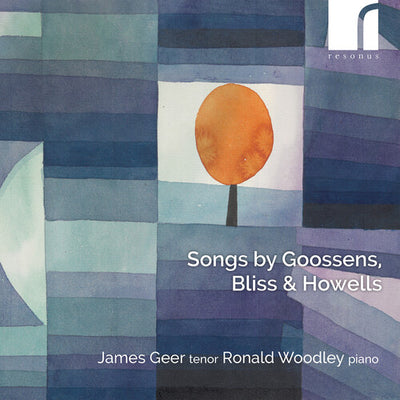
In the years immediately leading up to the First World War the Royal College of Music in London welcomed three of the most brilliant young musicians of their generation as students: Eugene Goossens, Arthur Bliss, and Herbert Howells. Close friends as they became, their musical personalities nevertheless evolved over the following years as notably distinct from one another. This disc brings something of their individual characteristics to the fore through a selection of their rarely performed solo songs, including four first recordings and three unpublished works. The songs are performed by tenor James Geer and pianist Ronald Woodley in this continuation of their long-standing partnership.
The publication Der Seele Innerstes ward offenbar on Walther von Goethe brings together exclusively world premiere recordings with a comprehensive accompanying book (edited by Ulf Bastlein and Ariane Ludwig). The compositions of Johann Wolfgang von Goethe's eldest, almost completely forgotten grandson are characterised by a wide stylistic range: from delicate 'miniatures en musique' through sarcastic and ironic scenes to sweeping ballads. A pupil of Felix Mendelssohn Bartholdy and Carl Loewe, he set to music, amongst other things, texts by his grandfather, by Heinrich Heine, by poets largely unknown today, and also his own poems. Compositionally, he forged his own, often experimental path. Central to his work is his aesthetic of inwardness. Some elements (harmonic breaks, surprising modulations) sound almost 'modern'. Goethe repeatedly explores the boundaries between sung melody and declamatory speech. As he conceives the song in terms of vocal melody, many of his songs are instantly memorable. The performers are Ulf Bastlein (baritone) and Silke Evers (soprano). Their musical partners at the grand pianos - five historical instruments, including the Goethe family's Nannette Streicher grand piano - are Christoph Ritter and Hedayet Jonas Djeddikar. Contributions on biographical, musical and cultural-historical aspects were written by, amongst others, Ulf Bastlein, Dieter Borchmeyer, Jochen Golz, Peter Gülke, Christian Hain, Karsten Hein and Ariane Ludwig.
Fernando Lopes Graca: Songs to Poetic and Folk Texts
Toccata
CD
$20.99Nov 06, 2026
The Portuguese composer Fernando Lopes Graca (1906-94) was one of the thousands of victims of Salazar's right-wing dictatorship: his works were confiscated, and he was prohibited from teaching. He responded in music, with a prolific output inspired by both folk-music and the evolving musical language of his European contemporaries, marrying tradition and modernism. His songs for voice and piano set texts from both popular and 'high' culture, unified by his ardent humanist outlook and the dignified manner in which he expressed it.
Evelyn Converse (Connie's mother): Is it sweet little ditties or is it modernistic? Connie Converse: It's got everything in it. I'm the one in the smoky gray button-down, gently disentombing a viola from it's case in the gauzy, late morning light illuminating this inviting Northcenter studio. In the freelance Classical (and Classical-adjacent) world, projects and their attendant rehearsals encompass the vibes and caliber spectrum, but managing the contents of one's tear ducts is not generally a required qualification. Maybe you can try to get word to the violist, currently encamping himself and his stand beneath a towering harp. That unwitting sap-the one who at this moment only knows that the pieces he's playing were originally penned by someone with an enticingly alliterative moniker-has no idea that this music is about to occupy a good deal of the rent-free space available in his head and heart long after the live broadcast, the 'gig,' wraps. It is, I'm afraid, a decidedly common reaction to an oeuvre of unquestionably uncommon music for those that encounter it some seventy-plus years since it was meticulously penned. Whether this is your first orbit or you already count yourself amongst the members of the How Sad, How Lovely devout-Connie's modest and also astonishing kitchen table recordings, most recently reissued by her fellow Michiganders Third Man Records-the sounds currently spinning through your synapses here offer an entirely unique perspective of an artist who not only scooped Dylan on coaxing folk music from the universal to the personal by a literal decade, but indeed ventured into a territory of art song he will never quite access. Her Only Light is a more dimensional, more expansive view of Connie Converse, a composer-performer-pacifist-scholar-activist who, like the story of her enigmatic departure, deserves a telling beyond an easy headline. Some orientation is necessary, though. Elizabeth Eaton Converse was valedictorian of her high school, a scholarship recipient at Mount Holyoke College, a songwriting hopeful in Harlem, and the Co-Editor of the Journal of Conflict Resolution (Center for Research on Conflict Resolution) at the University of Michigan. Was she, as is editorialized about so many of my favorite creators, maybe a little too smart to be happy? A more accurate assessment arrives by way of her nephew Tim Converse, who generously shared with me, 'I think that she saw so clearly the way things should be that she was constantly disappointed by how things actually were.' This was certainly the case regarding her years in New York, having absconded early from Mount Holyoke to pursue her songwriting and singing aspirations. Consider that the 1950's Greenwich Village folk revival-in full swing as she composed-for all it's posturing about political revolution and working-class authenticity, was structurally about as progressive as a debutante ball. Add to that the fact the (then) recording industry's almost unshakable insistence on genre conformity and, in the case of female performers, sexual magnetism, and it doesn't take much to understand how a path-carving artist more engrossed in her compositional brilliance than her appearance failed to break through to the monoculture. Though history is of course littered with unrecognized genius, this was actually not precisely the case for Converse. She was featured on CBS's The Morning Show hosted by no less than Walter Cronkite, and was championed by animator Gene Dietch who, in addition to her own efforts, we have to thank for the recordings found on How Sad, How Lovely. At this inflection point, when she seemed poised to, well, make it, Connie Converse pivoted her writing toward a far less marketable but perhaps more adventurous corner of musicmaking: 'art song.' If Connie's 'Guitar Songs' (singer-songwriter, folk-oriented) were slow to gain traction, what hopes could her 'Piano Songs' (art song, harmonically enterprising) possibly have in such an inhospitable industry? Jesus. We're halfway through these liner notes and I haven't even introduced you to the two remarkable interpreters of said songs-the thoughtful Converse evangelists behind Her Only Light: arranger Ronnie Kuller and vocalist Emmy Bean. Almost immediately in that aforementioned rehearsal, which I should clarify was in service of a live performance on WFMT after this album was mixed and mastered, I was scheming how I might stay in proximity to Ronnie's dextrous, insightful writing and Emmy's lustrous, utterly persuasive phrasing in the years to come. Like so many generative collaborations, theirs originated in an abiding desire for connection and a fascination with the sublime. It was also a creative lifeboat in the not-so-distant era of prolonged home confinement. Sparked by Bean's sharing the 2015 Anna and Elizabeth cover of 'Father Neptune'-the harmonizing of which would provide inspiration for the arrangement here-with Kuller (who had already taken Converse's music up on stage while in residence at beloved Chicago venue The Hideout) the latter describes her decision-making process with unguarded enthusiasm: 'I want a harp. I want two clarinets at the same time. I want a string section! I want Emmy Bean to sing to me!' Ronnie goes on to share what I consider an essential reason why Her Only Light is so riveting and unmissable: 'When Emmy is singing, I believe every word.' Given that Connie is often credited with originating the singer-songwriter genre, one in which vulnerability evaporates any dramatic or emotional partition between singer and lyric, Converse's songs can only truly thrive when delivered with such tender veracity. As the duo explored Converse's art songs, transcribed by Kuller from the hand-written original scores, the desire for immersion in and dispersion of these songs only deepened. Emmy describes her 'forever memory' like this: 'Once we got started on the art songs we began with 'Song for Old Wars,' and I remember singing it for the first time in a big cavernous room on an old piano. This was a few weeks after Russia invaded Ukraine in 2022. Hearing the final cadence of that song echo in the room-the "horns"-was incredible. It gave me something to honor in all the chaos of new/old wars; I felt like Connie was with us, grieving the losses.' The other partition in need of a wrecking ball-one of primary importance to both singer and arranger-was that of folk song vs. Art song. Not only is this boundary a fanciful one perpetrated by hierarchically-minded (i.e. misled or confused) listeners and record industry execs originating from preconceptions about formal education, 'rigor,' and, to get right down to it, vibratoin the context of Connie Converse it results from the reality that her art songs, the 'Piano Songs,' never made it on tape during her own and Dietch's kitchen recording sessions. They were written later, and composed for voices other than her own, sometimes soprano, sometimes baritone. Emmy found herself slipping into Connie's world without friction, but decisions on how to stylistically inhabit the 'Guitar' and 'Piano' songs only revealed itself once the project was at full tilt: 'I was surprised to find how Connie's songs invite another singer into them. Some songs belong so intimately to their writer's voice (especially folk singers or singer-songwriters) that it feels wrong to sing them or hear them sung by others. When I took on this project, I was afraid that I wouldn't be able to find the access point, that I wouldn't be able to inhabit them, that I would find myself mimicking her or struggling to find myself in them. But the craft that Connie put into her art songs-the 'Cassandra Cycle,' 'anyone lived in a pretty how town,' etc-is also there in the songs she wrote on guitar. They are no less solid, no less fully realized than the ones she wrote on piano. They completely stand on their own, and they welcome any singer with the imagination and humility to hear them and be with them. The reward of singing them is to be inside of Connie's mind for a moment, to feel such great joy and such deep empathy, and to be able to smile at things that are so, so sad. I was also struggling to figure out how Connie's guitar songs and piano songs would exist together on the same record, in the same voice (mine). It wasn't until we got into the studio that Ronnie and I figured out that I could be the same singer throughout; there was no need to over-stylize the art songs or under-sing the folk songs. Together we were able to find an approach that honored the depth of her writing in both contexts, and that kind of broke the spell of genre over the whole thing.' As you traverse these Guitar Songs- 'Talkin Like You (Two Tall Mountains)' 'I Have Considered the Lillies' 'Father Neptune' 'One by One' and these Piano Songs- 'Vanity of the Vanities' 'The Rainmaker' 'Incommunicado' 'anyone lived in a pretty how town' (text by e.e. cummings) 'The Age of Noon' The Cassandra Cycle (excerpted) 'Cassandra's Entrance' 'Song for Old Wars' 'She Thinks of Heaven' 'She Devises a Lullaby' -relish as I do, if you will, Ronnie Kuller's orchestrational witticisms and delights, as with her leitmotif approach to 'Talkin Like You (Two Tall Mountains),' here and elsewhere gracious without unnecessary reverence or over-caution. Be carried off by Emmy Bean's sumptuous and entrancing delivery of 'Father Neptune,' but don't miss the cheeky wink in her voice as she alights on the song's more eyebrow-raising lines ('And it's still his creed that he has no need of a wifeexcept on shore'). Perhaps you're familiar with the melancholy pervasive in Converse's tunes, but her humor is equally nimble. And of course, don't disembark before you experience 'One by One,' the song currently making the hapless gigger unprofessionally bleary-eyed in the middle of a rehearsal. Loneliness has found it's most crystalline, most desolate voice in these verses, and to these ears at least, it is a one-of-one. That quote at the top of the page? It arrives by way of a recorded conversation between Connie and her mother concerning an in-processopera! This heroine of songwriting contained multitudes-a conclusion you are funneling toward as you make your way through this enchanting tracklist-and with Her Only Light, we are finally provided Connie Converse in full, resplendent resolution. -Doyle Armbrust
Janacek: Zapisnik zmizeleho/The Diary of One Who Disappeared
DUX
CD
$24.99Oct 02, 2026
Leos Janacek's The Diary of One Who Disappeared stands among the finest masterpieces of 20th-century vocal literature and remains one of the composer's most frequently performed works. Straddling the boundary between song cycle and cantata, this extraordinary vocal drama is based on a poem attributed to Ozef Kalda, whose true authorship was only uncovered more than eighty years after it's publication. A powerful ballad of sensual love and longing, The Diary of One Who Disappeared has inspired musicians, visual artists, theatre directors, filmmakers, and creators across disciplines for over a century. Janacek's original scoring-two soloists, chorus, and piano-already hints at the work's remarkable theatrical potential. This recording presents the piece in a compelling new chamber orchestration by Arthur Lavandier, whose refined and imaginative instrumentation vividly illuminates the protagonist's inner world of emotions and psychological transformation. Drawing on the finest traditions of the Second Viennese School, Lavandier's arrangement achieves it's expressive power through remarkable economy of means, meticulous attention to detail, and a masterful command of instrumental colour.
Of Love and Life' brings together a selection of songs and song cycles by Hans Christian Detlefsen. His work combines influences from the European avant-garde with non-European soundscapes. Encounters with composers such as Karlheinz Stockhausen and Gyorgy Ligeti, as well as his study of Javanese gamelan music, shaped his musical language. This is characterised by flexible rhythms and harmonies influenced by Olivier Messiaen. The selected cycles bring together texts from different eras and linguistic regions. French poetry by Charles Baudelaire and Paul Verlaine is paired with Spanish poetry by Luis de Gongora, Federico Garcia Lorca, and St John of the Cross, as well as English-language works by Walt Whitman, Emily Dickinson, Edward Lear, and E. E. Cummings. The settings consistently follow the linguistic structure, unfolding a distinct musical dramaturgy from it that oscillates between intimacy, expressiveness and tonal colour. The featured vocalists are Anna Sophia Theil, Feride Buyukdenktas, Zacharias Galaviz-Guerra, Vincent Kusters and Ulf Bastlein. As the driving force behind the project, Bastlein once again demonstrates his talent for rare song repertoire. They represent a new generation of song interpreters who devote themselves with particular intensity to the contemporary repertoire. The piano accompaniment was provided by Charlie Bo Meijering, Martijn van Sas, Clara Sophia Murnig and Hedayet Jonas Djeddikar.
Mahler: Lieder der Jugend - Songs of Youth and Awakening
Signum Classics
CD
$19.99Jul 10, 2026
This album explores Gustav Mahler's early songs, tracing the emergence of his distinctive musical voice. Featuring works from his youthful Lieder alongside the complete Lieder eines fahrenden Gesellen, the programme reveals the composer's evolving relationship between song and symphonic thought. Performed by an ensemble of distinguished vocal soloists with pianist Joseph Middleton, the recording highlights Mahler's sensitivity to poetry, emotional nuance, and dramatic storytelling. Rooted in folk-influenced texts, these songs reflect themes of nature, love, memory, and self-discovery, offering insight into the formative creative period that shaped Mahler's later orchestral masterpieces.
Beloved songs by Stanislaw Moniuszko are presented here in a striking new sound world, inspired by the tradition of 19th-century home music-making, where the piano gives way to plucked instruments-lutes and guitars. This bold artistic vision is further enriched by masterful spoken interpretations of poetry by writers close to the composer, delivered by acclaimed actor Krzysztof Gosztyla. Two contrasting vocal voices-a light, luminous female timbre and a strong, resonant male voice-come together to tell a story in which wit and humor intertwine with moments of tender, nostalgic reflection.
In June 2026, Metier Records is proud to present "Infrastructure: The Songs of David Sisco" from the award-winning US composer, featuring over 25 years of his output of art song, performed by pianist David Fung, singers Laura Strickling, Elizabeth Mondragon, Michael Kelly, and David Sisco himself. The album mixes beautiful and thought-provoking settings of both contemporary and historic poetry with entertaining and often touching song cycles based on online posts and reviews, unusual inspirations for art song. David Sisco believes one way the genre can continue to thrive and engage with today's audiences is through the use of contemporary texts, whether by living poets such as the three he has collaborated with here, or from the myriad virtual town halls one encounters on a daily basis. Song cycle Italianate captures the wit and tenderness of his friend Linda Dini Jenkins' poetry about her travels in Italy, and is performed by the "mesmerizing" baritone Michael Kelly, who premiered the cycle in 2014 at Carnegie Hall. Infrastructure by Barbara Worton is performed by the composer himself and was set as a gift for a birthday celebration, perfectly encapsulating a typical New Yorker's skepticism and even a touch of neuroticism. Also performed by David Sisco is Where Memories Go to Die, the final piece in Sisco's song cycle 'Six Dennis Rhodes Poems', and like the poet himself, is a delightful, vulnerable, and joy-filled piece. Turning to writings of past centuries, mezzo-soprano Elizabeth Mondragon gives a powerful performance of the stunning setting of Amy Lowell's epic poem Patterns about a woman's loss during the First World War. Michael Kelly returns in My Best Beloved. Sisco was struck by the raw passion of the work of metaphysical poet Francis Quarles and has brought it forward in this gorgeous and sensuous art song. Missed Connections was written for Sisco's longtime muse, Elizabeth Mondragon, and won the 2010 NATS Composition Award. Set to anonymous posts from classified ad website craigslist. Com, these musical vignettes reflect the human desire to find (or avoid) one another and are surprisingly affecting. The Wrong Kind of Fountain Enthusiast is a song cycle set to colourful online reviews across the United States, often savage and hilarious, and, as with Missed Connections, uses a variety of musical idioms. Dear God, a cycle of children's prayers, tenderly captures the delicious mix of simplicity and complexity in these miniature compositions. Both feature the "powerful and expressive voice" (Classical Scene) of soprano Laura Strickling. Throughout the album, the superb voices are supported by the "poetic" (Washington Post) performances of pianist David Fung. David Sisco is an award-winning composer whose vocal and theatrical works have been performed at major venues such as Carnegie Hall and Lincoln Center. He has received commissions from choirs and ensembles across the US. An alumnus of the esteemed BMI Lehman Engel Musical Theatre Workshop and the New Dramatists Composer-Librettist Studio, he currently serves on the adjunct voice faculty at NYU Steinhardt and maintains an international presence as a voice teacher and pedagogue. David Sisco Editorial Review Quotes "David's songs run the gamut from profound to silly, from bittersweet to tragic, from aphorisms to epics. His name belongs alongside the many substantial and important American songwriters working today, including Tom Cipullo, Jake Heggie, and Ricky Ian Gordon. A composer couldn't ask for better interpreters of his work than those on his album. " Michael Brofman-Artistic Director, Brooklyn Art Song Society Infrastructure, The Songs of David Sisco, is a compendium of 43 songs composed by David Sisco over the last 25 years. Whether short (20 seconds) or long (13 minutes), each song reveals a composer extraordinaire. Setting a wide variety of texts, David consistently reveals an unerring instinct for creating a perfect setting - with wonderful pacing, imaginative responses to the texts, a gorgeous melodic sound world, and a superb understanding of how to write for the human voice and for the piano. The performers - baritones Michael Kelly and David Sisco, mezzo-soprano Elizabeth Mondragon, soprano Laura Strickling and pianist David Fung, are all brilliant and bring David's music to life with verve and understanding. This is one of the best CDs of vocal music I have ever heard and I cannot recommend it highly enough. Lori Laitman-Composer Infrastructure is refreshing, inspirational, and filled with such profound emotional breadth! As a performer of contemporary music and a teacher who regularly assigns repertoire in my studio, I can confidently say this body of literature has something for everyone. The sheer artistry alone makes it a must-have for your library-it is bound to spark deep discussion and heartfelt emotion. David Sisco is masterful in so many ways, and I am continually fascinated by his ability to weave everyday life into the fabric of our larger existence. The mundane becomes immediately relatable, but his true genius lies in connecting us through the broader meaning behind it. I'd be hard-pressed to choose a single favorite, but a few go-to tracks worth diving into right away: "Patterns" is stunning and mesmerizing; "My Best Beloved" will leave you in awe and immediately trying to program it into an upcoming gig; "Jeff" asks a question of God that makes complete, resonant sense; and "Cistio" offers true solace in the face of the frightening things we cannot change. You won't be sorry! Noélia Archambeault de Hernández-Assoc. Professor of Voice, University of Maryland "David Sisco's album is exquisite. Both the compositions themselves as well as the performances reveal a deep love of poetry as well as more unconventional text sources. His songs are succinct in the extreme, often achingly lyrical, and sometimes utterly hilarious. With "Infrastructure" one has the privilege of taking a deep dive into this vital compositional voice. " Daniel Schlosberg-Collaborative Pianist "This collection, Infrastructure, is a beautiful survey of David's creative output. The musical language is accessible yet sophisticated, drawing on David's expertise in a wide variety of genres. Even in his most concise songs, David manages to craft a vivid, self-contained world that instantly transports the listener. His work, like the composer himself, resonates with charm, empathy and a keen understanding of the human condition. " Jonathan Michie-Baritone David Sisco is one of America's greatest composers of vocal music, and his recent album of songs is an embarrassment of riches. Lyrical, smart, deeply-felt, and constantly surprising, the 43 songs presented are a treasure trove for those who love the marriage of text and music. And the performances by Michael Kelly, Elizabeth Mondragon, Laura Strickling, David Fung, and David Sisco himself are extraordinarily beautiful and committed. This album is not to be missed! Tom Cipullo-Composer
This album presents a new arrangement of Franz Schubert's song cycle Die schone Mullerin, performed by baritone Roderick Williams with the Carducci Quartet. Originally composed in 1823 for voice and piano, the cycle sets poems by Wilhelm Muller that trace the emotional journey of a young miller through hope, love, jealousy and despair. In this recording, the piano part is reimagined for string quartet, drawing out the implied instrumental textures in Schubert's writing while preserving the narrative flow of the songs. The arrangement offers a fresh perspective on the work's structure and atmosphere, highlighting it's central Romantic themes of nature, longing and reflection.
The Swedish composer Moses Pergament (1893-1977) - Finnish-born of Lithuanian-Jewish stock - chose the poems he set to music from a wide range of sources: those heard in this first-ever recording of his songs are mostly in Swedish but also in a variety of other languages. They likewise cover the gamut of human emotion, from buoyant folksongs and children's verses via lyrical expressions of love and loss to stark meditations on suffering and death. Many of Pergament's poets evoke the natural world in their expression of emotion, but his music never yields to sentimentality: he treats each song as a microcosm, expressed with drama and dignity. Time was when Pergament's songs were performed by singers of the calibre of Birgit Nilsson, Elisabeth Söderström and Nicolai Gedda; it is high time they were rediscovered.
Toivo Kuula (1883-1918) is one of the many composers who died at a tragically young age - 34 in his case: he was hit by a bullet fired after a brawl at a victory celebration at the end of the Finnish Civil War. The immediacy of the music he wrote during his short life points to the immensity of the loss not only to Finnish culture but to music more generally - as this second album of two, presenting his entire output of songs for solo voice and piano, makes abundantly clear. The range of moods captured here is striking; the most passionate of these songs generate an operatic intensity in their short span, in a style that balances directness of expression and rich late-Romantic harmonies.
The compositional career of Robin Stevens, Welsh-born (in 1958) and Manchester-based, is divided into two periods, separated by a period of illness. The first mainly produced chamber music and works for the church that employed him; restored to health, he found an appetite for larger forms, writing three substantial concertos and a number of other orchestral works. Stevens' substantial, four-movement Cello Concerto is something of a symphony-with-cello, casting the orchestra in kaleidoscopic discussion with the soloist. Here the Concerto sits between a charming orchestral miniature and a searching symphonic poem.
Werner Heinrich Schmitt: Piano Works, Chamber Music & Songs
Toccata
CD
$20.99Apr 18, 2025
Werner Heinrich Schmitt, born in Mannheim in 1961, began to study the piano in boyhood, and soon started to compose as well. Since then he has earned his living as a pianist, writing music as time permitted. This first album of his works reveals a composer of considerable substance, particularly in the two moving song-cycles that book-end this album. The sensitivity and resourcefulness of Schmitt's aural imagination are confirmed in the chamber and piano pieces heard here. Some are infused with joy, others with sorrow, but they all speak a musical language that aims to speak to the listener directly.
Ruoff: Organ Music, Vol. 5 - St. Paul's Church Helsinki / Lehtola
Toccata
CD
$10.49$20.99Save 50%Jan 05, 2024
This final instalment of the organ compositions of Axel Ruoff (born in Stuttgart in 1957) presents two starkly contrasted sides of his musical personality: three of them, for voice and organ, are concerned with the spiritual – two even addressing head-on the issue of death itself – and are thus solemn and hieratic, whereas the concluding work is a whimsical, tongue-in-cheek set of variations on ‘Happy Birthday’, written as a present for Ruoff’s publisher on his 80th birthday.
The Swiss composer Émile Jaques-Dalcroze (1865–1950) is best remembered for his development of Eurhythmics, which teaches the appreciation of music through movement. This first-ever complete recording of all his German-language Lieder – setting folksongs as well as more recent Romantic poetry – shows him bridging both French and German traditions with a style somewhere between Fauré and Brahms. Written early in Jaques-Dalcroze’s career, these songs span a wide range of emotions, from innocent rural idylls to the contemplation of existential pain and heartache.
The composer Peter Gast (1854-1918) - real name Heinrich Koselitz - is best remembered as a friend and posthumous editor of Friedrich Nietzsche rather than for his own music, which was kept under lock and key in communist East Germany for half a century; only recently has it begun to be performed and recorded. 'Il faut mediterraniser la musique', Nietzsche argued, and Gast's Lieder, in a reaction against Wagnerian gloom, do just that, singing of love, life, springtime, drinking and youthful ardour; even the more wistful songs have a spring in their step.
The star of tenor John Matthew Myers is rapidly in the ascendent. His debut album, Desiderium, coincides with his Metropolitan Opera debut in Brett Dean’s Hamlet. Desiderium – “an ardent desire or longing, a feeling of loss or grief for something lost” – beautifully showcases Myers’ mellifluous voice.
His thoughtful program of works by American and American émigré composers opens with Samuel Barber’s yearning Knoxville: Summer of 1915 – rarely heard sung by a tenor – and transitions to Charles Griffes’ similarly searching settings of 3 Poems of Fiona Macleod, and Andre Previn’s 4 Songs for Tenor and Piano. What follows is A Letter from Sullivan Ballou, set to the words of a poignant letter by an American Civil War officer, by John Kander (of Kander and Ebb musical theatre fame). Rounding out the recital are 4 Walt Whitman Songs by German-born composer Kurt Weill, including the classic O Captain! My Captain! John Matthew Myers says, “Call me a big-hearted Romantic. Each song on this album conveys yearning, separation, loneliness or distance but also a sense of intimacy and longing for connection.” It certainly does. Desiderium is an auspicious debut album, and one especially attuned to our times.
REVIEW:
For his debut recital disc John Matthew Myers has chosen songs and groups of songs by five American composers, active during the 20th century. The common denominator is a feeling of loneliness, and it all stemmed from Barber’s Knoxville Summer of 1915, which is the only really well-known work in this album.
It goes without saying that the overriding mood is that of melancholy and gloom, but the texts and the musical expressions differ greatly, which vouches for a varied program. Barber’s Knoxville was composed in 1947 for a high voice and orchestra, and has almost exclusively been soprano territory. Since James Agee’s dream-like prose poem from 1938 is written in the persona of a 5-year-old male child, it’s logical to have it performed by a tenor. John Matthew Myers sings the many lyrical sections with soft beautiful tone, but he is also apt at expressing the desperation and sorrow in the work's crucial lines. It is a deeply felt reading.
Composed in 1918 The three Griffes songs, to poems by Fiona Macleod (William Field), were orchestrated in 1919. Like Barber’s Knoxville the orchestration has an attractive colouring that the piano cannot measure up to, but still it has its own attraction, and since it is the original it’s valid and gives the music a more intimate image, more chamber music like. I am happy to have both versions in so convincing readings.
I must say that André Previn’s 4 Songs for Tenor and Piano is a harder nut to crack. Composed in 2004 they are dressed in a rather knotty harmonic language. The mood is gloomy, also in the up-tempo last song, The Revelation. I believe that repeated listening might open them up, but at present I must content myself with admitting that the singing and playing are of the highest order. As far as I have been able to find out, this is a first recording, even though the liner notes don’t specifically say so.
The setting for John Kander’s A Letter from Sullivan Ballou, a major in the Civil War, is wonderful and gripping. John Kander is known, at least to Broadway musical enthusiasts, for his collaboration with Fred Ebb in Cabaret, Chicago, and other Broadway successes. Here, in a quite different vein, he catches all the shifts and nuances of the letter so sensitively. There are certainly echoes from his musical background, which in no way is a drawback. John Matthew Myers reading is appropriately sensitive.
The Japanese attack on Pearl Harbor in 1941 triggered Kurt Weill to set three of the Walt Whitman poems recorded here. He “structured the original three as a gradual decrescendo of militarism from the bullish opening to the wistful intensity of the final dirge”, as Julian Haylock says in his notes. Five years later he added Come Up from the Fields, Father, which here is placed third in the suite. Weill was a great admirer of Whitman, and said as early as 1926 that he was “the first truly original poetic talent to grow out of American soil.” The music is warlike and sturdy in the first song, reminding me of his style in the 1920s, the second song is a funeral march, and the whole suite – I wouldn’t call it a cycle – is deeply engaging.
John Matthew Myers can feel satisfied with his debut album, and he is excellently supported by Myra Huang’s accompaniment.
Virko Baley was born in Ukraine in 1938 and came to the USA as a refugee in 1949, eventually making his home in Las Vegas. He has long been fascinated by the poetry of Emily Dickinson, as can be heard in the two moving works recorded here – one an orchestral song-cycle setting her texts, the other a suite for violin and piano inspired by those settings. They display an acute ear for orchestral colour, a fondness for dramatic gesture and a strong sense of lyricism, occasionally inflected by distant echoes of Baley’s eastern European origins, the richness of the song-cycle placing him downstream from Mahler and Berg and the restraint of the Songs without Words occasionally evoking Arvo Pärt.
Nikolay Myaskovsky (1881–1950) was given the sobriquet of ‘the conscience of Russian music’ thanks to his dignified bearing and quiet wisdom – qualities reflected in the unemphatic strength of his music. His orchestral, chamber and instrumental works are regaining the currency they once enjoyed, but his large corpus of songs, many of them understated masterpieces, has yet to attract systematic attention – a situation this series hopes to remedy. This second album presents his entire output of songs for baritone and piano, most of them early works responding to Russian lyric poetry with the calm dignity typical of his compositions – though there is the occasional flash of passion.