The works in this collection attest to the high standard of music-making in Naples. The composers here recorded were at the forefront of the achievements of Neapolitan music in the first half of the 18th century, the golden age of music production in the southern Italian centre. And the Neapolitan style at this time was fashionable beyond the borders of Italy, as well. Among all the composers presented, only Mancini lived and worked almost all his life in Naples. The others spent their lives travelling or serving foreign courts. This programme exploits the felicitous pairing of the voice with flute, two instruments similarly tied to the expressivity of human breath. Throughout this programme a baroque transverse flute, or ‘traverso’, is used, either called for specifically or substituted for the recorder. When these pieces were written the two types of flute still existed alongside each other as equals, as they had done for centuries before the transverse variety began to dominate later in the 18th century. Use of the viola da gamba for the bass part also finds justification in Naples. While in Rome the instrument had almost completely disappeared by the first half of the 17th century, it endured in Naples and continued to be used. Several mid-18th-century viole da gamba, preserved to this day, in various sizes by luthiers from the Neapolitan Gaglian family attest to the much later persistence of this instrument in that area.
During the 17th century, the Roman Catholic Church accepted instrumental interludes during mass as an addition or as a replacement of other parts of the mass. This practice inspired composers of that era, who wrote elaborate organ works to show their compositional skills.; Giovanni Salvatore (1620-1688) was one such composer, whose works are featured here. Salvatore worked as an organist in Naples.; With a compositional style reminiscent of the Neapolitan Baroque liturgy, Salvatore’s works feature rich vocals and instrumental polyphony.; Performing these works is organist Federico Del Sordo and the Nova Schola Gregoriana, conducted by Alberto Turco.
Featuring composers such as Piazzolla, Brouwer, Arcas, and Barrios, this album is an exciting adventure through pieces with latin musical roots. Guitarist Luciano Tortorelli is a professor of classical guitar and also performs frequently in concertos. He is one of Italy’s foremost guitarists. Tortorelli also performs an original piece on this album: Dobru noc Brno, which was composed as an homage to the Brno Guitar Festival.
On this new recording, Coro Victoria offers a portrait of Alonso Lobo (1555-1617) through a cross-section of his sacred output (his works in Spanish are all lost). The group also illustrates the variety of interpretative practices of the period. The concluding O quam suavis est Domine is sung by a single soprano while the vihuela accompaniment supplies the remaining five parts. Church choirs sang this music in the liturgy, but minstrels also played it during processions, and there was free traffic between sacred and secular contexts. Coro Victoria was founded by it's director, Ana Fernández-Vega, to recover and preserve a native, historically informed tradition of singing Spanish polyphony from it's Renaissance-era high noon, exemplified not only by Victoria himself but also his contemporaries such as the Seville-born and bred Alonso Lobo (indeed, Victoria considered Lobo his equal). He is now best known for a haunting, six-voice setting of the Requiem, and his magnificent motet for the obsequies of King Philip II, Versa est in luctum shares the Requiem's tone of mourning and remembrance, established by a dense mesh of overlapping counterpoint. Coro Victoria also presents other sides to a composer whose style is far more various than is commonly assumed. As well as the beautifully handled techniques of canon and counterpoint in Marian motets such as Ave Maria and Ave Regina coelorum, distinguishing features of Lobo's style are his jagged melodic lines, a far cry from Palestrina's smooth curves, and his more animated conclusions, both vividly demonstrated by Vivo ego, dicit Dominus. There is also a complete, portmanteau setting of the Mass, drawn from his Missa O Rex gloriae, Missa Petre ego pro te rogavi and Missa Simile est regnum caelorum, with the Credo filled in by the separate Credo Romano, which is underpinned by a figured bass and continued to be popular long after his death. These polished performances should renew wider interest in Lobo's music.
Having worked with the Berliner Philharmoniker, the Deutsche Oper and MusicAeterna, Sissi Makropoulou has established a reputation among the most talented harpists of her generation, as well as a composer working under the name Sissi Radu. On this, her debut solo album, she brings both talents together. As she explains in her engaging booklet notes, she has been familiar with The Seasons since childhood. They count among the composer’s most intimate works, as well as his most popular. ‘I hear tenderness, benevolence and loneliness – the core of romantic love – in each and every note.’ It is the harp that lends a unique color to some of Tchaikovsky’s most memorable passages such as the cadenzas in Swan Lake and The Nutcracker. In some cases – January, for example - Sissi Makropoulou has transposed the pieces to sit more easily on the harp and to exploit its sumptuous palette of enharmonics. And while the Shrovetide Fair of February presents considerable challenges to the harpist in terms of quicksilver articulation and lightning-fast chord changes, the results speak for themselves in terms of a happy marriage between music and instrument. March, for example, could have been written with the harp in mind. As an encore, Sissi Makropoulou plays her own arrangement of the second movement from Tchaikovsky’s Fourth Symphony. The gentle mood of this Andantino ‘in the style of a song’ transfers itself sympathetically to the harp in her hands, and is informed by her experience of playing the composer’s music under one of its most inspirational modern conductors, Teodor Currentzis.
The German-born Christian Friedrich Ruppe (1753-1826) made his career in the Dutch city of Leiden, where he had originally arrived in 1773 as a student of mathematics and literature. In 1784 he married Christina Chalon (1748-1808), the daughter of the lead violinist the of the Nederlands Theater in Amsterdam. In 1890 he was appointed as music director of the city’s renowned and ancient university, and from 1802 he taught theory of music there, having in 1788 become organist of the city’s principal Lutheran Church. In 1796 an orphanage choir was founded in Leiden on Ruppe’s initiative, consisting of girls and boys from the Holy Spirit or Poor Orphanage and Children's Home near the church. During the following church year he then composed a pair of cantatas on anonymous Dutch texts, designed for the orphanage choir. Despite their musical richness and evident beauties, the scores remained in the archives of the orphanage, only to be rediscovered in 1987. Two centuries after their first performance, they received the recordings reissued here by an accomplished team of experienced Dutch early-music performers. While comparing the cantatas to the music written by Handel for the Foundling Hospital would not flatter Ruppe, his music nonetheless exhibits many charms of its own: unfailingly graceful phrasing, for one, fresh melodic charm and sympathetic writing for voices. There appears to be a clear Haydnesque imprint to both works, but operatic models are more evident in the sinfonia that opens the Christmas Cantata as well as the style of the dramatic recitatives which move along each development of the familiar story. The work concludes with a trumpet-and-drum chorus in the style of oratorios such as Messiah and The Creation, rising to the grand harmonization of an Easter chorale designed for singing by the choir and entire congregation.
Played by Jeroen van Veen, the solo-piano collection (95129) of themes from Yann Tiersen’s film scores is a Brilliant Classics best seller. Now also available, some of Tiersen’s best-known melodies arranged for guitar by George Tossikian, who has given many successful concerts of this repertoire. Tiersen shot to worldwide fame with his quirky, haunting score for the Oscar-winning Amélie (2001), but by that point he had gained considerable experience composing soundtracks for short films and incidental music for plays. Several of these pieces ended up on his first album, Valse des Monstres (1995); they also featured intricate arrangements incorporating various instruments. Borrowing from French folk music, chanson, musette waltz, and street music, as well as rock, avant-garde, and classical and minimalist influences, Tiersen’s deceptively simple style has a classical base in the music of Chopin, Satie, Philip Glass and Michael Nyman. His gentle melodies lends themselves to the intimate language of the guitar, and Tossikian has selected pieces from throughout Tiersen’s career, focusing on these two albums but also including the title track La Plage. Since the days of Segovia, guitarists have practised the art of transcription, and the Greek guitarist George Tossikian continues that tradition with this album. In pieces scored for solo piano or violin, he has aimed for close fidelity, whereas in the ensemble numbers he has taken a freer, more creative approach in order to recreate the colors of Tiersen’s score using guitar techniques such as natural harmonics and tremolo. The result is no less delightful or captivating than the originals.
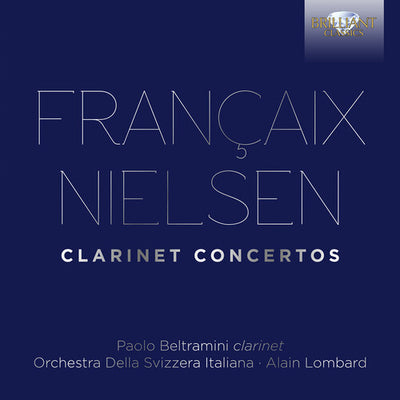
A unique pairing on record of 20th-century clarinet concertos, full of musical laughter and mischief. As principal clarinet of the Orchestra della Svizzera Italiana based in Lugano, Paolo Beltramini may be seen on many films of the orchestra in action such as a beautifully shaded set of the Brahms symphonies filmed by Sony and conducted by Markus Poschner. Beltramini shines in Brahms's slow movements with many solos of doleful and consoling ease. For this album, his debut on Brilliant Classics, he leaves his chair and stands out front for two clarinet concertos which have enjoyed strikingly different fortunes. The Nielsen is a classic of the genre, probably the best-known and most-played example from the last century, abounding in Nielsen's zany humor and rebellious temperament. This four-movement work opens conventionally enough with a cheeky little melody soon taken on a gentle flight of fancy by the soloist, but it's clear, as so often with this composer, that danger and even catastrophe lurk around the corner. Nielsen intended as a portrait of a leading Danish clarinetist of his time, Aage Oxenvad, who was reportedly 'somewhat choleric in temperament, irascible but warm at heart.' The concerto, it was said by those who knew him, captured the very soul of Oxenvad. Outside his native France, the reputation of Jean Francaix has not flourished like that of Nielsen, especially since his death in 1997. Francaix was a fluent musician to a fault, born and brought up within a deeply musical family unlike Nielsen, and blessed with a ready way with melody. In 1968 he wrote this four-movement concerto and dedicated it to the bassoonist and conductor Fernand Oubradous; the first soloist was one of his students, Jacques Lancelot. Francaix admitted (not without pride) that the concerto was 'a kind of aerobatics display for the ear, complete with loops, wing-turns and nose-dives which are fairly terrifying for the soloist' - and indeed both works here stretch the technique of any clarinetist to the limit.
When the minimalism movement originated in the early 1960s, it sprang up organically – some composers played by the rules (even if they were rules of their own invention), while others experimented freely, unaware or unconcerned about how music 'should' be composed. One of those young mavericks was Dennis Johnson, who has now faded into almost complete obscurity after he gave up his musical ambitions for a career in mathematics. But his 1959 composition November can be considered one of the first, if not the first, properly minimalist work. It later went on to inspire La Monte Young to write his prolific Well-Tuned Piano. Complete recordings are few and far between, and this new recording by Jeroen van Veen is the perfect introduction for anyone looking to get back to the roots of Minimalism. Jeroen van Veen is one of the Netherlands' most prominent recording artists. This collection of Minimal Piano Music follows two previous successful albums, available on Brilliant Classics (BC8551 and BC9171). The last album provided a snapshot into the extensive scene of minimalist music today; this one takes us back to how it all began. Featuring several famous pieces from the original minimalist canon – including Philip Glass's Music in Contrary Motion and Terry Riley's Keyboard Studies – there are hours of beautifully relaxing and inspiring music here to enjoy. This release brings the listener back to the roots of Minimalism, all works were written in the seventies of the 20th century, a time when the new aesthetics and perception of music, sound, repetition and time experience were creating a new chapter in music history. The longest piece is the 5 hour “November” by Dennis Johnson, a work in which the player is free to build the intervals and chords according to his own timing and spacing. The other composers in this set are Philip Glass, Tom Johnson, Peter Garland, Terry Riley, Harold Budd and La Monte Young.
Frescobaldi - Gesualdo - Solbiati: Music For Accordion
Brilliant Classics
CD
$7.49$14.99Save 50%Feb 24, 2017
On this new and interesting release, the works of two Italian Renaissance masters are performed on the accordion. The accordion is slowly emancipating, shedding its “light entertainment” image and claiming its right as a serious and valuable musical instrument. Its possibilities are enormous, its sounds and sonorities as varied as a church organ. This new recording presents keyboard works by Frescobaldi and Gesualdo, works which were intended for either harpsichord or organ, and therefore may be played on any keyboard instrument. The realization on accordion is fascinating in its fusion of both the harpsichord (its tactile precision) and the organ (its sustained polyphony.) Italian Francesco Gesualdi is one of the world’s foremost accordionists. He commissioned works for his instrument with many contemporary composers, and is well connected with composers such as Marucio Kagel, Sofia Gubaidulina and Wolfgang Rihm.
Founded in 1985, the Kammerata Luxembourg has established itself at the centre of the country’s musical life with new commissions, concert series and recordings, supported by its ministry of culture. One recent enterprising series was named ‘The European Union Enlarges’, focusing on the chamber music of future EU states, and others such as this album have constructed enlightening juxtapositions of modern and Romantic-era repertoire. Few composers from the 19th century have exercised so potent an influence upon composers of our time as Robert Schumann. His abrupt changes of mood and intense, passionate commitment to individual expressive states have seized the imagination of many composers as well as listeners. Not the least of them is Schumann’s fellow German AribertReimann, In arranging the Fantasiestücke Op.73, Reimann altered not a note of the clarinet part while arranging the piano accompaniment for the unusual combination of flute, a harp and two violas, which enables him to explore both the sombre timbres and the more ethereal hues of the score. The Op.107 songs are united by both a theme of unrequited love and a mood of wistful other-worldliness, which Reimann accentuates with an often-Expressionist recasting of the piano part for string quartet. The other original work here is the collection of canonic pieces originally written for a pedal piano and arranged by Schumann’s contemporary Theodor Kirchner. Meanwhile, the two contemporary responses to Schumann are undertaken in a spirit of the most sincere love and homage. Kurtág’s instrumentation for clarinet, viola and piano refers back to the Op.132 Märchenerzählungen – fairy tales – and he peppers his score with both literary allusions and references back to the object of his homage. Jörg Widmann likewise evokes Schumann’s Op.23 Nachtstücke in his own trio for clarinet, cello and piano. Anyone fearful of new music need not hesitate: Widmann insinuates himself into a world of Romantic melancholy with uncanny skill.
Comes: O Pretiosum - Music For The Blessed Sacrament
Brilliant Classics
CD
$6.99$13.99Save 50%Jul 29, 2016
One of the most influential composers of the early Spanish Baroque, Juan Bautista Comes (1582-1643) was one of the first composers to fuse together elements of Renaissance style with the emerging styles of the Baroque. Juan Bautista Comes held the post of chapel master of the Valencia Cathedral, the cathedral that since 1437 held the Holy Chalice, the cup that Jesus drank from at the Last Supper, which is the reason Comes composed extensively for the Eucharist. This new recording not only includes sacred Motets, but also a selection of choral works composed in the vernacular language and based on popular music to make the liturgy more accessible to common people.
For their 'commitment, technical versatility, unanimity of ensemble and near-immaculate tuning' (Gramophone) the five musicians of Seldom Sene have won golden opinions in repertoire ranging from songs and dances from Renaissance Spain and England to their own transcription of Bach's Goldberg Variations: 'With passionate command, skilful precision, nuanced dynamics and their outstanding potential for colouring, the ensemble succeeds in creating a surprising spectrum of enchanting, unheard-of sounds from Bach's Variations without compromising the "idea" of the work. ' (MDR. De) Now they undertake a new adventure, having commissioned pieces from four composers of diverse backgrounds and idioms. Aspasia Nasopoulou has written a collection of 10 miniatures - 'Dipoles' - which are inspired by opposites such as Male/Female, Bent/Straight, One/Many and so forth, giving rise to a cycle of high contrasts. Her fellow Greek composer Thanasis Deligiannis plays on the talents of Seldom Sene as singers as well as instrumentalists in setting a triptych of texts in English by the poet Iacovos Camhis, with the whimsical title of a bit unfair. Sören Sieg's work brings together the joyful and relaxed temperament of much African music with the dramatic tension of European music. As a multi-talented composer and performer on wind, string and keyboard instruments he has composed 24 recorder suites: this is the latest, titled Mathongo Amnandi, meaning 'sweet Dreams' in Xhosa. Finally Seldom Sene play Quo quondam victa furore ('Where once madness excelled') by the Dutch composer Paul Leenhouts: a character piece telling a pastoral story from Roman literature which extols the virtues of a simple country life. Leenhouts, too, has a background in early music, as a distinguished performer and director in his own right: like the others, he has composed a vividly communicative piece which is beautifully tailored to the talents of Seldom Sene.
Debussy: Reveries de Bilitis - Music for Two Harps & Voice / Duo Bilitis
Brilliant Classics
CD
$6.99$13.99Save 50%May 25, 2018
Harpists Eva Tebbe and Ekaterina Levental remark that Debussy makes the invisible visible and turns the unspeakable into a musical world full of mysticism, layers of ambiguity and evocative meanings. A century after his death, he is being celebrated across the world in 2018, and this album promises to make a special contribution on record with arrangements of works, most of them relatively unfamiliar, which particularly lend themselves to the ethereal and exquisite combination of voice and harps. Much of the music here was written while Debussy was composing his only opera Pelléas et Mélisande, a Symbolist drama based on the play by Maurice Maeterlinck, who recognized that in many ways Debussy had not only set his play to music but even outstripped and further enriched his original. There is the early and peaceful Ballade from 1890, then the Proses lyriques from 1892-3 and the seductive Trois Chansons de Bilitis (1897), from which this musical partnership takes its name. Bilitis is the fictional poet of Classical antiquity invented by Pierre Louÿs, writing in an erotic, symbolist vein after the fashion of Sappho: and when in 1900 Debussy came to use the texts of Louÿs again for the Musique de Scène pour les chansons de Bilitis, the music accompanied a tableau vivant in pre-Raphaelite style of winsome and scantily clothed young women. The recital is completed by the Danse sacrée et danse profane – originally composed for harp and orchestra in 1904, here with the orchestral parts arranged for a second harp – and the six Epigraphes Antiques from 1914, which return to the musical material of the Bilitis works but in the composer’s more allusive late style which would lead to his final masterpiece written for Serge Diaghilev, Jeux.
Dowland: Songs for Soprano and Guitar / McKenzie, Bini
Brilliant Classics
CD
$6.99$13.99Save 50%Oct 28, 2016
John Dowland is without doubt one of the most famous English composers, the foremost exponent of the Golden Age of the Elizabethan Era of the 16th and 17th Century. Dowland’s songs fully reflect the spirit and tastes of the Elizabethan age, with their tendency towards deep melancholy and their pronounced focus on darkness, moonlight and night time. Despite the predominance of grief, sadness, tears and death there are also songs in which a sense of optimism, lightness and joy prevail. This new recording uses the classical guitar as accompanying instrument, played by Adriano Sebastiani. The young soprano Siphiwe McKenzie was twice nominated by the prestigious magazine Opernwelt as “Young Singer of the Year.” She sang in important theatres such as the Wiener Volksoper, Teatro Colon (Buenos Aires), Teatro Regio di Parma, Leipzig State Opera and many more.
This double album is the third and last volume of Easy Studies for Guitar. The aim of the series has been to collect original works for the guitar by 20th- and 21st-century composers that fulfill didactic functions as well as being entertaining to play and listen to. Many of the studies here are receiving their first recordings, and the pieces by Biberian, Cavallone and Franco are so far unpublished. Music by the Belgian organist and composer Jean Absil (1893–1974) shows the influence of Wagner in the same way as his better-known compatriot Franck, and he absorbed the music of Milhaud and Schoenberg during his time in Paris. However, the Pièces Caractéristiques of 1964 capture a piece of sunshine no less than the folk- inspired Sei Canzoni Ebraiche by Cavallone or the Sette Aphorismi of Franco, even while certain movements exploit the more mysterious, nocturnal character of the guitar. The idea for Brèves de Pupitre sprang from Olivier Chassain’s work as a teacher, arising from his students’ basic technical needs or flaws – as well as his own. Cristiano Porqueddu is a distinguished editor and composer as well as performer, and he has selected an especially attractive set of Ten Studies for Guitar from among the many unpublished works by Gilbert Biberian, a British composer/guitarist born in 1944. Perhaps the set’s most intriguing rarity comes from the gifted Viennese composer Ferdinand Rebay, active in the early decades of the last century, and featured on a couple of previous Brilliant Classics albums; though himself a pianist rather a guitarist, he was encouraged to turn to the guitar by a fellow-professor and also by his guitar-playing niece; he eventually composed around 600 pieces for the instrument, including these Ten Little Songs without Words.
Kuhlau: Complete Sonatas for Flute and Piano / Tozzetti, Caturelli
Brilliant Classics
CD
$8.99$17.99Save 50%Aug 27, 2021
Friedrich Kuhlau (1786 - 1832) lived and worked during a transitional period of classical music. A contemporary of Beethoven and Schubert, his works remain almost unknown to this day, except for some compositions for the flute. The compositional style of the sonatas featured in this recording perfectly identifies with that of his contemporaries, while showing some differences in content; the structure of the sonatas is that of the classical period, but the use of melodic themes and harmony looks to the romantic period. These interpretations of the sonatas for flute and piano highlight the constant dialogue between the two instruments; in fact there is a continuous thematic exchange, which the artists found interesting to discover and highlight. The synergy is perceived above all in choppy tempos, while in every Adagio or Andante the flute assumes the role of the solo instrument, and the piano accompanies and responds. The themes in the slow movements are sweet and moving, and the composer manages to evoke emotions that are always different from each other, thus bringing out his predisposition for this type of tempo, present even in the most brilliant movements: in fact in every allegro, even in the one characterized by the greatest energy, there is a moment of tranquility in which the composer takes the time to make performers and listeners ponder.
Wagner: Wesendonck-Lieder / Angius, Orchestra di Padova e del Veneto
Brilliant Classics
CD
$7.49$14.99Save 50%Aug 27, 2021
Richard Wagner began composing his Wesendonck Lieder during a stay in Zurich between November and December 1857. Originally conceived for female voice and piano alone, the five songs were later orchestrated, first by the Austrian conductor and composer Felix Mottl in 1893, and then later in 1976 by the German composer Hans Werner Henze, in a chamber setting. In fact Wagner had already orchestrated a version of "Träume” to be performed by chamber orchestra (with violin playing the voice part) on the occasion of his wife Minna’s birthday in 1857. Later, in 1870, for his second wife Cosima’s 33rd birthday, he enacted a similar gesture. Mixing new motifs with themes from his Ring cycle, he composed the Siegfried Idyll and had it performed by a small orchestra as a birthday surprise. Hanz Werner Henze’s orchestration of Wagner’s Wesendonck Lieder highlights the relationship between the words and the sounds. The agile yet intense scoring for ten wind instruments, harp and small string ensemble appears to be Henze’s way of finding an alternative to the original piano without taking the cycle outside the realm of chamber music or altering the lieder’s original image. Siegfried and Brünnhilde sing from the depths of their hearts returns here with the grace of a child’s nursery. Salvatore Sciarrino’s Languire a Palermo (Languishing in Palermo), composed in 2018, is predominantly built around the melody Tempo di Porazzi, a fragment composed by Wagner during a visit to Sicily in late 1881 and early 1882. Sciarrino describes the ‘allure of a distant unaccompanied melody, played by someone for their own benefit and entrusted to the wind’ and hypothesizes that it may correspond ‘to the sounds in Sicily that stimulate and amaze the ears...Mediterranean charm gushes from the throat of every street vendor.’
Couperin: Complete Solo Harpsichord Music / Mahúgo
Brilliant Classics
CD
$8.99$17.99Save 50%Aug 27, 2021
Towards the end of the renowned Couperin dynasty, Armand-Louis was born in 1727 as the nephew of François Couperin (‘le grand’), and in due course he became titulaire organist at the Église Saint-Gervais in the Marais district of Paris, as generations of Couperins in a continuous sequence stretching back to 1653. In 1752 he married Elisabeth-Antoinette Blanchet, daughter of the harpsichord-maker François-Étienne Blanchet and herself the third generation of a family of musicians and luthiers. They had four children, three of whom lived to maturity and became musicians, including their son Pierre, who succeeded Armand-Louis at Saint- Gervais after a tragic accident with a runaway horse brought about the composer’s premature end in 1789. It has been suggested that personal modesty, as well as the demands of a schedule which saw him in demand at churches across Paris, was the cause of Armand-Louis publishing so little of his music. Certainly it was highly esteemed during his lifetime. These Pièces de Clavecin were published in 1751 as his ‘Opus 1’ and succeeded only by lesser-known collections of violin sonatas and trios. The Pièces de clavecin deserve consideration alongside the viol fantazias of Purcell and the Lachrymae of Dowland for their rich, saturated exploitation of an idiom passed its high noon. The collection is divided into two parts by key, G major/minor and B flat major/minor. The titles allude to friends and well-known figures of the time, and much is lost or rather buried within and between the notes in this kind of portraiture, yet the pieces spring to life in the right hands.
Poulenc: Melodies 1939-1961 "Poulenc et ses Poetes" / Coladonato, Proietti
Brilliant Classics
CD
$6.99$13.99Save 50%Aug 02, 2019
Poulenc once declared that ‘the musical transposition of a poem must be an act of love, not a marriage of convenience.’ By the age of four he was already able to recite Mallarme’s Apparition by heart, and while still very young he made his first efforts at setting verses to music. He loved listening to poets read their own work, and he was a voracious reader, who saw his purpose as a composer to embellish to enrich but never to obscure the words or their meaning. Poulenc loved singers and good singing as much as poetry. All these cycles were written with particular artists in mind; several of them for his life partner, the baritone Pierre Bernac, but he also worked very closely with Clare Croiza and Denise Duval, among others. Thus his vocal lines reflect their individual personalities while being couched in his own, very singable, jazz-inflected idiom. Valentina Coladonato has chosen a path less travelled through Poulenc’s song oeuvre, avoiding the Chansons villageoises and Air chantes. Yet in La Fraîcheur et le feu, setting Poulenc’s contemporary Paul Eluard, we find an intensity and urgency of expression to rival his masterpiece, the Dialogues of the Carmelites. Motifs from the opera recur in another Eluard cycle, Le travail du peintre, which addresses seven modern painters in turn from Picasso to Villon. A bittersweet air lingers over the Dernier poeme by Desnos, Aragon’s C and the monologue La dame de Monte Carlo; but his extrovert, amusing music-hall side comes to the fore in Les chemins de l’amour, based on Jean Anouilh’s Leocadia and dedicated to Yvonne Printemps, who was a singer of light music. Even within the same cycle there are contrasting moments that eloquently illustrate Poulenc’s own artistic credo: ‘My music is my portrait’. A specialist in early and new music, the soprano Valentina Coladonato has worked with conductors including Riccardo Muti and Claudio Abbado. She and Claudio Proietti have also recorded the Shakespeare Sonnets of Mario Castelnuovo-Tedesco for Brilliant Classics (BC95548).