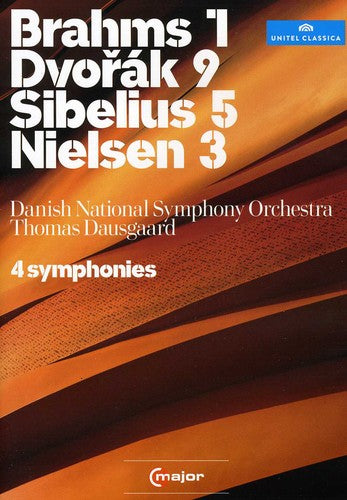
If, as I did, you were to begin your examination of this release with disc 1, track 1 (the Brahms symphony), you might well conclude that there was little need to continue. There is something rather too cool and casual about Dausgaard’s interpretation of this powerful music. It lacks inner tension. There is not enough contrast between ideas. Accents are in the wrong places. Short notes are cheated of their value. And that’s not all. The second movement just plods on, the third is charmless, the fourth frantic and lurches from one tempo change to the next. Listening to the complete symphony several times could not induce me to alter my initial unfavorable observations. Adding visual insult to aural injury, sight and sound are not synchronized, and the difference between the two is disturbing, to put it mildly.
But then came the Nielsen symphony. What a difference! Right from the opening moments it had all the vigor and élan and determination lacking in the Brahms. Rhythms were tight and crisp. The music bristled with enthusiasm and commitment. The finale positively beamed with Elgarian nobility and breadth, rising to an absolutely thrilling climax. What a joy! Nielsen’s Third had hitherto never been one of my favorite symphonies, but Dausgaard nearly made it so in this performance.
Does Dausgaard work his magic on the two remaining works as well? The answer, I’m glad to say, is yes. Furthermore, the synchronization problem that affected the Brahms symphony is only minimal in the Nielsen and nonexistent in Dvo?ák and Sibelius. The “New World” Symphony receives one of the finest performances I have heard. Dausgaard’s approach is no romantic wallow but rather a clean, purposeful traversal filled with taut rhythms, precise attacks and releases, glowing sound, and architectural strength. Dausgaard likewise makes a strong case for the Sibelius Fifth, never allowing momentum to sag, carefully propelling the music forward with masterly control. I am particularly impressed with the ease in which he handles the tempo change for the second part of the first movement. By the time the grand climax of the finale arrives, one feels a great journey has been completed.
All four performances were recorded live in Copenhagen’s Koncerthuset in 2009. The personnel changes from symphony to symphony, but both principal horns, both principal trumpets, and both timpanists are star players. Generally the woodwinds are excellent, but violins seem a bit thin for an orchestra that is otherwise so assured and well balanced. However, the basses make up for this deficiency with their huge, rich sound, heard at its best at the quiet endings of three of the Brahms movements and in some of the more powerful moments of the Dvo?ák symphony. Aside from the basses, the orchestra plays with a bright sound, textures are clear and clean, balances are well controlled.
The camerawork is devoted about 20 percent of the time to Dausgaard and his facial contortions, 10 percent to views of the full orchestra from afar, and 70 percent to the business of jerking the viewer’s eyes from one instrumental close-up to another—two seconds of a horn player’s embouchure, a second of flute keys, two notes from the timpani, etc. Who determined that this is what we want to see? I find it annoying to the point where I simply can’t bear to watch.
On ArkivMusic the price for these four symphonies is $27 ($40 for the Blu-ray version)—just under $7 a symphony, a good buy even without the inferior Brahms symphony, especially for performances as fine as the other three.
Few of Gioachino Rossini's operas are less well known than Adina. This production by Rossini Opera Festival and Wexford Opera Festival revives a masterwork of glittering arias and rich orchestral textures. The oriental tale, where Adina is a slave in a Baghdad seraglio, is set by Rosetta Cucchi on a giant and colorful wedding cake. The vocal star Lisette Oropesa "gave a splendid rendition as Adina. Her voice was brilliant, shiny on top, warm and round in the middle." (Bachtrack) World Premiere Recording on DVD and Blu-ray
Few of Gioachino Rossini's operas are less well known than Adina. This production by Rossini Opera Festival and Wexford Opera Festival revives a masterwork of glittering arias and rich orchestral textures. The oriental tale, where Adina is a slave in a Baghdad seraglio, is set by Rosetta Cucchi on a giant and colorful wedding cake. The vocal star Lisette Oropesa "gave a splendid rendition as Adina. Her voice was brilliant, shiny on top, warm and round in the middle." (Bachtrack) World Premiere Recording on DVD and Blu-ray
A film by Lillian Birnbaum and Peter Stephan Jungk
With: André Previn, Mia Farrow, Renée Fleming, Anne-Sophie Mutter, Tom Stoppard, David Finck, and others
Bonus: Wolfgang Amadeus Mozart: Piano Quartet No. 2 in E flat major, K. 493 Piano Quartet No. 1 in G minor, K. 478
André Previn, piano Rainer Küchl, violin Günter Seifert, viola Franz Bartolomey, cello
André Previn is one of the leading musicians of our day. The eighty-one-year-old cosmopolitan pianist, conductor and classical composer has not only received no fewer than four Academy awards for his film adaptations but was also one of the most influential jazz musicians of the fifties and sixties. A Bridge Between Two Worlds is a portrait of Previn's fascinating musicianship and also looks candidly at his private life, including his relations with his two ex-wives, Mia Farrow and Anne-Sophie Mutter. As a bonus, this release features Mozart's two Piano Quartets K. 478 and K. 493 with André Previn at the keyboard.
Picture format: NTSC 16:9 Sound format: PCM Stereo 2.0 / Dolby Digital 5.1 Region code: 0 (worldwide) Subtitles: English, German, French, Spanish Booklet notes: English, German, French Running time: 52 mins (documentary) + 55 mins (performance) No. of DVDs: 1 (DVD 9)
Andris Nelsons and the Wiener Philharmoniker explore the brilliance of Bela Bartok's Piano Concerto No. 2 and the emotional depths of Gustav Mahler's Fifth Symphony. Passionate but restrained, Andris Nelsons conducts both masterpieces with superb clarity and precision: Mahler's famous Adagietto unfolds with "unreal shimmer and dark glow" (BR Klassik). Yefim Bronfman is the soloist in one of the most difficult piano concertos ever written and impresses with "impeccable technique, expressive power, and a touch of swing" (Der Standard). The concert is part of the Wiener Philharmoniker's Mahler cycle with Andris Nelsons.
Among the most powerful works by Gustav Mahler and one of the longest symphonies of the Romantic period, the Symphony No. 3 is performed by Andris Nelsons and the Wiener Philharmoniker as part of their Mahler cycle. The composer's intention to create a musical reflection of the world is perfectly caught by Nelsons, who shapes the work's immense forces into a compelling narrative, from primordial darkness to transcendent affirmation. With Violeta Urmana as soloist, the Chor des Bayerischen Rundfunks and Salzburger Festspiele und Theater Kinderchor, the performance unfolds with luminous transparency and emotional depth. 'A melancholic giant, unleashed' (Der Standard) Program: Gustav Mahler: Symphony No. 3
Andris Nelsons and the Wiener Philharmoniker confront the uncompromising power of Gustav Mahler's Symphony No. 6, the composer's darkest and most enigmatic symphonic statement. With gripping intensity and architectural control, Nelsons traces the work's inexorable march from martial determination to catastrophic collapse. The famous hammer blows in the finale strike with devastating force, while moments of lyrical repose are shaped with haunting restraint. This performance reveals Mahler's Sixth as a tragic drama of fate and resistance, uncompromising in it's emotional impact. Recorded at the Salzburg Festival, the concert forms part of the Wiener Philharmoniker's Mahler cycle with Andris Nelsons. 'Mahler's ?tragedy' as a catharc experience in Salzburg. Standing ovaons for the Wiener Philharmoniker under Andris Nelsons' (Die Presse) Program: Gustav Mahler: Symphony No. 6
In this concert, the Wiener Philharmoniker, conducted by Andris Nelsons, present a "heavenly" pairing: Alban Berg's "Violin Concerto, To the Memory of an Angel", alongside Mahler's Fourth Symphony, whose final movement sets "Das himmlische Leben" (Heavenly Life) to music. With this performance, young German-American violinist August Hadelich gave his debut at the Salzburg Festival and thrilled the press: "The fabulous Augustin Hadelich filled the difficult solo part with emotion and fragility, his performance was sensitive and yet glowing." (Die Presse). With Mahler's Fourth, Andris Nelsons creates "a Mahler miracle of quiet tones" (Volksblatt), joined by German soprano Christiane Karg as the soloist of the finale. The concert is part of the Wiener Philharmoniker's Mahler cycle with Nelsons. Program: Gustav Mahler: Symphony No. 4 Alban Berg: Violin Concerto "To the Memory of an Angel"
In this concert, the Wiener Philharmoniker, conducted by Andris Nelsons, present a "heavenly" pairing: Alban Berg's "Violin Concerto, To the Memory of an Angel", alongside Mahler's Fourth Symphony, whose final movement sets "Das himmlische Leben" (Heavenly Life) to music. With this performance, young German-American violinist August Hadelich gave his debut at the Salzburg Festival and thrilled the press: "The fabulous Augustin Hadelich filled the difficult solo part with emotion and fragility, his performance was sensitive and yet glowing." (Die Presse). With Mahler's Fourth, Andris Nelsons creates "a Mahler miracle of quiet tones" (Volksblatt), joined by German soprano Christiane Karg as the soloist of the finale. The concert is part of the Wiener Philharmoniker's Mahler cycle with Nelsons. Program: Gustav Mahler: Symphony No. 4 Alban Berg: Violin Concerto "To the Memory of an Angel"
Andris Nelsons and the Wiener Philharmoniker explore the brilliance of Bela Bartok's Piano Concerto No. 2 and the emotional depths of Gustav Mahler's Fifth Symphony. Passionate but restrained, Andris Nelsons conducts both masterpieces with superb clarity and precision: Mahler's famous Adagietto unfolds with "unreal shimmer and dark glow" (BR Klassik). Yefim Bronfman is the soloist in one of the most difficult piano concertos ever written and impresses with "impeccable technique, expressive power, and a touch of swing" (Der Standard). The concert is part of the Wiener Philharmoniker's Mahler cycle with Andris Nelsons.
Andris Nelsons and the Wiener Philharmoniker confront the uncompromising power of Gustav Mahler's Symphony No. 6, the composer's darkest and most enigmatic symphonic statement. With gripping intensity and architectural control, Nelsons traces the work's inexorable march from martial determination to catastrophic collapse. The famous hammer blows in the finale strike with devastating force, while moments of lyrical repose are shaped with haunting restraint. This performance reveals Mahler's Sixth as a tragic drama of fate and resistance, uncompromising in it's emotional impact. Recorded at the Salzburg Festival, the concert forms part of the Wiener Philharmoniker's Mahler cycle with Andris Nelsons. 'Mahler's ?tragedy' as a catharc experience in Salzburg. Standing ovaons for the Wiener Philharmoniker under Andris Nelsons' (Die Presse) Program: Gustav Mahler: Symphony No. 6
Among the most powerful works by Gustav Mahler and one of the longest symphonies of the Romantic period, the Symphony No. 3 is performed by Andris Nelsons and the Wiener Philharmoniker as part of their Mahler cycle. The composer's intention to create a musical reflection of the world is perfectly caught by Nelsons, who shapes the work's immense forces into a compelling narrative, from primordial darkness to transcendent affirmation. With Violeta Urmana as soloist, the Chor des Bayerischen Rundfunks and Salzburger Festspiele und Theater Kinderchor, the performance unfolds with luminous transparency and emotional depth. 'A melancholic giant, unleashed' (Der Standard) Program: Gustav Mahler: Symphony No. 3
Turandot / Tosca / Love Duets - Sonya Yoncheva & Vittorio Grigolo Turandot: 'Netrebko does not merely sing it: she interprets it. What emerges is a character much more human and ultimately truer than usual' (La Stampa) Tosca: 'spectacle of monumental opulence' (Online Merker). 'A Tosca to relish!' (Artesnews. It) "standing ovation Tosca at the Arena di Verona" (Operalife). Love Duets - Sonya Yoncheva & Vittorio Grigolo: 'A concert evening about love, lust and passion. Sonya Yoncheva has the full and vibrant timbre of a true lyrical soprano' (L'Arena) 'Vittorio Grigolo is undoubtedly a charismatic artist and always attentive to the interpretation of the characters' (operclick)
Beethoven's Ninth: Symphony for the World / Currentzis
C Major Entertainment
DVD
$16.49$32.99Save 50%Jun 26, 2020
To this day, Beethoven’s Symphony No. 9 is one of the most popular pieces of classical music in the world. But what is it about this global hit? The film charts the success of the symphony around the globe and encounters passionate amateur musicians and musical personalities. Watch as Greek conductor Teodor Currentzis works on Beethoven’s Ninth with his ensemble, MusicAeterna. Follow Chinese composer and Oscar winner Tan Dun as he creates a new composition inspired by the great Beethoven symphony. Experience the Orchestre Symphonique Kimbanguiste in the Democratic Republic of the Congo, as they play the Ninth. Visit a favela in Brazil, where Beethovens’s music helps people get off the streets. Be amazed as a choir of 10,000 in Japan sings the final chorus of Beethoven’s Ninth Symphony, with great enthusiasm. Learn how Paul Whittaker helps make Beethoven accessible for deaf people. And find out how British DJ Gabriel Prokofiev performs a symphonic remix of Beethoven’s Ninth.
Beethoven: Complete Piano Sonatas / Buchbinder [Blu-ray]
C Major Entertainment
Blu-Ray
$82.99Oct 28, 2016
Beethoven’s opus of 32 piano sonatas, known as “the New Testament of piano music,” is a landmark in piano literature. Spanning Beethoven’s entire life, the sonatas reflect his whole development as a human being and a musician, moving from one century into the next, from one epoch in music in to another. With the sonatas “Pathetique,” “Moonlight,” “Waldstein,” “Appassionata,” “Hammerklavier,” and the final sonata op. 111, the cycle contains some of the most known piano pieces of all time. Now, for the first time in its history the complete cycle was performed at the Salzburg Festival. For this challenge the Festival asked no less than the world-renowned and influential Beethoven expert and pianist Rudolf Buchbinder. With more than 45 performances of Beethoven’s complete sonata cycle in concert halls all over the world and his relentless drive to discover new details and facets in the sonatas through meticulous study of the scores, “Buchbinder has set new standards in the interpretation of Beethoven’s works.” (Bayerischer Rundfunk). As a bonus, this release includes a 36 minute interview with Rudolf Buchbinder about the Beethoven Piano Sonatas.
Beethoven: Piano Concerto No 5; Rimsky-korsakov: Scheherazade / Nelsons, Bronfman [blu-ray]
C Major Entertainment
Blu-Ray
$45.99May 29, 2012
Still reeling from the previous night’s concert I was eager to hear Nelsons and the Concertgebouw in this mix of Classical and Romantic pieces. They are joined by the Israeli-American pianist Yefim Bronfman, who I’ve not heard in a very long time. I tend to associate him with the Russians – notably Rachmaninov, Prokofiev and Shostakovich – but he has recorded a fine version of the Beethoven concerto with David Zinman and his Zurich band (Arte Nova). As for the Rimsky, it’s one of those showpieces that seldom fails to please; and if the sonics of that earlier Blu-ray are anything to go by it should be a knock-out.
The Ruins of Athens, written to accompany August von Kotzebue’s play of the same name, is hardly a Beethovenian staple, but when it’s played with such affection it’s hard to understand why. Right from those opening figures on the double basses it’s clear this is going to be a performance of spontaneity and spirit, the camera cutting to key players when they get the chance to shine. And shine they do, the Concertgebouw as animated as they were the night before. On the podium Nelsons is equally alert, his boyish grin a sign that he’s having fun.
And who wouldn’t, with such thoroughbreds between the shafts? As for the concerto, a warhorse that seldom gets the performance it deserves, it’s played with tremendous brio. Bronfman fingerwork is clear and unmannered, and the orchestra responds with alacrity to Nelsons’ firm tug of the reins. Balances are generally fine, although the brass and woodwinds tend to leap out in the tuttis – some unnecessary knob-twiddling, perhaps – and the bass is not as firm as I’d like. Otherwise the Allegro is both passionate and elegant, and tempi are well judged; there’s plenty of thrust too, although at times momentum does flag.
Such lapses are rare though, Nelsons’ whipping his wayward steeds into line quickly enough. That said, the Adagio and Rondo-Allegro are more problematic. In the former the flute passage before the piano’s first entry is absurdly out of proportion – more intervention, perhaps – and Nelsons moulds the music far too much for my tastes. Yes it is beautiful, but it’s cloying and comes close to limpidity overload; as for Bronfman, his phrasing at the start of the Rondo is less easeful than usual. Even more distracting is the fitful progress, the music lacking the cumulative weight and growing tension one hears in other – more compelling – performances. It seems the audience have no such qualms though, demanding an encore. Bronfman duly obliges with a coruscating rendition of Chopin’s Etude in F major.
I so wanted to wallow in this concerto but alas I’m not likely to return to it in a hurry. At least there’s a consolation prize in the form of Scheherazade, whose terrifying start nearly blew me out of my seat. Having set the volume to a comfortable level for the Beethoven I was not prepared for such an assault on my senses; goodness, this really is Rimsky for the IMAX age, the brass- and timp-drenched climaxes simply crushing. The quieter moments are just as arresting, the Sultana’s beguiling narrative superbly evoked by the violin and harp.
As for ‘The Story of the Kalender Prince’ it’s packed with incident and colour, the many close-ups a reminder of just how virtuosic this piece is, and how exposed players are at times. There’s firm. characterful playing from the woodwinds, and the formidable battery of trombones sounds especially baleful. The big, bold recording handles these dynamic swings with aplomb, although anyone of a nervous disposition – or with unsympathetic neighbours – might want to reduce the volume by a couple of notches. As always, Nelsons is engrossed in the music, and it’s impossible not to succumb to his obvious and infectious enthusiasm.
That’s one of the unexpected joys of this concert; everyone is clearly having fun. What a change from those stiff-backed performers, stern of countenance, we see all too often. The tender music of ‘The Young Prince and the Young Princess’ is most eloquently done, and Nelsons shapes the dance-like episodes very persuasively. It’s the final movement, with its festival and shipwreck, that will take your breath away. The intimidating roar of this orchestra in full spate really confirms the sonic potential of Blu-ray; indeed, I’ve never heard that dash of spray, crack of sail and final cataclysm as powerfully realised as it is here. Those final, sinuous bars – as if enclosing these tales in parentheses – are simply overwhelming in their simplicity and charm.
Not surprisingly the audience demands – and gets – an encore in the shape of one of the Slavonic Dances from Dvor(ák’s Op. 46. It’s a polka, now winsome now trenchant, its storming conclusion a thrilling coda to an exhilarating concert. That said, Nelsons still looks as fresh as a daisy, and his players don’t seem to have wilted either. Despite the rather disappointing concerto I’m very impressed by this multi-talented Latvian; he can certainly batter one’s ear drums – the Rimsky is indeed a knock-out – but as the previous night’s Shostakovich Eighth and his 50th anniversary War Requiem so eloquently demonstrate, he can batter one’s heart as well.
A delightful overture, a competent concerto, and a Scheherazade to die for.
The Beethoven cycle of the 21st century! Christian Thielemann joins forces with the prestigious Wiener Philharmoniker in a unique and monumental project BEETHOVEN 9, their first-ever recording of all 9 Symphonies in full high definition and Surround Sound. This recording from the Golden Hall of Vienna´s Musikverein is accompanied by nine(!) hour-long documentaries, one on each symphony, featuring Christian Thielemann and Germany´s most eminent music critic, Prof. Joachim Kaiser. From insights into Beethoven´s musical thinking to interpretational comparisons, including excerpts form legendary performances by Karajan, Bernstein, Böhm, Järvi etc., to historical perpsectives – no aspect of Beethoven´s symphonic oeuvre will remain untreated! This 3 DVD-set contains Beethoven Symphonies 1, 2 & 3 and the Documentaries about Symphonies 1, 2 & 3.
Ludwig van Beethoven: Symphonies Nos. 1, 2 and 3 Coriolan Overture Egmont Overture, Op. 84 Vienna Philharmonic Orchestra Christian Thielemann, conductor
Recorded live at the Goldener Saal der Gesellschaft der Musikfreunde, Vienna
including: Discovering Beethoven with Joachim Keiser and Christian Thielemann one-hour long documentary for each symphony Picture format: NTSC 16:9 Sound format: PCM Stereo / DTS 5.0 Region code: 0 (worldwide) Subtitles: English, French, Spanish, Italian, Korean, Chinese, Japanese Running time: 155 mins (symphonies) + 170 mins (documentaries) No. of DVDs: 3
This fascinating release of Beethoven’s Symphony No. 9 stands apart from any other recording of the work. This is the first time that the magnificent piece has been recorded in HD and 5.0 surround sound, offering the most outstanding sound quality available today. Christian Thielemann leads the Wiener Philharmoniker in this moving interpretation. “Thielemann’s reading of the Beethoven symphonies stands heads and shoulders above the countless and mostly undistinguishable versions on offer.” (Die Presse) This performance is accompanied by an hour-long documentary featuring the conductor and Germany’s foremost music critic, Professor Joachim Kaiser. The film provides insights into Beethoven’s thinking, as well as interpretal comparisons from conductors like Karajan, Bernstein, and Jarvi.
Freedom, fraternity and humanity – this is what Beethoven’s 9th Symphony stands for. It opens the 10th Grafenegg Festival, performed by the Tonkunstler Orchestra, joined by 24 alumni of the European Union Youth Orchestra (EUYO) and “a soloist quartet which no one could possibly imagine to be more prestigious” (Die Presse). “Vogt’s tenor and the Wiener Singverein were especially moving” (Wiener Zeitung) and “the vocal performance by excellent bass René Pape, the fabulous soprano Camilla Nylund and the brilliant mezzosoprano Elena Zhidkova … in Beethoven’s Ninth was just sensational. Bravo!” (Kurier) Composer in Residence Christian Jost’s new work also centres around Beethoven, featuring the song “An die Hoffnung” (“To Hope”), and “convincingly used an impressive orchestra” (Der Standard), with “tenor Klaus Florian Vogt as a well-cast soloist” (Salzburger Nachrichten).
The Beethoven cycle of the 21st century! Christian Thielemann’s and Wiener Philharmoniker’s recording of BEETHOVEN 9 had been their first recording in HD of all nine Beethoven symphonies, accompanied by nine hour-long documentaries, one on each symphony, featuring Thielemann and Prof. Joachim Kaiser. From insights into Beethoven’s musical thinking to interpretational comparisons, including excerpts from performances by Karajan, Böhm, Bernstein, Järvi etc., to historical perspectives – no aspect of Beethoven’s symphonic oeuvre will remain untreated! “Thielemann’s recordings of the Beethoven symphonies stand head and shoulders above the countless and mostly undistinguishable versions on offer.“ (Die Presse) “The Vienna Philharmonic literally grew beyond itself that evening in the Konzerthaus.“ (Neue Züricher Zeitung) Missa Solemnis: Thielemann “conjured up the gigantic cosmos of the Missa with such lightness and grace that its mystery seemed to reveal itself.“ (FAZ)