Schelb: Piano Trio No. 2; Horn Quartet; Piano Quintet
Haenssler Classic
CD
$10.49$20.99Save 50%Jun 03, 2022
Dr. Albert Schelb writes: “As a composer, Josef Schelb incorporated the most important styles that had developed around the turn of the century into his early compositions, although most of these were destroyed in an air raid on Karlsruhe in 1942. After war, Schelb turned to impressionism, expressionism, atonality and finally also to twelve-tone composition, but without ever committing himself exclusively to any one of these styles. Self-taught, he combined them to develop a style all of his own, and followed, so to speak, his own rules of development. Throughout his life, his speciality was the polyphonic treatment of motifs and themes, which he handled strictly or playfully, as main elements or in episodes. His polyphony is never dry and academic, but rather is always paired with a dash of warming Romantic sensuality in sound. This even applies to his late orchestral music and Movimenti of the 1960s and 1970s, in which the themes are always twelve-tone expressionistic, but the harmony is also distinctly impressionistic.”
Tabakova: Orchestral Works & Concerti / Lazarova, Johnston, Rysanov, The Hallé
Halle
CD
$20.99Oct 06, 2023
This album marks the culmination of two special Hallé collaborations and includes four major pieces from one of the most distinctive of current British compositional voices. Delyana Lazarova (Hallé Assistant Conductor 2020-23) and composer Dobrinka Tabakova (Hallé Artist in Residence 2022-23) were both born in the historic city of Plovdiv, Bulgaria. Working together for the first time during their time with the orchestra they formed a strong musical connection in which the Hallé musicians displayed a close understanding of the intricacies and dialect of Tabakova’s musical language. This album contains two of Tabakova’s major orchestral works. The three-part Earth Suite, which the composer says was inspired by ‘the overwhelming force of Nature’, recently drew ‘exquisite playing’ from the Hallé (Bachtrack, April 2023).
Orpheus Comet features fast rhythmic material combined with atmospheric transparent orchestrations and a glorious climax featuring quotations from Monteverdi. The two significant concertos for strings and soloists included on this album solidified Tabakova’s reputation as an outstanding contemporary voice and display the composer’s close affinity with string instruments. Ukrainian-British Maxim Rysanov, is one of Tabakova’s longest collaborators who premiered the Concerto for Viola and Strings in 2004, a piece described as being ’saturated with an inner, captivating and natural energy’ (Culture Magazine, Nov 2004). The Concerto for Cello and Strings (whose score was described as ‘gorgeous’ by the Daily Telegraph, Australia) is here performed by Guy Johnson, one of the most exciting British cellists of his generation.
The program of this album offers a varied selection of chamber music with piano written by Hans Gál between 1922 and 1940. Among these, the main work on the album is undoubtedly the Piano Quartet written for the one-armed pianist Paul Wittgenstein. The work consists of four substantial movements, and each of the movements is uniquely melodic; moreover, there are strong contrasts between the two light and airy movements II and IV on the one hand, and the dignified opening movement and delicate Adagio on the other. Richness and variety characterize this most productive period of composer Hans Gál. The rest of the program is of a decidedly lighter character than the Piano Quartet and shows Gál at his most fluid and melodic.
Maria Bach: Piano Quintet & Cello Music / Hülshoff, Canpolat, Karmon, Triendl, Grauman
Haenssler Classic
CD
$10.49$20.99Save 50%Apr 01, 2022
A MusicWeb International Recording of the Month for July 2022!
All in all Maria Bach left more than 400 works to posterity. Most (about 80%) are Lieder and choral works, followed by smaller-scale piano works; not unlike Edvard Grieg or Hugo Wolff, she was an expert in that field, though she did also compose three ballets, made up of small, orchestral piano pieces. Her most ambitious works then, are the few excursions she made into the realms of chamber music (solo cello sonata, cello sonata, piano quartet and quintet, string quintet and two string quartets), in which she ventured a confrontation with the traditions of the grand, established genres. On the present release, Oliver Triendl, Marina Grauman, Nina Karmon, Öykü Canpolat, and Alexander Hülshoff showcase Maria Bach’s chamber works, including the Piano Quintet “Wolga-Quintet”, the Cello Sonata, and the Suite for Cello Solo.
Review
[Maria Bach's] music is infused with French and Russian elements and one can quite hear why it was so appealing to Roger-Ducasse who ensured that her 31-minute Piano Quintet was performed at the Paris Conservatoire when she visited Paris in 1930-31. Like all good music it’s clearly susceptible to strongly divergent interpretive stances. The Hänssler team is anchored by Oliver Treindl, who in my experience is probably one of the most hard-working and often recorded of players. He’s also an athletic figure who ensures forward-moving tempi.
The eminent cellist Paul Grümmer was a family friend and Bach was fortunate he liked her music and played the Cello Sonata frequently. It’s modestly structured – three movements and 19 minutes in this reading by Alexander Hülshoff and Treindl – and has a ripe Brahmsian rhapsodic feel, with a warmly curvaceous lyricism in the Romanze second movement. As with the Piano Quintet the finale is full of dextrous animation.
The final work in the disc is the Suite for cello, a crisp four-movement affair that looks back to Popper, as the notes indicate, rather than [J.S.] Bach. After a sonorous, chordal Praeludium come the registral leaps of an etude-like Scherzo, an expressive Air and then another of her favoured variations for a finale – including a Tango-like one – which call for supple bowing. It’s a deft work, all the more so in not honouring [J.S.] Bach’s legacy in any obvious fashion.
In terms of amplitude and density of sound this disc is an impressive one. The players sound firmly engaged in what must have been unfamiliar repertoire. They’ve been backed up by some classy notes. For overt expression, choose this[.]
This recording has been released in honor of Ursula Mamlok's 100th birthday, February 1, 2023. Mamlok Vol. 6, featuring new recordings made in Berlin and New York City, contains works from the German-American composer's last creative period- Mosaics (2011) for piano 4 hands, and Terzianum (2006) for violin and flute. Vol. 6 contains works from more than a half century of the distinguished German-American composer's career, dating back to her Suite for Four Cellos composed in 1957. Bridge's Ursula Mamlok series began under the composer's supervision, and continues with this fascinating retrospective.
In the discussion on women and classical music, perhaps no other instrument draws such a strong association with feminine stereotypes as the harp. Once the instrument of choice for respectable young ladies, it was considered suitable for the domestic sphere and the world of private salons. And yet, as the harp made it's way out of the home and into the concert hall, it's publicity was championed by male performers, playing the music of male composers. Often overlooked are the women-performers and composers alike-who revolutionized the instrument and gave it a solo voice. Birds of Paradise celebrates the artistic voices of women as both performers and creators. This album showcases living composers Reena Esmail and Angelica Negron and legendary harpist and composer Henriette Renie. Featured works include Renie's Trio, the first major work written for this combination of instruments, alongside the world premiere recording of Negron's Ave del paraiso and the first recording of Esmail's Saans as arranged for harp, violin, and cello. Listeners are invited to experience this dynamic sound world, full of color and warmth, created and performed by women.
Brahms: Piano Quartets Nos. 2 & 3 / C. Tetzlaff, T. Tetzlaff, Buntrock, Vogt
Ondine
CD
$24.99Sep 06, 2024
This album of two piano quartets by Johannes Brahms (1833–1897) captures pianist Lars Vogt’s last recordings. Before his premature death and between treatments, Lars Vogt was able to record a multi-award-winning album of piano chamber music works by Schubert together with Christian Tetzlaff and Tanja Tetzlaff, as well as albums of Mozart’s and Mendelssohn’s piano concertos. However, a project to record Brahms’ complete piano quartets was left unfinished after the studio recording of Piano Quartet No. 2 was completed. With the help of recording producer Christoph Franke, we are now able to offer this recording together with Piano Quartet No. 3 from a live concert performance in connection with the studio recording. Combined, these make up Lars Vogt’s last recordings. Violinist Christian Tetzlaff, violist Barbara Buntrock and cellist Tanja Tetzlaff offer stellar performances in these landmark recordings and fulfill Lars Vogt’s late wish to have these performances released.
REVIEW:
The final recordings of pianist Lars Vogt have offered many riches, but this one is arguably the most profound of all. This may be the most intense recording of the C minor quartet on recordings. In both works, the coordination among the players evinces a joy that characterizes the highest ideals of chamber music.
Erkoreka: Cello Concerto; Tres Sonetos de Michelangelo; Pian
Ondine
CD
$9.49$18.99Save 50%Jun 07, 2024
Award-winning composer Gabriel Erkoreka (b. 1969) is one of the leading composers of contemporary music from the Iberian Peninsula. This new album by the Basque National Orchestra conducted by Juanjo Mena is dedicated to his orchestral works. Erkoreka studied composition with Michael Finnissy at the Royal Academy of Music in London and after graduating, his works have been performed in important festivals across the globe. In 2021 Gabriel Erkoreka received the National Music Award given by the Spanish Ministry of Culture.
A Gramophone Magazine Editor's Choice - January 2023
"A perfect control of rhythm allows for beautifully expressive playing"
Cellist Johannes Moser and pianist Andrei Korobeinikov present Bohuslav Martinů’s complete cello sonatas. These works belong to the most significant twentieth-century repertoire for cello and piano. Reflecting Martinů’s troubled existence, defined by wartime, emigration, longing for the homeland, yet also full of hope and life-affirming energy, the music seems entirely topical in our own troubled times.
After their award-winning recording of works by Prokofiev and Rachmaninoff from 2016, Moser and Korobeinikov demonstrate their congeniality once more, fully realizing the extreme interdependence of cello and piano in these works. Johannes Moser has a vast Pentatone discography, consisting of releases with cello concertos of Dvorak and Lalo (2015), Elgar and Tchaikovsky (2017), Lutoslawski and Dutilleux (2018), works for cello and piano by Felix and Fanny Mendelssohn (2019) and Francesco Velázquez’s cello concerto (2022). His recording of works for cello and piano by Rachmaninoff and Prokofiev (2016), performed together with Andrei Korobeinikov, was awarded with a diapason d’or and ECHO Klassik 2017.
REVIEW:
Johannes Moser and Andrei Korobeinikov capture the rapidly shifting emotions in all three works while maintaining an unflappable rhythmic poise – no mean feat in such complexly syncopated music. The result are performances in which clarity and precision seem to take on an expressive power of their own.
Pentatone’s engineers do both players proud – balance between the two instruments is close to perfect – and the recording is significantly enhanced by the perceptive booklet note. Simply put, this is the most satisfying account of Martinů’s cello sonatas on record.
Julian Brink is a South African composer. Born in Johannesburg in 1989, he first picked up his mother’s guitar at the age of ten and grew up playing in rock bands. He discovered a love of contemporary classical music through the films of Paolo Sorrentino and Paul Thomas Anderson. Hearing Jonny Greenwood's score for There Will be Blood, in particular, was what led him to pursue composition. Although he didn’t learn to read music until he was 19, while studying guitar at undergraduate level, he went on to complete a master's degree in film scoring through Berklee College of Music and relocated to California in 2015. Brink works in film music and lives in Los Angeles with his wife, actress Maddie Hasson.
In collaboration with eminent classical label Sono Luminus, Utility Music is Brink's first standalone release. Originally composed in 2019 as a score for an abandoned film project, the music was arranged for piano, harp and string trio. It was later repurposed, reorchestrated and combined with a few older pieces into what is its current form. The album features performances by several distinguished musicians, with the heart of the music being the string trio of Moldovan violin virtuoso Dan-Iulian Drutac; Nick Revel, violist of the Grammy Nominated PUBLIQuartet; and Joe Zeitlin who was the lead cellist on Mica Levi’s Oscar-nominated score for Pablo Lorraín’s Jackie.
TRACKS:
Colombo / Green Fingers
Miniatures
Simple Trio No. 1
Eventually Lapse
Albatross
At Night
Eastwood No. 4
Simple Trio No. 2
Aura for M
Baptism in the Field
Pattern Shells
REVIEW:
For his first standalone release, Julian Brink has repurposed and re-orchestrated an incomplete score for an unfinished film. The 11 short, delectable tracks ‘toss boundaries’, as the trombonist provocateur Juliane Gralle observes. Taken together, it feels like there might still be a movie in there, somewhere.
‘Miniatures’ has the feel of a haunted, southern Viennese waltz surrounded in fog, its central beauty emerging serenely through the mist accompanied by drops of ringing pizzicatos. ‘At Night’ features cellist Joe Zeitlin creating other-worldly shadings of tone and colour then lifting them gently from the musical score. The two ‘Simple Trio’ tracks, which offer a vade mecum of ‘uncomplicated transitions between notes to make the samples sound more realistic’, feature the trio of Zeitlin, violinist Dan-Iulian Druțac and viola player Nick Revel of PUBLIQuartet, which Brink describes as ‘the heart of the album. I try to forget that they haven’t all met each other and aren’t playing together in the same room.’
‘Albatross’ channels John Cage and Morton Feldman with mesmerisingly deceptive, irregular beats, wonderfully quiet. The last track, ‘Pattern Shells’, influenced by Villa-Lobos, is a spontaneous splurge of brass and tropical birds.
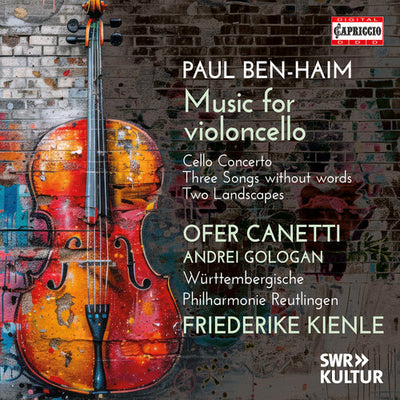
Paul Ben-Haim ranks among those leading Israeli composers from his generation. Born Paul Frankenburger in Munich he studied composition with Friedrich Klose and served as an assistant conductor to both Bruno Walter and Hans Knappertsbusch. His extensive catalogue comprises works in all the primary genres apart from opera. Music for or with cello features prominently throughout Ben-Haim's output. Following emigration, he increasingly advocated a specifically Jewish national expression while his own compositions favoured a late-Romantic vein redolent of - though by no means indebted (unlike other contemporaries) to - Ernest Bloch and frequently informed by Middle-Eastern overtones.
Drawing from influences as disparate as the blues, jazz, Broadway, gospel, folksong and the wild west, the 'American vignettes' in this album merge popular idioms into a new canon of the repertoire for cello and piano, in a series of musical snapshots that are as varied as the men and women who composed them and yet all remain quintessentially American in spirit. The distinctive voices of six US composers, from the late twentieth and early 21st centuries, here come together to weave a virtuosic and colourful tapestry of Americana.
This album is the culmination of an extraordinarily fruitful artistic collaboration that took place at the 2022 Boulder Bach Festival in Boulder, Colorado. The recordings were made immediately after the public concerts concluded. They document four of the many memorable musical interpretations at the Festival, which occurred not just because of the many talented artists, but also thanks to the kindness and generosity of countless members of the community and region. Although many musicians converged on Boulder from all over the globe, the Festival also featured several remarkable local artists. The entire project took place against the backdrop of some of the most majestic natural scenery in the world.
REVIEW:
Under artistic director Mina Gajić, and music director Zachary Carrettin, the Boulder Bach Festival of Colorado has progressed steadily in its artistic aims as well as providing an attractive setting for music lovers. The present recordings, made immediately after the public performances in the 2022 Festival, bear witness to this, in sparkling accounts of two concertos by Johann Sebastian Bach and two choral settings by Johann Christian Bach, an earlier sprig on a very prolific family tree.
Herz: Piano Concerto, Cello Concerto & Orchestral Works / Silber, Berlin RSO
Capriccio
CD
$21.99May 17, 2024
Maria Herz, nee Bing, was born in 1878 in Cologne. By the 1920s, she became to be recognized as a dynamic element of the contemporary music scene. New music's 'chief theoretician', Theodor W. Adorno, became interested in her works and their style, which was rooted in Late Romanticism and aimed at Modernism by way of Expressionism, New Objectivity, and Neo-Baroque, all while retaining it's playful, charming air. She was close to a veritable Who's-Who of contemporary musicians, including the Budapest String Quartett, Gregor Piatigorsky, Emanuel Feuermann, Hermann Abendroth, Otto Klemperer, and Hans Rosbaud. In her lifetime, only five songs (1910) and a transcription of Bach's Chaconne for string quartet (1927) were published, but all her 30 orchestral works, solo concertos, chamber music pieces, and art songs have survived in manuscripts. The Nazis seized her family's assets and forced Maria Herz to emigrate, first to England, and, after the war, to the United States where she lived with her children and died in 1950, in New York.
Ancient traditions, folklore, landscapes, and the natural world are central themes in the music of the distinguished Chinese composer Xiaogang Ye. This new album, performed by the Fidelio Trio and friends, spans over three decades of Ye's chamber works from 1989 to 2023. Known for his vast range of compositions, Ye's deep connection to his Chinese heritage is particularly evident here. His intricate use of instrumentation, rhythmic and melodic motifs, and dramatic forms come to life in these intimate settings. The album features a variety of ensembles and instruments, including the evocative traditional Chinese instrument, the pipa in Gardenia, highlighting Ye's ability to blend traditional Chinese elements with Western classical music. Each piece, from the lyrical Piano Trio Op. 59 to the vivid Nine Horses Op. 19, showcases Ye's mastery of timbral colour, rhythmic interplay, and melodic expression, offering listeners a fresh perspective on ancient myths and tales through a modern lens.
The centenary of the birth of Viktor Kalabis (1923–2006), a major 20th-century Czech composer, is worthy of attention. The previous Supraphon album, Symphonies & Concertos (SU 4109-2), mapping his mature and late works, met with critical acclaim (Gramophone Choice / Reissue of the Month, Choc de Classica). Much of Kalabis’s early output, however, is yet to be discovered. The present recording, containing three pieces dating from between 1948 and 1951, attests to the young composer’s remarkable maturity. In the Concerto for Chamber Orchestra, Op. 3 (1948), Kalabis paid tribute to Igor Stravinsky, a great idol of his, with the concerto grosso form and instrumentation referring to Dumbarton Oaks. The impressive brief overture Youth, Op. 7 (1950), demonstrates the composer’s brilliant mastery of large symphony orchestra. The surprising dark colours in the work may reflect the difficult period of the Communist dictatorship’s ascent. The neo-folk Concerto for Cello and Orchestra, Op. 8 (1951), reveals Kalabis’s Dvorák, Bartók, Hindemith and late symphonic Martinu inspirations. Youthful dynamic energy and intimations of future weighty profundity characterise Kalabis’s early music. Three decades later, the composer recorded his early pieces, conducting the Janácek Philharmonic Ostrava. The present album thus affords the opportunity to listen to their authentic performance.
Geminiani: La Forêt enchantée / Nannini, Elisa Baciocchi Ensemble
Tactus
CD
$21.99Mar 04, 2022
The musical production of Francesco Saverio Geminiani is totally focused on instrumental music, and includes two collections of violin sonatas, one of cello sonatas, three of concerti grossi, two of Pièces de Clavecin, and a series of transcriptions and revisions of works by other important Italian composers such as Arcangelo Corelli and Francesco Mancini. Geminiani was very active as a treatise writer: he published no less than six works, among which the one that stands out is The art of playing on the violin, published in 1751 and still regarded as the most important violin treatise of that period, together with that of Leopold Mozart from 1756. The treatise became quite famous at once, and was much used by the composer’s contemporaries; several versions of it were published up to 1790, with English and French editions, reaching the New World. The composer’s only digression from his customary work consisted of La Forêt enchantée, a theatrical pantomime meant to be performed by mimes and dancers on expressly-composed music; it had been inspired by Canti xiii and xviii of Gerusalemme liberata, by Torquato Tasso (1544-1595). The version drawn up by Claudio Valenti – who devised the dramatic part together with the actor Piero Nannini – seeks out and re-creates the prosodic relationship between the text and the music that constitutes the core of the composer’s inspiration in his reading of Tasso’s text. For this reason, the work is presented not only in its version for string instruments alone, with the addition of a single flute, but has also been stripped of its orchestral repetitions (all of them), so as to outline an instrumental structure that is transparent, but able to catch and amplify the expressive peculiarities of the score in relation to the text, achieving a novel sort of representative madrigal.
Dvořák: The Complete Piano Trios / Jarušková, Jarušek, Giltburg
Supraphon
CD
$47.99Sep 22, 2023
Piano Trio No. 4, “Dumky”, ranking among Antonín Dvořák’s most celebrated works, is one of the most frequently recorded chamber pieces in existence. After attending a performance, with the composer on the piano, Leoš Janáček summed up his impressions succinctly: “A new source of light has flashed.” When it comes to Piano Trio No. 3, the renowned Vienna-based critic Eduard Hanslick called it a gem, demonstrating that Dvořák was “one of the best modern masters”. Piano Trios No. 1 and 2, however, have been scarcely performed. In this light, the complete recording of Dvořák’s piano trios is a project richly deserving attention. All the more so due to the artists who have made it: Boris Giltburg, winner of the Queen Elisabeth Competition and one of the world’s most distinguished contemporary pianists, alongside Veronika Jarušková and Peter Jarušek, members of the globally celebrated Pavel Haas Quartet, who have earned great recognition for performing Dvořák’s music – Gramophone Recording of the Year (quartets) and Gramophone Chamber Award (quintets, together with Giltburg).
The three musicians featured on the album manifest an incredible chime. Possessing the uttermost technical brilliance, they breathe as one. The album was made at the studios in the picturesque Wye Valley, straddling the border between England and Wales, under the supervision of the legendary producer Andrew Keener while London was celebrating the coronation of Charles III. Exceptional moments for Dvořák’s exceptional music... Giltburg – Jarušková – Jarušek: A truly one-of-a-kind Dvořák festivity.
REVIEWS:
Make no mistake, this is Dvořák playing of the highest order and – even against some strong competition – these performances as a whole set a new benchmark in this marvellous quartet of works. Urgently recommended!
-- Europadisc
Happily, the present ensemble is equal to the demands of these fine works. The string players have a wealth of experience in the Czech repertoire as long-standing members of the celebrated Pavel Haas Quartet. Indeed, one of the most immediately striking aspects in these performances is the sheer beauty of the string sound. They are ably matched by pianist Boris Giltburg whose care over articulation and unfussy, nuanced playing is a constant delight. Among highlights, the conclusion of the development of the first movement of the B flat trio is quite magical and the entire F minor trio is powerfully focussed while resisting the hectoring tendency that mars even some committed renditions.”
-- BBC Music Magazine, November 2023
These performers bring out the rustic elements in this music; they connect with the childlike stargazers that we all are at heart, and that is a good part of Dvořák’s appeal. I suppose you could call it the ultimate in authentic performance, and that’s fine by me. Great sound, too (Wyastone Concert Hall, 2022 23, producer Andrew Keener). Strongly recommended.
-- Gramophone, Awards Issue 2023
The ‘Dumky’ trio is a delight here, as it should be; but I found myself drawn more to the others, enjoying the way they bring the folk rhythms and Dvorak’s lyrical gifts together, and the sense of effortless virtuosity and power Giltburg brings, even though a lot of the time he isn’t unleashing it.
-- BBC Radio 3, 30th September 2023
What a marvellous disc. Jaruskova and Jarusek of the Pavel Haas Quartet and the renowned pianist Giltburg are so at home in the four piano trios they might almost be tearing the freshly finished pages from Dvorak’s hands. Superbly recorded by Andrew Kenner, this is a total delight.
-- The Sunday Times, 8th October 2023
I found this disc an example of chamber musicianship at its best: the excellent sound engineering balances and blends parts, which underscores the ensemble’s successful delivery of Dvořák’s most sensitive nuances and extroverted peaks. Listening to all the selections in succession, we are treated to a vibrant experience indeed—but one in which the distinctive essence of each trio is aptly captured.
Erling Bloch – The Pioneering Danish Chamber Musician
Danacord
CD
$54.99Apr 17, 2026
Erling Bloch He was born into a home where artistic matters held pride of place. His father was a painter and at the same time extremely interested in music; therefore, a musical education was a wholly natural thing for the young Erling. Already at the age of seven he received violin tuition and was made familiar with chamber music through the cellist Emil Robert Hansen, the brother of the pianist Agnes Adler, whose piano trio was to be of great significance for him. He entered the conservatoire at the age of fifteen, where already in 1922 he gave his début concert, and only one year later became a member of The Royal Danish Orchestra. Here he was active until 1954, when teaching steadily began to take up more of his time. He had taught at the conservatoire since 1946 and became a professor there in 1949. Here he was held in affection and admired by his pupils, and was musically a central force at the conservatoire until he had to retire at the age of seventy. After his retirement, he continued as an examiner. I met him repeatedly for many years at The Royal Academy of Music, where I was a member of the staff. He was always friendly, attentive, and witty-in short, a person whom we always looked forward to meeting.