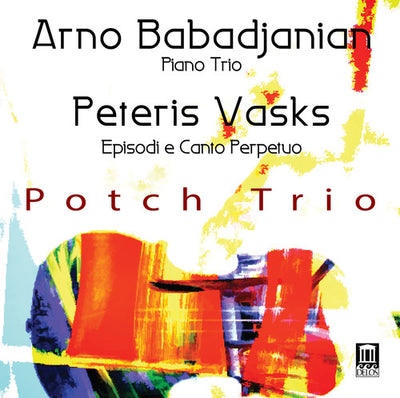
Delos exercises its penchant for rare and eclectic repertoire yet again with this recording of two highly significant 20th c. works for piano trio by Armenian master Arno Babadjanian (1921-83) and the legendary Latvian composer Peteris Vasks (b. 1946). The Potch Trio is one of South Africa’s most distinguished chamber ensembles. Their collective skill, emotional depth, interpretive intensity and glowing sound place them among the finest ensembles of their kind. “...both (works)…recognize suffering as well as bliss. Both emphasize beauty.” - Piet Koornhof
Realizing that early exposure is key to a lifetime of classical enjoyment, Amelia and pianist Carol Rosenberger (now Delos’ director), made the production of recordings for the very young one of their pet priorities. The resulting Family Classics Series (numbering more than 25 albums) has been hailed by critics and customers alike as the finest and most comprehensive series ever produced for young people. And a key component of this vibrant and varied series is the eleven-disc array of “Baby Needs” recordings. Three of these are being re-released, all with attractive new artwork. “Baby Needs Baroque” (DE 1609) is a varied and charming collection of Baroque-era jewels, selected individually for their “kid appeal.” Similarly, “Baby Needs Beethoven” (DE 1610) and “Baby Needs More Mozart” (DE 1614) offer gentle and accessible selections from their respective composers that are sure to captivate and soothe the spirits of little people … big people too! It’s family listening at its best.
A nostalgia-inspiring survey drawn from the extensive body of popular Russian WWII era songs, this album is the sequel to two all-time favorite Delos titles: Where Are You, My Brothers and Moscow Nights. Opera baritone superstar, Dmitri Hvorostovsky delivers these musical mainstays of Russian culture with relaxed classical technique and the kind of refined, yet soulful and deeply affecting emotional impact that make his concerts of these pieces wildly popular across Russia and around the world.
A Day In The Life Of Lucky - Music For You & Your Dog
Delos
CD
$13.99Jan 01, 2000
Meet the Delos pets, Lucky and Leo. Lucky (our dog) is sweet and lovable, truly the best of all friends. Leo (our cat) is a ten-year-old tabby, a noble beast indeed. Both probably share much in common with your own pets. Leo loves napping, meowing, stalking, pouncing, kneading, and grooming. Lucky's favorite activities include: excited barking, non-stop panting, and sniffing everything in sight. Whether you consider yourself a cat lover or a dog lover, no one will be able to resist these adorable furballs. Classical music has long been heralded as the most perfect form of entertainment for relaxing, introspection, joyous moments, and as a booster to our ability to focus -- why should this music only be available to humans? It's with this in mind that Delos presents a wonderful collection of classical music to accompany you and your cat or dog during the day's activities.
A winning assortment of time-tested and drug-free musical remedies for a wide variety of common ailments... ranging from mental and physical lethargy through a bad case of the blues to that up-tight, jittery feeling (among many other maladies). It's good for what ails you! This box set includes Laugh with Classical Music (DE1627), Classical Caffeine (DE1628) and Classical Chamomile (DE1629).
In addition to being the Metropolitan Opera Orchestra's principal flutist, Iceland native Stefán Ragnar Höskuldsson has forged a distinguished simultaneous career as a soloist and chamber musician. On this, his debut solo CD he offers an impressive and varied program of classic works for flute and piano by mainstream composers, plus a haunting unaccompanied flute novelty composed by a fellow Icelander. Michael McHale, with whom Mr. Höskuldsson collaborates, is one of Ireland's leading all-around pianists. "Stefán Ragnar Höskuldsson played with agility and warmth" - New York Times.
Following the success of Ceremony of Carols, Etherea Vocal Ensemble’s stunning debut album, Delos lost no time in producing their second effort. Containing several premiere performances, this CD is an enchanting mix of mostly uncommon works for female choir by Holst, Beach, Rheinberger, Mendelssohn and Rossini. While all of these works are standouts among the limited female choir rep, Holst’s third group of Choral Hymns from the Rig Veda and the Two Eastern Pictures are particularly exotic, and ripe for rediscovery.
Ms. Thomas – one of the world’s leading operatic sopranos – offers here a selection of our most beloved spirituals that may well even eclipse the legendary recordings of contralto Marian Anderson. Indra brings to them levels of sheer vocal beauty, intense emotional power and sacred sincerity that you may well have never heard in solo spirituals before … not to mention the full force of her African-American stylistic heritage.
SHOSTAKOVICH (arr. Atovmian) The Young Guard: Suite. Zoya: Suite1 • Walter Mnatsakonov, cond; 1Minsk Ch C; Belarusian RTV SO • DELOS 2001 (61: 37)
The Russian Disc label has been gone for a while now, and with it some interesting Russian repertoire otherwise not available. Apparently Delos feels our loss, since it has embarked on a rerelease of four CDs of Shostakovich film-score suites from the departed label. This is the first of the releases, recorded by the Belarusian Radio and Television Symphony Orchestra in 1995, four years after the independence of Belarus and the collapse of the Soviet Union. (I have corrected Delos’s anachronistic use of the old Soviet name.) That a so recently liberated Belarusian orchestra was willing to record these suites says something for their emotional integrity. The memories here evoked, even 50 years later, are part of a devastatingly painful collective memory of bitter losses during World War II, and at the hands of Stalin before.
It is, after all, easy to dismiss Shostakovich’s film scores as mere accompaniment to Soviet propaganda. In fact, he wrote his 34 film scores for a number of reasons; some to pay the bills and for political expediency, but many out of conviction. These two wartime films fit in the latter category. The films extol real heroism and personal sacrifice, and the composer responds with music that is poignant, inventive, and emotionally honest. Coming on the heels of the 1946 censure of the Ninth Symphony for “ideological weakness,” no doubt The Young Guard also seeks to ingratiate. And yet, with its Coates-like main theme and relatively subdued expression, this is not everyday Soviet populism. Even The Death of Heroes, a stirring funeral march in Shostakovich’s public style, suggests by its gravity that the homage to the martyred young Ukrainian resistance fighters is sincere. The 1944 Zoya is more characteristic of Soviet expectations, with its triumphalist chorus of eternal memory and bellicose marches, yet here as well, in the heartbreaking passages for muted duo violins, and the Mahlerian interlude in the “Apotheosis,” we feel the composer’s honest admiration for Zoya Kosmodemyanskaya, the 18-year-old guerilla fighter captured, tortured, and executed when resisting the 1941 invasion of Russia.
These two suites are 1950s reworkings of the film scores, with some additions, by Armenian composer Levon Atovmian. (Delos misspells it as Avtomyan.) He made a number of composer-approved arrangements of Shostakovich’s more popular music, including the familiar Ballet Suites. Atovmian’s additions here include a jaunty scherzo in The Young Guards suite composed from a fragmentary cue, and an orchestration of Shostakovich’s op. 34/14 Prelude in E?, which provides a touching Requiem, as annotator David Nice puts it, for the heroine of Zoya. With the exception of Atovmian’s banal “Song of the Young Guardsman,” inexplicably included instead of Shostakovich’s own patriotic song arrangements, the interpolations fit nicely, and the inclusion of the Prelude is a particularly apt amplification of the mood of the score.
The recorded sound is, unfortunately, reminiscent of earlier Soviet-period recordings; a bit brash and edgy in the climaxes. Violin tone is a little scratchy as well, whether from miking or substandard instruments, but in general orchestral execution is much better than competent, though more heartfelt than polished. Walter Mnatsakonov’s conducting is sensitive or rousing, as required, and the Minsk Chamber Choir is first-rate in its brief appearance. This disc joins recent Naxos and Chandos film-score releases as an important addition to the Shostakovich discography. No one who admires this composer will want to miss this, or any of the Delos series. Next up: seven suites from the early (1930–31) Alone.
What a shame that these works aren't better known by the chamber-music-loving public!
Listeners who are familiar only with Glazunov's symphonic oeuvre or incidental music could well be surprised at his string quartets. They are personal works, generally serious in tone and tersely argued, brilliantly conceived for the medium. The color and evocative imagery of his orchestral music is replaced by an ease—even a playfulness—with counterpoint that never descends into the merely academic. What a shame that these works (and similar compositions by Sergei Taneyev) aren't better known by the chamber-music-loving public!
The String Quartet No. 5 dates from 1908, toward the end of Glazunov's abruptly foreshortened compositional career. (Contrary to legend, he didn't cease composing because of "the political world changing around him" or any other such romantic nonsense. Glazunov stopped because of the extremely heavy responsibilities associated with the directorship of the St. Petersburg Conservatory, which he assumed in 1905 and held effectively until 1928.) It is one of his finest works, and a composition of great charm and subtlety, if perhaps a shade less immediately accessible than his String Quartet No 3, the so-called "Slavonic" (after its use of predominantly folk idioms).
The performing group on this release, the St. Petersburg String Quartet, was created in 1985 by Leningrad Conservatory graduates (yes, Glazunov's old stomping grounds). Despite their origins, this ensemble is in the modern "American" quartet mold of four equal voices whose balance inclines toward intense musical dialog rather than homogeneity of sound. This approach works very well in the Quartet No. 5, given its concentration on contrapuntal texture. Unfortunately, there are no currently competing versions I'm aware of on CD. An old Melodiya LP featuring the celebrated Shostakovich Quartet offers one of the finest "old style" quartets in this work, with a rich, plumy sound and extraordinary attention to dynamics; still I prefer the SPSQ's more linear reading.
Glazunov's Five Novelettes, composed in 1886, represent his other, more "public" side, offering delight to players and audiences alike without great intellectual effort. Each movement is ostensibly in a distinct nationalistic style: the first "In Spanish Style," the last "In Hungarian Style," and so on. But these are national styles seen through deliberately Russian folk-tinged glasses. While the third movement ("Interlude in the Old Style") does create a series of fine variations on what sounds like a Slavonic chant, the "Orientale" of the second movement is simply a pleasing scherzo in Glazunov's best Borodinesque manner.
Not surprisingly. The SPSQ has slightly more competition, here, and some of it is excellent. The Calvet Sring Quartet delivers a strongly nuanced 1931 reading of the "Olden Style" movement (Lys 298/9), while the Hollywood Quartet (Testament 1061, originally recorded in the 1950s) offers an energized, dynamic reading of all tlve pieces, wonderfully blended. The Shostakovich Quartet's superb tone is formidable again in several movements on another out-of-print LP (which, hopefully, someone will reissue, someday) -surely beauty of tone was on Glazunov's mind, given the expert performers at his disposal in turn-of-the-century Russia. But the SPSQ scores in the "Orientale" movement, whose trio is delivered over a vibratoless drone. I've not heard that interpretation before, but Glazunov, who was supposedly an expert on regional folk music, would probably have delighted in the effect.
All in all, this is a highly attractive CD of two rarely heard but compelling works, performed and recorded (in a closely miked environment) immaculately. Let's hope that the SPSQ continues with further explorations into the world of Glazunov's chamber music, for there are more gems out there.
Barry Brenesal, Fanfare, Issue 25:2 (Nov/Dec 2001)