Well-known to musical theater fans in London's West End, Maria Friedman made her Broadway debut in Andrew Lloyd Webber's short-lived THE WOMAN IN WHITE. Deftly turning lemons into lemonade, Friedman then ensconced herself at New York's Cafe Carlyle with a well-received cabaret act devoted to the music of Stephen Sondheim, a composer whose work she has had some experience with both on stage (PASSION, SUNDAY IN THE PARK WITH GEORGE) and in the recording studio (A LITTLE NIGHT MUSIC).
Now, Sony Classical has decided the time is right for Maria Friedman to become better-known stateside. NOW AND THEN, the singer's American solo debut, is largely made up of tracks recorded in 1995 for her first solo album in the U.K. Though only two of the tracks are newly recorded (including one with piano accompaniment by Sondheim himself), the whole CD invites the listener to give this talented Brit a long-overdue welcome.
"Friedman . . . knows how to sing, she knows how to act, and she knows how to interpret songs. 'I Happen to Like New York' is jubilant. . . . Friedman's take on Arlen and Gershwin’s 'The Man that Got Away' packs an emotional wallop. . . . [With 'Finishing the Hat,'] Friedman gives us a riveting portrait of the inner artist." - PLAYBILL
The Film Music Of Sir Richard Rodney Bennett / Gamba, Et Al
Chandos
CD · 1 disc
$21.99Nov 01, 2000
It is amazing to think that Sir Richard Rodney Bennett, knighted in 1998 for his services to music has written so much music: orchestral works, quartets, concertos, symphonies, operas, ballets, songs, madrigals, jazz pieces and much more - all totalling over 600 items! He has scored over 50 films (including some documentaries in the earlier part of his career). This album comprises a fair cross-section.
Usually we only hear Bennett's celebrated waltz from Murder on the Orient Express so the eleven-minute suite from the 1974 Academy Award nominated score is most welcome. Gamba, aided by Chandos's superbly dynamic and detailed sound, gives a thrilling reading of this glittering, sophisticated music for the smart set travelling on a mission to kill, on Europe's premier train. The music reflects the styles of that hedonistic era between the two world wars: waltzes, tangos and music played in the salon style. There is, as to be expected, an element of murky mystery and swift violence; but there is appealing elegiac material too. But overall, there is the glamour and urgency of the great powerful train itself.
From international sophistication, the prograame turns to a smaller world of rural romantic tragedy and to John Schlesinger's 1967 film of Thomas Hardy's Far From the Madding Crowd starring Julie Christie, Peter Finch, Alan Bates and Terence Stamp. Although the film had mixed reviews, Bennett's score was Oscar-nominated. Bennett wrote some beguiling pastoral themes, notably the poignant Bathsheba love theme. Opposed to this delicacy, is some very astringent, harsh, dissonant folk-like material that underlies the cruel reality of rural life like the loss of the shepherd's (Bates) flock of sheep (they throw themselves over the edge of a cliff) leaving him penniless and unable to pursue his love, Bathsheba. There is also bravado music for the proud, womanising soldier (Stamp), counterbalanced with elegiac material and music that, in its sense of chill isolation, recalls Holst's Egdon Heath.
Bennett has arranged his music for the 1972 film Lady Caroline Lamb as an elegy for orchestra and that Cinderella of the orchestra, the viola. His music for this film, which was about Lady Caroline Lamb's disastrous obsessive love for the poet Lord Byron, is distinguished by a very appealing tender romantic melody that is redolent of the Lady's yearning. The work is presented in two movements. Before the love theme is stated in the first of these, there is headlong skittish, neurotic music portraying the rash, foolish woman. Afterwards comes some comically ironical military music of some pomposity which includes (Lady Lamb's?) sighs before the mood darkens - perhaps signifying Lady Lamb's encroaching madness. The second movement reprises the love music, which becomes the theme for a set of variations: some dreamily nocturnal, some passionate, some troubled. Philip Dukes is a sensitive and refined soloist.
Cynthia Miller adds an ethereal touch, playing her ondes martenot for Bennett's Enchanted April score. This 1991 Merchant Ivory production dealt with the lives and loves of a handful of English ladies spending an idyllic month in an Italian villa. Accordingly, Bennett responded with a mellow nostalgic score, in which the ondes martenot transports the characters, and us, away from the ordinary, everyday world - to somewhere that is extraordinary and enchanted. His music is very delicate, atmospheric and impressionistic; and very reminiscent of both Debussy and Ravel (Ravel in Chinoiserie mode). At one point this delicate fantasy is grounded by the strains of Elgar's Chanson de matin played on a cor anglais but the peaceful idyllic mood is soon reinstated. A lovely work that perhaps is too fragile for its 19-minute length.
The concert is completed by two shorter works: the Nicole's haunting theme from the 1985 TV production, Tender is the Night, although I would argue that this is not its premiere recording for I remember hearing it the soundtrack recording I purchased at that time. I would also argue that Nicole was rehabilitated by the man she married and it was the strain of that work which caused his destruction! The concluding item is the touching and plaintive love theme for Four Weddings and a Funeral that tended to be overshadowed by more familiar pop source music.
Gamba leads the BBC Philharmonic in committed, romantic performances. A delightful album and strongly recommended.
A film score is inextricably linked with the image, it is composed according to the wishes of the director; sometimes it becomes a separate sphere of art. The beauty of the intertwined, overlapped melodic lines spun from dreams and longings and the depth of the harmonic structures occasionally introduce the listener into an unreal, irrational world, a world of illusion, dreams... I couldn't resist them - Maksym Rzeminski
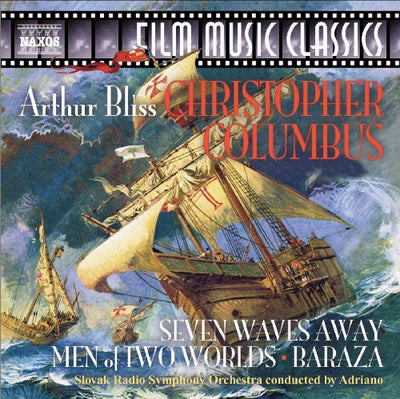
After Things to Come, his most famous film score, Arthur Bliss composed the soundtrack scores of CHRISTOPHER COLUMBUS and MEN OF TWO WORLDS, two dramatic pictures which are largely forgotten today. Their music, however, enlivened by Spanish and African rhythms respectively, is colourful and interesting enough to be revived in the form of concert suites. Men of Two Worlds contains BARAZA, a miniature concert piece for piano and orchestra (like Addinsell’s “Warsaw Concerto” from Dangerous Moonlight, Bax’s Oliver Twist, Rózsa’s Spellbound and Herrmann’s “Concerto Macabre” from Hangover Square), with additional male choir. The three orchestral pieces from SEVEN WAVES AWAY are another real discovery and if anything even more deserving of concert performances than the two earlier scores.
There is to be a journey, not too far away, because, after all, it's nicest at home, isn't it? A journey for invited guests, offshore and onshore, by boat and by bus, and a few steps on foot. A journey full of surprises. A journey as a performance. A journey into the night... When looking for a word to best describe Harald Weiss' musical oeuvre, the most applicable certainly appears to be "cross-over". He has been honored with numerous prizes and awards for his artistic work: among others, the Rome Scholarship of the Villa Massimo, the Lower Saxony Scholarship for Film and Music, and a prize from the Premier TV station for his video clips.
Rachmaninov: The Bells; Prokofiev: Alexander Nevsky / Evgeny Svetlanov
ICA Classics
CD · 1 disc
$14.99May 29, 2012
RACHMANINOFF The Bells.1 PROKOFIEV Alexander Nevsky2 • Evgeny Svetlanov, cond; 1Daniil Shtoda (ten); 1Elena Prokina (sop); 1Sergei Leiferkus (bs); 2Alfreda Hodgson (mez); 1BBC SO & Ch; 2Philharmonia O & Ch • ICA ICAC 5069 (78:30) Live: London 14/19/2002, 21/30/1988
Sometimes, archive recordings have the air of, “Well, as long as we have access to it, let’s release it on CD.” Some of ICA Classics’s BBC discs have presented fairly unexceptional music-making, to say the least. Here, though, we have one absolutely fabulous performance (The Bells) and one very good one (Alexander Nevsky), and I would even give them preference over Svetlanov’s studio recordings of these same works.
With gorgeous live sound to boot, this version of The Bells really rings my chimes, so to speak. This is a work that stands or falls with the quality of the chorus. When I first auditioned this disc, I was unaware that I was not hearing a native Russian group; that’s how good the BBC Symphony Chorus is here. Furthermore, some recordings of this work content themselves with wimpy or emotionally anonymous soloists. Tenor Daniil Shtoda, on the other hand, displays brilliance of both sound and temperament, and the first movement, depicting the silver sleigh bells of youth, has great élan. Sergei Leiferkus is appropriately mournful in the funereal fourth movement; as with Shtoda, familiarity with the language and the style pays off. I am less impressed with soprano Elena Prokina, who is affected by what used to be called a “Slavic wobble,” but even she convinces this listener with the involvement of her singing. Svetlanov tended to get slower as he got older. Here, though, he never drags, and he points up the contrasts between the four movements with vivid color and attention to mood. The booklet note indicates that he looked frail on this occasion, and in fact, he died just a few weeks later. There’s nothing infirm about his conducting here, though.
The sound in Alexander Nevsky is more recessed and even a little muffled, although not fatally so. It doesn’t shoot the performance in the foot, but of course this is music that benefits from as much sonic realism as engineers, live or in the studio, can muster. Svetlanov is more introspective here. I get the feeling that he was trying to purge the score of its inherent vulgarity without cutting down on its excitement. If that was the case, he largely succeeded. The Philharmonia Chorus can’t hide its Englishness (for better or worse) and mezzo Alfreda Hodgson is rather maternal in her sixth-movement solo. Still, there is a lot to like here. In some ways, this is like André Previn’s EMI studio recording in its refusal to confuse weight with ponderousness, its avoidance of bombast, and its rather sensitive demeanor. (I recently discovered the Previn on an English EMI LP, and it immediately moved to the top of my list, so my comparing Svetlanov to Previn is meant as high praise.) It’s better than Svetlanov’s harshly recorded and only superficially exciting Soviet-era studio recording.
No sung texts are included, but do you really need them? The booklet note includes an interesting bit of trivia: As a child, Svetlanov appeared onstage in the role of Trouble in Puccini’s Madama Butterfly. He also made, according to annotator Colin Anderson’s reckoning, more than 3,000 recordings for Russian, Japanese, French, British, and Dutch companies. And you thought Neeme Järvi made a lot of CDs!
Film Music Of Erich Wolfgang Korngold Vol 2 / Gamba, BBC PO
Chandos
CD · 1 disc
$21.99Oct 01, 2007
Released in July 1940, 'The Sea Hawk' was Korngold's last swashbuckler, and is arguably the finest film ever made in the genre. Certainly it is one of Errol Flynn's greatest films, and had a lavish budget for its time of 1.7m. One of the most difficult assignments of Korngold's career, it required a score of extraordinary length and complexity. The music was superbly multi-layered and thematically complex, literally sweeping the film along and matching its extraordinary visuals. Composition began just two days after the filming had been completed: in a special projection room equipped with a piano, Korngold had the reels of film run for him repeatedly while he improvised his music on the piano to the running footage. Later, he would then complete a full, annotated piano score. His training in the late symphonic traditions served him well. This recording has been very much a personal project for Rumon Gamba who comments, 'as with the rest of the Chandos Film series I very much wanted to keep the music limited to a single disc, instead of being dogged reconstruction of the complete score, including every single cue - some being just a quick trumpet figure or drum roll. I felt it was more important to represent the symphonic sweep of the score which is one of this film's greatest strengths'. Gamba has created a comprehensive 'suite' of six 'movements' that follows the action chronologically and only leaves out some insignificant cues and general repetitions. He continues, 'I believe that hearing Korngold's score in this manner will make for a wonderful listening experience representative of the narrative and in keeping with the spirit of this marvellous picture'. The BBC Philharmonic performs these scores with a symphonic precision and energy familiar with the first volume of Korngold's film music, released in 2005. Reviewing Volume 1, 'Music from the Movies' observed that 'Chandos has been doing great things in the film score re-recording world over recent years...With this release, however, they break new ground...this Chandos CD is for me the crowning achievement so far of what was already an impressive addition to the Golden Age film music'.
Chandos Movies is one of the best-known film-music based labels in the industry, and has received tremendous critical acclaim. The series is especially associated with the conductor Rumon Gamba, whose understanding of and enthusiasm for the genre is famous. Vaughan Williams' film music ranks amongst the very finest ever written, and this CD includes some of his best examples. This disc is especially important as some of the material has never been recorded before. The result is a hugely important release which will be of interest to both film music buffs and fans of Vaughan Williams.
Chandos' latest release in its film music series features the film music of Sir Arnold Bax. Comprising two of the composer's most important film scores, Oliver Twist and Malta, GC. This disc features the first complete Oliver Twist, in an edition specially compiled for this release. Both these works are rare in the catalogue. Recorded in: Studio 7, New Broadcasting House, Manchester 24 & 25 September 2002 Producer(s) Brian Pidgeon (Executive) Mike George (Recording) Sound Engineer(s) Stephen Rinker
As Time Goes By & Other Classic Movie Love Songs / Mancini
Sony Masterworks
CD · 1 disc
$17.99Dec 13, 2007
Track Listing 1. As Time Goes By 2. One For My Baby 3. Everything I Do (I Do It For You) 4. Stella by Starlight 5. Windmills of My Mind 6. Crazy World 7. That Old Black Magic 8. Unchained Melody 9. Mona Lisa 10. Call Me Irresponsible 11. Two For the Road 12. It's All There 13. Summer Knows, The 14. Tender Is the Night 15. Charade
The Film Music Of Alan Rawsthorne / Gamba, BBC Philharmonic
Chandos
CD · 1 disc
$21.99Mar 01, 2000
Alan Rawsthorne's music was the soundtrack to adventure. Between 1937 and 1964, he scored 27 films, most with a military or adventurer's theme. Bold brass and soaring strings characterize his vivid musical illustrations of conflict and courage. His music has a larger than life quality, fitting perfectly with the big screen. The regal style originates from a time when movies were still magic and audiences regarded performances as major events. Rawsthorne captures the essence of drama on the epic scale required by the stories. Recorded in 1999 by Rumon Gamba and the BBC Philharmonic, this album improves upon the original soundtracks with superior sound quality.
Romantic music for the screen - smooth and touching.
3453190.az_GUNNING_Poirot_Variants_1.html
GUNNING Poirot Variants.1 La Móme Piaf.2 Under Suspicion. Cold Lazarus. Rosemary and Thyme Caprice.3 Rebecca.4 Pollyanna. Firelight. When the Whales Came.5 The Hollow. 5 Little Pigs.6 Lighthouse Hill • Rumon Gamba, cond; BBC Phil; 1Martin Robertson(sax); 2,5Nicole Tibbels (sop); 2Matthew Compton (acc); 3Craig Ogden (gtr); 4Julia Bradshaw (vc); 6Yuri Torchinsky (vn) • CHANDOS 10625 (75:50)
Some 20 years ago a friend alerted me to a limited-edition recording of the score for a British television documentary, Yorkshire Glory. This gloriously lyrical music in a richly pastoral vein was my introduction to the work of Christopher Gunning (b.1944), a composer who is reinvigorating the timeless tradition of Vaughan Williams, Holst, Finzi, et al. However, this pupil of Richard Rodney Bennett as well as Edmund Rubbra can, when appropriate, also demonstrate an acute awareness of postwar developments in English music, as this generous and varied compendium of his film and television music over the past two decades makes clear.
This collection marks the first time in Chandos’s indispensable movie-music series when a living composer has directly participated in the presentation of his scores. Gunning has prepared special versions for this particular project in the form of small-scaled but through-composed tone poems, not the customary sequence of disconnected excerpts. So the listener can experience this disc as a kind of multimovement suite of diverse moods, because of the high consistency and individuality of the writing.
Although only a few of the films and television series will be familiar to American audiences, two of the well-known highlights open the program. The Poirot Variants for saxophone and orchestra—a totally independent work from the composer who gave us the lovely Thames Rhapsody for the same combination (available on a Dutton Epoch disc of several years ago)—is based on the well-known wily and insinuating theme that introduced the popular BBC series starring David Suchet. The following piece, for accordion and orchestra, is derived from music for the acclaimed film biography of French legendary singer Edith Piaf, La Vie en Rose. The alternation of film and television scores continues with the 1990s thriller Under Suspicion starring Liam Neeson, and the great television dramatist Dennis Potter’s final effort, Cold Lazarus. Both of these illustrate Gunning’s darker and more melodramatic side.
Then follow a number of lesser-known television productions: a sprightly, folk-inflected caprice for the series Rosemary and Thyme; yet another adaptation of the romantic perennial Rebecca (a haunting prelude for cello and orchestra); the family-styled Pollyanna (full of the usual good tunes); two individual Poirot episodes—The Hollow and Five Little Pigs—and finally an obscure British film (never issued here), Lighthouse Hill.
The most impressive compilations here are drawn from two somewhat better-known films, the romantic dramas Firelight of 1997 and When the Whales Came, the earliest score included, from 1989, where Gunning’s use of an eerie soprano vocalise recalls Vaughan Williams’s Scott of the Antarctic music. Both of these emphasize Gunning’s exceptionally scenic imagination and his natural gift for the telling and memorable theme garbed in a lustrous orchestration.
As always in this series, conductor Rumon Gamba, the BBC Philharmonic, and the Chandos recording staff offer this endlessly appealing music in the best possible light. Anyone who loves the traditional school of English music will not be disappointed.
FANFARE: Paul A. Snook
The case of Christopher Gunning has been well and truly taken up by Chandos. Last year we had two of his six symphonies and the oboe concerto (review). Now the genre that brought him to wide attention is tackled.
It's mostly suave music for television. We start with the Poirot Variants for sax and orchestra. This is a combination he has tackled before in On Hungerford Bridge on ASV (review). A smooth fantasy touches on train rhythms, Buenos Aires dance-halls and a worldly romantic lassitude. Martin Robertson's saxophone presents the music without rough edges, subtle and undulating: not a trace of rasp. La Môme Piaf - 2007 film – quite rightly fears no cliché in deploying the accordion. It's all very romantic. Under Suspicion leaves such smoothness behind in a gruff nightmare-image speaking of the ruptured emotional landscapes of late Malcolm Arnold … though tenderness does arrive. The Cold Lazarus (1996) music is at first ascetic and doom-laden with whip-like dactyls reaching out. From this Fahrenheit 451 chill arises the most glorious romantic theme - almost Born Free or Howard Hanson Second Symphony. The Rosemary and Thyme Caprice has the closely recorded Craig Ogden confiding Scarborough Fair to the listener in an English countryside evocation. Rebecca showcases the cellist Julia Bradshaw in another dark-clouded piece completely in keeping with the brooding and intensely romantic spirit of the Daphne du Maurier book. It's well worth hearing. Innocent folk voices abound in Pollyana which is heavily freighted with charm. Woodwind solos and piano are prominent. Firelight - 1997 film - is among his most popular scores yet is quite low key and contained. This is not a grand statement and the music is heavily characterised by Yuri Torchinsky's tremblingly vulnerable violin. When the Whales Came - 1989 film - is quite naturally threaded through with the spirit of the sea. There are added elements such as a slowed whale-song recording (like Hovhaness and George Crumb, in that sense only) and a vocalising soprano. The Hollow and Five Little Pigs are from Poirot episodes. The first is very romantic and memorable. The second is sly and ambivalent in mood as voiced by the solo violin. Lighthouse Hill - film, 2004 - is again hyper-romantic and rounded in its progress. I was rather sad that there was nothing here from Geoffrey Household's Rogue Male or from Porterhouse Blue or from Middlemarch.
A wide soundstage complements a lavish audio image each of which articulates the often simple textures yet meets with a fierce embrace the grander statements.
Barber, Korngold: Violin Concertos / Alexander Gilman
Oehms Classics
CD · 1 disc
$14.99Feb 28, 2012
BARBER Violin Concerto. KORNGOLD Violin Concerto. WAXMAN Carmen Fantasy & • Alexander Gilman (vn); Perry So, cond; Cape Town PO • OEHMS 799 (68: 09)
& WILLIAMS Schindler’s List: Theme
Except for John Williams’s theme from Schindler’s List, the compositions on violinist Alexander Gilman’s program with Perry So conducting the Cape Town Philharmonic Orchestra all suffered a certain amount of neglect after their first performances and recordings. Isaac Stern (and Louis Kaufman and Robert Gerle) brought Samuel Barber’s concerto to the attention of listeners, and now it has just about entered the repertoire, and students adopt it for competitions. Alexander Gilman produces a glowing tone from his Giovanni Battista Guadagnini violin, but the engineers don’t set him so far forward as Columbia’s did Isaac Stern; if Gilman plays with less ruddy energy, he more than compensates for it in subtlety and refinement. His generally more relaxed approach doesn’t prevent him or the orchestra from soaring in the climactic moments. Oehms’s engineers have set him just a bit forward, with just enough of the spotlight focused on him to lend him soloistic prominence. He and So take their time in the slow movement without giving even a hint of immobility; in the middle section, his tone grows temporarily as glutinous as Mischa Elman’s. And at last, alchemist Gilman transmutes even the finale’s most mechanical perpetual-motion elements into musical gold.
Erich Wolfgang Korngold’s concerto (like Piotr Ilyich Tchaikovsky’s) has also come a long way from the days in which Jascha Heifetz’s recording might have intimidated other violinists from trying their hands in the work (even if Irving Kolodin’s dictum “more corn than gold” hadn’t already done so) but also for years represented the only entry into the catalog. In the last decade, especially, many violinists have taken it up, many of them, notably perhaps Nikolaj Znaider (RCA 710336, Fanfare 32:6) taking the first movement at a much slower tempo than Heifetz’s. But while playing the movement more slowly for musical reasons may be defensible, Gilman seems also to struggle in its quicksilver technical passagework, though he soars in its rhapsodic lyrical moments (at least he attacks the double-stops about halfway through the movement with a sort of abrasive gusto). Still, at almost 10 minutes, the first movement sounds very slow, creating despair that the expected climaxes will never arrive. Heifetz took 7:47 in his 1953 studio recording and 7:46—always consistent, that Heifetz—in a 1947 live performance; but Anne-Sophie Mutter took 8:40; Philippe Quint, 8:48; James Ehnes, 8:57; Gil Shaham, 9:03; and Znaider, as mentioned, 9:19, and finally, Gilman, at 9:44, an obvious pattern. The slow movement also seems to stall in this way, although the lush sonorities that So draws from the orchestra gives listeners something to enjoy in the waiting room; Gilman’s corresponding timbral lushness extends from the top to the bottom of his violin’s range, and together violin and orchestra collaborate in a richly atmospheric reading of the movement. The tranquil conclusion, despite its near immobility, provides an effective lull before the boisterous intrusion of the finale’s theme. But Gilman balances percussive aspects with Heifetz’s penetrating clarity in the upper registers during the finale’s lyrical interludes, and fashions a climax of cinematic sweep.
Franz Waxman’s Carmen Fantasy, now, according to some, preferred to Sarasate’s similar work by Russian violinists, also has cinematic connections—and again to Heifetz, with whom negotiations for playing the violin solos in Humoresque broke down (Stern finally being engaged). Nevertheless, Heifetz played and programmed the work from the beginning. Gilman’s reading sounds at the same time a bit warmer and perhaps a bit cheekier, and even a bit more seductive. The program concludes with a rather lugubrious reading of the theme from John Williams’s score to Schindler’s List.
Those seeking these particular works on CD should find Gilman’s readings more than satisfactory even if Heifetz still reigns supreme in Korngold, with either Heifetz or Leonid Kogan occupying similar positions in Waxman’s chestnut—at least for sheer brilliance. Warmly recommended.
Chandos Movies is one of the best known film music labels in the industry, and has received tremendous critical acclaim. The series is especially associated with the conductor Rumon Gamba, whose undertstanding and enthusiasm for the form shines through. Vaughan Williams's film music ranks amongst the very finest ever written, and this CD contains some excellent examples. What makes this disc so important is that some of the material has never been recorded before, music which has been painstakingly assembled by Chandos' in-house arranger and music researcher, Stephen Hogger. The result is a hugely important release which will be of interest to both film music buffs and fans of Vaughan Williams.