Hong Kong TV & Movie Classics / Nishizaki, Hong Kong Philharmonic
Marco Polo
CD
$19.99Mar 11, 2016
This new release contains compositions from Hong Kong TV and Movie Classics. Violinist Takako Nishizaki is the featured soloist on this recording. The works are performed here by the Hong Kong Philharmonic Orchestra, conducted by Henry Shek, Varujan Kojian, and Kenneth Jean.
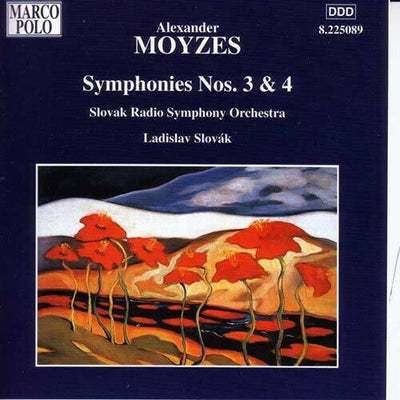
Moyzes: Symphonies No 3 & 4 / Slovak, Slovak Radio So
Marco Polo
CD
$19.99Feb 01, 2001
This second volume in Marco Polo's crucial survey of the symphonic cycle by the most prominent Slovak symphonist of the first half of the past century—Alexander Moyzes (1906-84)—comprises two consecutive though quite contrasted works.
The Third or "Little" Symphony of 1942 is one of the composer's shortest and least problematical, and thus an excellent point of entry into his musical world. It is adapted from an earlier wind quintet, and its atypical five-movement format projects an easygoing and celebratory character. Though it opens with a near-Beethovenian motto-motif, which recurs in the finale and thus helps the piece from lapsing into a species of symphonic suite, the symphony quickly springs into an essentially joyous and eventful kind of momentum. With its relatively compact movements—a Larghetto Variazioni, Presto Scherzo, and Largamente Intermezzo framed by two highly charged Allegros— the work is suffused with Moyzes's very personal but also universalized distillation of the Slovak folk spirit.
The Fourth Symphony, however—initially written during the dark days of World War II and extensively revised in 1952—is a very different kind of piece. Scored for a large orchestra and running 40 minutes, it is among the longest and most elevated of Moyzes's 12. Utilizing once again an integrative motto-theme, it is usually interpreted as both a protest against war and a healing evocation of the Slovak past and countryside. The 16-minute opening Andante con moto sets the tone for the whole work: one of expansive breadth and slowly unfolding narrative where the heroic and epic strains generate a high level of majesty and grandiloquence. These moods carry over through the quasi-Impressionist textures of the Adagio (in which a brief scherzo flare-up is embedded) and reach fulfillment in the guardedly affirmative Allegro moderato finale. Although the annotator speaks of stylistic parallels with Sibelius and Mahler, to these ears the idiom remains tenaciously Slovak in sonority and personality.
The veteran conductor Ladislav Slovak has been identified with the Fourth Symphony over many years, having recorded an analog version in the early 1960s. That earlier performance was perhaps somewhat tighter and more forceful than this more relaxed approach of three decades later. Nonetheless, this is a most sympathetic reading that succeeds in melding Moyzes's tendencies toward the rhetorical and the episodic into a satisfyingly coherent whole.
Another illuminating installment in the reconstruction of the mosaic of 20th-century Czech music, and an essential purchase for those whose interest focuses on the modern symphony.
Avshalomov: Orchestral Works Vol 1 / Asin, Avshalomov, Et Al
Marco Polo
CD
$19.99Jan 01, 2000
REVIEWS: American Record Guide (7-8/00, p.75) - Recommended Fanfare (1-2/00, p.195) - "...Fine performances from the Moscow Symphony Orchestra....Nadine Asin makes a lovely job of the Flute Concerto, and Avshalomov 'fils' and 'petit fils' keep the music moving along brightly and buoyantly..."
Chinese Evergreens / Jean, Yomiuri Nippon Symphony
Marco Polo
CD
$19.99Mar 11, 2016
Chinese Evergreens contains timeless pieces of Chinese folk music. Performed by Yomiuri Nippon Symphony Orchestra under the direction of Kenneth Jean, these songs are given new life for a new generation of listeners. Songs include Plum Blossoms in the Snow, The Evening Bells from Nanping, Flowers Are Not Flowers, and many more.
Those who’ve followed Marco Polo’s Louis Spohr string quartet cycle from its inception will know what to expect from this final installment. Both the A major and B minor quartets are extremely well written for the medium, contain lovely tunes all around with lots of chromatic surprises, and feature the first violin working overtime in the virtuosity department. Some of the Op. 61 Allegretto finale’s modulations are as fancifully discursive as Schubert’s, while the Op. 30 Adagio owes more than a little to Mozart’s K. 428 quartet.
However, original touches leap out, such as the Op. 30 Menuetto’s full-bodied pizzicato accompaniments, and the D minor Variations’ ingenuous yet formidably difficult figurations. In fact, the long Op. 61 opening Allegro might be described as a violin concerto that gives no respite whatsoever to the soloist! The Moscow Concertino Quartet doles out plenty of warmth and expressive nuance in the way of vibrato and portamento, although the rather grainy sonics exaggerate the ensemble’s timbral stridency in loud passages and occasional intonation problems. Still, the performances’ virtues largely outweigh the drawbacks: sample the well-controlled transitions and sustained soft playing in the lengthy yet consistently interesting Op. 30 finale to hear the Moscow musicians at their best. Self-recommending to Spohr fans.
Despite charitable funds raised by the Fortune and Viennese Kreutzer polkas revolutionary Habsburg insurgencies became a dangerous fact of life in the Vienna of 1848. Strauss (the Elder) demonstrated solidarity through his Austrian National Guard March lampooning the old order with his March of the Legion of Students. Heard on this recording in it's original more transparent orchestration and without the drum roll the irrepressibly festive Radetzky March celebrated military victory in Italy and became his most famous work. Viennese citizens filled the carnival season ballrooms and the escapist Stress Relievers waltzes which conclude this recording roused frenzied cheering.
Latin-American Classics - Gianneo: Piano Works Vol 1
Marco Polo
CD
$19.99May 01, 2002
An Argentinian composer of Italian origin, Luis Gianneo is much lesser-known than his slightly younger colleague Alberto Ginastera. His music however clearly paves the way for Ginastera’s in that much of it is, in one way or another, folk-inspired. Many of these pieces actually use Argentinian folk rhythms rather than quote or rhapsodise on folk-tunes, much in the same way as in Bartók’s so-called imaginary folklore. Indeed, Gianneo’s music is never slavishly nationalistic (i.e. in the narrowest meaning of the word) or merely picturesque. It nevertheless is deeply rooted in the local tradition as well as in mid-20th Century musical language. His piano writing is clearly of its time, and often brings Prokofiev, Stravinsky or Bartók to mind.
The Suite of 1933 is the earliest work in this selection and a good example of Gianneo’s musical thinking. It successfully blends folk-like rhythms and phrases with a more cosmopolitan idiom. It is a brilliant piece, full of energy and colourful contrasts.
The Sonatina, completed in Paris in 1938, is much more Neo-classical in outlook though its main themes are again often redolent of folk music. The thematic material is moulded in more traditional forms and handled with much economy and clarity. It never outstays its welcome.
The Piano Sonata No.2 (1943) is a much more ambitious piece, though it has still much in common with the earlier works, especially in its reliance on traditional Neo-classical forms and Argentinian rhythms. In this, as in the earlier pieces, there is much contrapuntal activity which Gianneo expertly masters; but again his colourful music is never blandly academic or dryly austere.
The shorter Improvisación of 1948 is set in a clear ABA form. The gently undulating outer sections frame a more impassioned middle section. A beautiful short piece that should become a popular encore, were it heard more often.
The Piano Sonata No.3, completed in 1957, is another ambitious, substantial piece. It is a much more troubled work than any of the other ones recorded here. According to Dora De Marinis, this may reflect the composer’s sorrow at the death of his wife but also the turbulent political situation of the country at that time. In any case, the music here is rather more austere, harsher, though it still has its share of folk-inspired material. The way in which this material is handled already points towards Gianneo’s later music. This is characterised by a greater economy of resources as is evident in the masterly Seis Bagatelas, written between 1957 and 1959. This is one of his last piano pieces, and, as far as I am concerned, the finest work here. The folk material is less prominent and the counterpoint is in strict two-part writing, whereas the musical idiom now tends towards some free atonality. The music is still very colourful, inventive and superbly written for the instrument.
Gianneo’s attractive piano music is well-served by the present performers and is given a warm, natural piano sound. I for one hope that Volume 2 will soon be released, for, judging by the present recordings, Gianneo’s music greatly deserves to be re-assessed, the more so when it is played, as it is here, by dedicated performers.
Petitgirard: The Elephant Man / Sykorova, Rivenq, Et Al
Marco Polo
DVD
$16.49$32.99Save 50%Sep 20, 2005
Laurent PETITGIRARD (b. 1950)
Joseph Merrick, The Elephant Man
Elephant Man - Jana Sykorova Doctor Treves - Nicolas Rivenq Tom Norman, showman - Robert Breault Mary, nurse - Valérie Condoluci Eva Lükes, matron - Elsa Maurus Carr Gomm, hospital manager - Nicolas Courjal The Coloratura - Magali Léger Jimmy, showman's assistant - Mari Laurila-Lili Nice Opera Chorus · Nice Philharmonic Orchestra Conducted by Laurent Petitgirard
DVD 9 · NTSC · Regions 1-6 Picture Format: 16:9 Audio Formats: Dolby Digital 2.0 · Dolby Digital 5.1 Subtitles: English · French · German Running time: 166 mins
Written in 1998, Petitgirard's opera differs from David Lynch's cult film in offering an entirely different perspective on the tale of Joseph Merrick, born in 1863 with horrific deformities, exhibited as a freak at the circus, taken in by Dr. Treves at the London Hospital and subsequently afforded celebrity status. Where the film is based largely on Dr. Treves' memoirs, the opera is based on biographies of Joseph Merrick giving his character a more central focus than in the film.
"The opera is many ways the most original treatment of the story... The most revolutionary aspect of the opera is the writing of Merrick's part for a female singer. At first tempted to make Merrick a counter-tenor, Petitgirard finally decided that only the contralto voice could give him the effects he wanted. Certainly, in the theatre, this helps to create the aura of strangeness, of otherness, which Merrick personifies." -- The Independent "Petitgirard's musical vocabulary reflects his French heritage - the influences of Fauré, Ravel, Poulenc and Satie are evident - but his subtlety, melodic gift and sensitivity to the drama make him well-equipped to inherit the mantle and create his own outstandingly original idiom... No doubt [the opera] would prove even more powerful onstage than on disc." -- Opera News