Debussy: Orchestral Works / Cambreling, Southwest German Radio Symphony
SWR
CD
$9.99Aug 10, 2018
This album presents two major orchestral works by Claude Debussy – Images and La Mer – alongside the delightful Danses for harp and orchestra. The French conductor Sylvain Cambreling highlights all the charm of these colorful scores. French-born conductor Sylvain Cambreling is a musician with big ideas. A thought-provoking, colorful and dramatic artist, he has a flair for grabbing the attention of audiences, yet his originality is rooted in thorough knowledge of musicology. As the Chief Conductor of the SWR Sinfonieorchester Baden-Baden und Freiburg, and Principal Guest Conductor of Klangforum Wien, he has offered ample proof of his gifts for imaginative programme-planning and persuasive championship of contemporary music.
This album gives an interesting overview of Ravel's orchestral output, with a mixed programme of works from different periods of his career. The outstanding soloists are soprano Arleen Augér and violinist Pina Carmirelli; conductor Ernest Bour presents wonderfully nuanced performances. Some of Ravel's most famous pieces are featured, including a beautiful interpretation of his song cycle Sheherazade, which tells the story of the narrator of The Arabian Nights. Another notable inclusion is Daphnis et Chloe Suites 1 and 2. Daphnis et Chloe began as a one act ballet by Ravel, and was later adapted by the composer into the two Suites heard here. This album is part of a new re-release series (Century Classics) consisting of SWR music bestsellers. The series is competitively priced, optically highly attractive and contains acclaimed SWR recordings mostly of the SWR orchestras and their chief conductors.
Mozart: Piano Concertos Nos. 9 & 19 / Haskil, Schuricht
SWR
CD
$13.99May 13, 2016
When these recordings were taken in 1952 and 1956, Clara Haskil was still climbing to stardom. Her perceptive artistry put her in a class above other pianists, and gave her the ability to interpret Mozart’s music in such an organic, natural way that these performances are definitely timeless. This release feature’s Clara Haskil’s performances of Mozart’s Concertos Nos. 9 and 19. Carl Schuricht conducting the Radio-Sinfonieorchester Stuttgart des SWR is equally perceptive in his interpretation of the score, beautifully complimenting Ms. Haskill.
Kirill Kondrashin was one of the most prominent Russian conductors in the generation following Mravinsky. He was born in Moscow in 1914 into a family of musicians, studied at the Moscow conservatory under Boris Khaikin, went to Leningrad in 1936 to be the conductor of the Maly Theater and to the Bolshoi Theater in Moscow in 1943. At the same time, he was conducting various Russian concert orchestras. In 1956 he left the Bolshoi Theater to devote himself entirely to the concert podium. He became the preferred partner of such great soloists as Emil Gilels, Leonid Kogan, David Oistrach, Sviatoslav Richter, and Mstislav Rostropovich. Tully Potter called him “probably the best concert accompanist of the twentieth century.” After Kondrashin’s work had increasingly shifted out of the country, he emigrated to the Netherlands in 1978 and became permanent conductor of the Amsterdam Concertgebouw Orchestra along with Bernard Haitink. From his home in Amsterdam, he kept up with his duties as guest conductor, including many at various West German radio stations. His concerts left a deep impression in Munich, and Kondrashin succeeded Rafael Kubelik as new Chief Conductor of the Bavarian Radio Symphony Orchestra in 1982. Before he was able to take over his new position, however, Kondrashin died of a heart attach shortly after a concert in Amsterdam in March 1981.
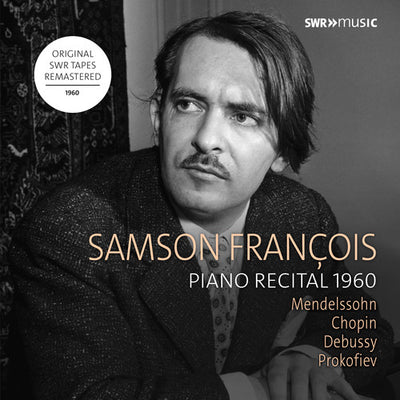
Samson Francois was considered an enfant terrible, eccentric and flamboyant; his life and demeanor were rather provocative and subjectivist. This release offers the rare occasion to hear the French virtuoso in a live recording from 1960, containing virtuosity milestones of the piano repertoire, such as Chopin Piano Sonata no.2 and Sergey Prokofiev Piano Sonata no.7 as well as delicate miniatures by Mendelssohn and Debussy. In 1943, be reaching the age of 20, Samson François won the Long-Thibaud Competition and thereafter embarked on a career, one of international scale once World War II had ended. Even during the war, Jacques Thibaud brought François to the attention of Walter Legge, the English recording producer turned wartime concert organiser; François was soon flown to England for an extended tour of factories and camps. From 1945 he toured regularly in Europe, and in 1947 he made his first appearances in the USA. He subsequently played all over the globe, including Communist China in 1964. Concentrating on the Romantic piano literature, and especially the French repertoire, he was acclaimed for his performances of Franz Liszt, Robert Schumann, and Frédéric Chopin, as well as Gabriel Fauré, Debussy, and Ravel.
The present release contains Hector Berlioz's complete concert overtures, including the one written for his early opera Les francs-juges, superbly performed by the SWR Sinfonieorchester Baden-Baden und Freiburg directed by the French conductor Sylvain Cambreling. French composer Hector Berlioz wrote a number of overtures, many of which remain concert staples. They include not only overtures intended to introduce operas, but also independent concert overtures. The album opens with one of the most popular overtures, Waverly, Op. 1. Composed in 1828, it was inspired by Sir Walter Scott’s Waverly novels. Also included are Le Carnaval romain, Op. 9, a standalone overture intended for concert performance made up of material from the opera Benvenuto Cellini, Le Corsaire, Op. 21, and others. This album is part of a new re-release series (Century Classics) consisting of SWR music bestsellers. The series is competitively priced, optically highly attractive and contains acclaimed SWR recordings mostly of the SWR orchestras and their chief conductors.
Suk: Asrael - Krejci: Serenada / Ancerl, Southwest German Radio Symphony Baden-Baden
SWR
CD
$13.99Feb 09, 2018
This is the only available official recording of Karel Ancerl conducting Josef Suk’s Asrael. Asrael is central to Josef Suk’s oeuvre and an outstanding work in the Czech music repertoire. The prominent standing of the conductor Karel Ancerl is due mainly to his success in establishing the Czech Philharmonic as one of the world’s most eminent and successful orchestras in only a few years’ time. Under his great predecessor Vaclav Talich, the most significant Czech conductor of the twentieth century, the orchestra was able to flourish primarily in its home country, yet under Ancerl it became, despite the restrictions of the Cold War, an orchestra that was celebrated everywhere, whose 1959 world tour went down in history as the longest and most extensive ever up to that time. A stirring intepretation of the Südwestfunk-Orchestra of Baden-Baden, digitally remastered from the SWR original tapes!
REVIEW:
Firstly, it is doubtful the orchestra was familiar with either score prior to this recording. Secondly, it appears that this was the conductor’s first engagement with them—though, unsurprisingly, he was invited back in 1969. To achieve such committed, marvellously played and eloquent performances of unfamiliar repertoire when conductor and orchestra had no prior relationship is a remarkable achievement.
The sound is pretty impressive, wearing its five decades lightly. It presents a very realistic aural picture of Ančerl’s interpretations. N,o one buying this disc will be disappointed on sonic grounds. What you will definitely get if you buy this disc is a memorable performance of a great Czech symphony. This an important release and a major addition to the Ančerl discography.
This is the fifth and last installment of the complete Debussy Piano Works with the pianist Michael Korstick. The first four volumes were highly acclaimed by critics worldwide, a new dimension of Debussy cycles has been achieved. The booklet text is written by the Debussy expert Prof. Robert Orledge. Michael Korstick received his first piano lessons at the age of 9 and was first prize winner of the "Jugend musiziert" competition in Cologne at the age of 11. After graduating from high school he entered the Staatliche Hochschule für Musik in Cologne as a student of Jürgen Tröster, and in 1974 he became a student of Hans Leygraf in Hanover. In the same year he took master classes from the Russian pianist Tatiana Nikolayeva and subsequently worked with her on several occasions. He made his formal concert début in Cologne in 1975, performing Beethoven's sonatas op.106 and op.111. Michael Korstick has made more than 50 CD recordings so far, among them most notably Beethoven's 32 piano sonatas (the complete edition was released in 2012). He has been the recipient of Germany's Echo Klassik prize in 2005, the MIDEM Classical Award Cannes in 2009, as well as of six "Awards of the German Record Critics", most recently in November 2014.
This release contains a great cross-section of American music: from ragtime pioneer Scott Jopin to Richard Rodgers, the legendary composer of musicals, together with works by Leonard Bernstein, George Gershwin and Aaron Copland. The musicians of the SWR Rundfunkorchester Kaiserslautern play with zest and flamboyance, led by celebrated conductors Klaus Arp, Saul Schechtmann, Ernst Wedam, and Caspar Richter. The Rundfunkorchester Kaiserslautern was founded in 1951 by Emmerich Smola for the Southwest Radio. In 2007 the ensemble merged with the Rundfunk-Sinfonieorchester Saarbrucken, and the combined group is still performing and recording to this day. This album is part of a new re-release series (Century Classics) consisting of SWR music bestsellers. The series is competitively priced, optically highly attractive and contains acclaimed SWR recordings mostly of the SWR orchestras and their chief conductors.
This album contains both sets of Antonin Dvorák's Slavonic Dances in an idiomatic and thrilling interpretation of the SWR Rundfunkorchester Kaiserslautern conducted by Jiri Stárek. Dvorak's Slavonic Dances are a series of 16 orchestral pieces composed in 1878 and 1886 and published in two sets. They were originally composed for piano four hands, and were inspired by Johannes Brahms's Hungarian Dances. They were orchestrated at the bequest of Dvorak's publisher soon after their composition. The miniatures are lively and full of character and nationalism, and were well received in their day. Even now, they are considered among the composer's most memorable works. This album is part of a new re-release series (Century Classics) consisting of SWR music bestsellers. The series is competitively priced, optically highly attractive and contains acclaimed SWR recordings mostly of the SWR orchestras and their chief conductors.
Rossini: Petite messe solennelle / Huber, Southwest German Radio Vocal Ensemble
SWR
CD
$9.99Jun 14, 2019
This is a re-release of an SWRmusic bestseller. The recording was the very first one of the original version of Rossini’s Petite Messe solennelle, realized using the critical new edition based on Rossini’s autograph score published in 1991 by Carus. Gioachino Rossini's Petite messe solennelle (Little solemn mass) was written in 1863, possibly at the request of Count Alexis Pillet-Will for his wife Louise to whom it is dedicated. The composer, who had retired from composing operas more than 30 years before, described it as "the last of my péchés de vieillesse" (sins of old age). The extended work is a missa solemnis, but Rossini labeled it, not without irony, petite (little). He scored it originally for twelve singers, four of them soloists, two pianos and harmonium. The mass was first performed on 14 March 1864 at the couple's new home in Paris. Rossini later produced an orchestral version, including an additional movement, a setting of the hymn "O salutaris hostia" as a soprano aria. This version of the mass was not performed during his lifetime because he could not obtain permission to perform it with female singers in a church. It was first performed three months after his death, at the Salle Ventadour in Paris by the company of the Théâtre-Italien on 24 February 1869.
This is the 8th installment in the SWR CLASSIC series dedicated to Fritz Wunderlich. It contains never before released recordings as well as rarely performed repertoire worth discovering, brilliantly sung by one of the most talented tenors of all times. The esteemed German tenor, Fritz Wunderlich was no doubt enveloped in music at an early age. Urged to pursue classical voice training by theater people who heard him singing as they passed the bakery where he worked, the young Wunderlich was granted a scholarship to the Freiburg Music Academy in Breisgau by the town fathers. He studied there from 1950 to 1955, also studying the classical horn, which explains his almost supernatural breath control. After playing Tamino in a 1955 student production of W.A. Mozart's Die Zauberflöte, Fritz Wunderlich was engaged by the Wurttemberg State Opera in Stuttgart. His first professional role was as Ulrich Eislinger in Die Meistersinger. When he was called to play Tamino for an ailing Josef Traxel, Stuttgart had a new star and Fritz Wunderlich's short but amazing career had begun. During the remaining decade of his life Fritz Wunderlich gained the highest respect as a W.A. Mozart singer, lending lyrical brilliance to J.S. Bach, Schubert and Gustav Mahler and melodic tenderness to Bel Canto and light opera roles. Following such greats as Tauber and Schmidt, Wunderlich also devoted a good part of his time to the beautiful songs of such composers as Strauss, Lehár, Kálmán and Fall.
Sammy Nestico, the composer-arranger known for his contributions to the Count Basie Orchestra library and whose name is familiar to anyone who’s played in a big band since the 1960s, recently has gone through a highly creative and productive phase. The rise of Nestico’s international profile has been sparked by a period of collaboration with the SWR Big Band of Germany that has produced several masterful albums, including No Time Like The Present (2004), Basie-Cally Sammy (2005), Fun Time (2009) and Fun Time And More (2011). The productive streak continues with this year’s A Cool Breeze, which finds the perpetually developing, 93-year-old orchestrator combining swing, soul, funk, fusion and symphonic expressions in a stylistic manner that’s distinctly modern yet undeniably Nestico. Unlike his previous SWR collaborations, Nestico (who’s based in San Diego) wasn’t able to travel to Germany for these recording sessions, but digital technology allowed him to participate via Skype and high-speed audio file transfer. His signature syncopations, volleying counterpoint passages, tensely stacked fourths, dramatic dynamics and tasteful manner of combining instrumental timbres are all manifest in the SWR Big Band’s impeccable, inspired performance. These dedicated musicians have become so adept at finessing and interpreting Nestico’s work that they actually transcend what’s on the printed page. They turn his carefully crafted charts into memorable works of art that will have toes tappin’ and fingers snappin’ for decades to come. - DownBeat Magazine Editors' Pick
This album is the sixth installment of the series dedicated to the SWR recordings of Fritz Wunderlich. It contains arias composed by less known contemporaries of Mozart, including two arias by Alessandro Scarlatii and Handel. Fritz Wunderlich had a bright, albeit entirely too short career. Born to a violinist mother and choir director father, he was enveloped in music from an early age. He was urged to pursue classical voice training by a theater troupe who heard him singing as they passed by the bakery where he worked. He was granted a scholarship to the Freiburg Music Academy in Breisgau, and studied there from 1950 to 1955. While there he also studied the classical horn, which explains his incredible breath control. During the remaining decade of his life Fritz Wunderlich gained respect as a Mozart singer, Bach interpreter, and Bel Canto and light opera performer.
The first attempt went awry. When Nat and his older brother Julian 'Cannonball' Adderley tried to start a quintet in the mid-fifties, hardly anyone was interested in the newcomers from Florida. And that, in retrospect, was good. Because the trumpeter Nat landed in this way in the bands of Jay Jay Johnson and George Shearing, and there refined, under expert guidance, his art of elegant blues-bopping ensemble playing. The alto saxophonist Cannonball in turn became Miles Davis' counterpart to tenor saxophonist John Coltrane for a good four years, a time he later described as the most artistically important of his life. When the brothers came together again in 1959, they had both matured and were ready to lead one of the most successful jazz bands of the 1960s. Unlike experimental colleagues who tested the limits of music, but more and more lost their audience, the Cannonball Adderley Quintet managed to reach a large audience with hits like "This Here", "Work Song", "Jive Samba" and above all "Mercy, Mercy, Mercy". No wonder, then, that a wave of applause greeted the Cannonball Adderley Quintet in the Liederhalle Stuttgart in 1969. Completed by bassist Victor Gaskin and drummer Roy McCurdy, they had brought with them just the right repertoire.
Bruchner: Symphony No. 7 / Hindemith, Stuttgart Radio Symphony
SWR
CD
$13.99May 11, 2018
Paul Hindemith was an all-round musician. He had a near-professional command of most orchestral instruments, which naturally served as an excellent prerequisite for both composing and conducting. His prominence as a composer meant that the best and most famous orchestras were happy to have him as a conductor, which is why he regularly took to the podium with outstanding ensembles. In the studio, he always conducted his own works, recording them for labels such as Deutsche Grammophon, EMI, CBS and Decca. His work as a conductor in the concert hall and his occasional radio studio performances were much more varied, as with the present recording. When we hear Hindemith conducting Bruckner in 1958, we should bear in mind that a grand master is at work, unsurpassed in contrapuntal expertise and musical invention, the product of a vibrant tradition extending from Schütz and Bach to Mozart and Beethoven, and on to Brahms and Reger. Bruckner was a high point on this route from the Baroque to his own contemporary output.
Dvorák: Symphony No. 9 "From the New World" & Carnival Overt
SWR
CD
$9.99Mar 08, 2019
This is a re-release within the new SWR series "SWR Century Classics". It contains two main works of Antonin Dvorak, his famous Symphony No.9 "From the New World" as well as the Carnival Ouverture, interpreted by the Radio Symphony Orchestra of the SWR, conducted by it's former chief conductor, Sir Roger Norrington. Sir Roger Norrington was born in Oxford, and comes from a musical University family. He was a talented boy soprano, studying the violin from the age of ten and singing from the age of seventeen. He read English Literature at Cambridge University, and spent several years as an amateur violinist, tenor singer, and conductor, before attending the Royal College of Music as a postgraduate student of conducting, studying with Sir Adrian Boult. Norrington's work on scores, orchestral sound and size, seating and playing style has had a growing effect on the perception of 18th- and 19th- century orchestral music. He is in great demand as a guest conductor for symphony orchestras worldwide, working regularly with orchestras in Berlin, Vienna, Leipzig, Salzburg, Amsterdam, Paris, New York, San Francisco, Los Angeles and London. He is Chief Conductor of the Stuttgart Radio Symphony Orchestra and of the Camerata Salzburg, and is closely associated with the Orchestra of the Age of the Enlightenment (which has taken over the work of the London Classical Players) and with the Philharmonia.
Bruckner: Symphony No. 7 / Sanderling, Stuttgart Radio Symphony
SWR
CD
$13.99Feb 09, 2018
This is a re-release of an SWRmusic-Bestseller. It contains Bruckner‘s most famous symphony heard in an outstanding interpretation. Kurt Sanderling, at that moment already 83 years old, fully demonstrates the experience gained from his long career, at his side an SWR Radio-Sinfonieorchester Stuttgart performing at the highest level. More than just a resident of Berlin, Kurt Sanderling has always been very closely connected with the city. It was here that he began his artistic career as voice coach at the Stadtische Oper at the age of eighteen, when Otto Klemperer, Erich Kleiber, Leo Blech and Wilhelm Furtwangler were conducting. Sanderlings guest tours took him almost everywhere in Eastern and Western Europe, to Japan, and the USA, where he conducted the world’s leading ensembles.
This is a new installment in the new series "SWR Century Classics." The recording gives testimony of Norrington's specific "Stuttgart Sound" and contains one of the best-known symphonies by Gustav Mahler. This is a re-release of a SWR bestseller, and is published on the occasion of Sir Roger Norrington's 85th birthday. Sir Roger Norrington was born in Oxford, and comes from a musical University family. He was a talented boy soprano, studying the violin from the age of ten and singing from the age of seventeen. He read English Literature at Cambridge University, and spent several years as an amateur violinist, tenor singer, and conductor, before attending the Royal College of Music as a postgraduate student of conducting, studying with Sir Adrian Boult. Norrington's work on scores, orchestral sound and size, seating and playing style has had a growing effect on the perception of 18th- and 19th- century orchestral music. He is in great demand as a guest conductor for symphony orchestras worldwide, working regularly with orchestras in Berlin, Vienna, Leipzig, Salzburg, Amsterdam, Paris, New York, San Francisco, Los Angeles and London. He is Chief Conductor of the Stuttgart Radio Symphony Orchestra and of the Camerata Salzburg, and is closely associated with the Orchestra of the Age of the Enlightenment (which has taken over the work of the London Classical Players) and with the Philharmonia.
The Seven Deadly Sins is a satirical parable and the last co-operation between Kurt Weill and Bertold Brecht. The present album is a re-release of the SWRmusic bestseller 93.109 having the outstanding Anja Silja as Anna. The ‘sung ballet’ is in nine movements, and was written in 1933 as Weill watched the Nazis seize power following the Reichstag fire of February 1933. Both Brecht and Weill knew that as Jewish men, Berlin could no longer be their home. He obtained the commission for Seven Deadly Sins while in Paris. The scenario of the libretto mirrors Brecht’s own travels after fleeing Germany, expanded to one-year sojourns in each of seven cities.