Reference Recordings
136 products
Brubeck: Danza del soul - Gandolfi: Line Drawings - Foss: Ce
Brahms & Weber: Clarinet Quintets
Blazing Redheads
Miraculous Metamorphoses
World Keys
Bates: Children of Adam; Vaughan Williams: Dona nobis pacem
The Times of Day
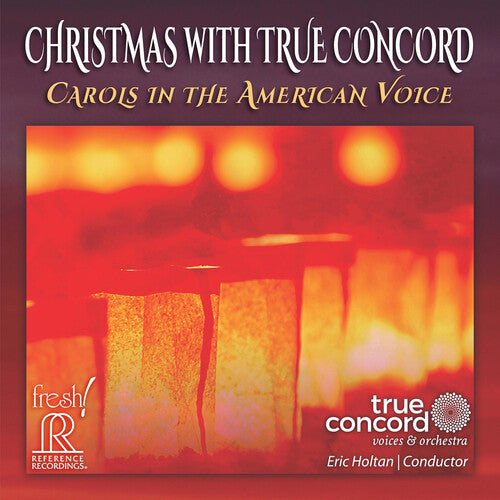
Christmas with True Concord: Carols in the American Voice
Brahms: Reimagined Orchestrations / Stern, Kansas City Symphony
REFERENCE RECORDINGS® proudly presents an imaginative album of three compositions by Johannes Brahms, in an outstanding interpretation from Michael Stern and the Kansas City Symphony. It features the first recording of American composer and Kansas City native Virgil Thomson’s 1957/8 orchestration of Brahms: Eleven Chorale Preludes for organ, op 122. It also contains composer Bright Sheng’s enchanting orchestration of the Brahms Intermezzo for solo piano, op. 118, No. 2, and the beloved and spectacular Arnold Schoenberg orchestration of the Piano Quartet No. 1 in G Minor, op. 25. "Brahms: Reimagined Orchestrations" was produced by GRAMMY® winner Peter Rutenberg, who has over half a century of experience in the music industry as a producer, composer, director, and teacher. This album was engineered by RR’s esteemed technical team, composed of GRAMMY® winning engineer 'Prof' Keith O. Johnson and multi-GRAMMY® nominated engineer Sean Royce Martin.
REVIEW:
This is an enjoyable and beautifully performed release with some unusual material. What is impressive is that the three works each offer a different approach to the orchestrator’s art. Brahms’ 11 Chorale Preludes, Op. 122 were orchestrated in the 1950s by Virgil Thomson, who was always an eclectic-spirited figure. The entr’acte is Bright Sheng’s Black Swan for orchestra, a version of the Intermezzo in A major for piano, Op. 118, No. 2; despite the retitling, this is the most straightforward of the three orchestrations, although Sheng’s orchestra is quite large. Perhaps the best-known item here, although it is hardly commonplace on orchestral programs, is Arnold Schoenberg’s orchestration of Brahms’ Piano Quartet No. 1 in G minor, Op. 25. This is also the most unconventional of the group; it actually sounds as much like Schoenberg as it does like Brahms. Reference Recordings’ sound from Helzberg Hall in Kansas City is clear and detailed, and this is a fascinating look at how composers from various periods have heard the music of Brahms.
— AllMusic.com (James Manheim)
Between Two Worlds - Ben-Haim, Engel & Prokofiev / Guy Yehuda
"Between Two Worlds" features clarinetist Guy Yehuda. Hailed by composer John Corigliano as “One of the most awe-inspiring clarinetists today,” Mr. Yehuda is widely recognized as one of the most outstanding and unique talents on the international concert stage. Reference Recordings is very pleased to release this beautiful musical program of three works from the early- to mid-20th century by Prokofiev, Engel, and Ben-Haim. We hope this new album will provide joy and comfort to many, especially to those who love Jewish music, history, and folklore. Featuring clarinetist Guy Yehuda and an ensemble of 7 award-winning performers.
Spanish Impressions / Hermitage Piano Trio
The Hermitage Piano Trio will take your breath away! Reference Recordings is pleased to announce Spanish Impressions, our second album with this elite Trio which consists of three accomplished and established soloists, now playing together for more than a decade. Misha Keylin plays violin; Sergey Antonov, cello; and Ilya Kazantsev, piano.
On this new album they perform two extraordinary Spanish trios by Turina and Cassadó; these are lush, exotic, and Romantic works. In addition, they perform three Spanish dances by Arbós and three Spanish impressions by Perello, which are musical gems and rarities.
This project has been years in the making. The album was recorded in April 2023 by RR’s own GRAMMY® winning and multi-nominated engineering team at legendary Skywalker Sound, in Marin County, California.
REVIEW:
Hermitage are passionate, skilled players, so these works sound great in their hands. The 3 Spanish Dances by Enrique Fernandez Arbos begin with a stylish Bolero, continue with a saucy Habanera, and end with the lively ‘Seguidillas Gitanas’. The Piano Trio 2 by Joaquin Turina has a sensual I, nervous II, and bold III. Even bolder is the Trio by Gaspar Cassado.
The album ends with the 3 Impressions by Mariano Perello, where a kaleidoscopic ‘Pensando en Albeniz’ gives way to a passionate ‘Capricho Andaluz’, and then to a hard-driving ‘Escena Gitana’. All are given first-rate, committed readings by this fine Trio.
-- American Record Guide
Schubert by Candlelight - Live in Madrid / Sergei Kvitko
Pianist, composer, and producer Sergei Kvitko’s new album, Schubert by Candlelight - Live in Madrid is a stunning collection of Schubert’s piano works. The album features thirteen piano works that showcase the beauty and depth of Schubert’s music, as well as the artistry and versatility of Kvitko, who is not only an award-winning, critically acclaimed pianist, but also a composer, arranger, producer and sound engineer. The album was recorded at Hinves Pianos, Madrid, Spain on April 7, 2022. (Reference)
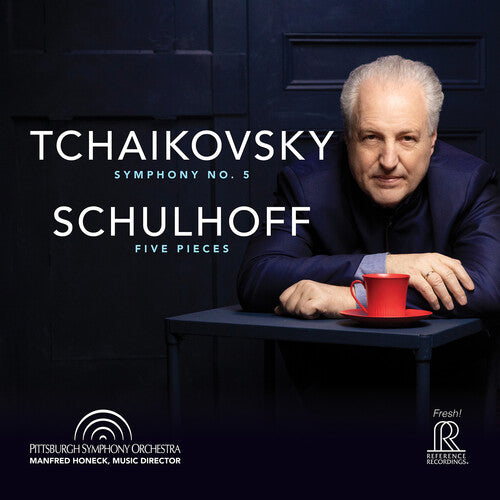
Tchaikovsky: Symphony No. 5 - Schulhoff: Five Pieces / Honeck, Pittsburgh Symphony
Tchaikovsky’s Fifth Symphony has accompanied me since my earliest years as a conductor. Additionally, it took on special significance for me as it was the first major work that I conducted together with the Pittsburgh Symphony Orchestra in 2006, unaware that they were looking for a new Music Director at the time. I take pleasure in returning to this symphony and continually discovering new elements in the score and it gives me the greatest joy to record this work with the fantastic musicians of the Pittsburgh Symphony Orchestra.
When I heard Erwin Schulhoff ’s Five Pieces for String Quartet in a wonderful concert by the Pittsburgh based Clarion Quartet a few years ago, I immediately had the idea to arrange these five jewels for large orchestra. Upon listening to them again, it was quite clear to me how to orchestrate this effectively for full orchestra and I knew that I wanted this to be the next in our line of new works performed and recorded for the first time. - MH
In late 1888, after a performance of his Fifth Symphony, Tchaikovsky wrote that he was now “convinced that this symphony has failed. There is something so repulsive in it, such a degree of screwiness and in addition insincerity, artificiality....” History would prove his assessment entirely incorrect, as the Fifth Symphony has long been regarded an indisputable masterpiece.
Following some years of study in Vienna, Schulhoff returned to his native Prague in 1924/ It was in that same year, on August 8, 1924, that the Five Pieces for String Quartet (composed the year before) received their premiere in Salzburg as part of the festival of the International Society for New Music.
REVIEWS:
Most defining is Honeck’s attempt to make Tchaikovsky’s struggle with fate believable and gripping. There are an infinite number of details in this interpretation that make one sit up and take notice and which are also described in detail in the introductory text by Honeck himself. Immensely important is the enhancement and intensification of secondary lines and the transparency achieved in the orchestral sound, the inner dialogue as well, for example between strings and winds. Not since Kitajenko’s recording have I experienced this symphony with such intensity, and the beginning of the Andante is simply unforgettable.
The dance-like pieces for string quartet by Erwin Schulhoff, which the latter dedicated to Darius Milhaud, have been arranged for orchestra by Manfred Honeck together with Tomas Ille. And because this arrangement is so well done, real value is added. Honeck and Ille, together with the brilliantly disposed Pittsburgh orchestra, get to the heart of the matter with great esprit. Finesse, imagination and orchestral color enhance the expressivity and sonic pleasure. The result is, as it were, a whole new, absolutely brilliant piece that is far from the original and a lot of fun to listen to.
This was a breakthrough moment for the visionary Schulhoff who desired to provoke and push forward to new ground, thoroughly interested in the modern trends of the time including expressionism, Jazz, and Dadaism.
-- Pizzicato
The dilemma of how to bring a venerable old warhorse back to life is admirably resolved by Manfred Honeck and the Pittsburgh Symphony Orchestra in a very attractive new offering on the Reference Recordings label. The nag in question is none other than Peter Illich Tchakovsky’s Symphony No. 5 in E Minor, arguably the most popular symphony in the repertoire. In Honeck’s hands, it comes across as the most spirited of young thoroughbreds.
Beginning with Honeck’s superb control of dynamics in the slow, quiet dawning of the Andante in the opening movement, with bassoon and flutes making their presence felt in a very quiet mid-section before the music really flares up dramatically in the Allegro con anima section. We’ve heard it all before, of course, in this most-frequently presented of symphonies, but it really makes a stirring impression here.
The companion to the Tchaikovsky in this program is Five Pieces for String Quartet by the Austro-Czech composer Erwin Schulhoff (1894–1942), here realized in a splendid arrangement for orchestra by Manfred Honeck and Tomáš Ille. The movements are (1) Alla Valse Viennese, with a very energetic opening, (2) Alla Serenata: Allegro con moto, featuring perky, whimsical flutes and other woodwinds and brass that are used very effectively, not to say aggressively, (3) Alla Czeza (in the manner of a Czech dance), marked Molto Allegro, very impetuous, with percussive accents, (4) Alla Tango Milonga: Andante, originally a Brazilian dance, with a languid, mysterious opening, later marked by an upsurge of emotion as it progresses, and (5) Alla Tarantella, a lively, perpetual-motion dance marked Prestissimo con fuoco (as fast as possible, and with fiery intensity), its savagery interspersed with murky interludes.
There’s a lot of musical substance in Five Pieces, packed into a mere 15 minutes’ playing time.
-- Audio Video Club of Atlanta
Manfred Honeck began his long association with the Pittsburgh Symphony Orchestra way back in 2006 by conducting a critically acclaimed performance of Tchaikovsky’s Fifth Symphony that was subsequently released on CD on the Exton label. Returning to this work after many years, his interpretation has, if anything, become even more compelling and here enjoys the benefits of a far superior recording with a wide dynamic range and a wonderful richness of sound.
As before, Honeck’s overriding objective has been to revivify a work that in lesser hands can easily lose its freshness and originality. To achieve this, he has followed Tchaikovsky’s carefully delineated performance instructions to the letter, investing every musical phrase with a wealth of insight, detail and colour. From the outset, Honeck’s infinitely varied texturing creates a huge amount of suspense and uncertainty in the gloomy lower string harmonies that underpin the clarinet’s first statement of the fate motif. The ensuing Allegro con anima, taken at a fast and driving tempo, has plenty of forward momentum, but Honeck adopts a sufficiently flexible approach in the contrasting second idea to ensure the more reflective moments have that necessary feeling of repose. As you’d expect, the Pittsburgh Symphony responds with phenomenal virtuosity to all the twists and turns in Honeck’s interpretation. The swooning string melodies are delivered with the same degree of warmth that you’d find in the great central-European orchestras, while the brass, in particular the quartet of horns, bring thrilling urgency to the big climaxes. But perhaps the most startling passage comes at the end of the movement where for once the murky descending line in the double basses is strikingly audible. With this particular sound image lodged in your mind, there’s an almost seamless transition into the resonant chords that open the slow movement, and this provides a wonderful cushion of sound for the magical horn solo.
There are many other moments in this performance that made me sit up and appreciate Tchaikovsky’s inventiveness in a completely new light. A good example comes in the third movement, where the isolated notes on the muted horn cut through the texture casting dark shadows over the elegant mood of the Waltz. Likewise, Honeck’s finely attuned concept of orchestral balance and brilliantly choreographed control of tempo brings tremendous dividends to the Finale. The roaring timpani roll that unleashes the Finale’s Allegro vivace section is simply electrifying, and what follows, with the raucous almost Stravinksian dialogue between wind and strings imitating the sound of balalaikas, is even more arresting.
There’s plenty of energy and imagination in Schulhoff’s Five Pieces for String Quartet, an unexpected coupling performed here in a fantastically resourceful full orchestral arrangement by Honeck and Tomás Ille. Schulhoff’s sequence of dances, ranging from a distorted waltz and a sultry Tango to a frenzied Tarantella, is a typical product of the roaring 1920s, and in this new version should certainly gain more admirers for this fascinating and immensely talented composer.
-- BBC Music Magazine
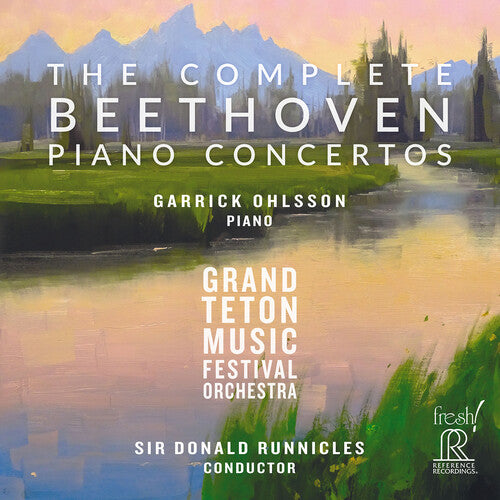
Beethoven: Complete Piano Concertos / Ohlsson, Runnicles, Grand Teton Festival Orchestra
Great Performances, Great Sound and World-Renowned Artists! Reference Recordings is proud to present The Complete Beethoven Piano Concertos played by Grammy-winning Garrick Ohlsson, performing with the Grand Teton Music Festival Orchestra, conducted by Sir Donald Runnicles. A student of the late Claudio Arrau, Mr. Ohlsson is especially noted for his masterly performances of the works of Mozart, Beethoven and Schubert, as well as the Romantic repertoire. He is the only American to win first prize in the International Chopin Piano Competition.
This new recording represents a pinnacle in his career. The Grand Teton Music Festival Orchestra consists of top talent from across the country, including more than 220 musicians from 90 orchestras and 65 institutions of higher learning, many performing together each summer for over 25 years. The Festival, founded in 1962, also welcomes yearly some of the most sought-after soloists and visiting artists in classical music today. Under the baton of world-renowned conductor Sir Donald Runnicles, these musicians come together to gather inspiration from the mountain setting and to provide spectacular music for Festival audiences. This album was recorded during live performances in July 2022, produced by Victor Muenzer, and engineered by Kevin Harbison.
REVIEWS:
Garrick Ohlsson and Donald Runnicles accomplished the ambitious feat of recording all five Beethoven piano concertos over five consecutive days in July 2022. You wouldn’t know that from these unpressured and poised performances, at least for the most part. The Grand Teton Music Festival Orchestra may be a pick-up aggregation, yet Runnicles obtains world-class results by way of clear-cut balances between orchestral strands, and virtually immaculate unanimity of ensemble attacks and releases.
Ohlsson’s 74-year-old fingers operate at unambiguous full capacity. Runs and trills are as accurate, assured, and directional as ever; themes are thoughtfully characterized and articulated with variety. Unlike many pianists who rattle off the “Emperor” concerto’s introductory cadenza like a day at the races, Ohlsson’s shapely phrasing draws attention to the composer rather than to himself. I’m especially taken with Ohlsson’s vocally informed legato and rapt sustaining power in all five slow movements, where he strikes a happy medium between his one-time mentor Claudio Arrau’s rhetorical inflections and Wilhelm Kempff’s luminous intimacy (the pianist’s hauntingly calibrated left-hand tremolos in No. 3’s Largo seem to emerge from afar). The assiduously dovetailed rapid exchanges between soloist and orchestra in No. 4’s Rondo either result from painstaking rehearsal or profound mental telepathy.
To be sure, all is not perfect: Tempos bog down in No. 1’s Allegro con brio from the development section on, while No. 2’s underplayed Rondo Finale lacks the bracing angularity that Schnabel, Kapell, Gould, and Fleisher brought to this music. The Creatures of Prometheus Overture that follows the “Emperor” on Disc 3 begins with a crisp, hard-hitting introduction, then settles into auto-pilot for the main section. If the Ohlsson/Runnicles Beethoven cycle falls short of the freshness and individuality distinguishing recent contenders like Zhang/Stutzmann, Barnatan/Gilbert, and Hough/Lintu, these superbly engineered recordings still offer much to savor.
-- ClassicsToday.com (Jed Distler)
Of all pianists before the public today, Ohlsson’s technique is among the most honest. Every note is present and accounted for, nothing ever fudged, all within an exquisitely calculated proportionality. His approach is, above all, lyrical. This is a bouquet of Beethoven concertos like no other.
-- Gramophone
I have several Reference Recordings in my collection and I’m always bowled over by their impeccability, where everything is recorded and mastered to perfection. For me, they’re the crème de la crème when it comes to recorded sound. This new release is no exception. The engineers have done a sterling job in placing the solo piano ideally in the sound picture. The three discs (Hybrid SACDS with Stereo SACD, 5.0 Surround SACD and Stereo CD layers) come nicely presented in the traditional fatbox format, and are well-annotated. There’s no doubting that this will be one of my Recordings of the Year.
-- MusicWeb International
Le Dolce Sirene / Bach Aria Soloists
Reference Recordings is proud to present a very special new release! Entitled Le Dolce Sirene to represent the all-women force of Bach Aria Soloists, this exciting new album includes works by Monteverdi, Handel, Mendelssohn and Bach, alongside a new transcription by BAS of Cecilia McDowall’s song cycle Four Shakespeare Songs. Hailed for producing “the most surprising and brilliantly innovative collaborations in Kansas City,” Bach Aria Soloists delivers each year their acclaimed concert series presenting the genius and relevance of Johann Sebastian Bach, his contemporaries, and those he inspired.
REVIEWS:
The Kansas City-based Bach Aria Soloists make their recording debut on Reference Recordings with a lovely album of Monteverdi, Bach, Handel and Mendelssohn, complemented by Cecilia McDowall and concluding with their own improvisation on La folia. Recorded with the label’s trademark sweet and clear perfection, ‘Le dolce sirene’ achieves that audiophile miracle, sounding even better on speakers than on headphones.
Most of the music is rich in conventional beauty, from Sarah Tannehill Anderson, luscious in Monteverdi and resplendent in Handel’s ‘Rejoice greatly’, to Elizabeth Suh Lane and her continuo mates illuminating Bach’s G major Violin Sonata from 1734. By contrast McDowall’s Four Shakespeare Songs use intriguingly skewed, modern notions of romantic beauty and sudden sweeps of song perfectly timed, voiced and sung to explore different aspects of love. ‘First Rehearse’ on its own, Titania’s blessing of the lovers, is a magical tour de force.
As Steven Ledbetter’s notes explain, the performers adopted the same practice for their La folia as those from about 1700, ornamenting and elaborating a basic framework that ‘appears constantly renewed’. According to founding artistic director Lane, the group’s name is a nod to the famed Bach Aria Group and in fact, she assured me, the Group’s last violinist Daniel Phillips gave ‘his full blessing, really excited that we were starting such an organisation!’
The album was recorded at Village Presbyterian Church in a suburb of Kansas City, where Elisa Williams Bickers proved with the Allegro con brio from Mendelssohn’s Fourth Organ Sonata how powerfully and inspirationally the Richards, Fowkes & Co three-manual mechanical action instrument installed in 2016 could speak.
-- Gramophone
Reencuentros / Cecilia Duarte
REFERENCE RECORDINGS is proud to announce "Reencuentros," Cecilia Duarte’s first solo album, produced by multiple-time Producer of the Year GRAMMY® winner, Blanton Alspaugh. Cecilia is best known as a classical and opera singer. This album is a departure, containing 12 romantic boleros from multiple countries. Sung in Spanish, these Latin popular standards are truly art songs from the mid-20th century. Cecilia is accompanied by Trio Chapultepec: Vincent A. Pequeño, Israel Alcala, and William Carlton Galvez, joined by Jesús Pacheco on percussion.
REVIEW:
Mezzo-soprano Cecilia Duarte, born in Chihuahua, Mexico, now makes her home in the United States. Reencuentros is her debut solo album for Reference Recordings. The album, dedicated to Duarte’s mother, and conceived during the pandemic, offers a collection of boleros.
The featured repertoire is by composers from Peru, Ecuador, Brazil, Argentina, Mexico, Puerto Rico, Cuba, and Chile. It’s clear that her chosen repertoire is close to the singer’s heart. She sings the various boleros with a lovely and rich tone, aligned with phrasing that is both elegant and seductive. Duarte allows these songs to make their impression without vocal or interpretive overreaching. And because of her keen, subtle artistry, the result is mesmerizing. The musicians collaborating with Duarte, offering both instrumental and vocal support, complement the mezzo’s refined approach.
The recording, typical of RR, is superb, featuring an ideal natural balance of presence, color, and detail. The booklet includes Duarte’s comments on the songs, as well as full Spanish texts and English translations. This recital is a winner in every respect.
-- Fanfare
Spratlan: Invasion - Music and Art for Ukraine / Shpachenko
A new album of World Premieres from GRAMMY® Award-winning Ukrainian-American pianist Nadia Shpachenko! As she watched in horror her home city of Kharkiv (and the rest of Ukraine) being destroyed and civilians being murdered every day, Shpachenko tried to come up with ways to express her feelings of utter despair and anger, as well as hope and resilience, through her music making. She decided to put together a new album to support Ukraine humanitarian aid. Reference Recordings is proud to release this album, with proceeds benefitting Ukrainian people affected by the war.
Shpachenko has collaborated with Ukrainian artists to create Invasion music videos and album art, describing their war experience. The key piece on the album, titled Invasion (for piano, alto saxophone, horn, trombone, timpani, snare drum, and mandolin) is Shpachenko’s longtime collaborator Lewis Spratlan’s response to this tragic war. The rest of the album features World Premiere recordings of solo piano music also by Spratlan. These pieces reflect on the human experience, often finding solace and inspiration in nature and music of the past. Wonderer, a major piece that closes the album, connects in its character to the current experience of many Ukrainian people, especially those displaced by the war. The hero, searching through the unknown, overcoming pain, and reminiscing about things past, triumphs at the end.
REVIEWS:
Just as 9/11 prompted a wave of commemorative works, so is the Russian invasion of Ukraine now doing. Lewis Spratlan’s Invasion is a raucous, volatile tone poem for a sextet of piano, saxophone, horn, trombone, percussion and – I assume to provide some local Ukrainian colour – mandolin, written at speed in March this year. Spratlan and pianist Nadia Shpachenko were already planning a new album to follow up her Grammy Award-winning ‘The Poetry of Places’, which featured Spratlan’s Bangladesh, when events overtook it. The performance is powerful...the booklet illustrated sumptuously with full-colour paintings by Ukrainian artists Shpachenko commissioned and by children in her battered home city of Kharkiv.
Shpachenko audibly has a deep understanding of Spratlan’s compositional processes, and – in writing all bar Wonderer for her – he clearly has an appreciation of her pianistic abilities.
-- Gramophone
West Of The Sun - Music Of The Americas / Joel Fan
Recorded at Skywalker Sound by RR’s renowned technical guru, “Prof.” Keith O. Johnson.
Thinking About Bix
* Definitive performances of Bix Beiderbecke's five original piano pieces, plus new Hyman arrangements and improvisations on classic Beiderbecke recordings.
* A spectacular recording by seven-time Grammy nominee Keith O. Johnson, at the famed Skywalker Sound.
* Hyman was composer, arranger, conductor, and pianist for many Woody Allen films including Bullets Over Broadway and Mighty Aphrodite. Other film scores have included Moonstruck and Billy Bathgate.
"Stunning virtuosity and audio fidelity that sets an unprecedented standard for recording that most recalcitrant of instrument, the grand piano. An extraordinary pianist with great taste, in total command of a magnificent instrument, recorded with awesome presence and fidelity!" -- JazzTimes
"A once-in-a-lifetime record that does everything right. The band is hot, and the sound is front-row center, the players set up in a virtual-reality semicircle inches from your face. It is the most enveloping recording in my collection, and my numero uno desert island LP." -- Stereophile
The Medinah Sessions / Chicago Pro Musica
This selection is a High Definition Compatible Digital (HCDC) recording.
The Human Holiday
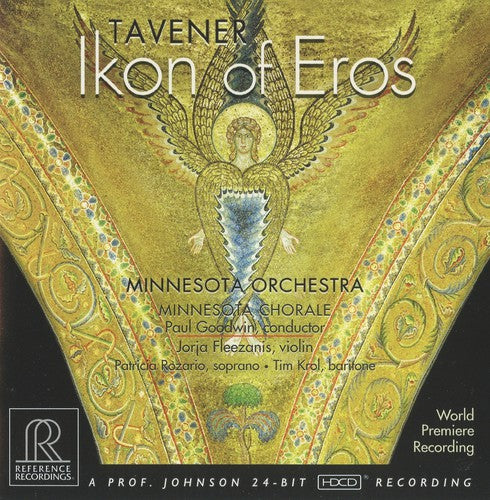
Tavener: Ikon Of Eros / Goodwin, Minnesota Orchestra
includes interview with John Tavener 10:45
"Gorgeous, mystical music with the power to entrance. Sir John Taverner, a follower of the Greek Orthodox faith, writes simple, repetitive compositions that embody the spiritual essence of prayer. . . Slowing down – sitting or lying in silence by candlelight would be ideal – is essential to experience Tavener's reverential universe. This is a universe that is always with us, Tavener's music suggests, if we are only willing to align ourselves and tune in. . . Captured in demonstration quality 24–bit HDCD sound by Prof. Keith Johnson, this world premiere recording is an extraordinary achievement." – Jason Serinus, Bay Area Reporter 11/27/03
"The recording, a world premiere of this piece, is beyond reproach. Individual instruments are distinct and float in space. By his own words, Tavener recommends that the piece be played in a resonant acoustic. He could have not asked for a better place. The voices echo slightly off of the walls and ceiling creating an even more metaphysical feeling. I don't think I've heard a better piece to test your soundstage. There is little else I can provide. Tavener says Ikon of Eros is "humbly offered to those who have ears to hear." I suggest you take him up on it." — Bill Brooks, 12/03, Soundstage.com
Chosen by Andrew Quint of The Absolute Sound magazine as one of the ten best classical releases of 2003.
Strictly Sousa / Junkin, Dallas Wind Symphony
This selection is a High Definition Compatible Digital (HDCD) recording.
Stravinsky: Song of the Nightingale, Firebird, The Rite of Spring / Oue, Minnesota Orchestra
This selection is a High Definition Compatible Digital (HDCD) recording.
Skrowaczewski: Concerto Nicolo, Concerto For Orchestra
All tracks have been digitally mastered using HDCD technology.
All tracks have been digitally mastered using 24-bit technology.