SIBELIUS Orchestral Works • Osmo Vänskä, cond;1 Neemi Järvi, cond;2 Jaakko Kuusisto (vn);4 cond;3 Leonidas Kavakos (vn);5 Dong-Suk Kang (vn);6 Marko Ylönen (vc);7 Lahti SO;1,3 Gothenburg SO2 • BIS 1921 (6 CDs: 420:41)
Overture in E.1 Scène de ballet.1 Karelia: Complete music;1 Overture;2 Suite.1 Impromptu.2 Presto.1 Press Celebrations Music.1 Menuetto.1 Coronation March.1 March of the Pori Regiment.1 Overture in a.1 Romance in C.1 Cortège.1 Pan and Echo.1 The Countess’s Portrait.1 Violin Concerto: (1903–04);1 (1905).5 Rakastava.1 2 Serenades.2,6 2 Serious Melodies (2 versions).1,2,6,7 6 Humoresques.2,6 Academic March.2 March of the Finnish Jäger Battalion.1 3 Pieces, op. 96.1 Suite mignonne.1 Suite champêtre.1 Suite caractèristique.1 Morceau romantique.1 Suite for Violin and Strings.1,6 Andante festivo.1 Processional.1 Preliminary and alternative versions1,3,4
Sibelius wrote a colossal amount of music for the orchestra. Already issued in BIS’s Sibelius Edition are boxes devoted to the tone poems (Vol. 1), theater music (Vol. 5, including the full scores plus the suites drawn from the composer’s incidental music), and voice and orchestra (Vol. 3); still to come, of course, is the volume of symphonies (Vol. 12, projected). That makes 21 or 22 well-filled CDs. Then there’s the present set, Vol. 8, which consists of everything else: works for violin and orchestra (about two CDs), music for patriotic pageants (one-and-a-half discs), and various occasional pieces, suites, and other works that don’t fit any of the above categories. The Sibelius quote with which annotator and project advisor, Andrew Barnett, begins his program notes could well serve as an epigram for the entire project: “I am myself a man of the orchestra. You must judge me from my orchestral works.”
Most of the contents of this set were first issued on single CDs: the Karelia music on BIS 915, the Press Celebrations Music on 1115, the two versions of the Violin Concerto on 500, the remaining works for violin and orchestra on 472, and various smaller works on 1265, 1445, 1485, and 1565. Items appearing here for the first time are the Karelia Suite, Menuetto, Romance, March of the Finnish Jäger Battalion, the three French-titled Suites, opp. 98 and 100, and the Processional, as well as several preliminary and alternative versions.
The sheer quantity of material here makes it most practical to discuss the works by category. Along with the Violin Concerto, the most important music in this set is that provided by Sibelius for two patriotic pageants during the Russian crackdown of the 1890s. Thinly disguised as benefits, the first in 1893 for education in the Viipuri district, the second in 1899 for the Press Pension Fund (the Russians had banned a Finnish newspaper), the Karelia and Press Celebrations pageants in reality served as nationalist rallies. The Karelia music, written the year after Kullervo and only two years after Sibelius’s first orchestral works, consisted of an Overture and music for eight tableaux; the Eighth Tableau quotes the song that would later become Finland’s national anthem. The Overture was published independently as op. 10, and three of the eight tableaux were adapted to form the Karelia Suite, op. 11. The remaining music—the entire score totals 50 minutes—is well worth hearing; particularly striking are the runic singing of Tableau 1 and the “siege” music of Tableau 6. In the runic singing, I prefer the earthy female voices used in Tuomas Ollila’s recording for Ondine to the bland baritones used here; otherwise, Vänskä’s version is more compelling. BIS includes Järvi’s energetic 1982 recording of the Overture (to avoid redundancy, one supposes), but gives the Suite in a new recording by Vänskä. I’m not sure why: there are plenty of fine recordings of the Suite already, and Sibelius collectors serious enough to consider this volume doubtless already have their favorite versions; mine is the RCA/Decca recording by Alexander Gibson, not currently available.
The Press Celebrations Music is almost as extensive, comprising a prelude and music for six tableaux; the final movement, “Finland Awakes,” with a new ending, became Finlandia, published as op. 26/7 in the expectation that the entire score would follow. In fact, only three other tableaux were published in revised form as Scènes historiques I, op. 25. The various stages of revision of Finlandia can be heard in Vol. 1 of the Edition; in the original, instead of the familiar apotheosis of the hymn tune, the ending consists of a series of bombastic fanfares. The Press Celebrations score is also included on the Ondine disc, but Vänskä is the clear winner.
The other major work here, of course, is the Violin Concerto. Kavakos and Vänskä give a compelling performance of the familiar 1905 revised version; it’s a performance of extremes, with the many technical challenges met head-on and the more lyrical music played with great sensitivity. Fans of Oistrakh on the one hand or Heifetz on the other won’t want to discard their favorites, but Kavakos offers yet another good option. The real story, though, is the 1991 version of Sibelius’s original score by the same artists; I believe it remains the only recording of the 1903–04 version. The comparison is intriguing; longtime Fanfare subscribers can find David K. Nelson’s detailed review in 14:6. It is impossible to discuss the two versions at length here, but two points should be made: first, the original is both longer and more difficult, including several fascinating passages that were later cut; second, as is almost invariably true, Sibelius’s final thoughts are his best. The revised version eliminates some interesting digressions and much extraneous detail, making it more cohesive and giving it more impact. The original version is still well worth hearing, not only because the comparison is so interesting, but also because it does include a good deal of music later eliminated. The two versions were originally issued in tandem, but here the original version is placed in an “appendix” on the last disc of the set, along with early or alternative versions of other works.
Kang and Järvi give sympathetic readings of the Two Serenades and the Serious Melodies; the latter are also given, in the appendix, in Sibelius’s cello version by Ylönen and Vänskä. Only the Humoresques are a bit of a letdown. These superb pieces, written in 1917–18 when Sibelius was working on the Fifth Symphony under horrible conditions, are technically demanding and musically complex; they should be far better known, but their format—six short pieces totaling about 20 minutes—seems to have no niche in today’s concert programs. Kang and Järvi are less volatile, less exciting than Aaron Rosand on an ancient Vox LP. I have not heard the recordings of the violin-and-orchestra works by Tetzlaff or Kuusisto; Robert Maxham gave the former a mostly favorable review in 26:6, but the latter does not appear in the Fanfare Archive.
The many other pieces in this set can be addressed only briefly. Sibelius’s first orchestral works were the Overture in E Major and the Scène de ballet, both written in 1891; in 31:1, I preferred Järvi to Vänskä in the former, the reverse in the latter. The Overture in A Minor was written to fill out the program for the premiere of the Second Symphony; supposedly it was composed in a single evening. It certainly is far thinner in substance than the Symphony; its introduction, striking in its use of the trumpets, fails to go anywhere. The well-known Romance in C Major is given a rather perfunctory reading; Pan and Echo, a “Dance Intermezzo” sometimes grouped with the tone poems, is a striking miniature.
Rakastava (“The Lover”), a three-movement work for string orchestra with triangle and timpani written in 1911, the time of the Fourth Symphony, is a small masterpiece. It actually grew out of a much earlier choral work (thus perhaps explaining the anomalous opus number 11), and it was revised in 1912, Sibelius being dissatisfied with the arrangement. Again the final version is far superior to the earlier one, included in the appendix. Vänskä gives a sympathetic account.
Most of the remaining works are of minor importance; the Three Pieces, op. 96, and the three suites that followed, written between 1919 and 1922, are all essentially salon music; the Suite for Violin and String Orchestra, written in 1929 and thus one of Sibelius’s final compositions, is likewise not consequential. The Andante festivo, a 1938 arrangement of a work composed in 1922 for string quartet, is notable not only for its noble formality, but also because the recording of Sibelius’s live broadcast for the New York World’s Fair is the only surviving document of his conducting. That recording shows that almost everyone, including Vänskä, takes the piece too quickly; Vänskä’s version here has a timing of 5:10 versus Sibelius’s 6:55. Finally, the Processional is an arrangement of one of several songs Sibelius wrote for the Finnish Masonic lodge in 1927, again making it one of his last works.
The contents of this set range from some of Sibelius’s finest, most important works to some of the least significant products of his mature years. If you don’t have the single CD of the two versions of the Violin Concerto, or either of the pageant scores, or if you absolutely must have every scrap of orchestral music he created, this set’s for you. Collectors who have been acquiring each volume of the Edition as it is released will find this one of the more rewarding ones. Essential for Sibelians.
FANFARE: Richard A. Kaplan
{# optional: put hover video/second image here positioned absolute; inset:0 #}
BIS
Sibelius Edition Vol 8 - Orchestral Music
Click here to view all 13 volumes of The Sibelius Edition 3332860.az_SIBELIUS_Orchestral_Works_Osmo.html SIBELIUS Orchestral Works • Osmo Vänskä, cond; 1 Neemi Järvi,...
If you are looking for ‘perfect’ symphonic Mendelssohn then this disc has to come somewhere near, if not at the very top of the list.
I am new to this series of recordings, but this disc represents the last in a set of three which covers all of Mendelssohn’s symphonies, celebrating the 200th anniversary of his birth in 1809.
Both of these works have an easy-sounding and relatively sunny disposition, which hides considerable difficulties in their genesis. Started in 1829 in Scotland, the cover image for this disc is an engraving of the Grass Market in Edinburgh, one of the places Mendelssohn stayed during his trip through what was then considered a romantic wilderness suitable for artistic reflection. The symphony was only completed by 1842 however; some 12 years after the Reformation symphony. The reason for its lower opus number is that Mendelssohn was dissatisfied with the latter work, and refused to allow its publication during his lifetime. As has been stated already, the lightness of touch which has made Mendelssohn such a refreshingly attractive voice among composers of this period is very much in evidence with these symphonies, and Andrew Litton gets excellent results from the Bergen Philharmonic Orchestra.
We have heard a few ‘period’ recordings of these pieces in recent years, and a trend towards smaller orchestral footprints from bands such as the Swedish Chamber Orchestra in their Schumann symphonic cycle with Thomas Dausgaard. This recording from BIS does not fall into these categories by any means. This is not to say that Litton’s approach is anything less than supple and idiomatically appropriate, and I know of several quarters which will welcome the warmly expressive strings in the playing here. Vibrato is also a quality in the woodwind, but my hat goes off to all of the Bergen players for impeccable intonation, and to the flute and other woodwinds for their expressive and thankfully non wide-and-wobbly vibrato. The weight of voicing is also very accurately placed at all times, and a superlatively good balance provides both detail and an overall orchestral texture in the tutti sections. This transparency of texture is an inherent quality in Mendelssohn’s orchestral writing, but I also have the feeling that we might owe a debt of gratitude to the kind of clarity obtained by Roger Norrington for his early 1990s recordings on Virgin Classics with the London Classical Players. In this way, Litton’s readings of these pieces fall somewhere between Norrington’s lithe cleanliness and Claudio Abbado’s more emotionally communicative performances captured through the London Symphony Orchestra on Deutsche Grammophon. Yes, Litton is clarity, dynamism and expressively warm playing personified, but he does tend to enhance the classical origins and early romantic context of these pieces. He draws superb results from the Bergen orchestra and brings out all of the rugged Beethovenian character in the Reformation symphony, but does steer an uncontroversial path which while wonderful for repeated listening and reference, may not have you in palpitations of excitement on first hearing.
I’ve read dismissive remarks on these performances as ‘middle of the road’, but extremes of interpretative license are not what we are likely to be looking for in Mendelssohn. He has his pious moments, and high octane passion and emotional hubris are not really ‘hot’ elements in this music, at least not to today’s jaundiced ears. There are some intriguing forward-looking moments as well. Listen to those calm string passages between 2:22 and 3:05 in the first movement of the Symphony No.5: Charles Ives’s The Unanswered Question? Not far off, and to my mind such spine-tingling moments lift this recording above the run-of-the-mill. Add the sheer quality of the playing into the mix, and we have a winning combination. The SACD qualities of the recording are a nice enhancement, as usual opening out the aural picture and giving a real sense of location and involvement. Still attempting to put my finger on some marginal reservations, I suppose it might come down to these performances being very much ‘studio’ in nature. Looking at the booklet, I don’t get the feeling that the impassioned photo of Andrew Litton in full action on the back is taken from these sessions or this music. One has a sense that the players might respond with just that extra ‘edge’ with a live audience rather than just the familiar if marvellous acoustic of the Bergen Philharmonic’s home concert hall, but this might as well just be my imagination looking for weaknesses which aren’t really there at all. Conductors and record producers just can’t win can they? Anything other than highly polished performances and we reviewers start moaning about blemishes; and the closer things come to perfection the more we’re likely to hit on a lack of that last nth of emotional content and excitement. Fear not in this case however: if you are looking for ‘perfect’ symphonic Mendelssohn then this disc has to come somewhere near, if not at the very top of the list.
Dominy Clements, MusicWeb International
------------------------------
3362430.az_MENDELSSOHN_Symphonies_3_Scottish.html
MENDELSSOHN Symphonies: No. 3, “Scottish”; No. 5, “Reformation” • Andrew Litton, cond; Bergen PO • BIS 1604 (SACD: 70:15)
I did not find Andrew Litton’s traversal of the “Lobegesang” symphony as convincing as I had hoped, so when this arrived in the mail I was full of concern. Mendelssohn’s works deserve the full-frontal SACD treatment, and Litton I had hoped was the man to do it, but the “Lobgesang” foretold that a successful complete series this was not to be. However, surprise of surprises, this new installment turns out to be all I had hoped for and more. The sound, to get that out of the way, is stunning, as are the performances by the Bergen players. They leave nothing to be desired.
But this is well-tread ground and needs groundbreaking readings to make a dent in almost anyone’s pantheon. Mendelssohn never really liked the “Reformation” Symphony, and to tell you the truth, I understand why. The thing is a hodgepodge of overblown Protestant sentimentality, uses the Dresden “Amen” in a way that is most artificial, and Luther’s well-worn “Mighty Fortress” easily degenerates into something pompous and bloated. Structurally this is one of the composer’s weakest works, and it takes a conductor with a great deal of sympathetic understanding to glue all the parts together. There are some exciting things here, and Mendelssohn’s symphonic skill is obvious, but his materials can grate when in the wrong hands.
Bernard Haitink is a conductor who understands this and was able to turn in a remarkably fluent performance on Philips years ago; it remains my favorite, at least did until a few weeks ago when I first heard this Litton. Everything is as right in this reading as it can be, and Litton presents the populist music in a manner that refuses to dwell on it as if it is populist music. The results are wonderful, and this one races to the top of the list.
The “Scottish” is Mendelssohn’s last and greatest symphony, though there have been very few really outstanding performances of the piece on record. Haitink coupled his “Reformation” with this work, and it is very well done. Leonard Bernstein knew his way around the work, though his sonics are a bit thin, and Christoph von Dohnányi also turned in a very fine reading on Telarc with his Clevelanders. Peter Maag has owned the piece for ages in my opinion, his also rather thin-sounding recording on Decca holding the fort until this Litton came along. Maag’s reading still reigns—his Decca is a classic. But this one is also extremely close to Maag’s, and the sound is simply not comparable in any way to the aged Decca. Litton’s grandeur and joyous verve in this work guarantees a place in the one-to-choose top five list, and BIS is to be congratulated for signing him and the Bergen folks to record this. Easily and somewhat urgently recommended.
FANFARE: Steven E. Ritter
{# optional: put hover video/second image here positioned absolute; inset:0 #}
YL Male Voice Choir was founded in 1883 - 125 years ago - under the auspices of the Helsinki University. Two years later Jean Sibelius became a student at the conservatory in Helsinki, and soon what would become a long and fruitful collaboration began. The present programme includes both a cappella works and works for male choir and orchestra, in which YL is supported by the Lahti Symphony Orchestra conducted by Osmo Vänskä. It takes us through a variety of moods and themes: from the brief and very moving 'Sydämeni laulu' - a lullaby for a dead child - to 'Tulen synty' (The Origin of Fire), a re-telling of the ancient Kalevala legend of how fire came into the world, as well as the patriotic sentiments of 'Vapautettu kuningatar' (The Captive Queen) and, of course, the hymn from 'Finlandia', probably Sibelius's most famous composition, here in a choral version.
{# optional: put hover video/second image here positioned absolute; inset:0 #}
On Sale
BIS
YL - The Voice of Sibelius / YL Male Voice Choir
YL Male Voice Choir was founded in 1883 - 125 years ago - under the auspices of the Helsinki University. Two years...
Albéniz: Complete Piano Music Vol 2 / Miguel Baselga
BIS
$21.99
January 01, 2000
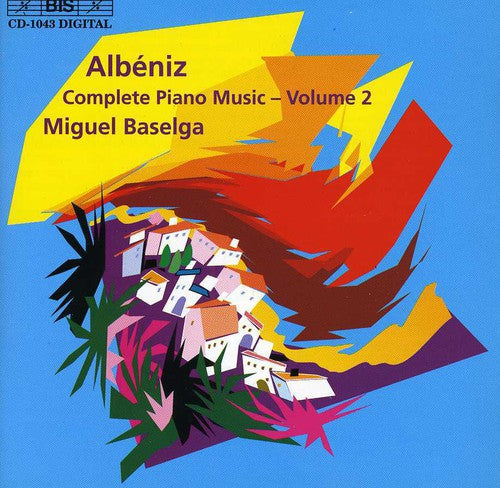
As the talented young Spanish pianist Miguel Baselga mentions in this release's excellent booklet notes, there's a considerable gap between much of Isaac Albéniz's salon-like piano output and the labyrinthine originality of Iberia's four books. For this reason, the pianist is allotting one book from Iberia per release in his ongoing complete Albéniz cycle for BIS. The project's second installment improves upon its predecessor in that Baselga truly is making this music his own. His assertive, communicative virtuosity uncovers all the poetic layers interwoven throughout Iberia Book Two's technical hurdles. Similarly, the pianist makes a cogent case for the composer's slighter but utterly charming, neo-Lisztian Seven Studies in the Natural Minor Keys. Baselga's fanciful yet tender treatments of the two salon mazurkas (Amalia and Ricordatti) and the evocative 1897 Souvenirs are absolute delights. The disc concludes with the wild and wooly La Vega, whose elemental impressionism sizzles under Baselga's hot hands. All the music on this disc conveys as full a scope of Albéniz's artistic development as can be contained on one CD. In sum, a disc guaranteed to perk up anyone's piano collection. --Jed Distler, ClassicsToday.com
{# optional: put hover video/second image here positioned absolute; inset:0 #}
BIS
Albéniz: Complete Piano Music Vol 2 / Miguel Baselga
As the talented young Spanish pianist Miguel Baselga mentions in this release's excellent booklet notes, there's a considerable gap between much of...
Skalkottas: Cello Works, Piano Trios / Kitsopoulos, Et Al
BIS
$21.99
October 01, 2003
This is the tenth Skalkottas CD produced by Bis since 1997. Very often these have been performed by Greek musicians and recorded by Greek production teams. Half of these discs have been of his chamber music. Each has been recorded and performed to the highest possible standards. The music is incredibly clever, complex, life-enhancing, joyous, shocking and tough by turns...The recording is clear, immediate and close...The performances are magnificent, bringing out all aspects of this emotionally complex music to its fullest extent. Highly recommended -- Gary Higginson, MusicWeb-International
{# optional: put hover video/second image here positioned absolute; inset:0 #}
BIS
Skalkottas: Cello Works, Piano Trios / Kitsopoulos, Et Al
This is the tenth Skalkottas CD produced by Bis since 1997. Very often these have been performed by Greek musicians and recorded...


 {# optional: put hover video/second image here positioned absolute; inset:0 #}
 {# optional: put hover video/second image here positioned absolute; inset:0 #}
BIS
{# optional: put hover video/second image here positioned absolute; inset:0 #}
BIS {# optional: put hover video/second image here positioned absolute; inset:0 #}
BIS
{# optional: put hover video/second image here positioned absolute; inset:0 #}
BIS {# optional: put hover video/second image here positioned absolute; inset:0 #}
 {# optional: put hover video/second image here positioned absolute; inset:0 #}
 {# optional: put hover video/second image here positioned absolute; inset:0 #}
 {# optional: put hover video/second image here positioned absolute; inset:0 #}
 {# optional: put hover video/second image here positioned absolute; inset:0 #}
On SaleBIS
{# optional: put hover video/second image here positioned absolute; inset:0 #}
On SaleBIS {# optional: put hover video/second image here positioned absolute; inset:0 #}
BIS
{# optional: put hover video/second image here positioned absolute; inset:0 #}
BIS {# optional: put hover video/second image here positioned absolute; inset:0 #}
 {# optional: put hover video/second image here positioned absolute; inset:0 #}
 {# optional: put hover video/second image here positioned absolute; inset:0 #}
 {# optional: put hover video/second image here positioned absolute; inset:0 #}
BIS
{# optional: put hover video/second image here positioned absolute; inset:0 #}
BIS {# optional: put hover video/second image here positioned absolute; inset:0 #}
 {# optional: put hover video/second image here positioned absolute; inset:0 #}

 {# optional: put hover video/second image here positioned absolute; inset:0 #}

 {# optional: put hover video/second image here positioned absolute; inset:0 #}

 {# optional: put hover video/second image here positioned absolute; inset:0 #}

 {# optional: put hover video/second image here positioned absolute; inset:0 #}

 {# optional: put hover video/second image here positioned absolute; inset:0 #}

 {# optional: put hover video/second image here positioned absolute; inset:0 #}

 {# optional: put hover video/second image here positioned absolute; inset:0 #}

 {# optional: put hover video/second image here positioned absolute; inset:0 #}

 {# optional: put hover video/second image here positioned absolute; inset:0 #}

 {# optional: put hover video/second image here positioned absolute; inset:0 #}
 {# optional: put hover video/second image here positioned absolute; inset:0 #}
 {# optional: put hover video/second image here positioned absolute; inset:0 #}

 {# optional: put hover video/second image here positioned absolute; inset:0 #}
 {# optional: put hover video/second image here positioned absolute; inset:0 #}

 {# optional: put hover video/second image here positioned absolute; inset:0 #}