Classical CDs
25001 products
-
-
-
Alfred Cortot - The Complete French Recordings, 1942-1943
$19.99CDAPR
Sep 05, 2025APR6046 -
-
-
-
-
-
-
-
-
-
-
-
-
-
-
-
-
-
-
-
-
-
-
Elsa Barraine: Musique rituelle
$20.99CDTemperaments
Oct 03, 2025TEM316076 -
-
-
-
-
-
-
-
-
-
-
-
-
-
Auber: Overtures, Vol. 7 / Salvi, Janácek Philharmonic
Dario Salvi's acclaimed survey of overtures by Auber continues with Volume 7. The Janacek Philharmonic Ostrava who were the featured orchestra on Volume 5 (8.574335) return to the series in a volume that includes several world premiere recordings.
REVIEW:
Conductor Dario Salvi is the creative force behind these recordings. All his albums maintain a high standard of performance. And all benefit from innovative programming. The Janacek Philharmonic Ostrava is in fine form here. Under Salvi’s direction, they play with a lighthearted elegance fitting the fairy operas. And they can also deliver some dramatic thundering when necessary.
Including additional music from the operas has slowed Salvi’s traversal of the overtures. But these recordings are about the journey, not the destination. These ballets and incidental music show Auber’s genius. His orchestrations set the stage and tell the story — in music, not words. Another fine addition to this edition.
— WTJU-FM (Ralph Graves)
Alfred Cortot - The Complete French Recordings, 1942-1943
Dvorak: Stabat Mater, Op. 58
The Decca Solo Recordings, 1941-1945 / Kathleen Long
An unobtrusive figure in the British music scene and despite her self-stated lack of ambition, KATHLEEN LONG (1896–1968) was a musician of the highest order. She taught for 44 years at the Royal College of Music and was a major Decca artist for two decades, having recorded for several other labels before that. Her first recording was made in 1928, and her first Decca recordings (of Mozart’s Piano Concertos K449 and K450) were made in 1935. Her first Decca solo recordings are those on this release. On disc, she made premiere recordings of several Mozart concertos and sonatas and was renowned for her Scarlatti and Fauré. For her service to French music, she was made Honorary Member of the Académie de France.
Mozart: Piano Concertos, Vol. 10
Go, Lovely Rose - Songs of Roger Quilter
Earthcycle / Orchestra of the Swan
Following their acclaimed mix-tape series on Signum Classics, Earthcycle is the fifth album from Orchestra of the Swan and David Le Page. Earthcycle is an innovative and timely project which finds a compelling way to engage with humanity’s most urgent threat. Through three initial performances, a recording and a film, Earthcycle contem- plates our impact on Earth’s environment and the disruption of its natural rhythms. To celebrate the 300th anniversary of Vivaldi’s Four Seasons they have commissioned a new version from our Associate Artist, baroque/jazz musician and composer David Gordon which is interspersed with traditional folk songs related to the theme of the seasons and performed by singer Jackie Oates. Earthcycle highlights the 21st century’s greatest concern whilst celebrating nature and our place within it.
Alfred Brendel plays Busoni & Liszt
Italian Cello Sonatas
By the time of the ‘Ottocento’ (19th century), opera was the dominant force in Italian musical culture, with bel canto composers such as Rossini and Donizetti creating a public appetite for opera that eclipsed achievements by Italy’s musical sons in other genres. Some of these composers who focused their energies instead on instrumental music, swimming against the operatic tide, remained in their native land, while others found a home (or were forced to find one) abroad.
Giuseppe Martucci (1856-1909) is one who stayed. A gifted pianist, he bypassed the operatic path and wrote music with a kind of fluent synthesis of Italian lyricism and German, dialectic approach to form that reached an early peak in his Cello Sonata of 1880. Yet Martucci, as a teacher of composition in Bologna and then Naples, urged the teenaged Alfredo Casella (1883-1947) to study abroad.
Ildebrando Pizzetti (1880-1968) is among the few composers in this set whose entire career centered in Italy, and he wrote a substantial body of instrumental music.
Before the war and eventual exile, Mario Castelnuovo-Tedesco (1895-1968) succeeded in reinventing an essentially Romantic model (of both form and harmony) for his own time with his Cello Sonata Op. 50 of 1928.
From seven years earlier, Ildebrando Pizzetti’s Sonata of 1921 is a more gloomy, even tortured affair. The Cello Sonata of Francesco Cilea (1866-1950), while unmistakably cast as an ‘operatic’ work from its opening solo, features a protagonist scarcely burdened by the existential angst to be found in comparable works from northern Europe.
Like Cilea, Ermanno Wolf-Ferrari (1876–1948) is known for his operas but unlike Cilea’s cello sonata, Wolf-Ferrari’s Op. 30 dates from the final three years of his life and belongs to a mature output of instrumental music.
Virtuoso cellists Alfredo Piatti (1822-1901) produced many trifles and showpieces to display his artistry to his adoring public in London. He was most proud of the set of six sonatas included in this set. In 1844 he made his first appearance in the English capital and soon settled there, playing both as a soloist and in one of the first celebrity string quartets.
The Cello Sonata by Mario Pilati (1903-1938) is another product of the fast-moving 1920s, formed in a Romantic tradition but inflected – like the music of Casella, Pizzetti, and Castelnuovo-Tedesco – by contemporary trends in impressionism and futurism.
From the next generation of composers, the Cello Sonata composed in 1948 by Eliodoro Sollim (1926-2000) fluently incorporates the kind of modal harmonies and cross-rhythms adopted by the likes of Bartók and Janáček from the folk traditions of their own cultures.
French Opera Overtures / Järvi, Estonian National Symphony
The nineteenth-century French opera overture was for many years looked down on by certain music critics (and musicians) - largely as the genre turned its back on the historical adherence to strict musical form (fugue, sonata form, etc.). Percy Scholes, in the 1955 Oxford Companion to Music, had the following to say: 'a cheap but not always ineffective type of opera overture is that of the pot-pourri or medley - little more than a string of tunes from the work to follow.' These overtures were incredibly popular in their time, and the revival of this repertoire is long overdue.
Daniel Auber composed more than fifty operas, some for the Paris Opera and some for the Opera Comique. His Grand Opera La Muette de Portici famously sparked the Belgian revolution in 1830, which led to the country's independence in 1839. Les Cloches de Corneville was by far the most successful of Planquette's twenty-four operas, receiving some 400 consecutive performances. Alexandre Lecocq's La Fille de Madame Angot was premiered in Brussels in 1872 and is set in post-revolutionary Paris. The Overture is followed here by numbers put together by Gordon Jacob, in his re-orchestration of material taken mainly from the opera, for Leonide Massine's ballet Mam'zelle Angot, which closely follows the action of the opera.
Debussy & Ravel for Two / Bax & Chung Piano Duo
Their third duo album on Signum Classics, husband and wife Alessio Bax and Lucille Chung unite to bring an album of French works by Debussy and Ravel in versions for piano duo and four hands. With arrangements by Dutilleux and Ravel himself key works include ‘Prélude à l’après-midi d’un faune’ for four hands and La valse for two pianos.
Shostakovich: String Quartets Nos. 9 & 15 / Carducci Quartet
Continuing their project to record all the Shostakovich String Quartets, award winning artists the Carducci Quartet return to Signum Classics for their third album of string quartets: String Quartet No. 9 in E flat major and String Quartet No. 15 in E flat minor, Op. 144.
Praise for SIGCD559 Shostakovich: String Quartets Nos. 1, 2 & 7
4 Star Performance, 4 Star Recording, "Beautiful honed" – BBC Music Magazine
Elgar: The Dream of Gerontius / McCreesh, Gabrieli Consort
The Dream of Gerontius by Edward Elgar is a two-part work for voices and orchestra composed in 1900 to text by John Henry Newman. Widely regarded as Elgar's finest choral work, and by some his masterpiece, Gabrieli’s first-class performance, and McCreesh’s superb interpretation demonstrate why their recordings are seen as some of the best in classical music today.
REVIEW:
This strong performance is apparently the first to use historically appropriate instruments. The trombone, just to give the listener an idea, was owned by Elgar. Tenor Nicky Spence, in the lead role, offers a rich, serious performance. McCreesh’s interpretation focuses on the chorus, placing the work in the grand English oratorio tradition.
— AllMusic.com (James Manheim)
Elly Ney Plays Brahms & Schubert / M. Fiedler, Melichar, Berlin Philharmonic
German pianist ELLY NEY’s posthumous reputation has, perhaps justifiably, been tarnished by her links to the Nazi regime, but 80 years on it’s easier to focus on her pianism and acknowledge she was one of the finest pianists of her generation. A previous APR release (APR7311) presented her interpreting a wide range of composers, but she came to be regarded as one of the great interpreters of the Austro-German repertoire and here she tackles two of the masterworks, including a monumental performance of the Brahms Second Piano Concerto with the Berlin Philharmonic Orchestra, the first version recorded by a woman. Brahms specialist, Max Fiedler, ostensibly conducts, though our booklet note reveals Alois Melichar as the uncredited conductor who completed the project after Fiedler’s sudden death. The suite of Schubert dances which completes the release appears never to have been reissued before.
Bach: Sonatas for viola da gamba, BWV 1027-1029 / Sofronitsky
Beethoven: String Quartets, Vol. 1 / Doric String Quartet
The Doric String Quartet is firmly established as one of the leading quartets of its generation, receiving enthusiastic responses from audiences and critics around the globe. Celebrating their 25th anniversary, the Quartet here embarks on a significant new recording project – the complete string quartets by Beethoven. This first volume combines works from Beethoven’s early, middle, and late period.
The six quartets Op. 18 were the first he composed, in 1799 and 1800, encouraged by Prince Franz Joseph Maximilian von Lobkowitz, a significant patron of the arts. Once he had completed the set, Beethoven heavily revised the first three quartets, writing to a friend: ‘I have changed it considerably; for I have only now learned to write quartets correctly, as you will see when you receive them.’
Andrey Kirillovich Razumovsky was the Russian ambassador to the Vieneese court, and the dedicatee of the three quartets Op. 59. The last of the middle-period quartets, Op. 95 (Serioso) was dedicated to Beethoven’s close friend and accomplished cellist Nikolaus Zmeskall and is regarded as showing a glimpse of what would come: Beethoven’s late quartets.
Extremely complex and largely misunderstood by musicians and audiences in Beethoven's day, these quartets are now widely considered to be among the greatest musical compositions of all time, and have inspired many later composers. Op. 127, featured in this volume, is the first of these monumental works.
Christopher Brown: 24 Preludes & Fugues / Williamson
I set myself the challenge of writing a book of 24 preludes and fugues in all the major and minor keys and I approached family, friends, and several institutions I had been associated with, to commission a prelude and fugue each, with many of the resultant commissioners asking for references to pieces of music that had a special meaning for them, a request that I tried to follow through wherever possible. Within a very short space of time, I realised just what a task I had set myself. The project took me 8 years to complete, and it was not until 2019 that I finally put the finishing touches to the concluding B minor Fugue. The score was published on my birthday in June 2020 and I received an unexpected email from Nathan Williamson, saying that he would love to learn the music, and, because of the restrictions imposed by the covid lockdowns, it might be a good time to see if a complete recording might be contemplated. To our considerable delight, Lyrita Recorded Edition agreed to take on the project that has led to the release of the present boxed set. Very early in the planning process I had decided that the set would be divided into 4 books (each made up of 6 preludes and fugues) based around one of the notes of the name BACH (B flat, A, C and B natural in German notation), and starting and ending in the major or the minor tonality of the 4 keys. In addition I wanted to reference the cryptogram of Dmitri Shostakovich (DSCH – D, E flat, C and B), whose own masterly set of 24 Preludes and Fugues also casts its influence across my set.
Christopher Brown
Elsa Barraine: Musique rituelle
Rameau: Pieces de clavecin en concerts / Accademia Strumentale Italiana
Jenkins: The Armed Man (A Mass for Peace) / London Orchestra da Camera
Their third release on Signum Classics, David Temple and Hertfordshire Chorus present Karl Jenkin’s The Armed Man. This is the first recording of the ensemble version of The Armed Man: A Mass for Peace. It was conceived by the composer as an alternative where performances of the full symphonic version are not possible. The work loses none of its impact, retaining the same big sound with driving rhythms, thundering climaxes, fearful moments and tender, memorable melodies. This recording features celebrated mezzo soprano Kathryn Rudge as well as muezzin Osama Kiwan and cellist Jamal Aliyev.
Santoro: Symphony No. 4 & 6 / Thomson, Goiás Philharmonic
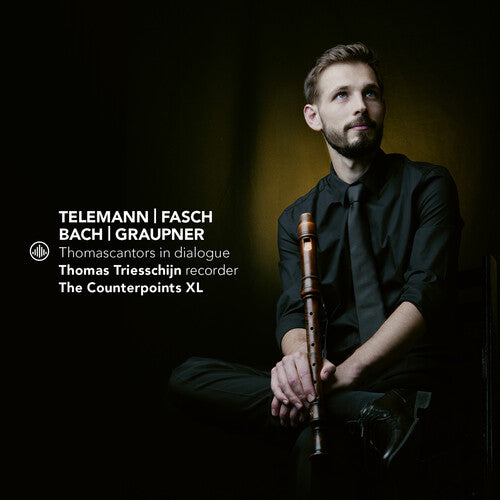
Thomascantors in Dialogue
Dvořák: Piano Trios Nos. 1 & 2 / Trio des Alpes
Dvořák’s chamber music is amongst the most extensive and significant of the 19th century, and the four surviving piano trios embody his command of the form. The first two were written in rapid succession, with No. 1 in B flat major marrying Schubertian lyricism with Slavic inflexions, serenity with joy. No. 2 in G minor is rather more classically conceived, though it shares the same formal structure as No. 1 and exudes a similar quotient of lyric beauty.
Coates: Orchestral Works, Vol. 4 / Wilson, BBC Philhamonic
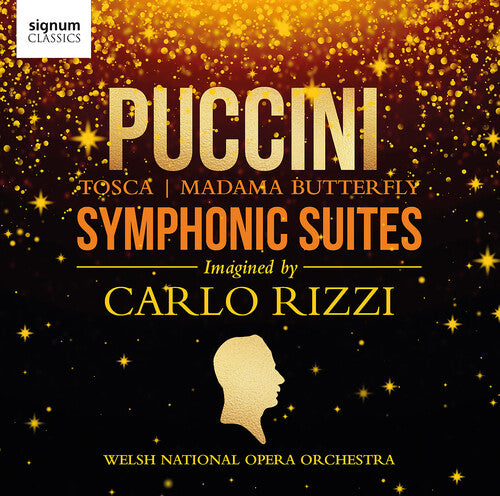
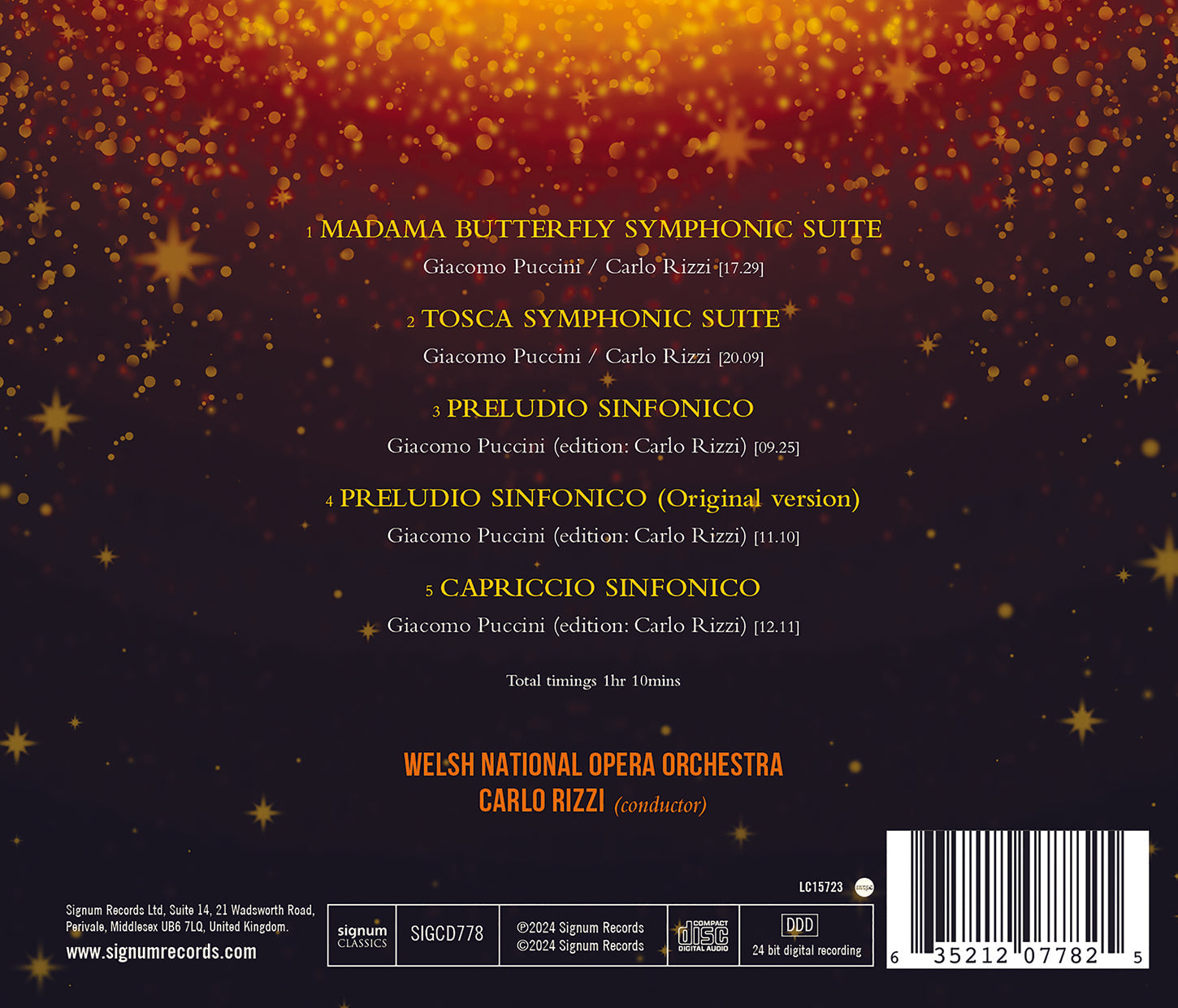
Puccini: Symphonic Suites / Rizzi, Welsh National Opera Orchestra
In Puccini’s anniversary year, Chief Conductor of Welsh National Opera Carlo Rizzi has created new, purely orchestral versions of some of his most well-known and beloved works. Staying pure and faithful to Puccini’s original orchestration without anything added to ‘cover’ any perceivable lack of vocal line the brilliance of Puccini’s Madama Butterfly, Tosca and other works shine through in this album of world premiere recordings.
REVIEW:
This fabulous album of world premiere recordings is just exhilarating from start to finish. I do hope that by the end of the year Maestro Rizzi will give us other orchestral suites, say, from La bohème or Turandot. I am sure they will be welcomed most enthusiastically.
This is an irresistible programme full of shimmering melodies that help us to really discover Puccini’s orchestral mastery which is often overshadowed by the singing and heartwrenching drama of the stories. This exceptionally innovative music that strongly enhances the total mastery of Puccini’s art is not to be missed.
-- Classical Music Daily