With this program spanning nearly a century, from Komitas' Dances written in the mid-1900s to pieces by my father, Gérard Gasparian, composed in the late 1980s, I aimed to highlight both the remarkable diversity of this repertoire and its profound unity. From the minimalist draft of Yerangi to the polyphonic virtuosity of the Capriccio, from the boundless lyricism of Spartacus to the percussive savagery of the Toccata, from the melodious simplicity of the Elegy to the tense chromaticism of the Sonata, one couldn't dream of more contrasting registers. The works on this program, however, all have one thing in common that expresses the true essence of Armenian music: They’re rooted in popular tradition. The very identity of this music – and the reason I feel such a deep, emotional connection to it – lies in the fact that it draws its inspiration from the folk heritage of the Armenian people: its songs, melodies, rhythms, and dances.
Sibelius: Works for Orchestra / Mälkki, Helsinki Philharmonic
BIS
SACD
$21.99Feb 16, 2024
The Helsinki Philharmonic Orchestra can with justification be regarded as ‘Sibelius’s own orchestra’, as it was this orchestra, usually conducted by the composer, that premièred most of his major works. On this disc of three such pieces, the orchestra is conducted by Susanna Malkki; the recording follows on from their three acclaimed albums devoted to the music of Bartók.
Although they were all later revised, the three works on this recording all originated within a very short period in Sibelius’s career: the years 1893–96, a time when he was beginning to establish himself as a composer and a time of national awakening.
One of his most popular works, the Karelia Suite is drawn from a series of tableaux that evoked events in the history of Karelia, the region where Finland and Russia meet. In late 19th-century Finland, the promotion of Karelian folk culture was both fashionable and politically relevant. The short suite Rakastava [The Lover] is a subtle reworking of a work for male voices based on lyrical poems from the collection Kanteletar; Sibelius often conducted it in concert. Sibelius often drew inspiration from the Finnish national epic Kalevala, and episodes from this poem provide the subject matter of Lemminkainen, a substantial four-movement suite (including the captivating Swan of Tuonela) that recounts the adventures of a daredevil hero, a sort of Nordic Don Juan.
REVIEWS:
Mälkki and the orchestra remarkably conjure the dark, swirling soundworld of ‘Lemminkäinen in Tuonela’ (the Hades of Finnish legend). And the concluding ‘Lemminkäinen’s Return’ canters along in roistering style.
-- BBC Music Magazine
Susanna Mälkki and the Helsinki Philharmonic Orchestra produce wellcrafted, beautifully detailed accounts on a par with rival versions – including the Helsinki orchestra’s own with Segerstam (with warm Ondine sound) from the mid-1990s.
John W. Duarte was born in Sheffield, England on 2 October 1919. He started playing the ukulele, but soon moved to the guitar at the age of 15. The advent of guitar phenomenon John Williams, whom Duarte taught for 18 months before the young musician’s entry into the Royal College of Music, London, gave the composer an opportunity to expand his chamber music oeuvre.
The Concertante Quartet Op.22, a substantial work in four movements. In 2021 the composer’s son, Christopher Duarte, discovered some folk songs arranged for guitar and small orchestra among his father’s manuscripts. There is no mention of these arrangements in his list of works and no correspondence relating to their creation, but from the composer’s handwriting these probably date from the mid-late 1950s and may have been written for John Williams to play with fellow RCM students.
Next Market Day, scored for piccolo, snare drum and strings, is an energetic rendering of an Irish love song which Duarte revisited several times. The Coolin of Rùm (or, The Rùm Cuillin), scored for flute, oboe and strings, is a tune from the Isle of Rùm, one of the small islands near the Isle of Skye in the Hebrides. Cuillin is the name for a range of mountains in this area and Duarte may have been alluding to the name of a previous owner of Rùm, Maclean of Duart.
Duarte began work on what became A Tudor Fancy in early 1967. Following A Tudor Fancy, a concerto in all but name. The Concierto alegre Op.101 (1986) is deliberately light in woodwind (2 flutes, one each of the rest), a trumpet, strings, but with a battery of percussion, including two vibraphones. As with A Tudor Fancy, the music proceeds in a variety of ‘conversations’, with the orchestration kept deliberately light when the guitars are playing.
American Tapestry by the Calidore String Quartet weaves together a panoramic portrait of American musical expression across the 20th and 21st centuries. The programme spans Samuel Barber's lyrical String Quartet No. 1, featuring the iconic Adagio; Wynton Marsalis's jazz-inflected At the Octoroon Balls; and John Williams's With Malice Toward None-here in it's world premiere string quartet version. The album concludes with Erich Korngold's radiant String Quartet No. 3 in D Major, written in postwar Los Angeles. Together, these works reveal a vibrant continuum of American artistry-a sound world both richly diverse and deeply unified in spirit.
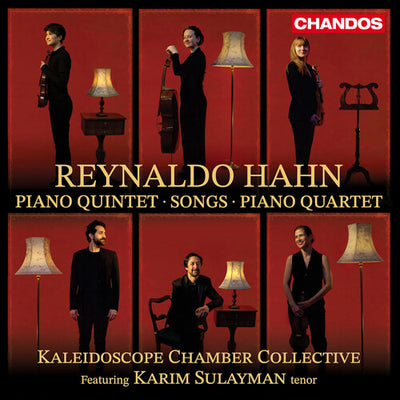
Praised by BBC Music magazine for his 'lucid, velvety tenor and pop-star charisma', the Lebanese-American Karim Sulayman has garnered international attention as a sophisticated and versatile artist. He joins the Kaleidoscope Chamber Collective for this album of works by Reynaldo Hahn. The founder members Tom Poster and Elena Urioste write: 'Kaleidoscope has championed many unjustly neglected composers, but in the case of Reynaldo Hahn the neglect seems particularly puzzling to us. His music is immediately approachable, soaringly beautiful, and speaks directly to the heart; audiences, on the rare occasions that they get to hear it, seem to adore it. His life story is fascinating, too: born in Caracas, to a Jewish-German father and a Catholic-Venezuelan mother of Spanish / Basque origin, the handsome and urbane Hahn charmed high-society Paris, enjoying great success as composer, conductor, singer, writer-lecturer, and music critic. The Piano Quintet had been on our programming wish list for some time: it was lauded as Hahn's greatest work at it's 1922 premiere, and the powerful intensity of it's first two movements in particular acts as a firm rejoinder to those who criticised Hahn as a lightweight salon composer. By the time he finished his Piano Quartet, in 1946, Hahn was a man out of place in the world; this is music which bears no trace of modernism, instead looking back nostalgically to Hahn's heyday in la belle epoque. A number of years ago, our dear friend Karim Sulayman joined Tom in several performances of a set of Hahn songs, and a shared love for the music led to a discussion about how beautifully some of the piano parts could work in chamber arrangements. Karim had first discovered Hahn through the touching recordings on which the composer simultaneously sings and plays his own songs; and we, in turn, have always been deeply touched by the direct channel which Karim seems to have to Hahn's heartfelt expressive world. For all of us, it has been a profound joy to put these new song arrangements down on disc for the first time.'
Mari Kodama, Momo Kodama, Karin Kei Nagano and Kent Nagano present Double and Triple Concertos by Mozart and Poulenc, together with the Orchestre de la Suisse Romande. This unique project highlights the musicality and congeniality of this extraordinary family of performers. On this album, the husband (Kent Nagano) conducts his wife (Mari Kodama), daughter (Karin Kei Nagano) and sister-in-law (Momo Kodama). The collective performance on this album resonates with Mozart's own practice of playing his music together with his father and sister. Despite belonging to different ages in music history, Mozart and Poulenc share a combination of playfulness and seriousness, and the latter composer manages to integrate touches of Mozartian neoclassicism into his genuinely French and twentieth-century double concerto. Sharing the stage on this recording is a dream come true for the Kodama-Nagano family. 8717306262026 PNTA5187202SACD 44281762 .00 21.99 .16 PENTATONE SUPER-AUDIO CD CLASSICAL ORCHESTRAL & SYMPHONIC 05/24/2024 https://mediacdn.aent-m.com/prod-img/500/43/4327443-3147654.jpg 80 1 N
NEWMAN,DAVID / RPO IT'S A WONDERFUL LIFE / MIRACLE 34TH STREE / CAROL 089408880124 TLAC88801.2 11666820 .00 15.99 .25 TELARC COMPACT DISCS CLASSICAL CHRISTMAS / CHANUKKAH 09/27/1988 https://mediacdn.aent-m.com/prod-img/500/55/4330555-3407272.jpg 8 1 N
OLNEY,DAVID HIGH WIDE & LONESOME 011671117720 PHIO1177.2 40364643 .00 15.99 .19 PHILO RECORDS COMPACT DISCS POP FOLK/AMERICANA/SINGER-WRITER 08/17/1995 https://mediacdn.aent-m.com/prod-img/500/31/4331631-3407105.jpg 3 1 N
SCHUBERT / BYLSMA / BETHS / IMMERSEEL PIANO TRIOS 1 & 2 074646269527 SNY62695C.2 37571474 .00 17.99 .23 SONY SRM EXCLUSIVE COMPACT DISCS CLASSICAL ORCHESTRAL & SYMPHONIC 06/03/2011 https://mediacdn.aent-m.com/prod-img/500/76/4333476-3177777.jpg 1 1 N
WINGS OF COURAGE / O.S.T. WINGS OF COURAGE / O.S.T. 074646835029 SSRM68350.2 38095184 .00 17.99 .25 SONY SRM EXCLUSIVE COMPACT DISCS CLASSICAL SOUNDTRACKS & FILM SCORES 05/07/2009 https://mediacdn.aent-m.com/prod-img/500/77/4334077.jpg 2 1 N
BEETHOVEN / ABBADO / BERLIN PHILHARMONIC SYMPHONY 9 IN D MINOR OP 125 074646263426 SSRM62634.2 37571337 .00 17.99 .23 SONY SRM EXCLUSIVE COMPACT DISCS CLASSICAL ORCHESTRAL & SYMPHONIC 08/30/2012 https://mediacdn.aent-m.com/prod-img/500/04/4334104.jpg 1 1 N
MOZART / BEETHOVEN / DVORAK / ORMANDY / ZUKERMAN SERENADE 074646241226 SSRM62412.2 37571245 .00 17.99 .24 SONY SRM EXCLUSIVE COMPACT DISCS CLASSICAL ORCHESTRAL & SYMPHONIC 06/03/2011 https://mediacdn.aent-m.com/prod-img/500/05/4334105-3177776.jpg 3 1 N
MAHLER / RACHMANINOFF / MITROPOULOS SYMPHONY 1 / ISLE OF THE DEAD 074646234228 SSRM62342.2 37571061 .00 17.99 .25 SONY SRM EXCLUSIVE COMPACT DISCS CLASSICAL ORCHESTRAL & SYMPHONIC 08/30/2012 2 1 N
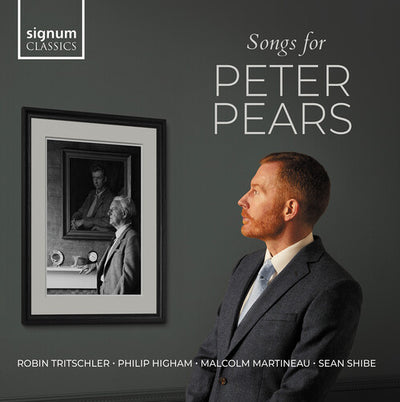
BENNETT / OLDHAM / TRITSCHLER SONGS FOR PETER PEARS For a period of the 20th Century, due to his talent and association with Benjamin Britten, Peter Pears was perhaps the world's most famous classical singer. Pears inspired Britten to create great works of art precisely because Pears was a compelling artist with an exceptional voice, an inquisitive mind, a knowledge of art, history, literature and poetry. They became a self-perpetuating duo, inspiring each other to even greater heights of artistry, technical ability, and emotional certainty. This album of works by Lennox Berkeley, Benjamin Britten, Arthur Oldham, Richard Rodney Bennett and Geoffrey Bush is performed by tenor Robin Tritschler, who is joined by cellist Philip Higham, guitarist Sean Shibe and pianist Malcolm Martineau. Praise for Robin Tritschler and Malcolm Martineau: 4 stars Performance, 4 stars Recording Robin Tritschler's sweet-toned voice is a continual delight, as is Malcolm Martineau's sparkling, pearly, luminous piano sound" - BBC Music Magazine
For this third instalment in his survey of orchestral works by Ruth Gipps, Rumon Gamba, conducting the BBC Philharmonic, is joined by the horn soloist Martin Owen. The album opens with Gipps's Coronation Procession. The piece depicts the journey of the Crown(s), perhaps as observed from the Royal Coach, culminating in the entry to Westminster Abbey. Written in January 1953, the piece was not used at the coronation, and instead first performed in September 1954 in Melbourne, Australia. Ambarvalia is a memorial tribute of 1988 by Gipps to the composer and colleague Adrian Cruft, who had died in February 1987. Gipps wrote the Horn Concerto in 1968 for her son, Lance Baker. The piece was later championed by Frank Lloyd, who gave a BBC broadcast in 1982. Here the virtuoso Martin Owen brings the work vividly to life. The Lake District was the inspiration for the 'Impression' Cringlemire Garden, a pastoral miniature for string orchestra. Dated September 1942, the First Symphony is a direct reflection of the horrors of war. The work demonstrates Gipps's personal voice, and features some wonderful writing for winds.
Grace Williams: Violin Concerto, Elegy for string orchestra,
Lyrita
CD
$23.99Nov 07, 2025
'When I'm composing, not only have I to create music, I must also search for the best way of putting it across. It means being on the alert the whole time; writing - then criticizing what I've written - and if it won't do, scrap it and start again - more criticism - and so on until I've done everything within my power to make the music live and flow naturally'. These insights from Grace Williams into her approach to the compositional process show her strong desire to communicate fluently and sincerely with her listeners. Also evident from this quotation is her professionalism, technical integrity and formidable capacity for self-criticism. She held herself and her art to the highest standards, withdrawing and destroying scores which failed to live up to her ideals. It can be inferred from this that she regarded the works which survived elimination as worthy of her musical legacy.
Principal conductor Ivor Bolton will bid farewell to 'his' orchestra, the Basel Symphony Orchestra, in summer 2025 with a 'French' album. He will hand over the baton to his successor Markus Poschner for the new season. So as a farewell, here are symphonic and vocal works by Ernest Chausson. The Symphony in B flat major recorded here is characterised by it's lyrical melody and harmonic sophistication, which builds a bridge between romantic expressiveness and impressionistic sounds. In comparison, the vocal works also presented here, such as 'Viviane' or 'Helene', often have a more intimate, vocal quality that emphasises the human voice. These differences illustrate Chausson's versatility as a composer and his ability to combine fascinating instrumentation with profound emotions in both instrumental and vocal music.
In Concert at the Library of Congress / Stuyvesant String Quartet
Bridge Records
CD
$16.99Aug 16, 2024
Bridge Records is pleased to present this previously unissued performance by the Stuyvesant Quartet. The recording is the only known "in concert" recording by this stellar quartet of players associated with Toscanini's legendary NBC Symphony Orchestra, and was made at the Library of Congress's Coolidge Auditorium in 1946. This release is part of Bridge's ongoing series devoted to the Stuyvesant Quartet's historic recordings.
REVIEW:
It is fitting that Prokofiev’s First Quartet is performed here, as this work was first performed at the LoC itself. The inclusion of Dohnányi’s Second Quartet is certainly cause for celebration. Their Dvořák cuts deep emotionally. This disc of historic performances is a little miracle and recommended without hesitation.
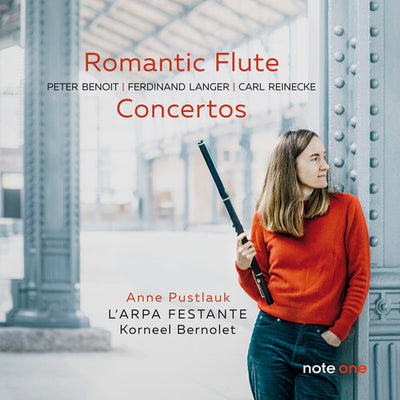
This CD recording with flutist Anne Pustlauk is an experiment: For about 15 years, she has been researching flute performance practices in the early and late 19th centuries, which differ greatly from our performance practices today. It is not only the historical instruments that make the difference; the playing style of that time is also extremely rare today. Together with L'arpa festante under Korneel Bernolet, Anne Pustlauk searches for new forms of expression without copying a specific playing style of that time. The artists demonstrate this impressively with the famous Flute Concerto, Op. 283, by Carl Reinicke and Peter Benoit's Symphonic Poem, Op. 43A, from 1865. The program also includes Ferdinand Langer's Flute Concerto in G minor, which he composed for his friend and colleague at the Mannheim Court Theater, Franz Neuhofer (a student of the famous flute maker Theobald Boehm), who held the position of principal flutist in the orchestra there.
Encounter brings together two towering works of contemporary chamber music that speak across cultures, histories, and inner worlds. Osvaldo Golijov's The Dreams and Prayers of Isaac the Blind and Peteris Vasks' String Quartet No. 6 arise from profoundly different traditions-Jewish mysticism and Baltic spirituality-yet meet in a shared search for truth, memory, and transcendence. Both works are intensely personal, rooted in lived experience and belief, and animated by music's power to give voice to what lies beyond words: longing, suffering, hope, and illumination. In this recording, these worlds do not merely coexist; they listen to, reflect, and transform one another. Performed by the Arethusa Quartet with clarinetist Chen Halevi, Encounter is also a meeting of artistic journeys. Golijov's ecstatic, ritual-like score unfolds as a spiritual ascent through dreams, prayers, and blindness-understood as deeper inner vision-while Vasks' Sixth Quartet traces a life's arc from farewell and remembrance to a final, hushed encounter with transcendence, illuminated by echoes of Beethoven. Across both works, vulnerability and intensity are balanced by stillness and song, darkness by light. What emerges is an album that feels at once intimate and universal: an affirmation of shared humanity, and a reminder of music's enduring ability to connect past and present, earth and spirit, performer and listener. = Curiosa is conceived as a personal "cabinet of curiosities" by violinist Jorge Jiménez, bringing together music that entered his life through years of travel, collaboration, and discovery. The album spans laments, dances, preludes, fugues, and songs from both renowned and anonymous sources, ranging from the Middle Ages to the Baroque and beyond. Each piece is selected for it's emotional depth, strangeness, and expressive power, forming a living repertoire shaped in rehearsals, late-night conversations, concerts, and recording sessions. Central to the project is Jiménez's fascination with unaccompanied music and historical instruments, particularly the baroque violin and vielle, whose raw and earthy sound transports the listener into earlier sound worlds. Throughout Curiosa, Jiménez weaves together personal heritage, musical memory, and imaginative storytelling. His own arrangements connect Bach, Dowland, Strozzi, Gaspar Sanz, and traditional tunes with vivid images. Joined by Joy Smith on early harps and Daniel Garay on historical percussion, and performing with his ensemble Tercia Realidad, Jiménez blends historical insight with spontaneity and improvisation. The result is an album that feels both intimate and expansive-music passed "between hands, ears, and hearts," constantly transforming while remaining deeply rooted in shared curiosity and human connection. Jorge Jiménez: "These pieces entered my life through the extraordinary musicians and ensembles I've been fortunate to work with across Europe. They form a living repertoire shaped in rehearsal rooms, late-night conversations, recording sessions, and concerts." = During the darkest of the lockdowns, I took my daughter to an open field near our home. In a time when the world felt shuttered and small, walking was our only escape from the suffocating stillness. As we reached the field, a sudden sensation washed over me-a quiet awakening. It wasn't just the spring breeze or the scent of the grass; it was a sudden reminder of what being alive meant. I felt I had been touched by Zephyr, the Greek god of the west wind, sparking a renewed wish to create and perform for the world once more. Liberte´: A piece exploring and searching for emotional freedom. Zephyr: Named after the gentle west wind, this track served as the primary source of inspiration for the entire album. Fushigi no Kuni: Translating to "Wonderland" in Japanese, this piece was inspired by Alice's Adventures in Wonderland written by Lewis Carroll. A Troubadour in the Moonlight: A composition and improvisation depicting a minstrel serenading a loved one beneath the moon. For Misato: A heartfelt dedication to Misato-san, my dear friend who departed too young. The five songs above are composed by Yukari. Eurus, Suibokuga, Pandora's Box, Don't Follow the Piper, and Au crépuscule are collective improvisations. = "We can imagine some eyebrows being raised at the description of Dora Pejacevic as a contemporary of Brahms; the two composers were born more than fifty years apart, and their lives only overlapped by twelve years. Yet both works by Pejacevic are unmistakably from the same compositional lineage as that by Brahms; and both are works written early on in Pejacevic's remarkable (and, sadly, all-too-short) life. Both pieces belong clearly to the romantic tradition, displaying no hint of the more modernist directions which her later works would take. We were immediately intoxicated by the passionate sweep of Pejacevic's Piano Quartet, but also the tenderness of it's slow movement, and felt it would make the perfect bedfellow for the First Piano Quartet of Brahms, a piece to which Tom has felt particularly close since student days. Brahms's Piano Quartet is justly one of the best-loved of all chamber works, and few works are more exhilarating to perform: the first movement offers an abundance of glorious themes; the second takes us to a mysterious dreamworld; the third luxuriates in expansive lyricism; then the fiery virtuosity of the gypsy finale sends us headlong to the finish line. This album brings us to the end of our recorded journey through Brahms's three piano quartets, and it has been the greatest privilege and joy to record these works, alongside three major piano quartets by composers who deserve to be far better known. However, we are pleased to say that the series does not end here: looking beyond the piano quartets, we have further albums in preparation, pairing Brahms with his brilliant and lesser-played contemporaries." -Kaleidoscope Chamber Collective
African American Voices II - Bonds, Kay & Perkinson / Gray, RSNO
Linn Records
CD
$20.99Oct 20, 2023
Kellen Gray has reunited with the Royal Scottish National Orchestra for a second instalment of African American Voices. Though representing differing schools of thought regarding African American classical music, the composers here are united by their roots in black history, culture and its rich musical heritage. Drawing upon jazz and spirituals – ‘I Want Jesus to Walk with Me’ serving as the source material – Margaret Bonds’ Montgomery Variations engages with African American history, namely the Montgomery bus boycott and the 1963 Birmingham church bombing. In this work, re-discovered in 2017, Bonds tackles the themes of strength, resistance, determination and faith. Bonds’ contemporary, the prolific composer Ulysses Kay cultivated a neoclassical voice, as his Concerto for Orchestra exemplifies, very much in line with William Grant Still and his teacher Paul Hindemith. A versatile musician, Coleridge-Taylor Perkinson comes a generation later. In his Worship: A Concert Overture, we can hear a blend of Baroque counterpoint, elements of the blues, spirituals and black folk music.
REVIEW:
Margaret Bond (1913–1972) wrote her 1964 Montgomery Variations as a seven-movement theme-and-variations on the spiritual “I Want Jesus to Walk with Me.” Bond’s impassioned cri de coeur bypasses the constraints of academic cd’s and don’ts as it chronicles in boldly theatrical music the beginnings of the Civil Rights Movement, from the Montgomery bus boycott through the tragic 1963 Sixteenth Street Baptist Church bombing. Bond dedicated the piece to Dr. Martin Luther King, Jr., though sadly never heard it performed during her brief lifetime.
Ulysses Kay (1917–1995) reflects in his 1948 Concerto for Orchestra the influence of several of his mentors – including Paul Hindemith – as a thoroughly tonal work conceived in mid-20th century, in a moment in which the music of the followers of the Second Viennese School reigned supreme in the classical music worlds of both Europe and America. Kay’s classically structured, richly orchestrated, harmonically dense, and contrapuntally complex composition remains at its core a consonantly melodic, post-Romantic work.
In his 2001 Worship: A Concert Overture Coleridge-Taylor Perkinson (1932–2004) successfully amalgamates sacred and secular music, incorporating blues in his nobly elegant treatment of Praise God from Whom All Blessings Flow.
Like so many important Austrian musicians forced into American exile by the Nazis, Richard Stohr (1874-1967) suddenly found himself cast from celebrity into obscurity, The optimism and energy, even defiance, of these three works from 1942 suggest that he took it on the chin, with his musical language retaining it's Viennese accent in an individual amalgam of Bruckner, Mahler, Schmidt and Korngold. Indeed, the echoes of Mahler in Stohr's Second Symphony may be a deliberate homage if, as seems possible, this 1942 version is a revision of a now-lost work first composed shortly after Mahler's death.
Marsalis: Blues Symphony / Bignamini, Detroit Symphony
PENTATONE
CD
$19.99Mar 14, 2025
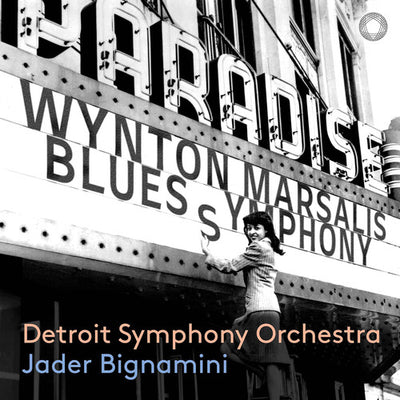
The Detroit Symphony Orchestra and it's Music Director Jader Bignamini present Wynton Marsalis' Blues Symphony. The piece is a triumphant ode to the power of the blues and the scope of America's musical heritage. With a blend of influences from ragtime to habanera, the piece takes listeners on a sonic journey through America's revolutionary era, the early beginnings of jazz in New Orleans, and a big city soundscape that serves as a nod to the Great Migration. Detroit being one of the most vibrant melting pots of musical cultures in the US, the Detroit Symphony Orchestra seems the ideal advocate for this original contribution to the symphonic repertoire. The recording is also the first with Jader Bignamini, giving a new dimension to his music directorship. Wynton Marsalis is a world-renowned trumpeter, bandleader, composer, and a leading advocate of American culture. Jader Bignamini has worked with the world's leading orchestras and opera companies, preferably conducting without a score to guarantee maximum engagement with his players. The Detroit Symphony Orchestra, America's fourth-oldest, has a history as varied and exciting as that of it's hometown.
Hodgkinson, Frank, Mendelssohn, Weir & Wheeler: Songs for a New Century
Navona
CD
$8.49$16.99Save 50%May 03, 2024
The singing quality of string instruments ties together "SONGS FOR A NEW CENTURY," a program featuring both world premiere recordings of new music commissioned for the artists and world premiere recordings of masterpieces by Mendelssohn.
The program opens with a set of Mendelssohn’s Songs Without Words, beginning with the Opus 109 written by the composer for cello and piano. It continues with a set of arrangements for cello and piano, some recorded for the first time, by the 19th-century cellist Alfredo Piatti, a personal friend of Mendelssohn’s upon whose cello Jonathan Miller plays. Gabriela Lena Frank’s Operetta for violin and cello, the composer writes, expands upon Mendelssohn’s concept of the “song without words,” creating opera without words that evokes scenes and characters through singing music for the duo of violin (Lucia Lin) and cello. Scott Wheeler’s second cello sonata, Songs Without Words, was inspired by Miller’s singing cello tone. Finally, Judith Weir’s Three Chorales for cello and piano meditate on religious poetry, departing from hymn texts –– and in the third Chorale, a melody from Hildegard of Bingen –– in a triptych that evokes the human condition.
"Operetta," "Three Chorales," and "Cello Sonata #2: Songs Without Words" were commissioned by Jonathan Miller and Diane Fassino for the Boston Artists Ensemble.
The currently hottest German brass ensemble with great concept albums presents Christmas classics in completely new arrangements for the first time?. All-time classics like "Driving Home for Christmas", "It's beginning to look like Christmas", "Santa Claus is coming to town", "All I want for Christmas", "Let it snow", "White Christmas", "Frosty the Snowman" give this Christmas album a unique sound?
Long available only in a larger box, the only available digital-era set of Martinu’s string quartets, recorded in 1990 by a native Czech ensemble.
Martinu composed seven quartets over the course of his career, from the First in 1918 to the Seventh in 1947. This chronological range therefore mirrors the development of his music, from Debussy and Franck-accented Bohemianism in the First to a more up-to-date French influence on the Second from 1925, which arrives in the finale at the kind of chugging accumulations of motoric energy that became his trademark.
The direct emotional appeal of all seven quartets is vividly brought to life by the Stamitz Quartet in a recording first issued in 1990, and which still has very few rivals on disc. Established in 1985, the Stamitz Quartet quickly became known as leading interpreters of Czech repertory. ‘I can heartily recommend this comprehensive traversal of the unpredictable, occasionally highly impressive works that make up the corpus of Martinu’s Quartets.’ (MusicWeb International)
Anyone interested in Romantic music will inevitably come across the name Carl Reinecke. Countless aspiring composers from Germany and Scandinavia went to him to learn their craft. To those who wanted to make it in the city of the famous Gewandhaus Orchestra, he was an institution. Reinecke the composer enjoyed great success during his lifetime. However, as a preservationist of musical traditions, he was quickly forgotten after his death. The inevitable course of musical development swept him out of the way. This was not due to the quality of his music. Not only does his compositional technique stand up to scrutiny, but also his music as a sonic experience. This is particularly true of his three symphonies, all of which are now available in our catalogue with the release of the powerful Second in C minor
Ockeghem: Complete Songs, Vol. 2 / Metcalfe, Blue Heron
Blue Heron Renaissance Choir
CD
$21.99May 03, 2024
Johannes Ockeghem (c. 1420-1497) was one of the most celebrated musicians of the fifteenth century and one of the greatest composers of all time. He was every bit the equal of J.S. Bach in contrapuntal technique and profound expressivity, and like Bach able to combine the most rigorous intellectual structure with a beguiling sensuality. His two dozen songs set French lyric poetry in the courtly forms of his era—rondeau, virelai, and ballade—to exquisitely crafted polyphony in which all voices are granted equally beautiful and compelling melodies.
This CD is the companion to Blue Heron’s 2019 release, Johannes Ockeghem: Complete Songs, Volume 1, which was named to the Bestenliste of the Preis der deutschen Schallplattenkritik and acclaimed in Gramophone as “performances of absolute clarity, beautifully in tune, beautifully balanced and beautifully recorded”; Early Music enthused that “the Boston-based ensemble is at its finest—a summit quite sublime.… The group’s extraordinary rapport with the music is evident everywhere in the recording; each melodic line is not only clear and precise but also imbued with obvious affection.”
Besides twelve of Ockeghem’s songs, the disc includes two related works (Gilles Binchois’s Pour prison, quoted by Ockeghem in his song La despourveue, and Johannes Cornago’s Qu’es mi vida, arranged by Ockeghem) and an anonymous instrumental arrangement of Ockeghem’s Je n’ay dueil. The CD booklet contains complete texts and translations, and notes by music historian Sean Gallagher and Blue Heron’s artistic director, Scott Metcalfe.
Click here to listen to the Naxos podcast interview with Paul Jacobs about this release.
This release features organ concertos by some of America's finest contemporary composers: Horatio Parker's 'imposing and brilliant' piece is heard alongside Christopher Rouse's concerto of contrasting light and dark sonorities, which is dedicated to album soloist Paul Jacobs, and Wayne Oquin's Resilience reflects the human capacity for tenacity and perseverance. The program ends with Ives' Variations on 'America' for solo organ.
Following his exploration of Spain with the music of Federico Moreno Torroba (BIS-2725), Franz Halasz now takes us to Brazil with the complete works for solo guitar by Heitor Villa-Lobos. The music of this extremely prolific composer often combines the influences of European classical music with the popular and traditional music of his homeland, which he played from an early age. The twelve etudes, thoroughly modern, are to the guitar what Chopin's etudes are to the piano. Andres Segovia put it perfectly: 'They present, at the same time, formulas of an amazing efficiency for the development of two-handed technique, and disinterested musical beauty.' In contrast, the Suite populaire bresilienne and Choros No. 1 reflect the composer's youthful experiences as a 'choro' musician playing Brazilian street music, and offer a fusion of the characteristics of traditional music. Finally, the five Preludes return to Brazilian folklore, of which they offer a synthesis in the form of five tableaux inspired by the popular repertoire. This recording also features two rarities: the recently discovered Valse-Choro and the unfinished Valsa Concerto No. 2, completed by Debora Halasz. An evocative blend of syncopated rhythms, exotic harmonies, sensual melodies... and guitaristic flamboyance!
Selections from King of Kings - Organ Music of Black Compose
GIA
CD
$18.99Jun 07, 2024
This recording highlights the tremendous contribution of black composers to the repertoire of church and concert organists. Includes organ works by composers from the late nineteenth century to the present day. The masterfully arranged spirituals and dynamic original compositions can add the perfect touch to a worship service. Artist Nathaniel Gumbs has been recognized as "one of 20 outstanding organists under 30 years old for his achievement in organ performance and church music (The Diapason magazine, 2017). The Newberry Memorial Organ, in Woolsey Hall at Yale University, heard on this recording is one of the most renowned Romantic organs in the world.
Solitude - Songs of Schubert, C. & R. Schumann, Wolf et al. / Konradi, Cosmos Quartet
Berlin Classics
CD
$21.99May 17, 2024
In her new album "Solitude," soprano Katharina Konradi embarks on a musical journey to explore solitude. On this journey, she is accompanied by poets and composers from different time periods. The Cosmos Quartet from Barcelona joins her on her journey. Art songs by composers such as Robert and Clara Schumann, Franz Schubert, and Hugo Wolf, as well as folk songs and French chansons, are waypoints on this journey on which they explore the various facets of solitude together. Miniatures for solo soprano by the Hungarian-French composer György Kurtág serve as transitional elements, providing subtle and sophisticated coherence. Among the special rarities of the recording are the two Catalan songs by the violinist, composer, and conductor Eduard Toldrà.
The soprano, born in Kyrgyzstan, captivates audiences and critics alike with her vocal brilliance and cultivated emotional depth. The Cosmos Quartet matches her with its honest elegance and compelling expressiveness. Although the Cosmos Quartet and Katharina Konradi only met at the beginning of rehearsals for "Solitude," a very special magic immediately revealed itself, inherent in the combination of Katharina Konradi's voice and the Cosmos String Quartet. "String quartet and voice blend incredibly well together – even though the four instruments already form a perfect sonic structure on their own. I always enjoy being surrounded by so many different colors while singing," describes Katharina Konradi about the collaboration.
The result of this collaboration and shared journey is an album characterized by emotionality, a variety of moods, and the highest musicality. It invites one to linger, to listen closely, to find tranquility in the beauty of music, and to draw strength from it.
Distler: Die Weihnachtsgeschichte / Riis, Vocal Group Concert Clemens
OUR Recordings
CD
$10.99$21.99Save 50%Nov 03, 2023
The inspiration for Hugo Distler’s gem of a Christmas narrative can be found in the German-language protestant sacred music of the early baroque era, especially the music of Heinrich Schütz. Drawing on Schütz’s example, Distler composed his Christmas story exclusively for vocalists – soloists and a 4-8-voiced ensemble – in what is, in Distler’s own words, described as an “Oratorium mit kammermusikalishem Charakter." We also hear parts of the beautiful choral Es ist ein Ros entsprungen, which appears seven times during the course of the narrative. – every time in a new harmonic colour. The story of Hugo Distler’s life is a tragic one. Born in Nuremburg in 1908, he would go on to teach at the School for Church Music in Spandau before being appointed professor of church music in Stuttgart in 1940. Distler, who was a deeply religious man, has been recognized as a forerunner of the New German Church Music, an important musical movement which developed in the 1930s. The Nazis stigmatized Distler’s compositions as “degenerate art”, and when he received his conscription papers, he took his life. Sadly, Distler’s music is seldom performed outside of Germany even to this day. Hailed by Gramophone as “a choir worth listening to for their beautiful singing, which can deliver performances of pure, natural eloquence,” the 16 voices of the award-winning vocal ensemble Concert Clemens, founded by conductor Carsten Seyer-Hansen in 1997, has established itself as one of the leading vocal ensembles in Scandinavia. Their stylistic versatility has been seen in numerous collaborations exploring the connections between jazz and classical music as well as note-perfect interpretations of standard repertoire. The evangelist, tenor Adam Riis, is one of Denmark’s leading voices. Recorded in the DXD format by the Danish “Wizard of Sound”, Preben Iwan, in the resonant sonics of Skt. Markus Kirken, Århus.
Paul Ben-Haim ranks among those leading Israeli composers from his generation. Born Paul Frankenburger in Munich he studied composition with Friedrich Klose and served as an assistant conductor to both Bruno Walter and Hans Knappertsbusch. His extensive catalogue comprises works in all the primary genres apart from opera. Music for or with cello features prominently throughout Ben-Haim's output. Following emigration, he increasingly advocated a specifically Jewish national expression while his own compositions favoured a late-Romantic vein redolent of - though by no means indebted (unlike other contemporaries) to - Ernest Bloch and frequently informed by Middle-Eastern overtones.
but I like to sing... / Carolyn Sampson & Joseph Middleton
BIS
SACD
$10.99$21.99Save 50%Nov 03, 2023
After many acclaimed releases on BIS, most recently ‘Sounds and Sweet Airs – A Shakespeare Songbook’ (BIS-2653), Carolyn Sampson’s latest recital with Joseph Middleton lives up to its name: it is an eloquent testimony to the English soprano’s love of her art. This programme artfully blends well-known and lesser-known lieder by German and Austrian masters such as Schubert, Mendelssohn, Brahms, Richard Strauss and Hugo Wolf with French songs by Gounod, Poulenc and Franck, as well as works by Anglo-Saxon composers such as Hubert Parry, Samuel Barber and Ivor Gurney. Female composers are not forgotten, with rarely-performed songs by Rita Strohl based on slightly risqué poems by Pierre Louÿs, music by Cheryl Frances-Hoad, Kaija Saariaho – who has recently passed away – and Deborah Pritchard, whose song presented here was composed especially for Sampson. And while Leonard Bernstein’s comically cheeky song ‘I hate music’, appears to be a call not to let music take itself too seriously, Errollyn Wallen’s ‘Peace on Earth’, which concludes the album, invokes calm and encourages us to find peace, a message that seems more relevant today than ever.
Drawing from influences as disparate as the blues, jazz, Broadway, gospel, folksong and the wild west, the 'American vignettes' in this album merge popular idioms into a new canon of the repertoire for cello and piano, in a series of musical snapshots that are as varied as the men and women who composed them and yet all remain quintessentially American in spirit. The distinctive voices of six US composers, from the late twentieth and early 21st centuries, here come together to weave a virtuosic and colourful tapestry of Americana.
Following her lyrical and witty complete recording of Mozart’s Keyboard Sonatas, issued by naïve in March 2023, Yeol Eum Son invites Svetlin Roussev to join her in enfolding himself in the enticingly subtle harmonic intricacies of Germanic post- Romanticism.
For their second recital as a duo, the Bulgarian violinist and the Korean pianist follow the course taken by works written over a period of slightly more than half a century by composers or famous performers upon whom Richard Wagner exercised crucial influence. They take on almost every genre – cinema, opera, chamber music, transcription – treating it in the lyrical, large-scale manner of the Bayreuth master. During their unexpected, fascinating journey, Svetlin Roussev and Yeol Eum Son chart a variety of pathways, from Waxman to Strauss.
So many different worlds! To begin, two figures who made their indelible mark on the music written for Hollywood. Of German-Polish origins, in 1946 Franz Waxman (Rebecca, Sunset Boulevard, A Place in the Sun, Prince Valiant) wrote, at Jascha Heifetz’s request, a paraphrase on themes from Wagner’s Tristan et Isolde, actually an adaptation of a section of the score he composed for the film Humoresque (Warner Brothers, 1947). In summary, a manifesto in music of an impossible love – to which, at the end of the disc, an extremely rare transcription one of the better known Wesendonck-Lieder, credited to the great virtuoso Leopold Auer, forms a response.
The programme continues with Erich Wolfgang Korngold, a child prodigy in Vienna during the 1910s. The famed Mariettas Lied – the best-known moment in his opera Die tote Stadt – and the sublime nocturne from his incidental music for Shakespeare’s Much Ado About Nothing (the Scene in the Garden) remain as much moments of lyric intensity as truly cinematographic, deliciously intoxicating love scenes. But lovers also know how to frolic, and if already in Korngold they readily do so, the three more light-hearted pieces by Fritz Kreisler will place them in everyday, commonplace scenarios, where laughing reigns.
The keystone of the programme is unarguably the magnificent Sonata for Violin and Piano that Richard Strauss composed in 1887. He was 23 years old, and still heavily influenced by Schumann and Brahms, even Grieg. Svetlin Roussev and Yeol Eum Son make its case with radiant commitment, sensitive to the spirit stirring in the young Richard, then already in love with the soprano Pauline de Ahna, who would become his wife.
Beyond Wagner, this highly original album above all celebrates that moment of falling in love when, overwhelmed, the heart quivers, to the point of being transformed.