Bach's Coffeehouse brings together a selection of Apollo's Fire recordings - old and new alike - featuring repertoire that is believed to have been performed at Cafe Zimmerman in Leipzig, the city where Johann Sebastian Bach served as Cantor. Coffee houses were all the rage at the time, centres for socialising and musical soirees. Bach would have found respite from his formal duties as Cantor, by curating informal concerts at the thriving coffee emporium. Bach's Coffeehouse features new recordings of Brandenburg Concerto No. 4 with virtuoso soloists Alan Choo, the Singaporean violinist and Assistant Artistic Director of Apollo's Fire, and recorder player Daphna Mohr; the Double Concerto for Oboe and Violin with Debra Nagy and violinist Johanna Novom; and "Air on a G String" from Orchestral Suite No. 3. Rounding out the album, Apollo's Fire brings back catalogue favourites by two of Bach's contemporaries: Telemann's swaggering Don Quixote Suite, and Vivaldi's fiery "La folia", featuring Alan Choo and Spanish violinist Francisco Fullana.
Prize-winning composer Gregory Fritze has written over a hundred compositions for a variety of forces, and is also a greatly admired teacher. The four works on this album share programmatic perspectives. The city of London is evoked in a celebratory overture full of vitality, diversity, and pageantry; the two symphonies reflect Fritze's immersion in the warmth, landscape, and festive excitement of the city of Valencia; and the overture Waterplace Park, a popular meeting place in Providence, Rhode Island, is a jovial piece that features five unusual instrumental soloists.
When the music of Nikolai Kapustin was discovered by a wider audience in the West, it was positively shocking: Who was this Soviet (!) composer, whose music sounded more like an Oscar Peterson improvisation than anything else - but who wrote detailed scores, black with notes?! As we discover more and more of his music and as we again can hear on the present recording, Kapustin developed his style subtly and steadily. He went with the times. As the music that influenced him changed, so did Kapustin's. The development of Big Band Jazz can be traced in his work. In that sense Kapustin never settled on one style (within the parameters of his unique fusion of jazz and classical, granted) but remained flexible about the musical material and the way he related it to the orchestra.
Corelli: Violin Sonatas, Op. 5 / Rachel Barton Pine
Cedille
CD
$19.99Sep 13, 2024
For her 24th recording for Cedille Records, violinist Rachel Barton Pine joins forces with period instrument specialists David Schrader, John Mark Rozendaal, and Brandon Acker to record Arcangelo Corelli's seminal set of 12 Violin Sonatas, Op. 5. "An exciting, boundary-defying performer" (Washington Post), Pine has been described as "a most accomplished Baroque violinist, fully the equal of the foremost specialists" (Gramophone). Known for her versatility across a vast repertoire - from Renaissance to heavy metal - she has studied period performance practice extensively and performs on the viola d'amore, renaissance violin, and medieval rebec. She has appeared as soloist with Apollo's Fire, the Seattle and Indianapolis Baroque Orchestras, Baroque Band, and Ars Antigua, and has performed concertos with Nicholas McGegan, Jeannette Sorrell, and Frans Bruggen. Published in 1700, Corelli's Twelve Violin Sonatas are foundational in the evolution of both the sonata and concerto forms. This recording explores these compositions through a historically informed approach, utilizing an array of period instruments, each chosen to enhance the expressive nuances of Corelli's music. Reflecting the era's experimental spirit, the ensemble embraces the interpretative freedom suggested by Corelli's original scores. Schrader alternates between organ and harpsichord, Rozendaal between violoncello and viola da gamba, and Acker performs on theorbo, archlute, and baroque guitar. Pine, inspired by the versatility of her colleagues, performs the famous "Follia" variations (Sonata No. 12) on an original-condition Gagliano viola d'amore, exploring this rarely used instrument in an authentic historical context. Corelli: Violin Sonatas, Op. 5, was produced and engineered by the Grammy-winning team of James Ginsburg and Bill Maylone. It was recorded on February 21, 23, and 25, 2024 and April 29-May 2, 2024, at Nichols Concert Hall in Evanston, IL.
Grammy Award-winning Chicago-based percussion quartet Third Coast Percussion (Sean Connors, Robert Dillon, Peter Martin, David Skidmore) presents Between Breaths, an album of world premieres of works by four contemporary composers, plus a work by the quartet itself.
Known for their captivating performances and innovative approach to modern classical music, TCP has been praised for “commandingly elegant” (New York Times) performances and the “rare power” (Washington Post) of their recordings. Between Breaths, a follow up to TCP’s widely praised album, Perspectives, “continues to push percussion in new directions, blurring musical boundaries and beguiling new listeners” (NPR).
The works on Between Breaths explore aspects of meditation in sound, incorporate unconventional timbres and tones, and invite listeners to lose themselves within a captivating sonic landscape. Missy Mazzoli’s five-movement Millennium Canticles transports listeners into a vivid realm where a group of people strive to recreate the rituals and stories of human life after an apocalypse. Mazzoli skillfully crafts an evocative soundscape using diverse elements such as wooden planks, resonant metal pipes, tone chimes, drums, discordant metallic tones, a resounding lion's roar, and an array of vocal expressions.
In Practice, a collaborative composition by TCP, began as a sound meditation drawing upon the personal rituals of the quartet’s members, from a warm-up routine to using sounds created with everyday objects. This source material laid the foundation for the work, which developed its own sense of direction and purpose, with an atmosphere of meditation and balance.
Tyondai Braxton's Sunny X juxtaposes otherworldly acoustic and electronic timbres against a steady rhythmic drive. Within this sonic tapestry, resonant wooden planks, metallic pipes and plates, and an array of gongs and woodblocks contribute to a distinctive and immersive experience.
Chicagoan Ayanna Woods’ Triple Point refers to the unique state where a substance simultaneously exists as a gas, liquid, and solid due to temperature and pressure conditions, which results in liquids bubbling into gas, rapidly freezing, exploding, and melting into liquid again. Woods’ composition mirrors this phenomenon, as it encapsulates moments of dynamic energy and musical elements that rise to the surface and dissolve again.
Gemma Peacocke’s Death Wish, composed in tribute to Hinewirangi Kohu-Morgan, a Maori artist, poet, and activist, has become a staple of TCP’s repertoire. Performed by four players on two marimbas, the music creates a powerful landscape of melancholy, personal devastation, and hope.
REVIEW:
Third Coast Percussion’s Between Breaths is another fresh and thought-provoking album in what has been a steady stream of recordings from the Grammy-award winning quartet over the past seven years. Released Sept. 8 on Cedille Records, Between Breaths returns to many themes explored on the ensemble’s debut EP, Ritual Music (2006): relationships between individuals, communities, and ritualistic acts. The highly programmatic and hypnotic new album showcases the quartet’s vision for commissioning works by living composers and features world premiere recordings of works by Missy Mazzoli, Tyondai Braxton, Ayanna Woods, and Gemma Peacocke, and by Third Coast Percussion itself.
Victoria: Tenebrae Responsories / Hollingworth, I Faglioni
Coro
CD
$10.99$21.99Save 50%Mar 01, 2024
In the late 16th century when vocal polyphony was developing into the excesses of the late Italian madrigal and the powerplay of multi-choir writing in Venice, Victoria, in Rome, chose to write his 18 Tenebrae settings with the simplest texture imaginable: four voices with internal sections for just two or three parts. These perfect miniatures force the question: how can so little mean so much?
Victoria’s austere yet profoundly moving setting of the Responsories for the services of Tenebrae (shadows) is one of the great classics of Renaissance music. In this new recording sung by solo voices it is restored to the low pitch and voicing intended by the composer.
These perfect miniatures are interspersed with nine of Christopher Reid’s heart-rending poems from his 2009 collection and Costa Book of the Year winner, ‘A Scattering’, a moving collection on the dying and death of his wife.
Bliss: Miracle in the Gorbals; Metamorphic Variations (compl
Chandos
SACD
$21.99Oct 17, 2025
Perhaps now overshadowed by his earlier ballet Checkmate, Miracle in the Gorbals was a tremendous hit for Bliss and the Sadlers Wells Ballet company. First performed in 1944, it was repeated in every season through to 1950. Based on a scenario by Michael Benthall (inspired by Jerome and Dostoyevsky), the ballet features the appearance of a Christ-like figure amid Glasgow's most infamous slum. This mysterious Stranger performs a miracle, reviving the Girl Suicide, who in despair had earlier thrown herself into the Clyde. The locals rejoice, but an Official (Benthall had in mind a priest) is jealous and, after a failed attempt to cast doubt on the virtue of the Stranger via the local Prostitute, has him slashed to death by a razor gang. Bliss's score employs a wide range of styles and harmonic language, and also exploits Leitmotifs for the principal characters. Originally titled Variations for Orchestra, Bliss' Metamorphic Variations was composed towards the end of his life, during a late surge of creativity. Two of the 16 movements were dropped at the first performance (given by the LSO and Vernon Handley in 1973) and for some reason were not re-instated at any of the work's later performances until that given by Michael Seal and the BBC Philharmonic in February 2025, the day before they made this recording.
Four-time BAFTA winning composer Christopher Gunning, has composed twelve symphonies as well as concertos for the piano, violin, cello, flute, oboe, clarinet, saxophone, and guitar. Here the BBC National Orchestra of Wales and conductor Kenneth Woods, perform his eighth and ninth symphonies, recorded in Hoddinott Hall in March 2024. "Each scored for a moderatelysized orchestra (the 8th has only one trumpet and no lower brass, while the 9th adds a second trumpet, a harp, and a small percussion section) and both [grapple], in Gunning's highly individual way, with the legacy of classical symphonic form" - Richard Bratby. [9th Symphony] "I believe this piece has a strong emotional flavour but if you try and untangle the story you're going to end up with your own story - and to me, that is absolutely perfect." - Christopher Gunning. "Gunning's [...] symphonies, numerous concertos and sundry orchestral pieces are as meticulously wrought as they are powerfully conceived." - Gramophone
[Their Beethoven performance's] were shockingly deep. I've never heard a quartet so young get so inside this ultimately inscrutable music LA Times The Calidore Quartet return to Signum Classics for the first instalment of their Beethoven Cycle: a 3-volume set of The Late Quartets. Their interpretation is informed by their diverse set of mentors which include Alban Berg, Emerson, Guarneri and yet still uniquely representing the sentiments, aesthetics and research of their generation. Their interpretations of Beethoven are already critically acclaimed with future performances planned at prestigious venues to be announced.
How Are The Mighty Fallen - Choral Music by Giovanni Bononci
Signum Classics
CD
$19.99May 24, 2024
This is the first recording not only of Ave Maris stella and Laudate pueri but also the original D-major version of Bononcini's Te Deum. The work has been newly edited here from it's English eighteenth-century sources. These works were written during Bononcini's time in London, and a few months after his arrival the country was ravaged by a smallpox epidemic, which also saw the first introduction of inoculation against disease in England. It's fitting therefore that this recording was made in the early summer of 2021, six months after the COVID-19 vaccination programme began in the UK. Despite the challenges that this caused, director Owen Rees says "it was heart-lifting to be able to bring this project to fruition after many months during which singing was silenced".
Liszt: Complete Piano Music, Vol. 66 - Mozart & Donizetti Op
Naxos
CD
$13.99$19.99Save 30%Jun 27, 2025
Volume 66 in the Liszt Complete Piano Music series focuses on transcriptions from operas by Mozart and Donizetti. The Reminiscences on Mozart's Don Giovanni, with it's technical demands and innovations, stands at the pinnacle of Liszt's transcription procedure.
An award-winning English composer of international standing, and one of the leading composers of his generation, whose music has been performed, recorded, and broadcast in many countries, Edward Gregson celebrates his eightieth birthday in 2025. He continues to compose and perform as actively as ever. This album presents three major concertos, interspersed with two shorter works for piano and orchestra. A Song for Bram was written in memory of his great friend and advocate, the conductor Bramwell Tovey. A Song for Sue, re-working the central Nocturne from his Concertante for Piano and Brass Band (1966), is a 2024 tribute to his wife. One of the most performed of all his works, the Tuba Concerto was written for John Fletcher, who gave the first performance in 1977. Gregson's Concerto for Viola and String Orchestra 'Three Goddesses' was given it's first performance in 2023 by Rachel Roberts. The goddesses depicted in the three movements are Morrigan (Celtic warrior queen and earth mother), Aphrodite (Greek goddess of love and beauty), and Diana (Roman goddess of the hunt). First performed by these forces in 2020, the Oboe Concerto 'A Vision in a Dream' is inspired by Samuel Taylor Coleridge's poem Kubla Khan. In following the narrative, Gregson comes closest in his series of concertos to producing a descriptive symphonic poem.
Antonio Salieri, Complete Works for Harpsichord & Piano
Dynamic
CD
$16.99Jun 20, 2025
Antonio Salieri was influential as an opera composer and later in life as a teacher to the likes of Beethoven, Schubert and Liszt - quite unlike the sinister and entirely fictional portrayal he received in the film Amadeus. Both of his keyboard concertos were composed during his early years in Vienna and reflect influences from Haydn and the galant style of Johann Christian Bach. The Harpsichord Concerto in B flat major is broader and more elaborate but lighter in mood when compared with the stormy first movement of the Harpsichord Concerto in C major. Heard here in it's world premiere recording, the Keyboard Sonata in C major presents as a suite of short independent pieces, while the short March in D major has only recently been discovered in a Berlin archive.
Pieter Wispelwey - The Complete Channel Classics Recordings
Channel Classics
CD
$82.99Nov 01, 2024
This boxed set brings together all the recordings that cellist Pieter Wispelwey (a disciple of Dicky Boeke and Anner Bylsma) made for Channel Classics between 1990 and 2009: 35 recordings in 20 years and an impressive diversity of repertoire. The great masterpieces of the solo repertoire, from the Bach Suites, recorded twice - an essential reference! - to those of Britten, not forgetting Reger, Kodaly, Crumb, Hindemith and Gubaidoulina, alongside all the great concertos (Haydn, Dvorak, Schumann, Elgar, Schumann, Shostakovich, Prokofiev, Lutoslawski) and also a magnificent anthology of chamber music, including sumptuous Beethoven and Brahms ensembles. This anthology also allows us to appreciate the Dutch cellist's taste for instruments, on the one hand, and to rediscover his collaborations year after year with a few well-chosen partners, such as Paul Komen, Paolo Giacometti, Dejan Lazic, and the conductor Ivan Fischer, on the other.
The Ensemble InterContemporain and it's musical director Pierre Bleuse continue their monographs on the great figures of contemporary musical composition. After the multi-award-winning Ligeti, it is the composer Unsuk Chin who is celebrated here. Of Korean origin, she moved to Germany in the 1980s. Her music shines with an immediate sensuality, and the inexhaustible transformations of her instrumental polyphony produce unprecedented sound constellations. This programme presents her piece Gougalon (2009/12), which evokes the memory of the travelling amateur theatres of her native country, with deliberately offbeat instrumentation in six episodes. She presents it as 'imaginary folk music that is stylised, fractured and only appears to be primitive.' Chin titled her 2013 piece for large ensemble Graffiti. All sound registers are exploited in a colourful, lively, and varied manner. 'The musical language of Graffiti oscillates between roughness and refinement, complexity and transparency,' says the composer. Her double concerto for piano and percussion completes this programme.
Arcadian Dreams: the title conjures pastoral perfection, an idyllic vision rooted in Greek mythology. Equally, it references the Arcadian Academy established in Rome in 1690, a vibrant hub of intellectual and artistic creativity whose influence quickly spread across Europe.
Arcadian Dreams assembles an exquisite group of composers-both esteemed and inspired-including the French luminaries Thomas-Louis Bourgeois, Louis Antoine Lefebvre, and Jean-Philippe Rameau; the Neapolitan maestro Domenico Scarlatti, who lived his last 35 years in Spain; and the German-born George Frideric Handel, whose early Italian career left an indelible mark on his masterpieces.
The enchanting realm of Arcadian Dreams abounds with gods and goddesses, shepherds and nymphs, and bucolic dreamscapes, creating an aural tapestry of pictorial, secular cantatas intertwined with entrancing instrumental numbers. The fearless young soprano Hannah de Priest, making her recording debut, vividly captures the essence of these beguiling works, alongside the entrepreneurial early music ensemble Les Délices, whose members bring long-forgotten music alive for contemporary audiences.
"[De Priest] sings with radiant tonal beauty ... always with compelling expressiveness. Her coloratura is both fluent and effortlessly produced... her colleagues in Les Délices ... help create vocal chamber music of the highest order. Together, their embrace of a variety of colors and subtle flexibility of phrasing add immeasurably to the quality of this recital... A most welcome release.” --Early Music America (Ken Meltzer)
"I’m thrilled that more audiences will learn what we already know in Chicago: Hannah De Priest is a star... on an upward trajectory as a leading interpreter of 17th and 18th century repertoire, [she] caps a breakout season... with her debut solo album. Referencing both Greek mythology and the Arcadian Academy in 17th century Rome, Arcadian Dreams features secular Baroque cantatas by Rameau, Handel, Thomas Louis Bourgeois, and Louis Lefebvre with Les Délices, an early music ensemble founded by baroque oboist Debra Nagy. De Priest’s rise as a Baroque specialist is linked with Les Délices and their breakout debut at the 2023 Boston Early Music Festival... The album also includes Albinoni’s Oboe Sonata in C major and a keyboard sonata by Domenico Scarlatti, showcasing Nagy and harpsichordist Mark Edwards." --WFMT Classical (Oliver Camacho)
Miho Hazama, J.S. Bach, John Zorn, & Claude Debussy: Crossin
Avie Records
CD
$19.99Feb 06, 2026
This thoughtfully conceived, beautifully executed, and boldly multi-idiomatic new album is a state-of-the-art insight into the unique soundworld of the contemporary marimba. It is also a portrait of the imaginative virtuosity of one of the instrument's finest practitioners engaging in the worlds of both contemporary classical music and jazz with equal devotion and insight. Her choices on this project display the creative boldness that has defi ned her entire career.
The Miro Quartet, celebrating their 30th anniversary this year, presents an album featuring the complete string quartets of Alberto Ginastera, one of the most influential Latin American composers of the 20th century. A master of vivid contrasts and emotional depth, Ginastera infused his music with the spirit of Argentine folk traditions, bold modernist language, and a profound sense of expression. These three quartets span the entirety of his creative development, tracing a fascinating journey across three distinct stylistic periods. The first two quartets are considered undiscovered masterpieces, often performed live to great reception but rarely recorded in their entirety alongside the third. The vibrant rhythmic energy and folkloric colours of the first quartet, the introspective lyricism of the second, and the haunting intensity of the third each reflect Ginastera's unique fusion of influences, drawing from composers like Bartok and Stravinsky to create a sound full of emotional rawness and storytelling. Together, these quartets form a powerful cycle, showcasing Ginastera's ability to create distinct narratives within each piece, while also weaving them into a larger, cohesive musical story. This is the Miro Quartet's third album on PENTATONE, following the recording of Beethoven's Complete String Quartets (2019) and Home (2024).
The acclaimed Schubert symphonies recordings by B'Rock Orchestra and Rene Jacobs now appear in a complete boxset. Finally recording Schubert offered Jacobs the opportunity to return to his first great musical love. His interpretation is rooted in profound research into early nineteenth-century developments and ideas, as well as a thorough exploration of Schubert's music and persona. Jacobs perceives this cycle as a series of multiple contrasting tandems of symphonies, oscillating between Italianate lightness and darker currents of Romanticism, between elegant forms and expansive endeavours, all in line with Schubert's dynamic, multi-faceted personality. Schubert's symphonies never acquired the paradigmatic status of his contemporary Beethoven, but with these recordings, Jacobs makes a compelling case to value and understand them on their own terms. He performs these works together with B'Rock Orchestra, one of the most adventurous period instrument ensembles of our times, with whom he has built up a congenial working relationship. In addition to his Schubert symphonies, multi-award-winning conductor Rene Jacobs released Haydn's Stabat Mater (2023) on PENTATONE, together with the Kammerorchester Basel and Zurcher Sing-Akademie. B'Rock Orchestra returned to the label with Antwerp Requiem (2022) and Handel: Water & Fire (2023).
Among Simon Rattle's first concert programs as the new chief conductor of the Bavarian Radio Symphony Orchestra was Gustav Mahler's Sixth Symphony. The performances marked the beginning of a new chapter in Mahler interpretation, for Rattle, like his predecessors Jansons, Maazel and Kubelík, is an ardent admirer of the composer. BR-KLASSIK has now released the live recording of the concerts.
Gustav Mahler's Sixth Symphony is perhaps the darkest work he ever wrote – its nickname is "The Tragic". And there is something almost destructive about the final movement. "But strangely enough," says Simon Rattle, "it is also a very classical symphony. Yes, it is extreme, but for long stretches it is less wild than other works of his – although of course it does convey a harrowing message. But it's like a lot of great works: there are always different ways of reading them. I've been conducting the Sixth for forty years now, and over time I’ve come to realise that it also contains hope."
Behzod Abduraimov's performances combine great musical depth with phenomenal technique: 'He has a magical touch,' wrote The Times. This recital is yet another illustration of his many talents: it begins with variations by Carl Czerny, a pupil of Beethoven and a teacher of Liszt. Next, the famous Après une lecture de Dante (whose title is borrowed from a poem by Victor Hugo) represents Liszt's Année de pèlerinage en Italie (1846-1849). The title is borrowed from a poem by Victor Hugo... Another era, another poetic inspiration (Verlaine), with the Suite Bergamasque, an allusion to the festivals of the Lombard commedia dell'arte, which Debussy composed between 1890 and 1905... Still celebrating, this time in Saint Petersburg, with 'it's crowds, it's shacks and it's small traditional theatre, the character of the magician and conjurer... and the animation of the dolls, Petrushka, his rival, and the ballerina', notes Stravinsky, who in 1921 wrote a piano transcription of his ballet Petrushka, composed ten years earlier. Brahms and a peaceful Intermezzo from his Klavierstücke Op. 119 conclude this infernal programme.
Since relaunching Sinfonia of London in 2018, John Wilson's hand-picked orchestra has attracted the highest critical acclaim from both national and international press, performed at the BBC Proms every year since 2021 (their live début), and made their international début at the Concertgebouw, Amsterdam in 2025. Regularly touring in the UK, they have also released 25 albums (this is the 26th), covering a wide range of repertoire, including works by Korngold, Respighi, Ravel, Strauss, Rachmaninoff, Britten, Walton, Bliss, and Rodgers & Hammerstein. The album opens with Dukas' The Sorcerer's Apprentice, followed by Debussy's Clair de lune (orchestrated by John Wilson). Chabrier's Joyeuse Marche and Ravel's Une Barque sur l'océan (orchestrated by their composers) are followed by Saint-Saëns' symphonic poem Danse macabre. The programme ends with all of the movements from Bizet's two Carmen Suites, but in John Wilson's preferred order!
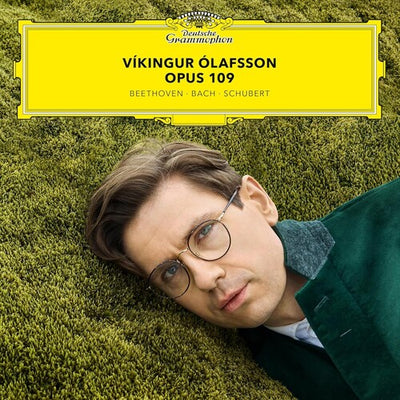
With over one billion streams worldwide, Vikingur Olafsson is one of the most listened-to classical artists of our time. Following the global success of his Grammy-winning recording of the Goldberg Variations, the Icelandic pianist now presents his latest album: Opus 109. At it's heart is Beethoven's Piano Sonata No. 30 in E major, Op. 109, a masterpiece of the composer's late period, which Vikingur Olafsson places in an illuminating and musically thrilling temporal dialogue, tracing the lineages that converge on this beloved beacon of the piano literature. CD Mintpack.
Bach: Mass in B Minor / Christie, Les Arts Florissants
HARMONIA MUNDI
CD
$27.99Apr 13, 2018
A MusicWeb International Recording of the Month!
This is a marvellous new B Minor Mass and it is, without a doubt, the most French-sounding version of the piece to have yet come my way.
That might sound like a lazy stereotype. After all, it’s performed by that most renowned Francophile among musicians, William Christie, who has dedicated his life to rehabilitating the French Baroque and whose efforts have meant that names such as Lully, Rameau, Charpentier and Marais have been not only rescued from their specialist niche but have been given an uncontested place among the concert programmes of the Anglo-Saxons. With his ensemble Les Arts Florissants he has become one of the greatest champions of that music, so it’s hardly surprising that some of the interpretative dust of the French Baroque should rub off onto his Bach.
It’s not just a trope to describe his Bach as Gallic, however. It’s there right from the start. The opening Kyrie is the most mellifluous and honeyed I have heard since the advent of historical performance practice. The two great fugues proceed with cultured smoothness that sounds as though they have one eyebrow perpetually raised. It’s a sound of which, I suspect, Lutheran Bach would have profoundly disapproved. I rather liked it, however, and as a change from what has become the norm of period practice I found it very effective.
That’s only one example of one of the performance’s wider traits. Throughout, it has an elegance, an élan, a nonchalance, almost, that would make them seem entirely at home if performed in the court of ancien regime Versailles. The solos with their instrumental obligatti, for example, sound refined and polished in a manner that is a hundred miles away from the church and more from the realm of the theatre. There’s nothing wrong with that, though, and it’s in keeping with Christie’s vision. My favourites included Katherine Watson in the Laudamus te, with a wonderfully dusky violin, and André Morsch’s playful combat with the horn in the Quoniam. Tim Mead’s lovely countertenor is a repeated highlight, be it slotting into Watson’s soprano in the Christe or sustaining a blisterinly poignant Agnus Dei at the end.
Not only are the orchestral and instrumental playing super throughout, but the choral singing is top notch, too. That, however, will come as no surprise to those how know and love the work of Les Arts Florissants, and it’s great to hear them tackling one of the central works of the German repertoire. It’s a Teutonic world that they can’t be too practised in, but they bring something remarkably distinctive to it.
The main reason for the performance’s success, however, is Christie himself. Bringing his lifetime’s experience to the B Minor Mass must, surely, have been a labour of love rather than an expectation, and the results are wonderful. There is majesty aplenty in the Gloria, whose opening casts off the mellifluousness of the preceding Kyrie as though emerging into a new light, producing rumbustious, gloriously winning tone that brought a broad grin to my face, as did the outer bookends of the Credo. The Sanctus is taken at a rapid pace, with brilliantly detailed violin inflections to enliven the texture, and the final Dona nobis pacem is brilliantly paced.
Perhaps the highlight of the work is the Easter sequence, however, and, in particular, the Crucifixus. Here you get the unmistakeable whiff of the Opéra, because Christie slows down the pace and stresses the beat with what comes close to string (and voice) sforzandi in a way that surely mimics the nails being repeatedly battered into Christ’s suffering body. It’s this movement that will tell you whether this performance is for you. Some might find it vulgar or too overtly theatrical. I thought it wonderful, an example of the conductor using his experience in the theatre to enlighten and deepen his vision of Bach.
Choose for yourself, but I thought this the most memorable B Minor Mass to have come my way since the (entirely different) performance from John Butt and the Dunedin Consort. Explore it and be surprised.
Having worked extensively with period instrument ensembles throughout my career, I was intrigued and fascinated about the possibility on this album of a delicious colliding of the two worlds. Alison Balsom. On this new recording Alison Balsom and her long term friend and conductor Trevor Pinnock bring alive works from Telemann, Handel, Vivaldi, Albinoni and Marcello. A baroque album, confronting the period instruments of the Pinnock Players and Alison's use of a modern instrument: a rotary valve piccolo trumpet. Alison comments: "The piccolo trumpet is a modern invention - something that Bach and his contemporaries could not have known was to come - it's power, it's gleaming bright tone and it's 20th century engineering technology. And this instrument is a world away from the subtle multifaceted sounds of the natural trumpet of the Baroque era. That said, the opportunity to perform much more chromatic and virtuosic music such as that originally written for solo violin or oboe, has seduced me and my trumpet colleagues since the days of the great Maurice Andre. He showed the world how intensely sweet the piccolo trumpet could be in it's upper register".
The first in a new cycle of Dvorak symphony recordings, Dvorak: Symphonies 5 & 6 is the second release from the Melbourne Symphony Orchestra and it's Chief Conductor and Artistic Advisor, Jaime Martin, on the MSO's own record label. Recorded in 2023 at Hamer Hall, Arts Centre Melbourne, these performances-under Concertmasters Dale Barltrop (Symphony No.5) and Tair Khisambeev (Symphony No.6)-were artistic highlights of the MSO's second season under Martin's baton. The artwork approach to the MSO's Dvorak cycle profiles iconic scenes from across Melbourne and the state of Victoria, beginning with the Twelve Apostles of the Great Ocean Road, a day trip from Hamer Hall.
Vikingur Olafsson / CONTINUUM As he continues his epic tour of J.S. Bach's equally epic Goldberg Variations, Vikingur Olafsson presents a series of six new Bach singles. Recorded at Reykjavik's Harpa concert hall in January 2024, the tracks feature piano arrangements of sacred pieces by Bach, four of which have been realized by Olafsson himself. 12" EP, 45 RPM.