This captivating collection celebrates the timeless sounds of the historic city Salzburg. Under the expert baton of Reinhard Goebel, renowned conductor and professor of historical performance practice at the Salzburg Mozarteum, this recording transports you through the vibrant tapestry of musical culture that defines Salzburg. The Mozarteumorchester Salzburg, celebrated for it's unparalleled interpretation of Mozart's style, takes you on an exhilarating journey through the organ sonatas, exploring how they seamlessly transition into other stylistic periods.
On 180gm vinyl, a new LP mastering for Zlata Chochieva’s definitive modern recording of a landmark in the Romantic virtuoso repertoire.
In March 2013, Bryce Morrison in Gramophone welcomed Zlata Chochieva’s debut on Brilliant Classics, playing Rachmaninoff (PCL0047) noting that she is ‘the possessor of a comprehensive technique who brings an inner glow to every bar. Her phrasing is indelibly Russian in its fullness and warmth, backed by a dauntless and easy command.’ Her recordings have continued to attract such praise, with this recording of the Chopin Etudes winning an Editor’s Choice award in 2015. It was claimed that one renowned pianist regarded Chochieva’s interpretation as ‘the greatest I’ve ever heard’ – backed up by Jeremy Nicholas writing in Gramophone that ‘in each of the 27 studies Chochieva comes as close to anyone to how I hear the ideal performance in my head, or as I would wish to play them had I the ability to do so… Taken as read are a superlative technique and an ideal recorded sound… One of the most consistently inspired, masterfully executed and beautiful sounding versions I can recall.’
On LP, Chochieva’s version deserves to take its place alongside classic traversals such as Pollini on DG. As with all Piano Classics LPs, the vinyl version has been mastered at the Optimal factory, renowned for its audiophile standards. The LP is packaged as a gatefold with an extensive essay on the Etudes and a full biography for Chochieva, which concludes with this endorsement from Stephen Kovacevich: ‘Zlata Chochieva is one of the most interesting and unusual pianists today. She has superb technical abilities, but it is her personal intuition in the music she play s that is special. I would be interested to hear anything she does and that is rare.’
Henze: Music for Orchestra / Mozarteum Salzburg Orchestra
Berlin Classics
CD
$21.99Mar 15, 2024
Founded in 1841 under the participation of Constanze Mozart, the Mozarteumorchester Salzburg today enjoys the highest reputation worldwide for its lively and style-conscious Mozart interpretations. In numerous ways it connects the Viennese Classical period to the music of the 19th/20th and 21st centuries. The orchestras constant preoccupation with his core repertoire also shapes its approach to the music of later periods. Thus chamber-musical transparency, articulatory clarity and nuanced sonority are a trademark that makes the Mozarteum Orchestra special and recognizable, also when playing the music of other composers. The Mozarteumorchester Salzburg proves once again its unrivaled position as interpreters of the Mozart stylistic and uses the organ sonatas as a departure into other stylistic periods. It Includes two world premiere recordings of Henze‘s "Konzertmusik" and "Three Mozart Organ Sonatas".
Bach revised his St. John Passion time and again - indeed making it one of his most enigmatic and fascinating compositions. On the 300th anniversary of it's world premiere, MDG is reissuing the highly acclaimed recording for the first time in full three-dimensional sound on Super Audio CD for the PREZIOSA series.
Founded in 1841 under the participation of Constanze Mozart, the Mozarteumorchester Salzburg today enjoys the highest reputation worldwide for its lively and style-conscious Mozart interpretations. In numerous ways, it connects the Viennese Classical period to the music of the 19th/20th and 21st centuries. The orchestra's constant preoccupation with his core repertoire also shapes its approach to the music of later periods. In this recording, the Mozarteumorchester brings chamber-musical transparency, articulatory clarity, and nuanced sonority to the highly romantic music by the late Richard Strauss. The selected repertoire on this Album highlights the individual sections of the orchestra.
J.S. Bach: Goldberg Variations (arr. Robin O'Neill)
BIS
SACD
$21.99Oct 18, 2024
Bach's music has always attracted arrangers and orchestrators - such as Stokowski, Elgar and Busoni, to name just three. Regardless of it's original version, Bach's music has an expressive power, drama and architectural logic that lend themselves well to expanded orchestral sonorities. Bassoonist and conductor Robin O'Neill buried his head in the Goldberg Variations, which he had discovered through Glenn Gould's recordings, during the first months of the Covid lockdown. Soon after that, the idea of making an arrangement for orchestra began to obsess him as he began hearing instrumental and orchestral sonorities in the keyboard work. Since the main challenge was to reclothe the music without damaging the subtle intricacy of the piece, and after much thought and experimentation, O'Neill chose instruments that Bach himself would have recognized for the solo parts. His reinterpretation of the Goldberg Variations offers a mixture of full orchestral variations interspersed with concertante ones involving two, three or four solo instruments, at times close to St Matthew Passion-style writing. Completed during a difficult period, this arrangement was made, in the words of O'Neill, in the hope that it expresses the joy and solace that Bach's music gives both performer and listener.
There is never a shortage of surprises with Joseph Haydn. The Leipzig String Quartet's latest instalment, Opus 2, of their benchmark complete recording of all Haydn's string quartets offers unexpected, unusual and always entertaining moments, presented with virtuosity and mastery by a quartet that combines curiosity and experience to create a delightful whole.
The only collected survey of George Benjamin’s
piano music on record, from a Dutch pianist
who specialises in new music and has worked
closely with the composer.
Benjamin was an accomplished pianist as well
as composer from his early years, and it seems
natural in retrospect that his first published
work should be the Piano Sonata he composed
in 1977-8, as a prodigious student of Olivier
Messiaen and Yvonne Loriod. Certain harmonic
touches may mark the sonata out as the work
of ‘a Messiaen pupil’ but the unsettled, leaping
gestural sense of the piece is particular to
Benjamin. So much of Benjamin’s later music is
fascinatingly prefigured here, including a sense
of timing for a gradual accumulation of tension
(‘stormy eruptions’ and ‘savage violence’ in
the composer’s words) that marks out his first
major orchestral score, Ringed by the Flat
Horizon. Underlying that sense of timing is a
feeling for dramatic gesture which has found
its natural expression in a series of operas
written during the last 20 years.
Dedicated to Loriod, Sortilèges (1981) makes
clear its French heritage in the notes as well as
the title, while the three subsequent Studies
for piano, composed over the next four years,
find Benjamin working out intricate rhythmic
problems and their solutions. Even the
Relativity Rag takes a quirky, sideways look at
its superficially familiar material. The next
piano pieces had to wait until 2001, and the
Shadowlines which Benjamin wrote for PierreLaurent Aimard. This set of six canonic preludes
takes Benjamin’s inclination to distill and pare
back to a new level, while the piano writing
itself is richer and more unselfconsciously
informed by the heritage of piano literature.
Finally, there are the Piano Figures of 2004,
written for students of the piano and
accordingly pitched at a technically lower level
than the other pieces, but no less preoccupied
with the rhythmic games and sudden swerves
of thought that are hallmarks of his most
complex music. All these pieces have been
recorded, but never by the same pianist,
making Erik Bertsch’s new collection unique,
and indispensable for any collector of new
music.
Hardly any other keyboard instrument is as multi-faceted in it's expression and affect as the clavichord. The extremely simple, direct action allows for the finest nuances - even vibrato is possible. Lea Suter showcases these unique capabilities, demonstrating the wealth of inspiration in such well-known works as Chromatic Fantasia and Fugue, Partita in E Minor and even the grandiose Chaconne in D Minor.
Casella, Mule, Respighi & Pizzetti: Music for Cello & Piano / Trainini, Pontoriero
Tactus
CD
$21.99May 03, 2024
A cross-section of the Italian production for cello and piano, conceived during the hazy beginning of the twentieth century, shows us how the most varied influences – coming from all sorts of styles: Gregorian, Monteverdi, operatic, German and French late-romantic, avant-gardist, Franco-Russian impressionist, French symbolist, veristic – are absorbed and remoulded, accepted and rejected, by various personalities of the world of composition. In this cultural ambience, a crucial role was played by the so-called Generation of Eighteen-Eighty, whose components, Casella, Malipiero, Pizzetti, Respighi, friends and collaborators, stood out for their pursuit of innovation and their aim to create a character peculiar to Italian music; this quest was accompanied, at least in their artistic choices, by a certain lack of political commitment. Within this recording, cellist Roberto Trainini and pianist Stella Ala Luce Pontoriero are delivering an anthology of precious musical gems as necessary testimony to the great value of some obscured and forgotten Italian early twentieth century repertoire.
Lang: composition as explanation / Eighth Blackbird
Cedille
CD
$9.99$19.99Save 50%Aug 09, 2024
Four-time Grammy-winning sextet, Eighth Blackbird (8BB), "one of the smartest, most dynamic contemporary classical ensembles on the planet" (Chicago Tribune), presents the world premiere recording of Pulitzer Prize-winning composer David Lang's composition as explanation, based on Gertrude Stein's seminal 1926 lecture of the same name. Called "Super Chamber Music" by David Lang, this multidisciplinary work incorporates elements of chamber music, theater, and performance art; it has the groundbreaking ensemble not only performing the music, but also speaking and singing Stein's text.
For the performance, the 8BB players committed themselves to a rigorous education process, including lessons in acting, diction, and the art of theater. Musical America praised 8BB's live performance of Lang's work as "every bit as witty, circular, and self-referential as Stein's own prose; it's rare, not to mention utterly satisfying, to hear a work that so completely embodies it's text. To invoke Stein, one suspects Composition as Explanation will be a work of our time for many times to come."
In 2016, 8BB asked David Lang to propose a project that they could perform at the Chicago Arts Club in conjunction with the Club's centennial year. In his research, Lang discovered that Stein had spoken at the Club in 1934; this led him to employ Stein's text as the basis for the piece.
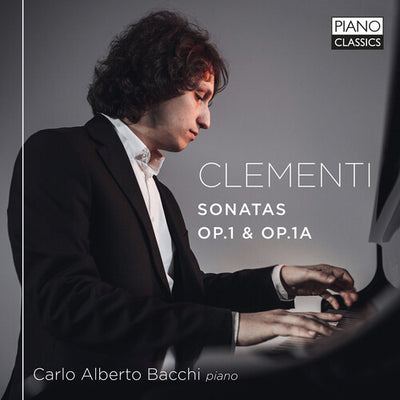
While Clementi’s sparkling music has been recorded by many celebrated pianists such as Arturo Benedetti MIchelangeli, few of them have paid much attention to the composer’s first published collection. This new recording by Carlo Alberto Bacchi is all the more welcome for being informed by his study of the composer’s complete oeuvre as part of the ‘Clementi Project’ which sees him performing many of the sonatas in concert as well as recording them for Piano Classics.
The inscription on Clementi’s tomb in Westminster Abbey commemorates him as ‘the father of the piano’. Clementi above all was responsible for devising a modern technique, of the kind still recognisable today, which would serve pianists on the larger instruments being manufactured in the early years of the 19th century. This technique is differentiated from harpsichord technique, and trained not just through lessons but through pianistic ‘methods’ and publications such as these sets of sonatas, which are arranged in order of progressive difficulty in order to introduced students to technical challenges step by step. Like Mozart, Clementi also manifested his musical talents at a very early age: at the age of 7, he was already studying organ, singing and counterpoint; he wrote a mass at the age of 11 and an oratorio at the age of 12.
The English nobleman and eccentric Sir Peter Beckford effectively bought the young Clementi on a seven-year contract and kept him at his West Country pile. When the contract with Beckford expired in 1774, Clementi moved to London and took off on a career that brought him fame across Europe – as a touring virtuoso, a teacher, publisher – and even sometimes composer. The six Op.1 sonatas were published in 1771, during Clementi’s period in service to Beckford. Although he was not yet 20 and almost completely self-taught, they show his mastery of material and his irrepressible invention. All the sonatas have a simple, playful and light-hearted character, and a two-movement form. The five Sonatas of Opus 1a, on the other hand, date from a decade later, even after the Op.6 Sonatas. They were published in Paris around 1781, and here we sense the stirrings of Clementi as ‘father of the piano’ in the cascades and doublings and expanded imagination.
Through this exciting recording, the violinist Fabio Biondi pursues his exploration of the seventeenth- and eighteenth-century repertoire for solo violin. Two years after his complete recording of Johann Sebastian Bach’s solo Sonatas and Partitas (V 5467), he lands on entirely unknown territory, the Assaggi by the Swedish composer Johan Helmich Roman (1694-1758). Rarely lasting more than twelve minutes, the Assaggi is thus a fascinating melting-pot of multiple aesthetics in vogue in Europe at the beginning of the eighteenth century. Fabio Biondi champions this little-known territory of the European late baroque with a voracious generosity and highly eloquent sense of phrase.
In his own time, Roman was an important figure in the violin world. His career led him to the four corners of Europe, affording him the opportunity to meet many crucially important figures on the German and more southern musical stages, composers as well as renowned performers, especially when he was in Italy, where he visited Tartini. He also played with Handel. In Dresden, he met Pisendel, then dazzling everyone with his playing. In Hamburg, he probably met Telemann, whose Fantasias for Solo Violin, a highly creative and secret aspect of the great North German baroque master’s work, he studied intensely.
All of these encounters had a long-term influence on Johan Helmich Roman’s style, a different and important take on les goûts réunis. If the highly polyphonic structures of the Assaggi naturally remind us of the Swede’s Saxon origins (BeRI 314), if their study-like nature willingly brings to mind the twenty-four Fantasias of Telemann, works as much intended for professional musicians as for accomplished amateurs (the last movement of BeRI 310), the harmonies, which like the melodic outlines in Roman’s work are subtly tinged with an Italianate flavour, clearly recall contrasting works by Tartini (the second part of BeRI 320 for instance, or again the Andante of BeRI 324).
A superb, collector’s-item vinyl transfer for a recent and widely acclaimed recording of Bach’s nocturnal meditations. When Piano Classics released this recording of the Goldberg Variations on CD in 2022, critics praised its natural phrasing and unobtrusively skilful and sensitive response to the technical demands made by Bach in his most virtuosic piece of keyboard writing.
According to Fanfare magazine, the playing of Klára Würtz ‘has limpid clarity, and rhythmic firmness and exactitude; her articulation is clean and nimble (she has a cleaner trill than Perahia), and her voicing of different lines is splendidly balanced. Her rapid playing is vigorous, her slower playing has calm repose. Her interpretive outlook has spirit and vivacity, but also a total sense of confidence and security, the kind of integrity that needs no ostentatious display to make its mark of absolute rightness... Perahia now has a pianistic rival on my shelf; strongly recommended.’ Reviewers elsewhere were hardly less enthusiastic. ‘Cards on the table, what Würtz’s Goldbergs offer is calm appreciation of the music’s manifold beauties,’ according to Rob Cowan in Gramophone. ‘Her pianism sidesteps overt display or affectedness in favour of purely musical values... This for me is truly great piano playing, a direct route to the soul with no tiresome diversions along the way.’ Vinyl collectors can now enjoy this superb recording in a new transfer made for analogue at the Edel factory in Hamburg, which specialises in collector’s print LP editions such as this one.
The heavy-grade vinyl has exemplary quiet surfaces, and the Dutch church acoustics of the original recording gain a rounded, luminous quality which ideally complements Klára Würtz’s pianism. The set is issued as a 2LP gatefold with booklet notes on the inner sleeve.
Berg, Hindemith, Janáček & Schulhoff: 1923 - 100 Years of Radio / Schumann Quartet
Berlin Classics
CD
$10.99$21.99Save 50%Oct 20, 2023
The Schumann Quartet dedicates its latest studio production "1923" to that year in which new musical paths were sought, found, or questioned, and at the same time, the birth of radio heralded a new age for composers and the dissemination of their works. The CD program combines selected quartet music by Paul Hindemith, Alban Berg, Erwin Schulhoff, and Leoš Janácek.
J. S. Bach: The Well-Tempered Clavier, Books 1 & 2
Accentus Music
CD
$39.99Sep 19, 2025
For Zhu Xiao-Mei, Bach's Well-Tempered Clavier is not only a masterpiece but also a source of inner freedom and comfort. In the interview printed in the album booklet, she shares her moving story of how, during her forced labor in the Cultural Revolution, she secretly copied Bach's preludes and fugues an act of resilience and spiritual rebirth. These recordings of the Well-Tempered Clavier from 2007 and 2010 are the result of a decades-long journey with Bach's music, which she regards as one of the deepest forms of human expression. This complete recording offers the listener a unique, emotional, and profound interpretation of this timeless work and this re-edition makes it once again available on CD.
Meta - Schubert: Piano Sonatas Nos. 18-21; Lieder / Huangci
Berlin Classics
CD
$13.49$26.99Save 50%Oct 20, 2023
For her 10th anniversary with Berlin Classics, the US pianist Claire Huangci presents herself and her label with a weighty recording project, Schubert's late sonatas D 894, D 958, D 959, and D 960, as well as the Three Piano Pieces D 946 and a selection of songs from Schwanengesang. She accompanies the baritone Thomas E. Bauer in four of the songs and plays two in an arrangement by Franz Liszt. To be heard in a box with three albums under the title META.
META stands for the importance of Schubert's music in Claire Huangci's personal and musical life. Schubert's compositions, which she has played since her earliest youth, "show my development, that reflects unconscious emotions," as she writes in the booklet. Schubert's music is "the music I would like to take with me to a desert island...Schubert has accompanied me through all times", especially the late sonatas, which are at the center of the META box.
Alfred Schnittke's film music encapsulates almost everything that characterises the Russian composer's compositional style. A self-described polystylist, he began writing for film in the 1960s, penning 66 film scores between 1962 and 1984 for Soviet film companies. His method of drawing on the past was rejected by the avant-garde but embraced by filmgoers and concertgoers too. Volume six in this CD Edition of Schnittke's film music presents music from the film series "Little Tragedies" (1979) based on popular novels by Alexander Pushkin. After longtime research conductor Vladimir Jurowski also recorded all parts of the score which have been cancelled at the end for the final Film Version.
The virtuosic Supraphon debut of Jan Schulmeister So far, the career of the Czech pianist Jan Schulmeister has been distinguished by victories at dozens of international competitions (including the 2019 Cesar Franck Piano Competition in Belgium, the 2021 North International Music Competition in Sweden, and the 2022 Manhattan International Competition in the USA), to which he added Third Prize at the prestigious Cliburn Junior Competition (Dallas, USA) in 2023 at 17 years of age. For his Supraphon debut, he has chosen works of the late 19th century by Russian composers, music that is firmly grounded in the national tradition but that often seeks out and remains open to stimuli from the surrounding world. The oldest of them, Mussorgsky, was a loner without any depth of academic training, but he greatly advanced the boundaries of musical expression. In Pictures at an Exhibition, he accompanies listeners at an imaginary exhibition of paintings by his late friend, the painter and architect Viktor Hartmann. Rachmaninoff wrote his lovely cycle of piano pieces Moments musicaux under time pressure while facing a profound existential and creative crisis. His classmate Scriabin, no less brilliant a pianist, chose the path of a visionary and an experimenter as a composer, as we can hear from an early opus he wrote for piano (at age 16), the Etude in C sharp minor, Op. 2, No. 1. His later Five Preludes, Op. 16 (1895) reflect the omnipresent Impressionism of Paris at the end of the century. In this repertoire, Jan Schulmeister can demonstrate all of his qualities - virtuosic technique and depth of musical feeling.
Previously unreleased broadcast recordings capture Thomas Jensen in Baroque and Classical-era repertoire new to his discography. Jensen makes a stylish Mozartian in these rhythmically sprung and cultivated concert performances, given by the DRSO in Copenhagen and on tour. They are joined by the Danish violinist Tutter Givskov for one of Mozart’s earliest masterpieces, the Violin Concerto No. 3 K216.
John Ireland is widely regarded as one of the greatest British composers of the twentieth century. His contribution to the piano solo repertoire is of great significance. This album, performed by award-winning pianist Rebeca Omordia, is an exploration of John Ireland's piano music composed over a period of almost forty years. His distinctly English yet individualistic musical style is reflected in works bearing evocative titles that reveal Ireland's deep connection to landscapes and literature, creating a unique sound world. The release includes Decorations, published in 1915, as the earliest pieces; the substantial Piano Sonata in E minor (1920), described by Lisa Hardy in her book as "the outstanding example of all British piano sonatas"; the large-scale Sarnia: An Island Sequence (1940-41); and Columbine, the last piano piece he wrote, from 1951.
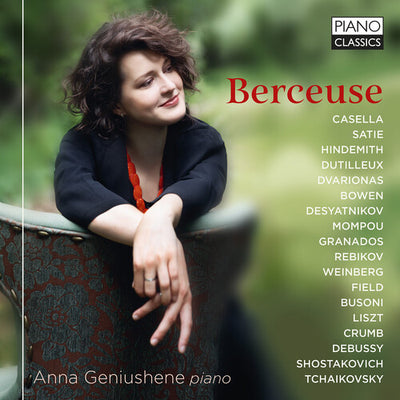
A unique and imaginative collection newly recorded by a recent star of the Van Cliburn Piano Competition. Anna Geniushene’s fresh; layered; and powerful interpretations won her a worldwide following at the 2022 edition of the Van Cliburn International Piano Competition; where she took Silver Medal with a stunning account of Tchaikovsky’s First Piano Concerto which the critic for Gramophone compared in its power and nuance to Van Cliburn himself.
Born in Moscow; Anna Geniushene pursued graduate studies in London and now lives in Lithuania with her husband; the pianist Lukas Geniusas. In her own booklet introduction; she explains the inspiration for this quirky collection of instrumental lullabies. The Berceuse is ‘associated with tenderness; care; purest love; and the most sensitive moments in our lives.’ She dedicates the album to her two young sons. Perhaps the most celebrated Berceuse of all; by Chopin; is missing; because it was Anna Geniushene’s particular wish to find and share neglected examples of the genre; even by well-known composers. Debussy composed the Berceuse heroique during the First World War as a tribute to the soldiers on the Western Front. The Berceuse Elegiaque of Busoni is better known in its orchestral guise. The brief Berceuse by Hindemith; unpublished in his lifetime; ‘draws listeners’ attention by its utterly eloquent and typically sarcastic character; which has nothing in common with traditional lullabies.’ The sheer diversity of composers makes for a continually varied sequence. George Crumb evokes a magical night-time stillness with a minimum of notes. Mompou’s Berceuse is likewise remarkable for its distilled serenity; whereas the examples by Granados; John Field and Liszt bring comfort with more Romantically moulded melodies in the tradition of Chopin. Anna Geniushene closes the album with two Russian Berceuses; by Shostakovich and Tchaikovsky; lyrical; simple and utterly beguiling in her hands.
The Exclusive Subscription Concert Series - Christian Thiele
C Major Entertainment
Blu-Ray
$45.99Oct 04, 2024
Special concerts reserved for subscribers. Due to the exceptional quality of the concerts and the limited offer, the average waiting time for subscribers is more than 10 years. With this series, these very special concerts are made available for the first time audiovisually to a wider audience worldwide. For this subscription concert, the Wiener Philharmoniker asked a long-time artistic companion to take the podium: more than 140 concerts and a multitude of celebrated recordings connect Christian Thielemann with the traditional Viennese orchestra. The live recording of his debut on the podium at the Vienna Musikverein almost 23 years ago promptly became a reference recording. On the programme then as now: Richard Strauss' monumental Eine Alpensinfonie (An Alpine Symphony). This work, often regarded as the final and climax of the "symphonic poem" genre, is juxtaposed with Arnold Schönberg's probably most famous tonal composition, the orchestral version of the string sextet Verklärte Nacht (Transfigured Night). Composed in 1899, this highly expressive work by the 25-year-old Schönberg reads, in retrospect, like a swan song to the 19th century. "Schönberg and Strauss rarely sound so grandiose." Kurier "A truly persuasive performance." The New York Times "The 'Alpine Symphony' under Thielemann has long been a Viennese legend." Die Presse Program: Arnold Schoenberg: Verklärte Nacht (Transfigured Night), op. 4 Richard Strauss: Eine Alpensinfonie (An Alpine Symphony), op. 64
With Marimba, David Moliner presents an extraordinary album that places this unique instrument and it's manifold colors and sounds at it's core. Moliner's masterful arrangements and two original works composed specifically for the instrument take listeners on a sonic journey through the centuries, combining both technical skill and creative expression. The album brings together works from various epochs and styles. Particularly notable is his arrangement of Johann Sebastian Bach's Cello Suites, which he transforms into new, polyphonic textures using his four Marimba mallets. Moliner successfully combines Bach's rhythmic pulse and musical complexity with the Marimba's unique tonal color. In addition to the Baroque works, the album also features pieces by Claude Debussy and Franz Schubert. Moliner brings a new dimension to Debussy's impressionistic Arabesques, allowing the Marimba to bloom in a delicate, almost pictorial soundscape. Schubert's romantic Impromptu, transcribed by Moliner for Marimba, unfolds in it's poetic beauty and gains expressive depth through the instrument's distinct timbre. Another highlight is the composition Jalak Suren by contemporary composer Alexander Liebermann, inspired by the bird songs of Indonesia. Moliner brings the subtle melodies and rhythmic structures of this music to life, allowing the Marimba to shine as a sensitive storyteller of a musical nature portrait. The album concludes with Moliner's own Marimba composition, making a powerful statement: the Marimba is not just an exotic instrument but a full-fledged member of the classical music scene, capable of interpreting the entire spectrum of the repertoire from Baroque to Modern. A must for lovers of sophisticated percussion and for all those who want to experience classical music in a new, captivating sonic dimension. Recorded at Kloster Lankwitz, Berlin October 2024
The Exclusive Subscription Concert Series - Christian Thiele
C Major Entertainment
DVD
$32.99Oct 04, 2024
Special concerts reserved for subscribers. Due to the exceptional quality of the concerts and the limited offer, the average waiting time for subscribers is more than 10 years. With this series, these very special concerts are made available for the first time audiovisually to a wider audience worldwide. For this subscription concert, the Wiener Philharmoniker asked a long-time artistic companion to take the podium: more than 140 concerts and a multitude of celebrated recordings connect Christian Thielemann with the traditional Viennese orchestra. The live recording of his debut on the podium at the Vienna Musikverein almost 23 years ago promptly became a reference recording. On the programme then as now: Richard Strauss' monumental Eine Alpensinfonie (An Alpine Symphony). This work, often regarded as the final and climax of the "symphonic poem" genre, is juxtaposed with Arnold Schönberg's probably most famous tonal composition, the orchestral version of the string sextet Verklärte Nacht (Transfigured Night). Composed in 1899, this highly expressive work by the 25-year-old Schönberg reads, in retrospect, like a swan song to the 19th century. "Schönberg and Strauss rarely sound so grandiose." Kurier "A truly persuasive performance." The New York Times "The 'Alpine Symphony' under Thielemann has long been a Viennese legend." Die Presse Program: Arnold Schoenberg: Verklärte Nacht (Transfigured Night), op. 4 Richard Strauss: Eine Alpensinfonie (An Alpine Symphony), op. 64
J.S. Bach, Berio & Boulez: Music for Solo Clarinet
Supraphon
CD
$34.99$45.99Save 25%Oct 31, 2025
Bach - Berio - Boulez: Marek svejkar's bold and brilliant debut The clarinet is one of the instruments with the broadest spectrum of sonic possibilities in terms of it's range of dynamics and pitches. It received the greatest attention during the era of Classicism both in solo parts in concertos and in the roles of a chamber music partner and an orchestral instrument. It had to wait until the 20th century for works featuring it's unaccompanied solo voice in it's full range of colours. Outstanding among the composers who created such works are two figures who fundamentally shaped musical thinking in the latter half of the 20th century: Luciano Berio and Pierre Boulez. Commemorating the 100th anniversaries of both men's birth, this recording covers their complete music for solo clarinet. Berio and Boulez sought new ways to organise music in time and space, and both took inspiration from poetry. Boulez gave symbolic expression to their quest: "It must be our concern... to jettison the concept of a work as a simple journey starting with a departure and ending with an arrival." One of the things that inspired Berio's idea of "polyphonic music for a monophonic instrument" were works by J. S. Bach. One of them, Partita in A minor for solo flute, is heard on this recording in juxtaposition with the modernism of the 20th century. The clarinettist Marek svejkar is a laureate of the Premier Prix from Paris's prestigious Conservatoire National Superieur, and he has been a winner of international competitions including events in Markneukirchen, Germany, and in Carlino, Italy. He has appeared as a soloist with the Czech Philharmonic and with Jiri Belohlavek, and having participated at the Karajan Academy of the Berlin Philharmonic, he is now enrolled at the Accademia Nazionale di Santa Cecilia in Rome under the tutelage of Alessandro Carbonare. The elite circle of European clarinettists is now within Marek svejkar's reach.
This CD features works whose first editions or manuscripts are preserved in libraries north of the Alps, particularly in present-day Germany. Of particular interest is that these are primarily works for wind instruments, especially oboes, but also trumpets. Another important aspect is the transcription and arrangement of Albinoni's works and themes from the pen of two famous German composers, Johann Sebastian Bach and Johann Gottfried Walther. Albinoni was already very famous during his lifetime and admired by princes and fellow musicians, even north of the Alps!
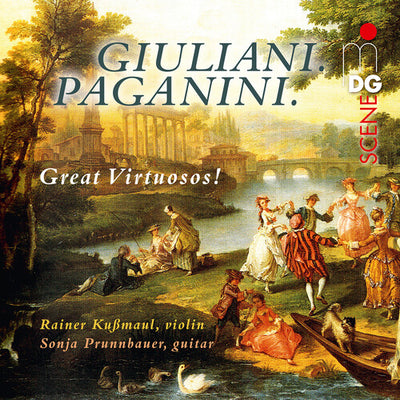
At the beginning of the nineteenth century, Paganini and Giuliani both sought their fortune in Vienna, a city that later consecrated them as great virtuosos and founders of the Italian violin and guitar school. Paganini, AKA the "devil's violinist" was an uncanny idol and heartthrob to countless music lovers and also had a masterful command of the guitar. Giuliani was the premiere guitarist of his day and also had a great understanding of the violin. His nickname, "the Paganini of the guitar" helped intensify the bond between the two and further sealed their friendship and mutual esteem. Two world-class virtuosos, Rainer Kussmaul, on a Stradivarius from 1724, together with guitarist Sonja Prunnbauer, perform a selection of their great virtuosic duos.
Ferruccio Busoni (Empoli 1866 – Berlin 1924) died the same year as Puccini and was born when Puccini was a child, yet he was way more than an opera composer. While he lived several years in Trieste and some time in Bologna, he mainly lived abroad and spent the second half of his life in Berlin. Way more than a composer, he was a wide-ranging artist and musician, an acclaimed concert pianist and sought-after piano teacher, a learned reviser of piano music, and the author of many and varied pieces. Busoni was also an aesthete, an intellectual, a music reformer, and author of texts on musical topics. A child prodigy, he wrote the Symphonische Suite for orchestra at the age of 17.
Nicola Bignami and Lucija Majstorovic brilliantly face the arduous task of performing the two monumental and demanding sonatas for violin and piano that the composer wrote at twenty-four (first sonata) and at thirty-two (second sonata), in which the equal and dialogical relationship between the two instruments combines with a wealth of invention with respect for the great tradition.