Composer: Erik Satie
63 products
Time Remembered / Matthias Kirschnereit
Experience Matthias Kirschnereit's fascinating musical life in the album "Time Remembered." This extraordinary playlist of 36 hand-picked pieces tells personal stories and brings memories to life. From Bach, Bussoni, and Bruckner to Handel, Janácek, Ligeti, Rachmaninoff, Satie, and Bill Withers - this musical journey spans almost 400 years of music history and takes you into different genres and styles. Discover the turning points, rough edges, and Matthias Kirschnereit's constant urge to express himself through music. From moving to Namibia at the age of nine to leaving grammar school without A-levels to become a pianist, his musical horizon expanded abruptly. Today, after almost 50 CD recordings, thousands of concerts played worldwide, and awards, Matthias Kirschnereit is still searching for new things, challenges, and tasks.

Berceuse / Anna Geniushene
A unique and imaginative collection newly recorded by a recent star of the Van Cliburn Piano Competition. Anna Geniushene’s fresh; layered; and powerful interpretations won her a worldwide following at the 2022 edition of the Van Cliburn International Piano Competition; where she took Silver Medal with a stunning account of Tchaikovsky’s First Piano Concerto which the critic for Gramophone compared in its power and nuance to Van Cliburn himself.
Born in Moscow; Anna Geniushene pursued graduate studies in London and now lives in Lithuania with her husband; the pianist Lukas Geniusas. In her own booklet introduction; she explains the inspiration for this quirky collection of instrumental lullabies. The Berceuse is ‘associated with tenderness; care; purest love; and the most sensitive moments in our lives.’ She dedicates the album to her two young sons. Perhaps the most celebrated Berceuse of all; by Chopin; is missing; because it was Anna Geniushene’s particular wish to find and share neglected examples of the genre; even by well-known composers. Debussy composed the Berceuse heroique during the First World War as a tribute to the soldiers on the Western Front. The Berceuse Elegiaque of Busoni is better known in its orchestral guise. The brief Berceuse by Hindemith; unpublished in his lifetime; ‘draws listeners’ attention by its utterly eloquent and typically sarcastic character; which has nothing in common with traditional lullabies.’ The sheer diversity of composers makes for a continually varied sequence. George Crumb evokes a magical night-time stillness with a minimum of notes. Mompou’s Berceuse is likewise remarkable for its distilled serenity; whereas the examples by Granados; John Field and Liszt bring comfort with more Romantically moulded melodies in the tradition of Chopin. Anna Geniushene closes the album with two Russian Berceuses; by Shostakovich and Tchaikovsky; lyrical; simple and utterly beguiling in her hands.
Hymne a l‘amour
With their new CD "Hymne à l'amour"; the Duo Minerva once again shows how exciting and multifaceted classical music can sound. Their arrangements; woven with great artistry; their virtuosity and their exceptionally emotional style of music-making breathe fresh life into often-heard works. With a great deal of playfulness; the well-rehearsed duo moves between the most diverse genres and combines classical masterpieces with contemporary avant-garde; folk music and a pinch of the as yet unheard on the subject of love - entirely in Duo Minerva style.
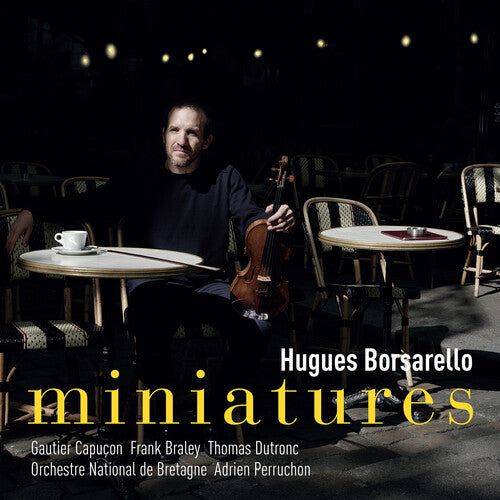
Miniatures - French Music for Violin & Orchestra / Borsarello, Perruchon, Breton National Orchestra
The French violinist Hugues Borsarello draws this programme of miniatures from the repertory of his instrument and from the great operatic arias, transcribed for violin and orchestra: ‘My idea was to relate a French history of music over the course of three centuries, in the form of short pieces.’ Lully’s Marche pour la cérémonie des Turcs rubs shoulders with arias by Bizet, Saint-Saëns and Offenbach, Satie’s Gymnopédie no.3 and Gounod’s Ave Maria. All these universally known pieces ‘are perfectly suited to the soul of the violin’, says Borsarello, who is joined by prestigious guests: cellist Gautier Capuçon for Vieuxtemps’s Duo Brillant, guitarist Thomas Dutronc for Django Reinhardt’s celebrated Nuages, pianist Frank Braley.
And this programme doesn’t neglect the classics of the violin, including Ysaÿe’s magnificent Berceuse de l'enfant pauvre. Vieuxtemps’s famous set of variations on Yankee Doodle is here performed for the first time in its version with orchestra.
Stravinsky & Satie: Paris joyeux & Triste / Lubmiov, Poprugin
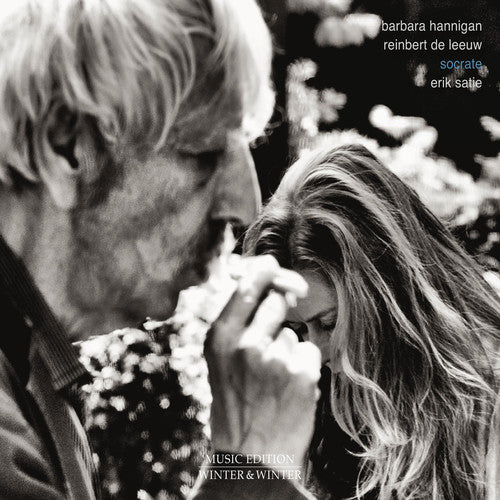
Satie: Socrate / Hannigan, De Leeuw

Coming off the immense success of the Billboard-charting Let me tell you — which received rave reviews from the New York Times, NPR, Washington Post, Boston Globe, Wall St. Journal, and many more — Barbara Hannigan turns her attention to the work of Erik Satie as the musical world celebrates his 150th birthday. The disc focuses on one of the minimalist composer’s few elaborate masterpieces: the almost-forgotten vocal piece “Socrate,” on three Plato dialogues in French translation.
In celebration of Satie's 150th birthday, the venerable label Winter & Winter recorded a selection of works with the world-famous soprano Barbara Hannigan and pianist Reinbert de Leeuw, known for his outstanding Satie interpretations. “Socrate” is the central focus of the album, heard alongside “Trois Mélodies” from 1886, “Trois Autres Mélodies” from 1886–1906, and “Hymne” from 1891. Barbara Hannigan and Reinbert de Leeuw are two of the most important representatives of the contemporary classical music world.
Satie: Complete Piano Music / Frank Glazer
Romance - Debussy, Poulenc, Saint-Saens / Richard Stoltzman
The two sonatas concerned are those of Poulenc and Saint-Saens. Among the lighter examples of their kind they fit the programme very well indeed and also, it seems, the performers; for Stoltzman has a style, beautifully expounded, which suits the lighter music ideally (indeed, the booklet suggests that he has also a feeling for sophisticated jazz playing, which is easy to believe; and it is a field in which I will hope to hear him one day).
In the sonatas Stoltzman is partnered excellently by Irma Vallecillo; in the arrangements of the shorter pieces he is partnered equally excellently by the harpist, Nancy Allen. The soloist's style of playing perhaps gravitates more easily to the lighter, more romantic than to the classical. In fact, a few will think the lighter side overdone here and there (the Debussy Prelude, perhaps?): hopefully, many more will think all the music suits ideally: and especially so the Satie Gymnopedies, sounding at their very best in these arrangements."
-- Gramophone [4/1992]
Meditation: Zither & Piano / Murray, Davenet
The Meditation collection was created to feature famous classical melodies in an original dialogue between two distinctive instruments. These beautiful recordings will encourage a sense of calmness and serenity during meditation. Philippe Davenet on piano and Martial Murray on the angelic zither join forces for this latest edition in the series. Satie's "Gymnopédie No. 3," Chopin's "Nocturne in C sharp Minor," and Offenbach's "Barcarolle" from the Tales of Hoffman are just a few of the classic titles you'll discover on this marvelous recording.
Meditation: Kora & Cello / Burtin, Marcinkowska
The Meditation collection was created to feature famous classical melodies in an original dialogue between two distinctive instruments. These beautiful recordings will encourage a sense of calmness and serenity during meditation. This edition combining kora & cello is one fo the top five best sellers from the Meditation collection. Some of the timeless titles on this recording include "Jesu, Joy of Man's Desiring" by Bach, "Sarabande" from Suite in D minor by Handel, and the traditional Irish tune "Londonderry Air" (Danny Boy).
Meditation: Cello & Harp / Kozielska, Dupuis
The Meditation collection was created to feature famous classical melodies in an original dialogue between two distinctive instruments. These beautiful recordings will encourage a sense of calmness and serenity during meditation. This edition combining cello and harp is one of the top five best sellers from the Meditation collection. You will be transported by the beautiful performances of Frédérick Dupuis on cello and Joanna Kozielska on harp. "Prelude in C major" by Bach, Bellini's "Nocturne for Cello and Harp," and Caccini's "Ave Maria" are just a few of the treasured titles from this fine assortmen tof the most recognized and beloved melodies in classical music.
James Galway - The Lark In The Clear Air
The works on this disc were arranged by Hiro Fujikake.
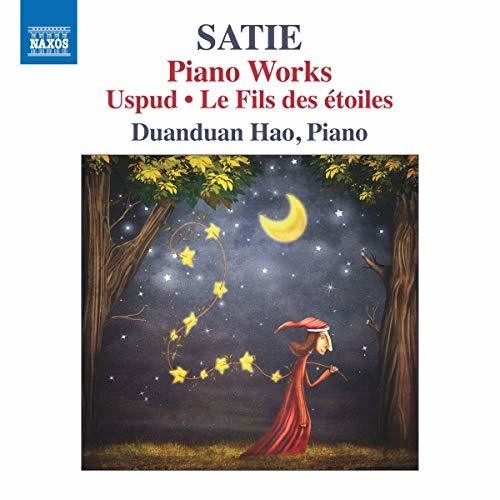
Satie: Piano Works / Hao
Satie’s personal eccentricities have never masked the fact that his music was both revolutionary and anticipatory of later artistic movements, principally Minimalism, Surrealism and Theatre of the Absurd. His piano music offers a perfect distillation of these elements. The Allegro is his earliest known work, offering his first use of quotations, a favored device. The extended pieces Le Fils des etoiles and uspud derive from incidental music, glorying in parodic and grotesque scenes, while his ‘humoristic’ phase of the 1910s is explored in Cinq Grimaces. Only Satie could attempt to fuse a fugue with a waltz, as he does in the Fugue-valse. Duanduan Hao was born in China in 1990. He began his piano lessons when he was four and by the age of six was already drawing attention to his precocious ability. He then studied in Shanghai and in Paris, going on to win many prizes in international piano competitions. He currently lives in New York and studies at The Juilliard School and Columbia University.
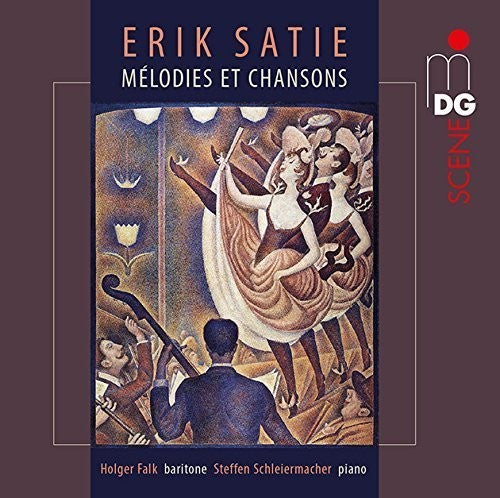
Satie: Melodies et chansons / Falk, Schleiermacher
Saint-Saens: Sonata for Oboe and Piano; Faure / Mayer, Wisniewska
Then we are back to Fauré with a sequence of five song transcriptions. Après un rêve is heavy-lidded and weighed down with sleepy contentment. Le secret is suitably grave with the music carrying a faintly melancholy tincture. Au bord de l'eau explores an elusive mood though the faint clicking of the oboe’s key mechanism can be heard and does return you to earth. Clair de lune is a brisk and pleasant stroll of a piece; not ardent. Mayer’s oboe here takes on the opulence of its cousin up the road, the clarinet. There are two Pierné’s represented in this recital Gabriel’s Serenade has an Iberian accent – more Massenet than Ravel. The Pièce sounds rather Tchaikovskian with a surprisingly brusque role for the piano. Fantasie Pastorale is by Paul Pierné. It radiates elysian calm – superbly done by the two players. The Satie pieces are well enough known. Here that sentimentality deficit I mentioned earlier is again in evidence though I did note that Wisniewska’s insight provided emotional contrast – listen to the way she gives face to a simple note cell in Gymnopédie 2. Bozza’s Fantaisie Pastorale is so much more than the shallow display piece I had braced myself for. It surveys stygian Bax territory, moves into showers of fanciful curlicues and culminates in a magically poised and elfin close. Koechlin’s Au Loin is for English horn and piano. It is splendidly ermine-dark and languid. The melodic material might remind some listeners of Bax’s In The Faery Hills.
-- Rob Barnett, MusicWeb International
Picasso: Music Of His Time
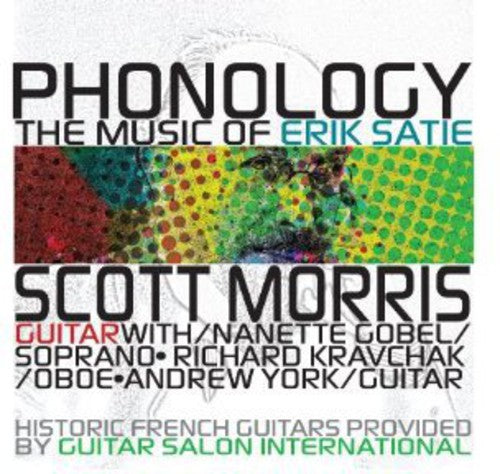
Phonology: The Music Of Erik Satie
Phonométrie - Satie, Svoboda / Krüger, Hussong
SATIE (arr. Svoboda) Sports et divertissements: La chasse. Ludions. Avant-dernières pensées. 3 poèmes d’amour. Gnossienne No. 1. SVOBODA 20 French Songs. Study No. 1, “ Speed.” 5 Canon Studies • Anne-May Krüger (voc, barrel org, toy pn, melodica); Stefan Hussong (acc, toy pn, melodica); Mike Svoboda (tbn, melodica) • WERGO 6806 (72:16)
Composer/trombonist Mike Svoboda was born in 1960 on Guam. Raised in Chicago, his musical path subsequently took him to Germany where, from 1984 to 1995, he worked with Karl-Heinz Stockhausen, Martin Smolka, Helmuth Lachenmann, and Wolfgang Rhim, among others. His trombone virtuosity led to numerous engagements with renowned orchestras. He also bestrides the world of jazz, but that influence won’t be found here except on a most metaphorical of levels.
Here he presents Erik Satie as a most kindred spirit to his own. As one can discern from the headnote, all of the Satie on this release has been arranged by Svoboda for a nontraditional group of instruments, from time to time informed and united by the oracular sound of his trombone. The melodica, incidentally, is a quasi-serious contraption invented by the German accordion firm Hohner in either the 1950s or 1960s—a small toy-like wind instrument with a keyboard. Svoboda’s use of the two toy pianos with their not-quite-in-tune tuning conjures up the spirit of John Cage, which hovers benignly over this whole enterprise.
The basic ground plan for most of this offering was to take Satie’s Sports et divertissements , separate each of its melodies in sequence, rescore them from the piano original, and then to intersperse each with one of Svoboda’s 20 French Songs, each of which provides a commentary and an insightful deepening of the Satie jumping-off point.
Satie was an outsider. His contemporaries, Debussy and Ravel, managed to break into the “proper” concert world. When Diaghilev finally presented him with the commissions for Parade and Relâche , which he fulfilled, it was too late. Satie was then an embittered man who shortly died of liver cancer, no doubt aggravated by his alcoholism. Despite Svoboda’s invoking in the liner notes the fact that Satie didn’t think himself a composer but a mere phonométrie , I think that Satie was selling himself short, as was his ironic wont. In fact, his minimalistic piano pieces inspired Les Six , among others, and actually altered the course of French music in the remainder of the 20th century and beyond. In those same liner notes, Svoboda makes his choice of low-tech media clear. In this computer-driven age, a composer has tools that would have boggled the mind of J. S. Bach. I’m sure that Bach would have loved and embraced them, as he had the newest of new-fangled organs. Svoboda claims that his beloved trombone is among the lowest-tech instruments still in use. He has a valid point—the trombone’s basic technology and construction have largely been unchanged since medieval times. Add to this his use of toy and otherwise largely maligned instruments in his sound scheme, and we of the Classical bent are in for something special. So here we have a paradox, a lot of low-tech instruments realizing a lot of music that is potentially high-tech.
German-trained soprano Anna-May Krüger is fully up to the task. She has to steer a course somewhere between a popular chanteuse and a contemporary (Schoenberg-like Sprechstimme artist), and does so with impeccable French diction and affect. Svoboda’s use of slightly out-of-tune toy instruments also bears fruit. In many instances, unisons are not quite intonationally accurate. Rather than being a minus, this proves to be a plus. The beats thus set up become, in and of themselves, musically compelling—yet another case where sheer sonority becomes a vital element of the music.
In the end, I see this release as a manifesto on behalf of all disenfranchised composers of serious music everywhere. Along the way, it provides over 70 minutes of revealing and insightful music-making, captured in state-of-the-art sound.
FANFARE: William Zagorski
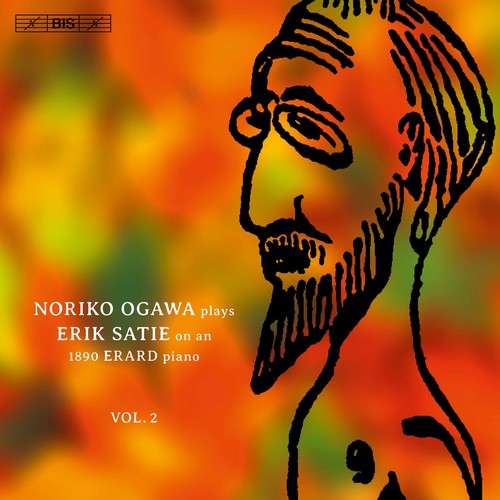
Ogawa plays Erik Satie on an 1890 Erard Piano, Vol. 2
Released in 2016 - the 150th anniversary of the birth of Erik Satie - the first volume of the series was warmly greeted by reviewers worldwide, who paised the clarity of Noriko Ogawa's interpretations as well as teh crystalline sound of her chosen instrument, an Erard grand piano from 1890. Like its predecessor, this second instalment takes in music from different phases of the composer's career, including the very early Three Sarabandes from 1887. A few years later Satie became involved with an esoteric society called ''The Catholic Rosy Cross of the Temple and the Grail'' for which he composed works such as the Sonneries de la Rose+Crois. Throughout his life, Satie identified strongly with children and famously said of himself that he ''came into the world very young, in an age that was very old''. In 1913, during what is often termed his ''humorous'' period he composed the four sets of children's pieces included on this album. Hailing from the same period are the two sets of ''Flabby preludes for a dog'' as well as the suite Sports et divertissements. Often regarded as one of the finest examples of Satie's art, this consists of a prelude and 20 musical snapshots depicting different sports and leisure activities, including golf, fishing and dancing. The suite was first published as a collector's album, accompanied by illustrations by Charles Martin and Satie's own prose poetry and calligraphy.
My Playlist for Baking
Wooden spoons at the ready! Turn the oven on, weigh out the sugar and immerse yourself in a feast of classical music – from Tchaikovsky’s enchanting Dance of the Sugar Plum Fairy to Clara Schumann’s delicious Notturno. Perhaps you fancy making a sweet French Pastry with Hayman, baking a pie with Bax – or maybe even conjuring up a wedding cake with Saint-Saëns? Whatever you’re baking, this album will serve as the perfect accompaniment to your culinary creativity.
Musique De Nuit - Fauré, Pierné, Satie, Koechlin / Lencsés
It is evening and Tityre, a herdsman, is lying under a tree playing his shawm. This episode from Virgil's "Bucolics" is the beginning of "Night Music", a series of French miniatures of pastoral character, inspired by night, dream and mysticism. All the pieces were composed around 1900 during the "Belle Epoque", at the same time when Henri Rousseau painted the picture on the cover of this CD. But while Faure's music is well known, the works of Koechlin, Satie and Pierne are likely to be rarities. It is hoped that the music on this record will be an inspiration for tranquillity, contemplation and meditation to the listeners.
Melancolie / Aoki
On her third solo release, Miki Aoki features works by the members of Les Six, a group of early 20th century French composers who were blazing their own trail. The music of Francis Poulenc is what's really touched Miki's heart. Ever since she was invited to play his Violin Sonata about eight years ago, she's been obsessed with his unique character. "It's got this humor and irony." - Miki Aoki
Great Classical Masterpieces: Bestselling Recordings 1987-2012
French Piano Music / Grant Johannesen
Eternal Satie / Kormendi, Eckhardt, Bodtker, Et Al
Discover The Classics Volume 2
This set also comes with a sixty-page booklet. It provides an introduction to classical music and the various national styles, complete texts for all vocal pieces, and recommended listening grouped by country and composer.
Chill With Satie
Includes work(s) by Erik Satie.
Bear Essentials - Lullaby Classics
Includes work(s) by Ralph Vaughan Williams.
Adagio - A Consideration Of A Serious Matter / Ensemble Caprice
Under the artistic direction of Matthias Maute, Ensemble Caprice is renowned for its innovative interpretations of baroque music. Centered around Bach’s aria Ich habe genug, this recording of adagios presents choral and orchestral pieces, mostly well-known to the general public, all having one element in common: they are all meditations on the fundamental questions of life and death. Throughout history composers have attempted to express the seemingly endless pain of human suffering through music. All performed on baroque instruments, the examples contained on this recording are among some of the most powerful explorations of this emotional space.
Portrait / Hélène Boschi
Hélène Boschi’s repertoire was broad-based, ranging from the Baroque (François Couperin, Jean Philippe Rameau, Johann Sebastian Bach) to contemporary music. Her favorite composers of the Viennese Classical era were undoubtedly Joseph Haydn, Wolfgang Amadeus Mozart and Franz Schubert; strangely, it seems she left behind no Beethoven recordings. One notable fact about Boschi is that she was the first female pianist to record the works of Padre Antonio Soler (1729-1783), receiving the 1952 Grand Prix du Disque in honor of her achievement. As for the nineteenth century, her passionate readings of Schumann are of the utmost importance; but Carl Maria von Weber and Muzio Clementi also captured her attention, as did Frédéric Chopin and Emmanuel Chabrier and the Impressionists Claude Debussy and Maurice Ravel. Modern classics were also integral to her repertoire – as were the works of her immediate contemporaries. Luigi Dallapiccola dedicated his 1952 piano composition Quaderno di Annalibera to Hélène Boschi, Claude Ballif paid her that honor with his Fourth Sonata op. 31