Alberto Ginastera
18 products
-
String Quartets & Piano Quintet
$18.99CDCPO
Jan 30, 2026555633-2 -
-
-
-
-
-
-
-
-
-
-
-
-
-
-
-
-
-
-
-
-
-
-
-
-
-
String Quartets & Piano Quintet
Ginastera: Harp Concerto, Variaciones concertantes / Walstad, Harth-Bedoya, Norwegian Radio Orchestra
Alberto Ginastera (1916-1983) is a distinctive voice in twentieth-century classical music, and together with the master of the tango, Astor Piazzolla, he is the towering musical figure of Argentina. Born in Buenos Aires of an Italian mother and a Catalonian father, Ginastera is a complex composer and personality, shaped by the traditional folk culture and history of his native country and by impulses from the world at large, during a time of radical upheavals in the realm of Western classical music. The Harp Concerto was commissioned in 1956 by Edna Phillips. The work was not premiered until 1965, and then it was the Spanish harpist Nicanor Zabaleta. When the concerto first appeared, it became a brilliant addition to the harp literature and twentieth-century instrumental concertos. Variaciones concertantes was completed more than ten years earlier and was premiered in Buenos Aires in 1953. The music is an irresistible combination of orchestral timbres and virtuosity communicating directly with the listener, especially as regards the entertainment aspect inherent in virtuosic orchestral sound and a demanding soloist performance.
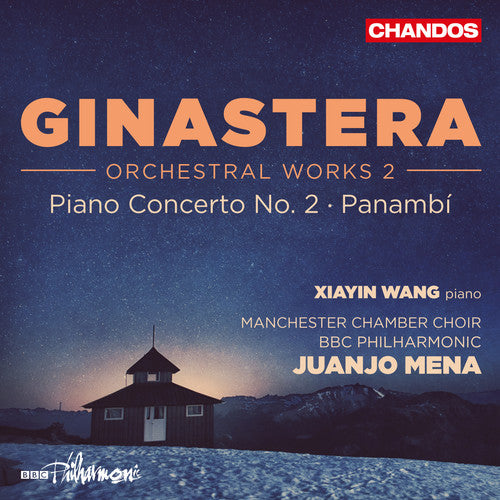
Ginastera: Orchestral Works 2 / Mena, Wang, Manchester Chamber Choir, BBC Philharmonic
This is the second in our three-volume series of Juanjo Mena's idiomatic exploration of Ginastera's orchestra works with the BBC Philharmonic. The series was started to celebrate the 100th anniversary of the birth of the greatest of all Argentinean composers, Vol. 1 - receiving uniformly high praise. This album features a late work, lesser-known, yet rich in surprises, namely the Second Piano Concerto. Here the keen musicality and sweeping virtuosity of Xiayin Wang meet the sumptuous sound of the BBC orchestra. It succeeds her recording of concertos by Tchaikovsky and Khachaturian with the RSNO which was made Editor's Choice by Gramophone. It is coupled with the exotic early ballet Panambi, heard complete with a concluding contribution from the Manchester Chamber Choir.
Ginastera: Orchestral Works, Vol. 3 / Wang, Mena, BBC Philharmonic Orchestra
In his final year as BBC Philharmonic’s Chief Conductor, Juanjo Mena completes a highly-acclaimed Ginastera series with this third volume. Like in his previous series ‘La Musica de Espana,’ Mena brings the composer’s creative genius to a more deserved fame, showcasing here three works that belonged to three different periods of his compositional life. While the Concierto Argentino is the most significant score of his early years, drawing directly on Argentinian folk music and full of youthful exuberance, the Variaciones Concertantes (more a concerto for orchestra than a set of variations) assumes a more personal and abstract form in accordance with the development of his harmonic ideas in the later stage of his life. The rhythmic energy and magic scoring of the ‘neo-expressionist’ piano concerto (as Ginastera defined the third phase of his life) is faithfully expressed by the highly technical and virtuosic playing of Xiayin Wang, widely praised for her recent solo recording of piano works by Enrique Granados.
Ginastera: Orchestral Works, Vol. 1 / Mena, BBC Philharmonic
Impressive in our ongoing, very successful Spanish music series, the BBC Philharmonic and its chief conductor, Juanjo Mena, also explores the works of the Argentinean composer Alberto Ginastera in three orchestral volumes. Not only acknowledged as a leading South-American composer of his day, Ginastera is also seen as one of the heroes of Latin-American music in general, whose enduring source of inspiration was Argentina itself: its pre-Columbian legacy on the one hand and the vast landscapes of the pampas on the other.
Review:
There is some fabulous solo playing here, not least from the BBC Philharmonic's principal flute…bring on Vol. 2!
– Gramophone
The BBC Philharmonic is in cracking form at the moment…and in Juanjo Mena it has a chief conductor capable of leading it through the dance rhythms and moods of the Spanish-speaking world with gusto and understanding…altogether, this is a thoroughly enjoyable start to what should be a significant series.
– BBC Music Magazine
Ginastera: Complete Music for Piano
Alberto Ginastera Orchestral Works
Alberto Ginastera is considered one of three 20th century composers that brought Argentina to the forefront of global attention, along with Carlos Gardel and Astor Piazzolla. Whereas Gardel and Piazzolla came out of the Argentine tango tradition, Alberto Ginastera is considered th emost important Argentinian classical composer of the 20th century. Anchored by the engaged work of the Deutsche Staatsphilarmonie Rheinland conducted by Karl-Heinz Steffens, this release is a marelous retrospective of Ginastera's development beginning with his 'first period' and the folklorically influenced Obertura para el Fausto Criollo, Op. 9 (1943) as well as the Symphonic Triptych Ollantay, Op. 17, inspired by his trip to the U.S. (1947).
The Variaciones Concertantes for chamber orchestra, Op. 23 (1953) derive from the middle of Ginastera's middle period. Finally, the premiere recording of the opera Bomarzo, Op. 34 (1966/67) represents the penultimate work of Ginastera's third and final 'New-expressionist' period
Pipe Dreams / Bezaly, Tognetti, Australian Chamber Orchestra
Ginastera: Piano Works / Korstick
Michael Korstick has produced more than forty albums and with them, received distinctions such as the Echo Klassik, Midem Classical Award of Cannes, as well as repeated prizes of the German Record Critics. Since 2014 he has live and worked in Linz, Austria, where he holds a professorship at the Anton Bruckner Private Univeristy. On his latest album, Korstick dedicates himself to the Argentine composer Alberto Ginastera with great passion and virtuosic technique. The present album released on the occasion of the hundredth anniversary of Ginastera's birth comprises this composer's complete published piano oeuvre - apart from his Piano Sonata No. 2. The pieces display great virtuosity, brilliance and rhythmic brisance. In the piano parts Ginastera comes forward as an orchestral composer who repeatedly complicates the piano part with enormous intervals imitating the effect of percussion and wind instruments and playable in the exact rhythm only with great difficulties. For Korstick this is no problem. After all, reviewers have repeatedly emphasized as a characteristic quality of his playing the astonishing balance he maintains between brilliant virtuosity and musical interiorization while negotiating between his very distinctive personality and uncompromising faithfulness to the works.
Ginastera: Música de Cámera y Cançiones
Profesión - Guitar Music of Villa-Lobos, Ginastera & Barrios / Sean Shibe
Sean Shibe returns to the classical guitar on Profesión, bringing together works by Agustín Barrios, Heitor Villa-Lobos and Alberto Ginastera. The album derives its name from Barrios’s “Profesión de Fe” (profession of faith), a poem which he often used as a preface to his concerts. The poem references indigenous mythological deities, and praises the power of the guitar as the ultimate conduit to the secrets of the divine South-American destiny. Barrios’s La Catedral and Julia Florida are combined with Villa Lobos’s 12 Études, while Ginastera’s Sonata completes the program.
These works by South American composers begin with homage and pastiche in reverence of the Old World, but build towards a totally original idiom - musical magical realism. The repertoire is voluminous, indulging in excess, and narcotic, and as such creates a counterweight to the reserved and introspective nature of Shibe’s acclaimed classical predecessor album Camino.
This will be Shibe’s first-ever album focusing on repertoire that was originally written for the classical guitar, and he plays a Hauser copy built for Julian Bream. It was considered one of the best instruments of the 1930s, and fits the sound world of this program like a glove.
REVIEWS:
It’s an extraordinary account [of the Villa-Lobos], bursting with nuance and personality and easily rivaling Julian Bream’s classic, late-1970s version.
— Gramophone
This is a gleaming and brilliant album that doesn’t fail to awaken the senses to the exhilarating world of un-adulterated acoustic sound.
— BBC Music Magazine
R. Schumann, Villa-Lobos et al: Vibrant Rhythms / Navarro-Silberstein
Rhythm is at the heart of the new CD of piano music released on the GENUIN label by José Navarro-Silberstein. The winner of numerous competitions (including the Anton Rubinstein Piano Competition in Germany, the Claudio Arrau Competition in Chile, and the Tbilisi International Piano Competition) combines Schumann's “Davidsbündler dances” with South American piano works by Ginastera, Villa-Lobos, and Sandi. Dance has played an essential role in all civilizations and is an integral part of everyday life in a wide variety of cultures. Navarro-Silberstein offers a veritable palette of diverse musical dance forms, ranging from stylized folk music to sublimated art music, all in accomplished, beautifully sonorous interpretations.
Ginastera, Guastavino, Villa-Lobos & Turina: Fiestas y Siestas / Rosenfeld
This delightful album contains an interesting Spanish and Latin-American piano program with Swiss pianist Marian Rosenfeld. Unknown and highly appealing works by Turina, Villa-Lobos and others are highlighted. Marian Rosenfeld immediately captivates the audience with her intensity: her passionate and personal playing leaves no one untouched. Born into a family of musicians in Lucerne, she was accepted into Homero Francesch's master class at the Zurich University of Music at the age of thirteen and made her debut at the Tonhalle Zurich at the age of fourteen. With second prize at the Eurovision competition for young musicians in Copenhagen in 1986, she is still the most successful Swiss in this competition. Further prizes and awards as a soloist or as a chamber musician followed, e.g. nationally the multiple award of the study prize of the Migros-Genossenschafts-Bund or a well-known sponsorship prize of the city of Zug, as well as the international competition of the ARD (in a duo with her brother Rafael Rosenfeld) and the International Robert Schumann Competition in Zwickau. Building on this, concerts followed in leading houses in Europe, including Vienna, Salzburg, Lisbon, Berlin and London (Queen Elizabeth Hall, Wigmore Hall).
Ginastera: Estancia Suite, Etc / Jan Wagner, Odense So
Born in Buenos Aires in 1916, Alberto Ginastera lived to become unquestionably the most significant figure in Argentine music in the 20th century. This CD combines Ginastera's deep interest in the authentic folk music of his country alongside the more radical compositional techniques which gave his music such individual personality. Commissioned in 1941 for Lincoln Kirstein's Ballet Caravan, the 1943 Suite made from Estancia became the piece that launched Ginastera's international fame - the spectacular Danza Final is perhaps Ginastera's most celebrated essay in the style of the Malambo - an exhilarating explosion of kinetic energy. Also in 1943, Ginastera composed his Overture to the Creole Faust, and it is, in a way an appendix to the Estancia dances, since it again deals with the life of the gauchos. Ollantay is nearly a symphony. Composed in 1947 for Erich Kleiber, the three movement work takes its inspiration from a poem from the early Incan period. Pampeana No. 3 is even closer to the symphony that Ginastera never wrote. Pampeana No. 3, like Ollantay, is also in three movements. The title recalls rhythms and melodies of the Argentine pampas, and the second movement contains one of the most extraordinary rhythmic tours-de-force in all of Ginastera's output. The Odense Symphony Orchestra continues their new series on Bridge with this outstanding recording. Bridge discs which also feature the Odense Symphony Orchestra include: Bridge 9129 (Villa-Lobos Symphonic Music), Bridge 9122 (Poul Ruders Edition, Vol. 3) and Bridge 9100 (Nielsen Violin Concerto).
Ginastera: Glosses Sobre Temes De Pau Casals / Gisele Ben-Dor
GINASTERA Glosses on Themes of Pablo Casals: op. 46 for string quintet and string orchestra; 1 op. 48 for orchestra 1. Variaciones concertantes 2 • Gisêle Ben-Dor, cond; 1 London SO; 2 Israel CO • NAXOS 8.572249 (58:46)
Naxos is doing well by Ginastera. The label has recorded much of his chamber music, including the complete string quartets, and reissued two significant recordings of his orchestral music. This is the second of those reissues, recorded in 1995 and originally available on the Koch label.
The main point of interest in this program is the inclusion of both versions of the late masterwork Glosses on Themes of Pablo Casals. The version for strings came first, written to celebrate the centenary of the beloved Catalan cellist in 1975. (Ginastera’s cellist wife, Aurora, had been one of Casals’ disciples.) Two years later Rostropovich, then at the helm of the National Symphony Orchestra of Washington, D.C., asked the composer for a new work and the result was the second version, fully scored and considerably re-thought in orchestral terms, so much so that it warranted a different opus number.
The work is more of an imaginative deconstruction and decoration of themes than a straightforward set of variations, hence the title “glosses.” Several pieces by Casals are quoted: in the first movement, a solemn chorale from his Prayer to the Virgin of Montserrat , an ardent love song in the second movement, and in the penultimate fourth movement the cellist’s well-known encore piece Song of the Birds . In this work, Ginastera’s musical interests come together: his distant Catalan roots and (in the concluding sardana ) Argentinean dance rhythms, along with the textural intricacies of his late orchestral style, bracingly avant-garde at the time.
While the orchestral version is a true showpiece with many fascinating and effective moments—I love the Gabrieli-style brass scoring of the chorale theme in the first movement—the string version has greater strength and unity. The work’s free-form structure feels less piecemeal when held together by string timbres. I know of a couple of fine recordings of the full orchestral version postdating this one, but none of the string version. It is an asset to be able to compare both on one disc, and a salutary reminder of the composer’s fastidious ear for texture. The London Symphony plays beautifully for Gisêle Ben-Dor, a specialist in Latin American music.
In between the two Glosses comes a set of genuine variations, the Variaciones Concertantes for chamber orchestra of 1953. The original theme is built on a chord of rising fourths, equating to the open strings of a guitar. A string ensemble provides the backdrop to a series of variations featuring one or two wind soloists per variation. All the forces come together in the final movement, which employs a favorite stamping dance rhythm of the composer, the malambo . A popular and oft-recorded work, it receives a fine performance from the Israel Chamber Orchestra.
This has always been one of the most satisfying discs in the Ginastera catalog. If you missed it the first time around, you now have a bargain opportunity to remedy that error.
FANFARE: Phillip Scott
"Alberto Ginastera’s Variaciones Concertantes are a series of variations scored primarily for very small groups of instruments, with the full orchestra only entering for a brilliant malambo folk-dance finale. As a result the piece sounds like a richly varied chamber epic, and the different textures and colours never grow old. I found the Variaciones very easy to enjoy, and you will too: the lovely thematic material is presented first by the solo cello and harp, then in a sequence of delectable solos for flute, clarinet, viola and horn with spare orchestral accompaniment, plus a surprising appearance by the double bass. This colorful but exceedingly simple orchestration demands a clear, intimate sound picture and superb first-chair playing, both of which are manifest here. The various soloists of the Israel Chamber Orchestra are not intimidated by the spotlight, and Uruguayan-born conductor Gisele Ben-Dor keeps the music flowing well. This is a work which adventurous (and virtuosic) ensembles ought to consider programming into their concerts, and the present performance has me quite excited for a live performance of the Variaciones scheduled for my hometown next spring.
There are three recordings of the Variaciones Concertantes readily available. This Naxos release is in fact a reissue of an old Koch recording; another, featuring the Richmond Sinfonia from Virginia, is available in America on the Elan label. The Richmond group certainly plays well, but its sound is not as idiomatic, lacking a certain Latin-ness; moreover, a few of the solos (particularly the cello’s) are less than appealing. I have not heard the third recording, featuring the Europa Symphony on Arte Nova, but cannot see how it would preclude a recommendation for this excellent, and very modestly priced, reissue.
The rest of the music on this album is not as immediately appealing, but makes for interesting close listening. The program begins with the orchestral version of the Glosses sobre temes de Pau Casals and, after the Variaciones, concludes with the original instrumentation of those Glosses, for string quintet and string orchestra. The full version is genuinely creepy music, often sounding as if it arrived from another planet. There are ruggedly atonal sections here, whirlwinds of fierce and bizarre orchestral colors, and snatches of the lyrical tunes Pau (better known as Pablo) Casals originally wrote. The opening moments are the first and almost the last passages of lyrical repose; the “Sardane” is particularly hair-raising. The final movement, marked “Conclusio delirant,” is a wild ride, but rather fun. This orchestral version was, interestingly, premiered in 1978 under the baton of Mstislav Rostropovich.
Originally, however, these Glosses were scored for string quintet and string orchestra. If you are not one for repeat listening to the same work, rest assured that these two renditions make for rewarding comparison. They sound like two different pieces (and were published under two different opus numbers.) If anything, the original, pared-down version is even more engaging, with the soloists presenting the Casals material while the orchestra buzzes about them like a swarm of wasps. Even in the delirious final movement, I never really missed the greater color and variety of the full orchestra.
In sum, the repetition in this program will be cause for hesitation for some buyers, who might be intrigued by the more substantial coupling on the Elan disc (a phenomenal performance by Santiago Rodriguez of Castelnuovo-Tedesco’s First Piano Concerto). Even so, I did enjoy playing this album straight through. The Variaciones Concertantes are an immense pleasure; consider the Glosses a welcome bonus."
-- Brian Reinhart, MusicWeb International
Ginastera: Complete Music for Cello and Piano / Kosower, Jee-Won Oh
GINASTERA Pampeana No. 2. 5 canciones populares argentinas (arr. Kosower). Puneña No. 2, “Homage à Paul Sacher.” Cello Sonata • Mark Kosower (vc); Jee-Won Oh (pn) • NAXOS 8.570569 (52:10)
Ginastera was one of those composers who, in continually evolving and experimenting, could not easily be pinned down stylistically. His famous Harp Concerto, written for Osian Ellis, is as different from his stark, atonal opera Bomarzo (still one of the neglected masterpieces of the 20th century) as night is from day. Yet despite his evolution, he did break his music into three styles: objective nationalism, subjective nationalism, and neo-Expressionism. Cellist Mark Kosower presents all three styles here by transcribing the Cinco canciones populares (“Five Popular Songs”), music of objective nationalism, from their original voice setting to the cello. The CD, however, starts with a subjective work, the Pampeana No. 2 , in which folk music is never actually quoted but suggested in his original themes. Compressing four sections into one continuous piece lasting only nine minutes, Ginastera tried to capture the alternating feelings of ebullience, awe, and melancholy that crossing the pampas evoked in him. It is a marvelous piece, played with tremendous élan by Kosower and Oh.
I found this transcription of the five popular Argentine songs to be effective but not entirely convincing as cello music. It’s the sort of piece that I’m sure I would enjoy in a live concert setting, but listening on record, I found myself becoming restless. Some of this, however, stems from Oh’s piano accompaniment, which I found carefully crafted but emotionally cold. Kosower plays with warmth of tone and generous spirit, but these are still songs. I want to hear a voice, I want to hear words. Falla’s Popular Spanish Songs works for the violin; these do not translate quite as well, at least not for me.
Ginatsera’s neo-Expressionist period, his last and longest (1958–1983), is the one that includes both the unaccompanied Puneña No. 2 and the Cello Sonata. The first work is intended to capture the feelings of the mysterious world of the Inca Empire, and is divided into two movements, a melancholy love song (“Harawi”) and a wild carnival dance (“Wayno karnavalito”). I personally found Kosower’s performance of the first movement to be lacking in atmosphere. Whether this is due to the actual music or merely his interpretation of it is difficult to determine. In the second movement, Kosower has great energy for the Argentinean rhythms, and the highly imaginative writing (including octave glisses into the stratosphere and rapid finger triplets) brings out some wonderful effects on the cello. This was, for me, one of the highlights of the entire recital, and I was sorry when it was over.
The Cello Sonata is a real masterpiece in every respect. From its opening jagged rhythms to the sizzling finale, this is a work that constantly entertains as it challenges the listener. Despite an almost constant use of bitonality and tone clusters, there is an almost modal feeling to the first movement—at least, until the music melts down into the collegamento section. The music still hovers around tone clusters, but its range is tightly circumscribed. The second movement, an Adagio passionato, is extremely odd. To begin with, the music moves at a snail’s pace, more of a Lento than an Adagio. For another, there is no forward propulsion at all. In a way, this sounds like subconscious music, very close to the effects created by “automatic composers.” Every phrase sounds as if it were being improvised into being—at least, until the piano begins a more energetic rumbling, followed later on by dramatic singing, flourishes, and suspenseful silences in the cadenza. The third movement, Presto mormoroso, is a murmuring piece that begins with a note here and there, the instruments alternating as if in dialogue. Both instruments climb into the upper registers as piano flourishes suspend time at the movement’s midpoint. The change in pitch begins the musical inversion; at the cello’s reentry, the two instruments play in retrograde back to the beginning, disappearing into nothingness. The final movement is an uninhibited romp, starting in marcato clusters before moving into wild passages combining sonata form with a toccata and complex interplay between the two instruments. As Kosower puts it in the liner notes, “The explosive nature of the music is fueled by syncopated dance rhythms including the Karnavalito, obsessive running sixteenth notes, sudden shifts in material, and a boldness of character.”
Overall, the performance of the Sonata is quite good; even pianist Oh plays with more boldness than on the other pieces. It is certainly finer than the poorly recorded version by Carter Brey and Christopher O’Riley (Helicon) and, in the recording by the Sonata’s dedicatee, Aurora Natola (Pierian), her superb work is undercut by the rhythmically driving but lead-footed playing of pianist Barbara Nissman. I feel that the other performances could be improved on somewhat, but this is still an interesting disc and a good place to start in these works.
FANFARE: Lynn René Bayley
Ginastera, Massa, Piazzolla: Buenos Aires Resonances / Massa Trio
For Omar Massa, it is important to break new ground to bring the music of Buenos Aires into the 21st century. This task requires him to be creative and searching, without forgetting his roots and the past. This is his passion: to write contemporary tango. In Argentina, tango embodies the so-called "way of life" and apart from the fact that it is not as popular today as it was in the days of his grandparents or in the "Golden Age", many people still gather in the nights of Buenos Aires to surrender to the music, the dance and the poetry of tango. For Omar Mass, the tango is still a hidden treasure of the nights of Buenos Aires. To deal with its mystery, its mysticism, is a very wonderful ritual for him. Together with Markus Däunert and Kim Barbier, Massa presents music that is almost congenial for exploring and exploring extreme ranges of sound possibilities. The classical musicians Däunert and Barbier discover new sides of themselves through the Argentine tango.
---------------------------------------
REVIEWS:
The Massa Trio plays their own pieces as well as those of Piazzolla with gripping intensity, with glowing colors and passionate rhythms. Consequently, I rank this outstandingly recorded SACD as one of the most exciting and immersive tango recordings in my collection.
© 2022 Pizzicato
-------------------
Lovers of Latin American music will find some interesting things to discover in this release.
The extensive liner notes give full details of each of the works. So, there is no need for me to elaborate on that. Listeners should nonetheless be aware that not all is easy on the ears. Although Massa, in his personal note believes that “Tango is a form of meditation”, some of his dances may arouse powerful emotion. But that is all part of the discovery trip, though I take it that for insiders Piazzolla and Ginastera are familiar ground.
All of it was captured by Manfred Schumacher in Ars Produktion’s notably fine resolution in full (!) surround. Why not try it out?
© 2022 HRAudio.net
Ginastera: Panambi, Estancia / Ben-Dor, London Symphony

Ginastera's two early ballets continue to sustain his reputation among music lovers, even though he wrote quite a bit of worthwhile music in a variety of styles (including one of the most exciting and appealing dodecaphonic piano concertos ever). The two suites, which include less than half of each ballet, omit a great deal of colorful, attractive music. Gisèle Ben-Dor originally recorded this disc for Conifer, magnificently both in terms of playing and sound, so it's wonderful that Naxos has rescued these performances from oblivion. Even if you were only interested in the music from the two suites, this would be the preferred version to have (just listen to Estancia's final Malambo, and you'll be sold), so you might as well have it all. In any event, there is no competition for the complete works, and at the price this is a steal. If you missed this release the first time around, you have no excuse now. [12/5/2006]--David Hurwitz, ClassicsToday.com