Alfredo Casella
17 products
Casella: Complete Music For Cello & Piano / Favalessa, Semeraro
The First Sonata, like his other youthful compositions, reveals various stylistic influences: there are hints of Debussy, Mahler and Strauss, as well as traces of what Casella had learnt from Fauré. Even in these early works, however, the composer’s own personality comes across clearly in the search for what was new and hitherto unexplored ground. The Second Sonata reveals a change in compositional approach. In fact, it bears witness to his interest in a style that he defined as ‘baroque in its monumentality’. With its four movements it is more extensive, with dynamics based on deep contrasts between passages that are passionate and vigorous, and others in which the atmosphere is quietly intimate. The same rhythmic energy returns in the Tarantella, composed in 1929 along with the Notturno for violin and piano, transcribed by Luigi Silva in 1931, and ultimately reworked by Casella for cello and orchestra in 1934.
Andrea Favalessa and Maria Semeraro are young Italian musicians who regularly play together in a fruitful artistic partnership that has won them international recognition and numerous awards.
Other information:
- Recorded in 2013.
- The music of Alfredo Casella is experiencing a true revival: labels like Chandos and Naxos issue his large scale orchestral works to great critical and public acclaim, and this new recording presents his wonderful works for cello and piano.
- Casella’s musical language is often called “Neoclassical”: clear structures, open and strong melodic lines, vibrant and sharply edged rhythms, music of great vitality and power.
- The cello sonatas receive a passionate and convincing performance by two young Italians, Andrea Favalessa and Maria Semeraro, a duo already for many years, having won several international prizes at chamber music competitions.
- Booklet includes notes on the music by Maria Semeraro.
Casella: Le liriche degli anni di Parigi
Casella: Symphony No. 1, Elegia Eroica; Symphonic Fragments Op. 19 / Noseda, BBC Philharmonic

Gianandrea Noseda’s Casella reappraisal for Chandos, among his most significant achievements to date, has radically shifted our perspectives on one of the finest if most neglected Italian composers of the post-Puccini generation.
Finicky about his own music, Casella dismissed the symphony as juvenile and the ballet – it was offered to Diaghilev, who rejected it – as derivative, though we might now question his judgement in both cases. Le couvent sur l’eau evokes Venice as a place of decaying, sinister beauty, with faded allusions to Baroque suites, a dark, post-Impressionist tinge in the scoring and a disembodied soprano voice weaving its way through its textures. The symphony, meanwhile, reveals its influences a bit too obviously in places but shows a powerful dramatic imagination at work. His mature ability to filter his influences through his imagination to create something utterly original, meanwhile, informs the Elegia, which blends Mahlerian anguish with Stravinskian rhythmic violence in a lament for an unknown soldier killed in the First World War. It’s a shattering work, one of his greatest.
The performances are exemplary. Noseda’s familiar combination of rigor and emotional extremism is in evidence throughout. The symphony seethes with tension and excitement, even in the lengthy finale where the material is occasionally repetitive. Highly recommended.
– Gramophone
Casella: Piano Music
Casella: Symphony No. 2 & La donna serpente Suite / Ventura, Munster Symphony
Inspired by Mahler and Strauss, the Italian composer Alfredo Casella created his multi-layered second symphony in Paris in 1908/09 - the highlight of his early work. With this work, he regained international recognition for the Italian symphony. At the age of 45, he also devoted himself to the music theater and composed the opera La Donna Serpente after a fairy tale by Carlo Gozzi.
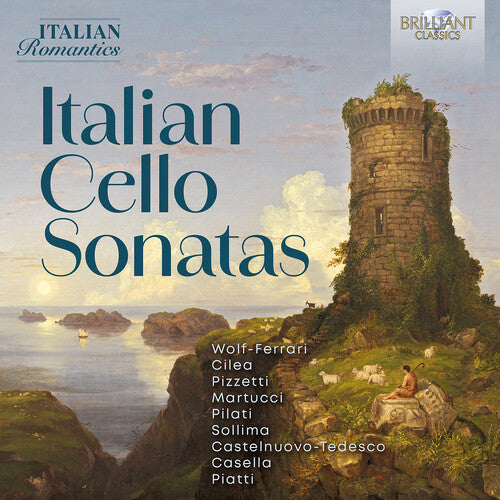
Italian Cello Sonatas
By the time of the ‘Ottocento’ (19th century), opera was the dominant force in Italian musical culture, with bel canto composers such as Rossini and Donizetti creating a public appetite for opera that eclipsed achievements by Italy’s musical sons in other genres. Some of these composers who focused their energies instead on instrumental music, swimming against the operatic tide, remained in their native land, while others found a home (or were forced to find one) abroad.
Giuseppe Martucci (1856-1909) is one who stayed. A gifted pianist, he bypassed the operatic path and wrote music with a kind of fluent synthesis of Italian lyricism and German, dialectic approach to form that reached an early peak in his Cello Sonata of 1880. Yet Martucci, as a teacher of composition in Bologna and then Naples, urged the teenaged Alfredo Casella (1883-1947) to study abroad.
Ildebrando Pizzetti (1880-1968) is among the few composers in this set whose entire career centered in Italy, and he wrote a substantial body of instrumental music.
Before the war and eventual exile, Mario Castelnuovo-Tedesco (1895-1968) succeeded in reinventing an essentially Romantic model (of both form and harmony) for his own time with his Cello Sonata Op. 50 of 1928.
From seven years earlier, Ildebrando Pizzetti’s Sonata of 1921 is a more gloomy, even tortured affair. The Cello Sonata of Francesco Cilea (1866-1950), while unmistakably cast as an ‘operatic’ work from its opening solo, features a protagonist scarcely burdened by the existential angst to be found in comparable works from northern Europe.
Like Cilea, Ermanno Wolf-Ferrari (1876–1948) is known for his operas but unlike Cilea’s cello sonata, Wolf-Ferrari’s Op. 30 dates from the final three years of his life and belongs to a mature output of instrumental music.
Virtuoso cellists Alfredo Piatti (1822-1901) produced many trifles and showpieces to display his artistry to his adoring public in London. He was most proud of the set of six sonatas included in this set. In 1844 he made his first appearance in the English capital and soon settled there, playing both as a soloist and in one of the first celebrity string quartets.
The Cello Sonata by Mario Pilati (1903-1938) is another product of the fast-moving 1920s, formed in a Romantic tradition but inflected – like the music of Casella, Pizzetti, and Castelnuovo-Tedesco – by contemporary trends in impressionism and futurism.
From the next generation of composers, the Cello Sonata composed in 1948 by Eliodoro Sollim (1926-2000) fluently incorporates the kind of modal harmonies and cross-rhythms adopted by the likes of Bartók and Janáček from the folk traditions of their own cultures.
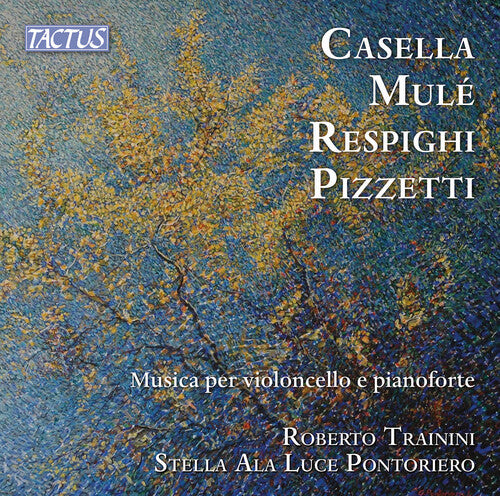
Casella, Mule, Respighi & Pizzetti: Music for Cello & Piano / Trainini, Pontoriero
A cross-section of the Italian production for cello and piano, conceived during the hazy beginning of the twentieth century, shows us how the most varied influences – coming from all sorts of styles: Gregorian, Monteverdi, operatic, German and French late-romantic, avant-gardist, Franco-Russian impressionist, French symbolist, veristic – are absorbed and remoulded, accepted and rejected, by various personalities of the world of composition. In this cultural ambience, a crucial role was played by the so-called Generation of Eighteen-Eighty, whose components, Casella, Malipiero, Pizzetti, Respighi, friends and collaborators, stood out for their pursuit of innovation and their aim to create a character peculiar to Italian music; this quest was accompanied, at least in their artistic choices, by a certain lack of political commitment. Within this recording, cellist Roberto Trainini and pianist Stella Ala Luce Pontoriero are delivering an anthology of precious musical gems as necessary testimony to the great value of some obscured and forgotten Italian early twentieth century repertoire.
Casella: Works for Piano and Orchestra
Berceuse / Anna Geniushene
A unique and imaginative collection newly recorded by a recent star of the Van Cliburn Piano Competition. Anna Geniushene’s fresh; layered; and powerful interpretations won her a worldwide following at the 2022 edition of the Van Cliburn International Piano Competition; where she took Silver Medal with a stunning account of Tchaikovsky’s First Piano Concerto which the critic for Gramophone compared in its power and nuance to Van Cliburn himself.
Born in Moscow; Anna Geniushene pursued graduate studies in London and now lives in Lithuania with her husband; the pianist Lukas Geniusas. In her own booklet introduction; she explains the inspiration for this quirky collection of instrumental lullabies. The Berceuse is ‘associated with tenderness; care; purest love; and the most sensitive moments in our lives.’ She dedicates the album to her two young sons. Perhaps the most celebrated Berceuse of all; by Chopin; is missing; because it was Anna Geniushene’s particular wish to find and share neglected examples of the genre; even by well-known composers. Debussy composed the Berceuse heroique during the First World War as a tribute to the soldiers on the Western Front. The Berceuse Elegiaque of Busoni is better known in its orchestral guise. The brief Berceuse by Hindemith; unpublished in his lifetime; ‘draws listeners’ attention by its utterly eloquent and typically sarcastic character; which has nothing in common with traditional lullabies.’ The sheer diversity of composers makes for a continually varied sequence. George Crumb evokes a magical night-time stillness with a minimum of notes. Mompou’s Berceuse is likewise remarkable for its distilled serenity; whereas the examples by Granados; John Field and Liszt bring comfort with more Romantically moulded melodies in the tradition of Chopin. Anna Geniushene closes the album with two Russian Berceuses; by Shostakovich and Tchaikovsky; lyrical; simple and utterly beguiling in her hands.
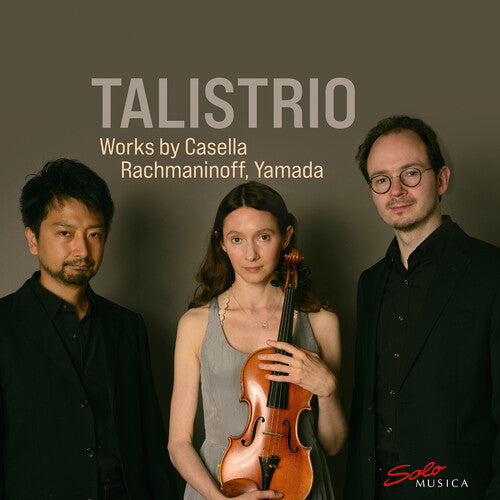
Casella, Rachmaninoff & Yamada: Works / Talistrio
Paul Klee’s picture Ad marginem provides inspiration and context for the present program and is a visual guide to performance for us as Talistrio: a radiant red circle in the middle, while around it - driven back to the margin - living creatures and abstract objects emerge. It is surely this mixture of melancholy and hope that links all the works listed below, be it Casella’s neoclassical dance on the volcano from the early 20th century, Tchaikovsky’s death and its shattering inspirational impulse upon the young Rachmaninoff, or the Japanese child scene at sunset. Amazement and admiration have attended Talistrio since its debut concert of 2012. The press credits the trio with “great intensity and virtuosity”, “great differentiation of tone”, and a “spiritual penetration of the compositions followed through to the slightest detail”.
Talistrio is the Augsburg piano trio that belongs to a new generation as an international ensemble. It was in 2011 that siblings Elisa and Wenzel Gummer joined cellist Takuro Okada to form a German-Japanese trio. Concert tours have since taken them from Bavaria to Holland, Switzerland and Japan. Talistrio sets great store by projects promoting exchange and understanding between the German and Japanese cultures.
Casella: La donna serpente / Villari, Luisi, Orchestra Internazionale d'Italia
When, in 1928, Alfredo Casella approached opera for the first time, he was already a mature, 45-year-old composer. La Donna Serpente by Carlo Gozzi was a subject that had intrigued him for a decade or so and, in fact, in 1918 he had conceived of a choral ballet, for which he commissioned scenery and costumes from the Russian painter. La Donna Serpente kept Casella busy for three years, from October 1928 to the same month in 1931. Just days before the opening at the Teatro Reale in Rome of his "opera-fairy tale" - the description the composer and obliging librettist Cesare Vico Lodovici chose to give the score - Casella listed the criteria utilized for its composition: choice of a subject taking place in an imaginary, fantasy world given the fact that opera itself already represented an anti-realistic genre and prevalence given to the music.
Casella: Notte Di Maggio, Cello Concerto, Scarlattiana / La Vecchia, Rome Symphony Orchestra
From mysterious moonlit night to joyous sunlit day, this recording runs the gamut of Alfredo Casella’s huge stylistic range. Notte di maggio (‘A Night in May’), composed in the wake of Stravinsky’s Rite of Spring, is Casella at his most radical, while the delightful ‘Divertimento’ Scarlattiana finds him at his most relaxed, spicing up themes from Domenico Scarlatti’s keyboard sonatas—in the manner of Stravinsky’s Pulcinella. Between them comes Casella’s Cello Concerto, its style influenced by the ‘baroque magnificence of Rome’, with a finale the composer called ‘the flight of the improved bumblebee’.
Martucci, Casella & Clementi: Chamber Trios / Hèsperos Piano Trio
A plunge among the sunken composers of Italian chamber music and the salvaged ones. The program recorded in this album is a ticket for a journey of a century and a half, that is the distance between the composition of the Sonata “con accompagnamento” by Muzio Clementi (1792) and its transformation into the Trio ortodosso by Alfredo Casella (1936). An intermediate stop is represented by the Trio op. 59 by Giuseppe Martucci (1882). The route of this journey retraces a history that is not unimportant or unsurprising: it summarises the significance and vicissitudes of the chamber music produced by Italian composers from the middle of the eighteenth century onwards. In many texts of music history this topic is relegated in a note, or at most is dealt with in a paragraph, not even a chapter: an upgraded echo of the Fascist nationalism and dislike for Puccini that, for ideological reasons rather than for a historical or critical conviction, made themselves useful in raising the issue in the twentieth century. This recording, which presents a performance for piano, violin and cello, is a tiny artistic compensation, and an aesthetic and formal clarification. It leads us to consider and understand the role that Italian composers played also in the specific area of non-theatrical music.
Casella: La Donna Serpente / Noseda, Teatro Regio Torino
Alfredo Casella was one of the ‘Generation of the eighties’ who sought to shake Italian music from its longstanding operatic heritage and the dominance of Puccini. La donna serpente was Casella’s only full-scale opera, its fantastic plot based on Carlo Gozzi’s renowned fairy tale that perpetually alternates between tragedy and comedy, expressed in neo-Classical music that skillfully portrays the sinister and ethereal world of the fairies as well as the intense emotions of the human realm. This production was acclaimed for Arturo Cirillo’s dreamlike setting and Gianandrea Noseda’s pin-point conducting: ‘What energy, what precision! … he delivers the complexity of this score with a disconcerting ease.’ (resmusica.com)
-----
REVIEW:
In the leading role of Miranda, Carmela Remigio is one of today’s leading Italian sopranos in high demand in the world’s leading opera houses. Totally committed in an exacting role, she is partnered by the Sardinian tenor, Piero Pretti, who is often called upon to go into that upper stratosphere, the conclusion in a duet of sheer exultation. To bring the comedy to life, the Italian trio of Francesco Marsiglia, Marco Filippo Romano and Roberto de Candia are superb both vocally and characterisation.
– David's Review Corner (David Denton)
Casella: Complete Symphonies / Noseda, BBC Philharmonic
Casella: Symphony No. 1

The performances are exemplary. The symphony seethes with tension and excitement, while the shattering Elegia is one of the composer's greatest works. Highly recommended.
– Gramophone
Casella: Symphony No. 2
A stunning first recording of the Second Symphony, written just a few years (1908–10) after the First. Among its notable incidental virtues is an irresistibly tuneful scherzo cast in a tarantella-like mode that foreshadows important elements in Casella’s later development.
– Fanfare
Casella: Symphony No. 3
The conductor makes much of the vastly proportioned work’s orchestral panoply. The musicians’ energy and sensitivity, and the brilliant Chandos sound make for a most welcome disc.
– Fanfare
Casella: Symphony No 3, Elegia Eroica / La Vecchia, Rome Symphony
To my mind one of the most interesting and successful current Naxos series is that devoted to the orchestral music of Alfredo Casella. The current release is the fourth and contains Casella’s third and last symphony. Suffice to say all of the excellent values of performance and engineering/production of the first three volumes are duplicated here so admirers need not hesitate.
I had no knowledge of the major works prior to collecting these discs but I was mightily impressed with the scale and power of the earlier two symphonies. Casella’s third and final essay in the form is actually – and rather confusingly – simply titled Sinfonia and dates from 1939 making it a full three decades younger than the earlier pair. All three are big works; Nos. 1 & 3 clock in around the ¾ hour mark and No.2 is a full 55 minutes. Although the influences are different it is clear to hear that Casella was a man who was willing to let his admiration for the music of others infuse his own. So where the earlier works are epically Mahlerian the later work echoes Shostakovich and Nielsen as well. I would have to say that this Sinfonia has not made as immediate an impact on me as the earlier works. The central pair of movements seem to contain the most cogent and well argued music. In the excellent liner-note by David Gallagher it is pointed out that the work is truly symphonic in that nearly all of the melodic material in the entire work derives from the opening germinal material. This I suppose reflects the experience gained through his career but it does not necessarily make for as compelling a listen as the excitingly confident indeed bravura music he wrote in his twenties. The first movement in particular suffers from extended passages of musical material being ‘worked’ without the sense of it creating an emotional landscape for the listener. After the rather appealing sparse opening the scoring suffers from being rather heavy and unrelenting. That being said the final pages of the movement flutter away into quiet inconsequence. These are all impressions that are based on a relatively brief acquaintance with the work and without the benefit of the score.
The Orchestra Sinfonica di Roma under conductor Francesco La Vecchia continue to make the good impression they formed previously – the strings play with good ensemble and a well balanced tone. Italian brass players are always game to play with plenty of edge and attack and so they do here. I have not heard the other available version on CPO from the WDR Sinfonieorchester Köln under Alun Francis but I cannot imagine they have much to fear from it in purely technical terms. Having heard very little ‘war’ music in the opening movement the second movement Andante molto moderato opens with a string-led threnody that is instantly much more engaging and powerful than anything in the opening movement. The Rome strings are good but I can imagine this movement being even more powerful if played with the weight and unanimity of Vienna or Berlin. I like the way the music slowly builds a momentum becoming a rather lop-sided yet unrelenting march underlying some lovely lyrical lines for the strings and woodwind. It is rather quirky and individual before the mood lightens towards a calm major key resolution. The third movement Scherzo has a mechanistic (rather than militaristic) feel and while it has some of Shostakovich’s stamping energy it lacks the nightmarish malice of that composer’s writing that makes his scherzi in particular so remarkable. I wonder if it would benefit from a slightly more unleashed tempo than here? I’m sure La Vecchia’s choice is dictated by the complex filigree writing that surrounds the main material but it does result in a basic pulse that plods.
The Finale is altogether more buoyant indeed optimistic which might seem at odds with the wartime context. But as Gallagher points out repeatedly Casella was an enthusiastic indeed sycophantic supporter of Mussolini and his fascist agenda and since the war was still going relatively well for the regime in 1939/40 why not be optimistic? Again, I find there are passages which I suspect appeal more to the academics who admire the way in which the material is developed – to my innocent ear they lack a huge amount of melodic interest. But there are several passages which allow the impressive Rome horns and brass to shine excitingly. This is the movement that sounds most heroically filmic. After the bombast of the opening ten minutes of the movement there is a coda/epilogue that is rather beautiful in the way the musical lines grope upwards sinuously in a mood of hymn-like reflection which just as it is fading away with elegiac solo strings is flattened by a raucously noisy conclusion. Given that that ending lacks any of the irony or forced good-humour of a Shostakovich one is left assuming that Casella was feeling pretty good about things in 1940 after all!
If the symphony was the only work on offer here I would direct collectors to the earlier works. However, it is this disc’s ‘filler’ which proves to be the absolute jewel here and indeed one of the finest works by Casella I have yet encountered. This is also a work written in time of war – 1916 – but here the presence of tragedy and sorrow is unmistakeable. This Elegia eroica is subtitled “alla memoria di un Soldato morto in Guerra”. The very opening is magnificently striking in a way that eluded the symphony totally. Tolling horns, ominous tam-tam, skirling wood-wind and disconsolate strings immediately plunge the listener in a world of loss and despair. It feels much more modern and challenging than the later work. This is how Casella described it; “a heroic funeral march, a more intimate deeply sorrowful central episode; and finally a fusillade of death that thunders through the orchestra [and] subsides into a tender lullaby evoking an image of our country as a mother tenderly cradling her dead son”. The musical means Casella uses for this are actually considerably more modernistic than the potentially maudlin narrative might imply. It reminds me of the expressionist scores being written in Germany around this time and certainly quite unlike any other contemporaneous Italian score I can think of. The Rome orchestra are superb here relishing the extremes of dynamic and range the piece demands. Casella’s particular coup-de-théâtre was lost on the work’s first audience. The final lullaby is given to the solo oboe which plays fragments of the 19 th century patriotic song Fratelli d’Italia over a string-led rocking berceuse accompaniment – definite echoes of The Firebird here. It is a passage of tender beauty and poignant rapture – all drowned out in 1916 by “a tidal wave of indignation … not a single note could be heard.” Casella pares his orchestration right back to a skeletal minimum to stunning effect. In its quasi-minimalist way this passage pre-echoes Holst’s Uranus or the finale of Vaughan Williams’ Symphony No.6. Even the way Casella avoids any ‘comfortable’ ending adds to the impact and sincere power of the work.
So a conundrum for the collector to consider – a big symphony that is interesting but not the place to start your symphonic investigation of the composer coupled with a shorter work that represents him at his considerable finest. On balance, at the Naxos bargain price point, I would say worth buying for the Elegia alone. Hopefully Naxos will continue to use this creative team for further projects and indeed more Casella.
-- Nick Barnard, MusicWeb International
--------
Francesco La Vecchia’s recordings of modern Italian music for Naxos have been impressive, nowhere more so than in his discs dedicated to the finely crafted works of Alfredo Casella. The Third Symphony, written for Chicago, is a late piece (1940), but still an ambitious essay in the grand tradition. It’s beautifully put together, melodically pungent (maybe a touch of Honegger), colorfully scored, but also austere, even severe in places. It’s clearly the work of a mature master. Elegia eroica is a funeral march dating from 1916, a passionate threnody “to the memory of a soldier killed in battle.”
As with the other discs in this series, the performances are wholly convincing, well played and recorded. In the case of the symphony, though, there’s very strong competition, even better engineered, from Alun Francis and the slightly finer WDR Symphony Orchestra on CPO, coupled to the tone poem Italia. La Vecchia does present a legitimate alternate view, of course, with some strikingly different bits of instrumental detail, and a work of this richness ought to be heard in more than one interpretation. So if you’ve been collecting this series, by all means grab this release without qualms.
-- David Hurwitz, ClassicsToday.com
Casella: La Donna Serpente; Introduzione, Aria E Toccata; Partita / La Vecchia, Rome SO

The composer that Casella most resembles in his chameleon-like musical personality is probably Martinu, and this is nowhere more true than in the Partita for piano and small orchestra. Scored for the distinctive combination of oboe, two clarinets, bass clarinet, three trumpets, timpani and strings, the work is an unalloyed delight. Listen to the end of the first movement recapitulation, and you’ll be hooked. Like Martinu’s Sinfonietta giocosa, the lightweight title in fact conceals a work of genuine substance, lasting (in this case) just over half an hour. The central Passacaglia (a form much exploited by Casella) is profoundly beautiful, and its evocative use of trills reveals that Casella learned a trick or two from the first Nachtmusik of Mahler’s Seventh, which he arranged for piano four-hands.
The Introduzione, aria e toccata again recalls (or foreshadows) Martinu–in this case the Toccata e due canzone. Like that piece, this is a substantial, at times brooding work brimming with memorable invention. The music’s stylized, neo-Baroque idiom couldn’t be farther removed from the nearly contemporary orchestral fragments from Casella’s only opera, La donna serpente (The Snake Woman), after a play by Gozzi. These “fragments” are actually pretty extensive, lasting a full half an hour, and if they pay homage to anyone I’d have to mention Rimsky-Korsakov. The Military March that ends the first suite evokes a fairytale atmosphere similar to that of The Golden Cockerel or Tsar Sultan, but there’s nothing Russian about the melodic material, which is completely personal.
This disc marks the conclusion of Naxos’ Casella series, and it has been a wonderful journey. As with the other discs, the performances are excellent. Sun Hee You does a wonderful job in the Partita, offering effortless virtuosity and an aptly light touch. There’s only one other recording available, featuring the very good Joshua Pierce, coupled to concertante works by Respighi and Rachmaninov, but conductor Franceso La Vecchia proves himself more imaginative an accompanist the Anton Nanut, and he also has the better orchestra and engineering. Casella truly was a great composer. The evidence on this disc is incontestable.
– David Hurwitz, ClassicsToday.com