Aram Khachaturian
28 products
-
Khachaturian: The Dancing Violin
$20.99CDFuga Libera
Mar 14, 2025FUG840 -
-
-
-
-
-
-
-
-
-
-
-
-
-
-
-
Famous Flute Concertos / Jean-Pierre Rampal
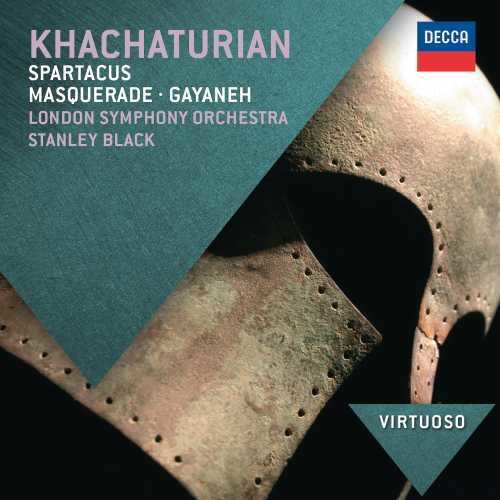
SPARTACUS MASQUERADE
Khachaturian: The Dancing Violin
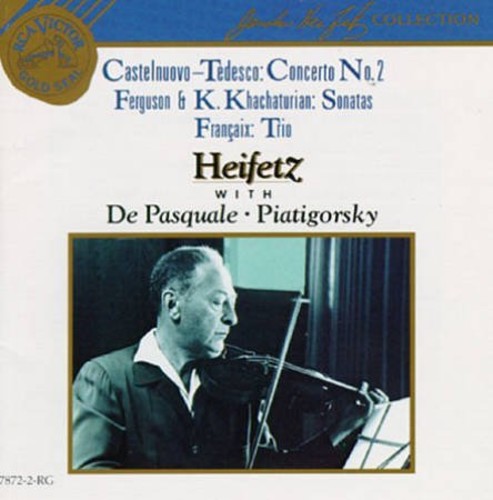
Castelnuovo-tedesco: Concerto No 2; Khachaturian / Heifetz
Heifetz was without doubt a uniquely gifted artist. It has been a very rich experience for me to explore these five discs, and I can do no more than give them the highest possible recommendation.
-- Gramophone [from a review of five titles featuring Jascha Heifetz]
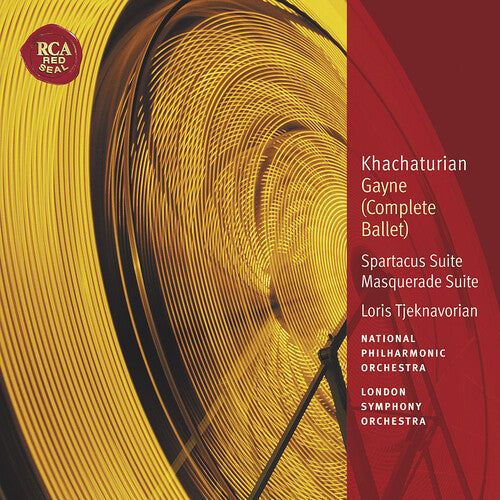
Khachaturian: Gayne; Russian Fantasy / Tjeknavorian
Of course, the nicest thing about Khachaturian's music is that none of it pays the slightest heed to the above scenario: it's straight Romantic nationalism, and all of your favorite numbers, including the Saber Dance and the Lezghinka, come off brilliantly in impactful but somewhat glassy sonics. Loris Tjeknavorian and the National Philharmonic pick-up orchestra clearly are having a terrific time. The excerpts from Spartacus (Danse with Crotales, Adagio of Spartacus and Phrygia, Bacchanale, Spartacus' Victory) and the Masquerade Suite have just as much oomph, and are even better engineered. Major league fun!
--David Hurwitz, ClassicsToday.com
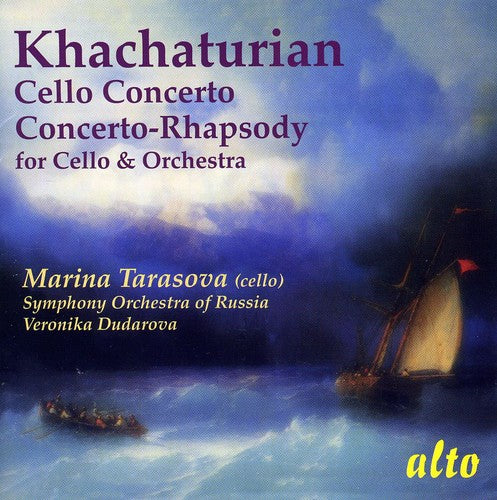
Khachaturian: Cello Concerto - Concerto-Rhapsody
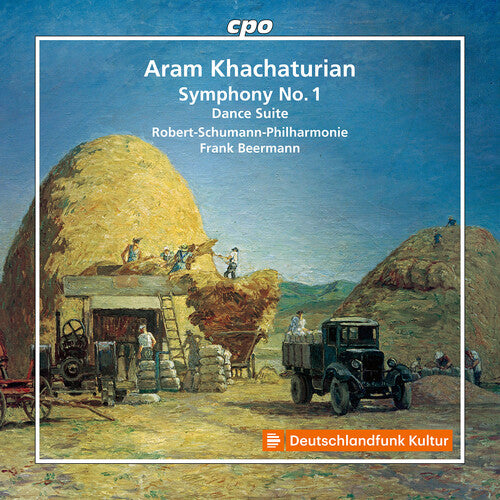
Khachaturian: Symphony No. 1; Dance Suite
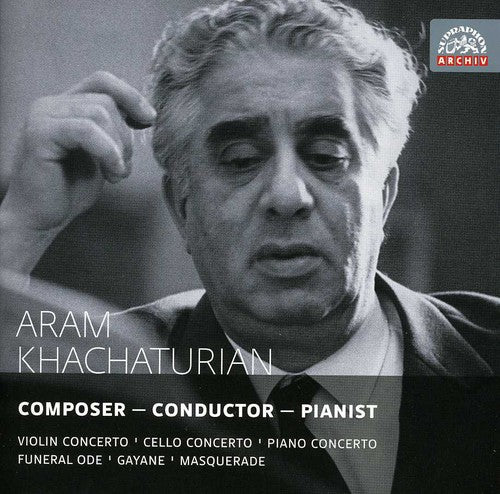
Aram Khachaturian: Composer - Conductor - Pianist
KHACHATURIAN, A.I.: Symphony No. 2 / Gayane Suite No. 1
Khachaturian, A.I.: Spartacus / Ode in Memory of Lenin / Ode
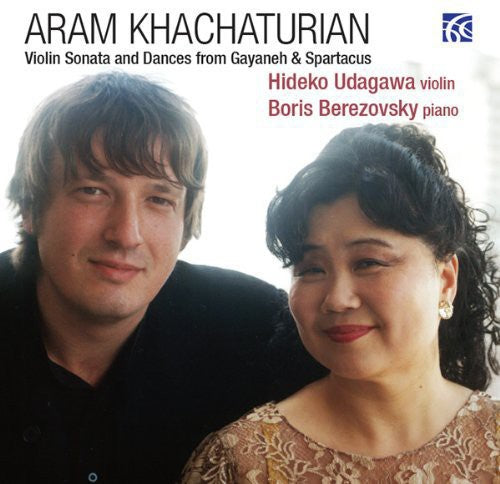
Violin Sonata and Dances from Gayaneh & Spartacus
Khachaturian, A.I.: Violin Concerto / Concerto-Rhapsody for
Pontinen, Roland: Russian Piano Music
Khachaturian: Piano Transcriptions / Ayrapetyan
Armenian Rhapsody
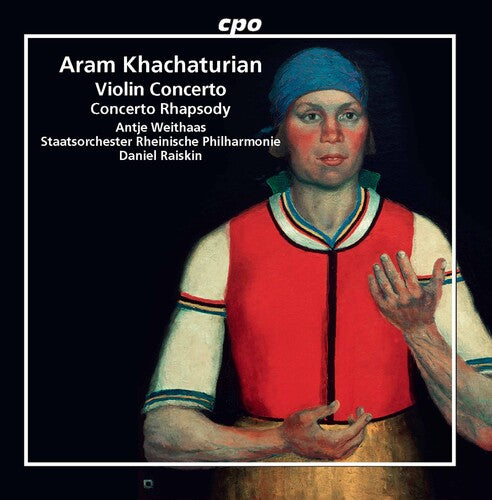
Khachaturian: Violin Concerto & Concerto Rhapsody / Weithaas, Raiski, Rhine Philharmonic State Orchestra
In the 1960s Aram Khachaturian engaged in a number of experiments in which he covered terrain situated at an astonishing distance from the immediately appealing tone of the works that he had composed prior to those years. These experiments included the first of his three concert rhapsodies, in which he completely emancipated himself from the established forms that he had filled out in his concertos for piano, violin, and violoncello, which already then were world famous. While the virtuosic ambitions of the rhapsodies are in no way inferior to the technical demands of their older sister works, he now requires what is perhaps an even higher measure of expressive shared experiencing and solo messaging. The direct juxtaposition of the two concert violin compositions recorded by Antje Weithaas and Daniel Raiskin and the Rhineland-Palatinate State Symphony Orchestra conveys the extraordinarily grand leap into a “modernism” that hardly anybody would have thought possible for the author of the Sabre Dance. In 1971 Aram Khachaturian was honored for his rhapsodic risk-taking when he received the State Prize of the Soviet Union for his second concert trilogy.
Khachaturian: Cello Concerto; Rhapsody etc. / Thedeen, Raiskin, Staatsorchester Rheinische Philharmonie
Aram Khachaturian was an established Soviet artist when he realized an old dream of his in the first postwar year 1946 and composed a grand, quasi-symphonic work for his main instrument. Following his spectacular concertos for piano and for violin, which in the meantime had taken the world by storm, he now surprised his public with music that only gradually reveals its fiery temperament: we hear very clearly how well the composer knew the violoncello, the instrument on which during his study years he had practiced until his fingers hurt, in all its special qualities and how precisely he knew how to bring out its expressive and velvety autumnal personality. Neither this concerto nor the Rhapsody composed by Khachaturian seventeen years later for Mstislav Rostropovich can be mastered with mere virtuoso ostentation. Both works demand the services of a soloist who does not misunderstand the unprecedented difficulties of his parts as an opportunity for self-display, and Daniel Raiskin has found such an interpreter in the person of the Swedish cellist Thorleif Thedéen: sovereign in every technical respect, he surmounts the enormous challenges even when he removes himself from the intensive dialogues with the orchestra and – left entirely to his own devices – captures the whole of Khachaturian in the monologues.
Khachaturian: Piano Concerto & Concerto Rhapsody / Raiskin, Simonian, Rhenish State Philharmonic
-----
REVIEW:
You can hear the really extraordinary pianistic qualities of the soloist in the piano concerto recording.
– Klassik Heute
Khachaturian: Spartacus - 1968 Version / Jurowski, DSO Berlin
REVIEW:
While Spartacus will probably never replace Gayane in the affection of the general public, it remains a colorful and exciting score in the composer’s characteristic style. In reviewing the complete score played by the Bolshoi under Algis Zhuraitis (IMP), Lawrence Hansen was pleasantly surprised how much good music the complete ballet has...Zhuraitis’s familiarity with the score gives the music a coherence, drama, and compactness most recordings of the suite lack. On Capriccio Michail Jurowski’s Berlin players lack the sheer Russian character of the Bolshoi, but his smoothly blended strings and healthy vigor have much to recommend them.
-- American Record Guide
Khachaturian: Concertante Works for Piano / Sughayer, BBC National Orchestra of Wales
The expressive immediacy of Aram Khachaturian's music, with its sensuous melodic writing, vibrant orchestration and rhythmic drive, resulted in a popularity equaled by few composers of his generation. Composed in 1936, the Piano Concerto was the work that established Khachaturian’s name. Cast in the customary three movements, it is scored for a sizable orchestra, with notable contributions from both side-drum and military drum in the percussion section. In the second movement there is also an extensive solo for a so-called ‘flexatone’; it is often put forward that Khachaturian in fact intended the part to be played on the musical saw, as it is on the present recording. Thirty years after the Concerto, the composer returned to the genre with his Concerto-Rhapsody for piano and orchestra. This time the score offers prominent roles for the xylophone, marimba and vibraphone, which contribute towards making this one of the composer’s most colorful works. The demanding solo parts are here performed by the young Jordanian-Palestinian pianist Iyad Sughayer, with spirited support from the BBC National Orchestra of Wales under Andrew Litton. Sughayer made his acclaimed début as a recording artist with an album of Khachaturian's piano works and sandwiched between the two works with orchestra he here presents the piano version of one of the composer's best loved pieces, the Masquerade Suite with its yearning opening Waltz and closing Galop.
Khachaturian: Spartacus Suite No 4, Etc / Anichanov, Yablonsky, St. Petersburg Orchestra
Khachaturian: Piano Concerto, Etc / Yablonskaya, Yablonsky
Khachaturian: Cello Concerto, Concerto Rhapsody / Yablonsky, Fedotov
The work for cello and orchestra is not as well-known as its counterpart, but that is an injustice which this new recording attempts to counteract. Dmitry Yablonsky is the excellent soloist, and his account makes it clear that a potential audience favorite has been withheld from the standard repertoire for too long.
Khachaturian no longer needs introduction to Western audiences. He is known from his ballets Gayaneh and Spartacus, and from his Violin Concerto, as a composer who pleases both the crowds and the critics. The Violin Concerto was premiered by legendary violinist David Oistrakh, and has been a staple of concert programs and new CDs ever since. It has been recorded by the likes of Leonid Kogan, Itzhak Perlman, Henryk Szeryng, Ruggiero Ricci and, more recently, Julia Fischer. The Cello Concerto has not received anything like that level of advocacy. By my count, this is just the seventh major recording of the stereo era. The work’s relative obscurity may have something to do with its gloomier overall atmosphere, its more troubled emotional state, and, worst of all, the harsh denunciations leveled at it by Soviet authorities after its premiere in 1946. Let us hope that this fantastic recording will inspire its return to the mainstream.
The Cello Concerto opens with an orchestral introduction of only about a minute’s duration. It is heavy with foreboding and tapers off into one of the many moody, mysterious clarinet solos which punctuate the first movement. Then the cello enters and announces the memorable first theme. After that the movement is off to the races: brilliant color, skilful thematic development, and high drama mix in the same folksy idiom which characterizes so much of this composer’s music. A delicious clarinet solo prepares the way for the second subject, and there is a sudden reminiscence of the Dies irae theme by the orchestra as the cellist enters, but the Catholic hymn is warded off before it can really settle in. The development reaches its peak with a deliciously colorful dance in the seventh minute, before the cellist’s cadenza skillfully combines the movement’s dueling moods of exuberance and introspection.
The second movement, beginning with an eerie flute solo, is a dramatic, stern creation in which we see only glimmers of the consoling ‘big tune’. One might compare it to a view of a harsh landscape with a mere hint of lush green far in the distance. The lyrical heart of this movement is evasive and fleeting.
The finale brings the expected fireworks, but it also presents the main structural flaw: the energy level in the second half of the finale consistently decreases until the lightning-fast coda shocks the music out of its slumber. Perhaps this is partially the responsibility of the performers, but I doubt it. Dmitry Yablonsky’s cello playing is consistently riveting; his regular work as a conductor on Naxos has concealed the fact that he is a very fine cellist indeed. What’s more, the Russian Philharmonia plays superbly throughout. The orchestra itself is somewhat of an enigma — it was previously known as the TV 6 Orchestra and does not appear to give public concerts — but the level of the playing here is impressive. As mentioned, the first-desk wind players are especially praiseworthy. And, even when the final coda seems to come too soon, it is a mark of Khachaturian’s skill that we are left hungering for more rather than wishing there had been less.
Luckily there is more. The Concerto-Rhapsody for Cello and Orchestra is a twenty-four minute work in a single movement. It makes even greater demands on Yablonsky than the longer concerto. Within a minute we are launched into an extremely long and grueling solo cadenza, in which the cellist presents all the themes we will soon be hearing amid much fiercely difficult passage-work. The Concerto-Rhapsody is, perhaps, more interesting on first listen, because its musical idiom is largely more advanced and more forbidding than a typical Khachaturian work. Oddly, on repeated hearings it is the simpler, more tuneful concerto which is more rewarding. The Concerto-Rhapsody, which occasionally quotes the Dies irae idea from the earlier work, simply does not have enough thematic material to justify its twenty-four minutes. There is a frankly dull and repetitive stretch in the development passage, which is a pity because the titanic cadenza had commanded our attention so powerfully. Near the end Khachaturian pitches in a few spectacular moments for the percussion and brass which recall the peasant dances from Gayaneh, but this comes after an awful lot of dithering over a very small number of interesting musical ideas. By contrast, the Concerto is both a potential crowd-pleaser and a satisfying, intelligent piece.
This recording makes me wonder just why the Cello Concerto isn’t a smash hit in concert halls across the world right now. It’s instantly appealing, emotionally complex, fantastically orchestrated, virtuosic, and filled with an abundance of good tunes. At the very least, one would expect more recordings to be available, but there is almost no major competition for this Yablonsky performance. A Chandos disc featuring Raphael Wallfisch puts the Concerto in a more elegiac light and features very polished, expressive cello playing, though the acoustic is not always flattering to the cello itself and the London Philharmonic winds are not as characterful as their Russian counterparts. Wallfisch has a definite edge on Yablonsky in the expressive slow movement, but Yablonsky takes extra trouble to make the repeated-note theme in the finale genuinely interesting and varied, where Wallfisch simply runs the notes together. The coupling on the Chandos disc is the Violin Concerto, which most Khachaturian fans will likely already have.
I have not heard the Regis recording with cellist Marina Tarasova, but the disappointed reviews on this site by Michael Cookson and Jonathan Woolf suggest that that performance, a full four minutes slower than Yablonsky’s, is not a good advocate of the piece. A Philips CD starring Christine Walevska and conductor Eliahu Inbal is long out of print.
This new recording featuring Dmitry Yablonsky is, then, the finest available performance of the Khachaturian Cello Concerto, and as such merits the strongest possible recommendation. If the Concerto-Rhapsody does not always reach the same level of inspiration, Yablonsky’s playing is still breathtaking. These are recordings which any fan of Khachaturian would delight to have, and which should commend a richly enjoyable but long-forgotten concerto to a much wider audience. Rich, clear sound completes the package.
-- Brian Reinhart, MusicWeb International