Carlo Gesualdo
20 products
Gesualdo: Madrigali
V2: MADRIGALI LIBRO
Gesualdo: Silenzio mio - Il quarto libro di madrigali
Gesualdo: Responsoria – Canto dell'ombra
Gesualdo: Quarto Libro di Madrigali a 5 voci
V1: MADRIGALI LIBRO
Evviva! Il Principe
Gesualdo: Madrigals, Book 1
Gesualdo: Madrigals, Book 2
Gesualdo: Madrigals, Book 3
TENEBRAE RESPONSES GOOD FRIDAY
Gesualdo Madrigals / Holten, Musica Ficta
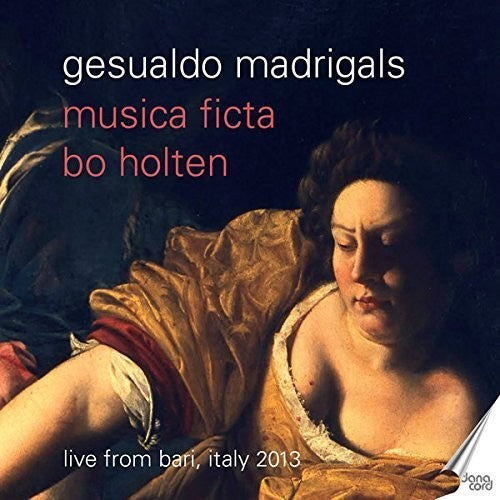
This new release with the Danish Copenhagen early music ensemble Musica Ficta under conductor Bo Holten was recorded in a live concert Nov. 18 in Bari, Italy. After the concert the following praise was given: “As I told you, I've heard lots of groups sing Gesualdo, many of them very, very good. But I would rank yours right at the top. It was absolutely splendid, and for that you have my eternal thanks.” (Glenn Watkins, leading Gesualdo scholar). The intensity of the performance and the stylish and vocally superb musicianship shines through with full force. Early music ensemble Musica Ficta is the leading Danish expert group in the field of early music. Their recordings consistently receive high ratings from critics and audiences, and their concerts continuously delight fans.
Gesualdo: Madrigals, Book 4 / Longhini, Delitiae Musicae
It goes on that way: the six singers and keyboard player (Carmen Leoni) treat every piece by the usually only anthologised Gesualdo as its own gem. They approach each madrigal almost as if it were Gesualdo's only one. This could, admittedly, lead to a laboured and self-conscious style. It doesn't. The Italian group's familiarity with and obvious love of Gesualdo's world sees to that.
Instead, our response is anticipation for each next madrigal while thoroughly savouring the particularities of the one we're listening to. In a way this helps to create an understanding of the corpus of this aspect of Gesualdo's output … two more CDs from Naxos - to whom Delitiæ Musicæ is under exclusive contract - and the cycle will be complete.
The composer's Fourth Book of madrigals was published in Ferrara in 1596 and quickly achieved several further printings - including one in 1613 in Genova in partitura - a rare occurrence enabling singers to experience the music 'horizontally', line by musical line.
This Fourth Book was intended as a kind of atonement for the composer's (conviction for the) murder of his first wife, Donna Maria d'Avalos in 1590. In the Kingdom of Naples a husband had such a legal right in the case of infidelity. But, although Gesualdo faced no punishment from the legal system, he was ostracised and marginalised by his own community. What Longhini - who also produced the 'Urtext Edition' for these recordings - and his singers have achieved so well is a convincing set of performances. This graciously and genuinely blurs any distinction that we might make four hundred years later between heartfelt remorse on Gesualdo's part and what the Renaissance poet, playwright and composer was able to make using events from life as material for art.
In a way the tone, the weeping, the dourness, the (self-)deploring, above all the self-doubt must be taken as starting points for this beautiful and affecting music - not as something to be expressed in and by it. The creativity, the tight and effective matching of texts (mostly anonymous and by Guarini) to tonality and texture are what matter. They stand on their own. That's the approach which these performers so successfully take.
At the heart of the set is what at first sight appears a misfit: Sparge la morte al mio Signor [tr.12], the longest piece here at almost seven and a half minutes. In fact to transfer the remorse to images of the unjustly (with ambivalences) murdered Christ illuminates the complexity of Gesualdo's thinking in these works. The suggestion is clear … alongside remorse and torment should come forgiveness and some sort of 'settlement'. Indeed by the time we get to Arde il mio cor [tr.19], the darkness has lifted somewhat, though Delitiæ Musicæ's tempi are still slow, if a little less deliberate. Although those resounding bass notes of Walter Testolin are held for just as long and are as chilling, there is a sense of hope. Certainly the remaining three pieces look upward and let light in.
Nevertheless, overall we're not allowed to forget the trauma, the potential for trauma, the torment represented by (secular) love, and the totality of a soul so affected when subjected to such searing and unrelenting self-examination. Not once do the singers lay the mud or paste on too thickly. Nor do they overlook the innovative nature of the sonic impact of the poetry … dissonance, distortion, a little interruption of the metrical line and much expressive, more easily-flowing consonance between text, harpsichord and song. You can hear this in the fittingly final Il sol qual or piu splende [tr.22]. While the phrase 'tour de force' would be wrong because it would suggest the need for a more mighty and strenuous push than is necessary here, the achievement of Longhini with Delitiæ Musicæ is a considerable one.
Their tone is just right from first to last, their articulation, emphases and sense of seriousness yet neither drab nor spuriously sparkling are indeed delightful. There is, to be sure, little of the lighthearted and springing qualities which we often associate with some madrigals. The purpose and drive behind these interpretations makes them hugely successful.
The booklet that comes with the CD has useful background - particularly to the killing and its subsequent effect on Gesualdo. It contains all the texts in Italian with English translation. The acoustic is clear and not too resonant, though full of intensity in atmosphere. If you've already been attracted to this excellent series, don't hesitate to add this to the collection. It's also a convincing and sensitive enough set of performances to encourage you to start and explore the lot. The Fifth Book is eagerly awaited.
– Mark Sealey, MusicWeb International
Gesualdo: Madrigals, Books 5 & 6 / Longhini, Delitiae Musicae
GESUALDO Madrigals , Books 5 and 6 • Marco Longhini, cond; Delitiae Musicae • NAXOS 8.573147-49 (three discs: 182:40 Text and Translation)
Don Carlo Gesualdo (1566–1613), Prince of Venosa (the last of that aristocratic line), is renowned for the mannerist music he wrote, both sacred and secular, and the personal failings that enliven so many accounts of his life. He spent an important few years of his life in Ferrara after marrying the niece of Alfonso II d’Este, a court where he had much company among composers and singers, including Cipriano de Rore, Jacques de Wert, and Luzzasco Luzzaschi, not to mention the celebrated singing Ladies of Ferrara. He had grown up in similar surroundings in Venosa, where one of his teachers was Pomponio Nenna.
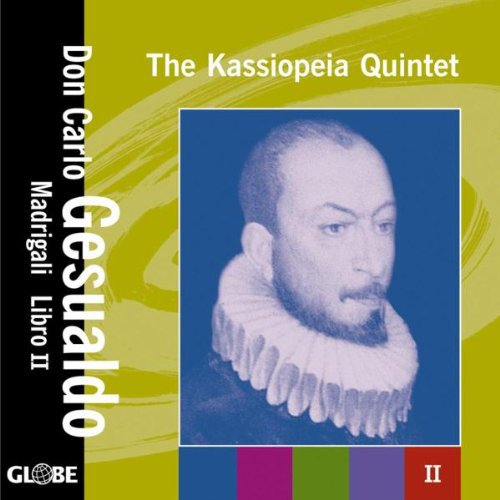
Another set of Gesualdo’s madrigals has now been completed, the last of several recordings marking the quarter-centenary of his death, although even this last installment was recorded two or three years ago. Marco Longhini’s interpretive approach is just different enough to make this an alternative to the others rather than a competition among them. We have had the old version of Angelo Ephrikian, recorded in 1968 but still available, sung one voice to a part with slow tempos (not as slow as Longhini), stylistically obsolete in a new era of Baroque interpretation. The other complete set came from Kassiopeia ( Fanfare 33:4) with considerably faster tempos but a keen sense of style. Longhini has now provided the third complete set, including for good measure the few other secular works published separately. Several other directors have recorded complete books, perhaps hoping to complete all six, among them Harry van der Kamp (29:3), Anthony Rooley (8:2), and those mentioned below.
This collection is striking for its departure from the performance practice of the first four books, issued one disc at a time (34: 1, 34:5, 35:3, 36:2). In each of those discs, he acknowledged an alternative performance practice by using harpsichord or theorbo to accompany half of the madrigals, leaving the rest unaccompanied, as all other recordings known to me have done. In these last two books, the madrigals are all unaccompanied. I find no explanation in Longhini’s lengthy and informative notes to indicate why his practice in the first four books has not continued here.
Tempos are again an obvious measure of the difference among competing versions of these madrigals. In Book 5, the northerners, Kassiopeia (33:4) and Hilliard (35:6), take about 55 minutes in all, while among the Italians, La Venexiana (29:2) takes 64 minutes and Longhini 83 minutes. Book 6 is similar, for Kassiopeia (also 33:4) is 67 minutes, La Compagnia del madrigali (36:6) is 78 minutes, and Longhini is 100 minutes. The very first madrigal in Book 6, Se la mia morte brami , is exactly twice as long here as in Kassiopeia’s. I would rather hear it too slow than too fast, but note that the recent La Compagnia del Madrigale version is a moderate four minutes. So it goes for every selection, if not exactly a 2:1 ratio. To be sure, all the cited versions are listenable or better, and on the fast side the Hilliard’s Book 5 is exquisite. Choosing moderation, it may be noted that La Venexiana’s Book 4 (24:3) may be added to their Book 5 and La Compagnia’s Book 6 to encompass lovely renditions of half the total. On the other hand, do not overlook Longhini’s extensive and literate notes (in fluent translations) in each issue, treating both music and biography at considerable length.
All of the recordings cited are sung very well and recorded up close. If you started collecting Longhini, don’t hesitate to complete the set. Naxos prints texts and English translations in the booklets as well as posting them online, unlike for some of their other recent issues.
FANFARE: J. F. Weber
Gesualdo: Madrigals, Book 3 / Kassiopeia Quintet
Carlo Gesualdo: O Dolce Mio Tesoro
Carlo Gesualdo Da Venosa: Sacrarium Cantionum Quinque Vocibus
Although the madrigals of Carlo Gesualdo da Venosa constitute the best-known part of his oeuvre, his religious music is no less important, revealing a completely different facet of the composer. Aside from the Responsoria (1611), of which Philippe Herreweghe recently made a magnificent recording (LPH 010), most of Gesulado's religious music was published in 1603 under the title Sacrarum cantionum. Unlike the Responsoria, intended for Holy Week services, the motets of 1603 are settings of texts for all circumstances of the liturgical year. For this recording, made in the Santa Trinità abbey church in Venosa, ODHECATON has enriched the sound palette of its men's voices with a few instruments, including an ensemble of violas da gamba. Liuwe Tamminga counterpoints this programme with selected pieces by Giovanni Maria Trabaci and Giovanni de Macque on an historical organ of the Venosa region.
Gesualdo: The Prince's Archlute / Zuljan
Gesualdo: Dolcissima mia vita. Madrigali a cinque voci, Libro quinto (1611) / Herreweghe, Collegium Vocale Gent
Philippe Herreweghe records his third disc devoted to a controversial figure in the world of music and art in general: Carlo Gesualdo, who had his wife murdered and is suspected of having his son smothered. This time Collegium Vocale Gent performs his fifth book of madrigals (1611), published two years before his death. A collection that even today contributes to the eternal debate: to what extent does art become impregnated with reality, and how can it be appreciated when it emanates from a mind living so close to horror? Here the bold dissonances and sometimes tortured expressiveness that can be perceived in his harmonic language offer food for thought. Can we speak of redemption through art for a murderous composer in the twilight of his life?