Christoph Graupner
30 products
-
Lamentare
$24.99CDGramola Records
Nov 28, 2025GRAM99353 -
-
-
-
-
-
-
-
-
-
-
-
-
-
-
-
-
-
-
-
-
-
-
-
-
-
-
-
Lamentare
Graupner: Das Leider Jesu & Passion Cantatas I / Heyerick, Mannheim Baroque Orchestra
The court of the Landgraves of Hesse-Darmstadt developed a magnificent and richly varied music culture very much standing up to comparison with larger music centers such as Hamburg and Mannheim. The Darmstadt court ensemble must have had considerable musical forces at its command. For five decades the court chapel master Christoph Graupner was the absolute ruler in this musical kingdom. This universal spirit and highly individual and original composer unfortunately receives much too little attention today. Along with the Mannheimer Hofkapelle Baroque Orchestra under the conductor Florian Heyerick and with top soloists, we at cpo have committed ourselves to changing these circumstances. Vol. 1, Das Leiden Jesu, presents recordings of three passion cantatas by Graupner. What we hear is a composer of the late Baroque who (like his friend Telemann) participated in a perennial quest for new expressive options – which brings genuine pleasure! The key to his personal style is found in his delight in experimentation and his incredibly individual instrumentation technique. Graupner fascinates us not so much with compelling »melodies« as with intensive playing with the various tone colors made available to him by the energetic members of the court ensemble and their instruments.
Christoph Graupner: Concerti E Musica Di Tavola
Ritratti a colori
Graupner: Jesus ist und bleibt mein Leben - Solo & Dialog-Kantaten / Luts, Kirchheimer BachConsort
On its brand-new second Graupner album the Kirchheimer BachConsort performs solo and dialogue cantatas by this composer who always met the highest standards of his times. Graupner sought opportunities for original expression and was open to the latest developments and to unfamiliar instruments. With his inexhaustible imagination he was able to create cantatas rich in contrasts and with variability, originality, diversified instrumentation, special tone color opulence, intelligent voice leading, and drama schooled on the opera as their hallmarks. The interplay of the vocal and instrumental parts is also a special feature of his music. In the introduction to his Hymnbook published in 1728 Graupner emphasized what in his view was the most important task facing a composer: “Edifying words in a song make an even deeper impression on human hearts when the meaning and message of the text, as it were, are vividly presented through the music with carefully considered and select expressions. And this is the noblest thing in every composition in which specific texts and words are prescribed.” In his cantatas Graupner succeeded in employing purposeful musical affections to illustrate and represent the texts. For him there was no difference between secular and sacred music; he knew how to engage in skillful negotiations between these two genres.
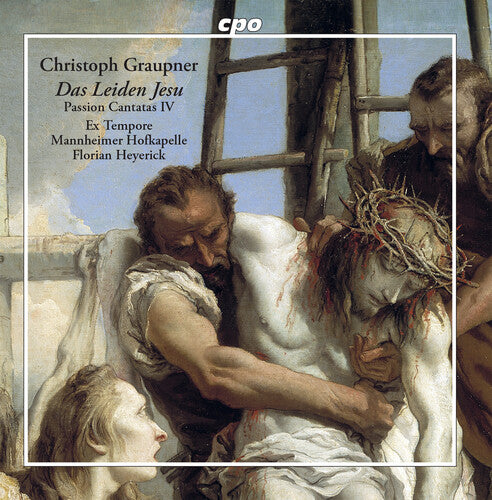
Christoph Graupner: Das Leiden Jesu - Passion Cantatas IV
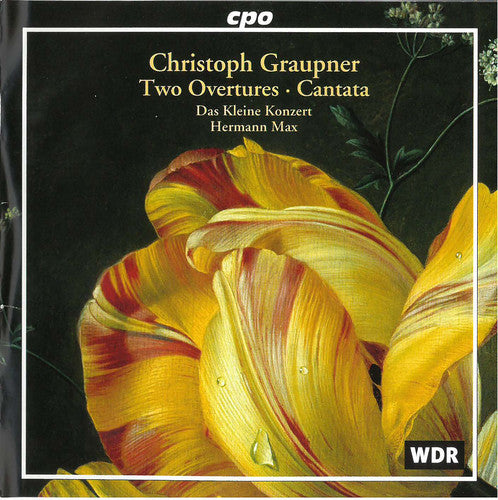
Graupner: Two Overtures Gwv 418 & Gwv 466, Cantata / Max, Das Kleine Konzert
Graupner: Das Leiden Jesu - Passion Cantatas III
Graupner: Wo gehet Jesus hin
GRAUPNER, C.: Instrumental and Vocal Music, Vol. 1 (Ensemble
GRAUPNER: Instrumental and Vocal Music, Vol. 2
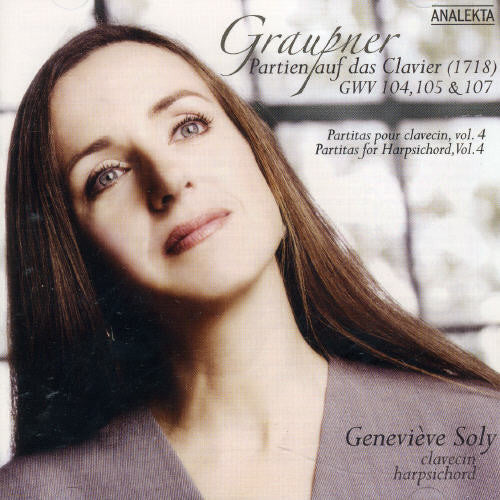
GRAUPNER, C.: Partitas, Vol. 4 - GWV 104, 105 and 107
GRAUPNER: Instrumental and Vocal Music, Vol. 3
Concerti d'amore: Telemann, Graupner & Vivaldi
GRAUPNER, C.: Partitas, Vol. 2 - GWV 102, 108 and 141
Christoph Graupner: The Seven Words Of Christ On The Cross
Graupner: Orchestral Suites / Kaakinen-pilch, Finnish Baroque Orchestra
Graupner's total surviving output comprises some 2,000 separate works, including ten operas, a hundred symphonies, a thousand cantatas, 85 orchestral suites and 44 concertos. A significant part of his orchestral output consists of concertos and suites with diverse, sometimes very curious instruments in the solo ensembles.
Among the rarer solo instruments he favoured were the flûte d'amour, a flute pitched a third lower than the normal transverse flute, and the viola d'amore, an instrument roughly the same size and shape as a viola but with resonating free strings in addition to the (usually) seven strings played with the bow. Combining the traverso and hunting horn in the same concerto, or the viola d'amore and the chalumeau, was extremely exceptional for the period.
What is significant in Graupner's music is his exceptional command of melody and harmony, which do not really resemble those of any of his contemporaries.
Christoph Graupner: Trio Sonatas
Graupner: Antiochus und Stratonica / Boston Early Music Festival Orchestra
Spectacular Baroque Opera with the BEMF. The prizewinning Boston Early Music Festival, joined by the choicest soloists, once again presents a spectacular Baroque opera discovery with Christoph Graupner’s Antiochus and Stratonica. Graupner composed the musical play L’Amore Ammalato, Die kranckende Liebe, oder: Antiochus und Stratonica during his time as the harpsichordist at the Gänsemarkt Opera in Hamburg. The core subject of the opera is the love of the Seleucid prince Antiochus for his stepmother Stratonica. This match brings with it highly dramatic moments as well as deeply sad ones inasmuch as Antiochus is supposed to have an incurable illness – but then at the end three old and new romantic couples appear on the stage and everything comes to a happy ending. Graupner’s opulent orchestral ensemble, which prescribes three recorders and four oboes in addition to strings and a large continuo apparatus, offers the most highly nuanced tonal manifoldness – and during his later decades as the Darmstadt court chapel master the composer would continue to expand this element.
Graupner: Bassoon Cantatas / Heyerick, Kirchheimer BachConsort
Spirited Bassoon Cantatas. During the eighteenth century the knowledge that the bassoon could very well rise up to the virtuosic spheres was reserved for only rather small circles of hearers. After all, the employment of this instrument depended directly on the particular musician’s capabilities in playing technique. In April 1736 a new bassoon star in the person of Johann Christian Klotsch came from Zerbst to Darmstadt. Christoph Graupner must have been extremely delighted to work with this talented musician; Klotsch had only recently been under contract in Darmstadt when he was given multiple opportunities to demonstrate his bassoonist’s skill in the Sunday cantatas. Since Graupner loved to experiment with innovative tone colors, he increasingly placed the bassoon in the spotlight in his cantatas. This development reached its height in 1741 with bassoon parts of concerto character in sixteen different cantatas. Sergio Azzolini is currently a star of today’s Baroque scene. When he plays his bassoon, the music is brought to life, and on this album with vocal soloists and the Kirchheim BachConsort he has “revived” (in the truest sense of the term) church cantatas with obbligato bassoon by Graupner. Sergio Azzolini comments: “The Baroque bassoon is fragile. And this fits this music because the music too is fragile. The Baroque bassoon is one part, and the player has to do the rest, that is, our body. For this reason we are also very close to the singer. And I believe that Graupner understood that, and it was precisely this that he celebrated.”
Graupner: Passion Cantatas II / Heyerick, Ex Tempore, Mannheim Hofkapelle
“Graupner holds in store music of the highest artistic sophistication. Flawless vocal achievements and an orchestra that savors all the color nuances of Graupner’s carefully thought-out instrumentation make these Passion cantatas a genuine listening feast.” This is what klassik-heute.com wrote after the release of cpo’s Vol. 1 featuring cantatas by Christoph Graupner. Vol. 2 now follows, just in time for Passiontide. Once again the instrumentation is manifold in its design, and it is here too that we find the key to Graupner’s personal style: he captivates his listeners not so much with catchy, easy-to-remember »melodies« as with intensive play with the tone colors made available to him by the court chapel members and their instruments. For example, while the Cantata for the Third Sunday in Lent exclusively employs stringed instruments, for the Cantata of the Annunciation of Mary Graupner chooses a clearly more colorful instrumentation by additionally using two transverse flutes and two oboes opposing each other as pairs in the opening chorus. The instrumentation of the Bass Aria No. 5 in the cantata exhibits special finesse. Along with the pair of transverse flutes, the first violin part is given an original design: it has tones held for an entire measure in the lowest register on the lowest string, while the two flutes insistently repeat their syncopated motion. This recording is new proof that Graupner was indeed the most independent-minded and individual and composer of the German Baroque.
Graupner: Gott der Herr ist Sonne und Schild / Kaakinen-Pilch
The uncommonly productive Christoph Graupner composed the five Epiphany cantatas selected for this recording between 1730 and December 1753, when he was no longer practicing the art of opera composition. The words were written by his brother-in-law, the Darmstadt pastor and superintendent Johann Conrad Lichtenberg. Lichtenberg was an extremely voluminous writer who turned out some 1500 cantata texts between 1719 and 1743, all imaginatively set to music by Graupner. The choice of cantatas for this recording was governed by two guiding principles: the subject matter of the Epiphany period, and their remarkable instrumentation, which exemplifies the wide range of timbres in Graupner’s music. Particularly in the arias he succeeded in displaying the musical potential of the instruments without neglecting the human voice. Founded by Kominik Worner in 2008, the Kirchheim BachConsort consists of leading musicians from the early music scene who appear in solo formations to study and perform programmes of 18th century music.
Christoph Graupner: Frohlocke Gantzes Rund Der Erden - Bass Cantatas
Like Telemann, Christoph Graupner (1683-1760) was a universal spirit and a highly original, independent composer, undeserving of his relative obscurity. This selection of his bass cantatas is free of baroque overloading, extreme figurations or colorations in the vocal part, and evidences his assimilation of musical innovations through to the end of his creative career. The bass baritone Klaus Mertens, holds a "prominent position among German singers in the field of early music." (klassik-heute).
Graupner: Christmas Cantatas / Max, Das Kleine Konzert
One of the most remarkable things about German composers of the 17th and 18th centuries is the size of their oeuvre. One wonders where they found the time to compose so many works, considering the general slowness of life. It took days to travel from one part of Germany to another, and weeks to go from Germany abroad. Writing a composition by hand, copying parts for all performers, teaching, rehearsing - it is just amazing how much work they had to do. And in addition, there was an insatiable demand for music which they had to satisfy. This is also the main reason they composed so much.
Take Christoph Graupner: the number of his cantatas is estimated at about 1400! He had to deliver a cantata for every Sunday, plus all feastdays, plus special events like the birthday of his employer. And then there was the instrumental music, both chamber and orchestral music, which was played as entertainment. Reusing old material was no option: music which was more than 10 years old was considered old-fashioned. As Graupner worked in Darmstadt from 1709 until his death there was no material his employer hadn't heard before.
But by good fortune he had some assistance. From 1713 to 1738 the cantatas for the first and third Christmas days - one of the busiest periods of the year - were written by his assistant chapel master, Gottfried Grünewald. The second Christmas day was also the birthday of his employer, so the music for that day, which had to be particularly festive, was written by Graupner himself. He also composed the music for New Year, and the following Sundays, including Epiphany and Candlemas.
Four of the five cantatas on this disc date from the 1740s. Graupner used texts which were provided by his brother-in-law, the theologian Johann Conrad Lichtenberg, who for a number of years wrote a cycle of cantata texts every year. The cantatas consist of a sequence of recitatives, arias and chorales, but the texture varies.
Frohlocke, werte Christenheit, begins with a chorus on a free poetic text. This is followed by two pairs of recitative and aria, for bass and soprano respectively, and closes with a harmonisation of two stanzas from the old hymn 'Ein Kind geborn zu Bethlehem'. The vocal parts are embedded in lively orchestral figurations which is typical of Graupner's treatment of chorales. This practice has its roots in the 17th century, and was often used by composers like Johann Kuhnau and Johann Ludwig Bach.
Der Herr hat mich gehabt im Anfang and Das Licht scheinet in der Finsternis both begin with a dictum, a quotation from the Bible. The former has a recitative for bass and a duet for alto and tenor, who mostly sing in parallel motion, which is only broken at the end. The duet is followed by a recitative and an aria for tenor, and closes with a stanza from Luther's hymn 'Gelobet seist du, Jesu Christ'.
The latter also contains a duet, this time for tenor and bass. There is a strong contrast in the vocal and instrumental parts between section A and section B, reflecting the juxtaposition of light and darkness in the text. The preceding recitative for bass is a perfect example of Graupner's effective treatment of the text.
Das Licht des Lebens scheinet hell opens with an accompanied recitative for bass, who then sings an aria. This is followed by a chorale - a stanza from 'Ermuntre dich, mein schwacher Geist'. Then the soprano sings a recitative and an aria, and the alto has a recitative which ends in an accompagnato at the last line. The cantata ends with another stanza from 'Ermuntre dich'.
The last cantata of this disc, Von Gott will ich nicht lassen, is the only one which dates from the period that Grünewald was active. It was written for the second Sunday after Epiphany, 18 January 1728. But during the winter season 1727/28 Grünewald was ill. Because of that he wasn't able to compose, and Graupner had to write all cantatas himself. As Grünewald also participated in the performances as a bass, Graupner omitted bass parts in his cantatas. This shows that at that time cantatas were performed with one voice per part, which is also practised in this recording. This particular cantata is the only one from this period that has a bass part. One may conclude that Graupner temporarily had a bass at his disposal, but probably a not very experienced one as he only participates in the three chorale settings.
These are three stanzas from the hymn 'Von Gott will ich nicht lassen' (1563). The cantata opens with the first stanza, which is followed by a recitative for the tenor, who then sings a duet with the alto which is an eloquent expression of the text: "Jesus provides. Now away, you cares!" This is followed by another stanza from the hymn. Next are a recitative and an aria for soprano. In the latter she is accompanied by a trio of two oboes and bassoon which are joined by the strings in the ritornelli. The cantata closes with another stanza from the hymn 'Von Gott will ich nicht lassen'.
During his career Graupner has developed a musical language of his own, which is not comparable with anything written in his time. His compositions are certainly not easy-listening stuff as recent recordings of his instrumental oeuvre show. Of his vocal music very little has been performed and recorded as yet. There is hardly a better way to get to know his vocal oeuvre than with this disc.
These five cantatas are varied in scoring and offer a number of beautiful arias and duets. It is particularly advisable to pay attention to the way Graupner uses the instruments to express the Affekte of the texts. Things could hardly be better. The four soloists are completely congenial and their voices blend perfectly, as the chorale settings show. The individual performances of the singers are also excellent; the delivery is immaculate thanks to good diction and pronunciation. The instrumental parts are engagingly given by the members of Das Kleine Konzert.
The booklet contains extensive programme notes and all the lyrics have an English translation. In tracks the lines are printed in the wrong order.
-- Johan van Veen, MusicWeb International
Graupner: Easter Cantatas / Bonath, Pulchra Musica Baroque Orchestra
In 1711 Christoph Graupner was already appointed court conductor and he would continue to work in Darmstadt for the rest of his life. Graupner’s focus shifted to sacred vocal music, which explains the sheer abundance of the 1,400-plus cantatas he composed. In 1723 the Leipzig city magistrates were looking for a new cantor at the Thomas School – and wanted him, above all. Alas, Graupner’s patron did not release him from his contract an so they had to hire Bach. Graupner, famous and widely celebrated during his lifetime, was soon thereafter forgotten. As we rediscover and hear more and more of his works, however, the judgment of his contemporaries would appear to us as increasingly germane. The present recording spans the liturgical arc from Maundy Thursday via Good Friday and Easter Sunday to Easter Monday and presents one liturgical work for each of the festive days – and each of them a world premiere recording!
REVIEW:
As one might expect, even though the accompaniment is limited to strings, the emotional content of the words, appropriate for the season, are reflected in Graupner’s progressive music. The text is never obscured, and he takes great pains to insure that rhythmic and textural variations are done gracefully. The performance by the Pulchra Musica ensemble is quite exact, with good intonation and a sense of style that allows for the variety of the music to emerge easily. Conductor Christian Bonath keeps things moving along, and the chorus Capella Vocalis works well. Sebastian Hübner’s tenor and Johannes Hill’s bass have the lightness of sound and flexibility for this sort of music, and the richness of countertenor Jan Jerlitschka complements them well. My only concern is that the one-on-a-part strings are perhaps too thin, and there are times when the orchestral accompaniment fades almost into obscurity. The recording of these sensitive and lyrical cantatas would have been enhanced by a thicker orchestral texture. But that being said, the performances are well worth adding to the growing collection of this master of the Baroque church cantata.
-- Fanfare