Christoph Graupner
30 products
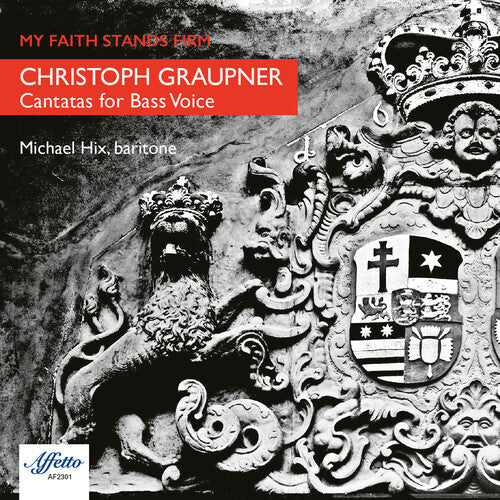
Graupner: My Faith Stands Firm - Cantatas for Bass Voice / Hix
Very often discussions regarding the composer Christoph Graupner (1683-1760) places him in comparison with J.S. Bach. If one has heard of Graupner, it is usually the bit of trivia that he was offered the Leipzig Thomaskirche cantor position before Bach. Of particular interest, however, is the vastness of extant material Graupner composed. There are scores for over 1,400 of Graupner’s church cantatas. Forty-seven of these are for solo bass voice with a variety of instrumental pairings. One can assume that the majority of these works were written for the bass (and composer) Gottfried Grünewald (1665-1739), whom Graupner knew in Leipzig and with whom he worked at the opera in Hamburg. Grünewald served as the vice-capellmeister in Darmstadt under Graupner from 1713 until his death. In addition to the forty-seven solo bass cantatas, Graupner also wrote seventeen duet cantatas for soprano and bass. Alongside the staggering number of cantatas, Graupner composed a wealth of instrumental music including keyboard works, more than 100 sinfonias, and a canon with 5,626 inversions.
The sheer volume of this relatively unexplored repertoire is thrilling but also overwhelming, making categorization of Graupner’s overall musical style problematic. This recording, featuring cantatas and instrumental works composed between 1720 and 1745, offers the listener an introduction to Gaupner and an important, if small, piece in the larger puzzle that is Graupner’s life and work. It premieres Graupner to a wider music world largely ignorant of this talented and nearly unknown Baroque composer by baritone Michael Hix, Chair of the Department of Music at the University of New Mexico, praised by critics for his “expressive voice” and “commanding stage presence”, and whose research has brought Christoph Graupner to light through this album.
Graupner: Overture, Trio, Sinfonia / Rampe, Nova Stravaganza
Includes work(s) by Joh Christoph Graupner. Ensemble: Nova Stravaganza. Conductor: Siegbert Rampe.
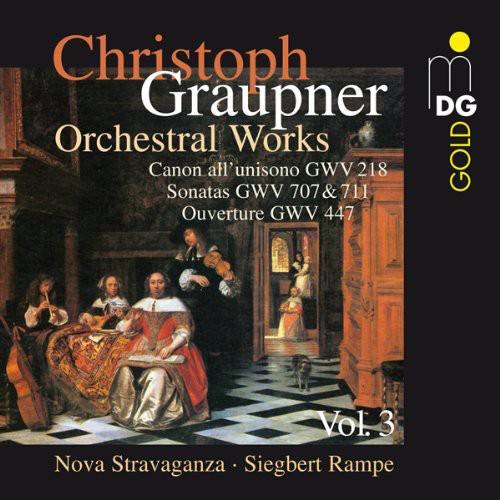
Graupner: Orchestral Works Vol. 3 / Rampe, Nova Stravaganza
To commemorate the 250th anniversary of the composer’s death, Nova Stravaganza present the recording premiere of some of the few chamber works by Graupner and perform on historical instruments.
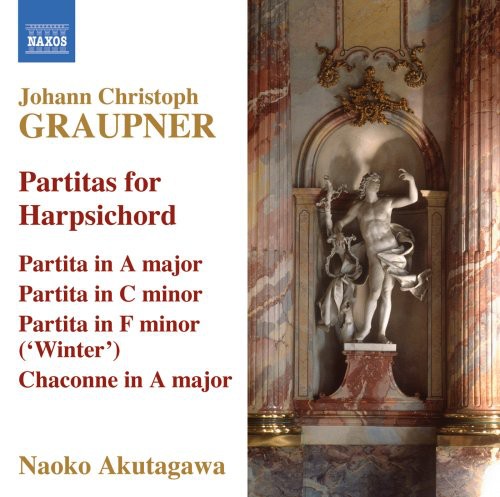
Graupner: Harpsichord Partitas / Naoko Akutagawa
Not long ago Christoph Graupner was little more than a name. He was mainly known for being one of the applicants for the position of Thomaskantor in Leipzig in succession to Johann Kuhnau. He was second on the town council’s list, and when the first, Georg Philipp Telemann, was not available after all, they turned to Graupner. His employer, the Landgrave of Hessen-Darmstadt, didn't want to let him go, and therefore Leipzig had to settle for - as it was called - 'mediocrity' in the person of Johann Sebastian Bach.
Some of Graupner's music has been recorded in the past, but it is only since the beginning of this century that some musicians have started to focus strongly on his oeuvre. The German conductor and keyboard player Siegbert Rampe recorded two discs of orchestral and chamber music with his ensemble Nova Stravaganza (MDG), and the Canadian harpsichordist Geneviève Soly is recording Graupner's keyboard music (Analekta). In his programme notes, Glen Wilson - himself a renowned harpsichordist and the former teacher of Naoko Akutagawa - refers to Graupner's "sterling reputation as a performer". A part of Graupner's keyboard music was published during his lifetime, but this disc mainly contains pieces which were never printed. And Wilson may be right in suggesting that the virtuosity of these pieces is such that they were mainly written for Graupner's own use.
The works here are called 'Partita' which is one of the terms used in Germany for a suite of dance movements. The standard structure of the suite was a sequence of allemande, courante, sarabande and gigue. But - like other composers - Graupner adapted the structure when he wanted. And so the Partita in A, which opens this disc, begins with a preludium, the sarabande - with double - is followed by a menuet and an aria with five variations, before closing with a gigue. Or rather, it does on this disc: it really ends with a Chaconne which is played later. The Partita in c minor doesn't have a gigue at all; again it opens with a praeludium, and after the sarabande we find a menuet and another aria with variations. The disc ends with a Partita which was the first of a series of Partitas which was planned to be published as 'The Four Seasons', but only this Partita, called 'Winter', has come down to us. It is not known whether Graupner for some reason didn't continue with this series or whether the other pieces have been lost. This work also starts with a praeludium, followed by allemande and courante, three menuets, an 'air en sarabande' and is closed with a 'bourrée en rondeau'.
As with many composers in Germany Graupner, both in his keyboard works and his orchestral music, is a representative of the 'mixed taste', a combination of French and Italian elements. The preludes are especially interesting because of their almost improvisatory nature. All of them are in two sections: the preludes of the Partitas in C minor and F minor begin with a slow section, followed by a fast second section. The prelude of the Partita in A is in fact a prelude and fugue, and bears the traces of the 'stylus phantasticus' which was a feature of the North-German organ school. Graupner is more interested in counterpoint than some of his contemporaries. This shows the influence of his teacher, Johann Kuhnau, who thoroughly instructed him in counterpoint.
Naoko Akutagawa shows her impressive technical skills in this programme of pieces which are often very virtuosic. That is not only the case in the preludes, which are played with the appropriate touch of improvisation, but also in the large Chaconne - probably one of the longest in the 18th century. It is another bow to tradition in that it is a passacaille bass but slightly extended. It was originally part of the Partita in A which opens this disc, but played here independently. Ms Akutagawa plays it brilliantly with an intensity which never fades. Other highlights are the air with variations which ends the Partita in C minor and the three menuets from the Partita in F minor. She has a very good sense of the rhythm of the dance movements: listen, for instance, to the courante from the Partita in A. Only the menuets of the Partitas in A and in C minor could have been played with a little more elegance; Ms Akutagawa's performance is a bit too robust to my taste.
I mentioned some highlights in this recording, but in fact that is hardly necessary as this disc is captivating from beginning to end. If you are sceptical about the quality of a composer whose name hardly ever appears on the concert programmes of keyboard players, just purchase this disc. I am sure it will convince you that Graupner was a great composer whose name deserves to be mentioned in one breath with the likes of Telemann, Fasch, and - indeed - Johann Sebastian Bach. And it wouldn't surprise me at all if you end up looking for more. Thanks to Naoko Akutagawa and her wonderful recording.
-- Johan van Veen, MusicWeb International