Clara Schumann
10 products
-
-
-
-
-
C. Schumann: Piano Music, Vol. 2
$19.99CDGrand Piano
Jan 16, 2026GP931 -
-
-
-
-
-
-
-
Clara & Robert Schumann: Piano Concertos / Rana, Nézet-Séguin, Chamber Orchestra of Europe
Beatrice Rana combines Clara Wieck-Schumann and Robert Schumann's piano concertos with the Chamber Orchestra of Europe under conductor Yannick Nézet-Séguin In an interview with the New York Times, Rana, who called the piano concerto by Clara Wieck "a genius work in many ways," said: "I think that it's very, very underestimated - the intellectual value of this concerto in the history of music. It's fascinating to see that she conceived of this music free from any limitations; that as a teenager she composed an uninterrupted concerto with no breaks between the movements. We think of Liszt's First Piano Concerto as revolutionary in that regard, but Clara wrote hers so much earlier, unbroken and with connecting themes linking the movements."
Romances / Pahud, Le Sage
Flautist Emmanuel Pahud and pianist Eric Le Sage play arrangements of short pieces and songs by four German composers of the mid-19th century: Robert Schumann and his wife Clara (born Clara Wieck), and Felix Mendelssohn and his sister Fanny.
Major composers of the earlier Romantic period somewhat neglected the flute as a solo instrument, even though there were a number of virtuoso players and the flute was popular with amateurs. The fact is that the instrument presented technical difficulties in terms of consistency of timbre and intonation; these were not satisfactorily resolved until 1847, when Theobald Boehm, a German manufacturer of wind instruments, produced the revolutionary prototype of the modern flute. The album comprises: Robert Schumann's three Romances op 94 - originally written for oboe and transcribed for flute in the 1950s by Jean-Pierre Rampal - and his three Fantasiestücke op 73, originally conceived for clarinet; Clara Schumann's three Romances op 22, which she dedicated to the great violinist Joseph Joachim; arrangements of six lieder by Fanny Mendelssohn, and the sonata in F that Felix Mendelssohn composed as a violin work in 1838.
C. Schumann: Piano Music, Vol. 2
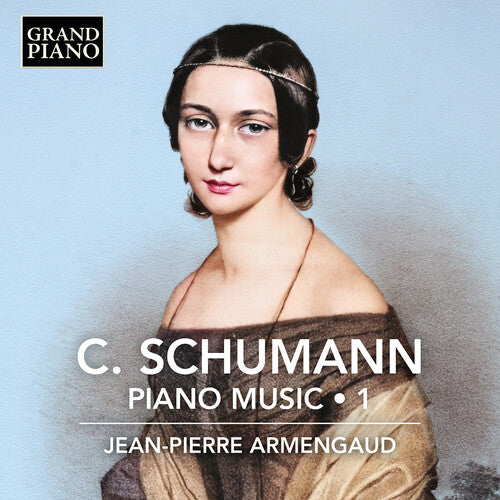
Schumann: Piano Music, Vol. 1
Schumann: Works for Cello & Piano
We find ourselves in a crucial year, 1849. At that time, the Schumanns opted for a rural retreat due to the tension in Dresden, where they resided at that moment—a city that was the center of notable revolutionary episodes during the uprising that occurred there, with its epicenter in May of that year. Precisely in that fruitful year, Robert Schumann tackled several chamber works that seem to be written in a relaxed atmosphere, in a very short time, without excessive formal nor constructive ambition, but with the stamp of his high melodic and harmonic inspiration. There is a certain common denominator among them, which we could call a certain lack of instrumental definition - pieces for oboe and piano, or for horn and piano, or for clarinet and piano - but in which the “melodic” role, as indicated in the score, can be transferred to other instruments with similar “singable” capacity, either to the same woodwind family or even to the string family (violin, cello). In short, it’s about “singing without text”; they are authentic “songs without words.”
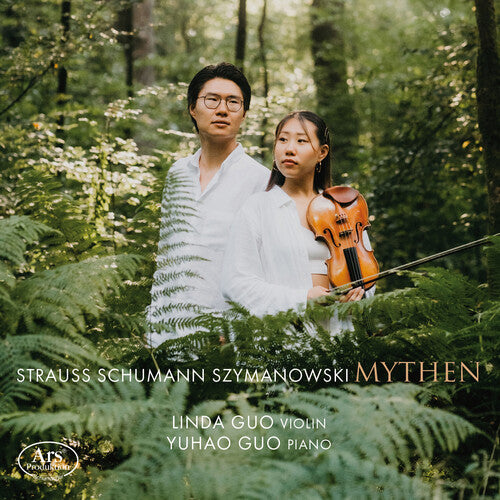
Schumann, Strauss & Szymanowski: Mythen / Linda Guo, Yuhao Guo
This CD brings together works by three outstanding composers of the 19th and 20th centuries, each of whom interprets the connection between violin and piano in a unique compositional way. The Violin Sonata Op. 18 by Richard Strauss transports you into a world of melodic beauty and harmonic unity between the two instruments. Strauss, known for his symphonic poems and operas, shows here his masterly ability to combine the virtuosity of the violin with pianistic brilliance. Clara Schumann's Three Romances for Violin and Piano Op. 22 reveal a tender and expressive connection between the instruments. A remarkable pianist and composer of the 19th century, Clara Schumann here demonstrates her masterful ability to bring the violin and piano together in an intimate union. The Myths Op. 30 by the Polish composer Karol Szymanowski unfold as fascinating musical tales from Greek mythology. Here the violin becomes the storyteller, while the piano sensitively accompanies the dramatic and expressive aspects of the myths. The two instruments blend into a mysterious and colourful overall sound. In each of these compositions it becomes clear how both instruments together unfold an extraordinary expressive power. Whether it is melodic beauty, tender expressions or dramatic narratives, these works show the timeless fascination and unique connection between violin and piano.
C. Schumann & Weber: Piano Concertos
Introducing the latest recording with Luisa Imorde and the Bremer Philharmoniker, featuring two great romantic Piano Concertos from Clara Schumann and Carl Maria von Weber. Following the success of her previous albums dedicated to Beethoven/Wölfl, Bach/Kapustin, and Couperin/Messiaen, the pianist now presents her latest recording that explores the romantic repertoire with orchestra. This album features two Piano Concertos that beautifully capture the essence of the romantic era, complemented by solo piano pieces by Robert and Clara Schumann and C.M. von Weber. Weber's departure from the classical to the romantic era and Schumann's legacy as a female composer bear witness to the mastery of both in Luisa Imorde's outstanding interpretation.
C. W. Schumann: Piano Concerto, Trio / Nicolosi, Et Al
Clara & Robert Schumann (with works by Brahms & Ernst) / S. Wang, F. Glemser
Florian Glemser asks...are Robert Schumann’s late works the product of a household where two married composers, one physically and mentally declining and the other refusing to admit that reality, were living in a stuffy atmosphere? Or was their Düsseldorf circle a fruitful terrain that gave rise to magnificent masterpieces because close, talented friends and family members – Robert, Clara Wieck Schumann, Albert Dietrich, Johannes Brahms, and Joseph Joachim – continually inspired one another?
"For this recording, Sophie [Wang] and I have chosen a program that attempts to answer those questions. All the chamber music works on this album are from the period between 1849 and 1854, thus stemming from the Schumanns’ time in Düsseldorf. The personal and musical connections between Robert, Clara, Johannes Brahms, and Joseph Joachim are intrinsically present in all these works. Those biographical relationships are interesting for us as interpreters because they give rise to special moods we can sense in the music. We want to fathom them, to feel them, and to make them palpable for the listener: this is one of the most exciting projects we have ever undertaken as performers.”
C. Schumann: Piano Music / Yoshiko Iwai
With great resolution, Clara Schumann continued performing and supported her family while serving as guardian of her husband's legacy. Understandably, most of her few compositions are early efforts, and they sound like the work of a talented student influenced by Robert Schumann.
One of the most outstanding is the touching set of variations on a Schumann theme she gave her husband as a birthday gift shortly before his collapse. Pianist Yoshiko Iwai presents a powerful argument for the variations and is evocative in the shorter pieces, all well recorded by Naxos.