Frank Bridge
28 products
Bridge: Oration & Phantasm
Bridge: Piano Music, Vol. 3
Frank Bridge: The Complete Music for Cello & Piano
Bridge: Piano Music, Vol. 1
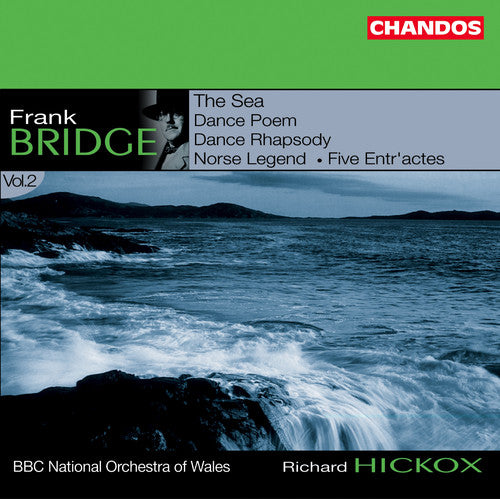
Bridge: Orchestral Works Vol 2 - The Sea, Dance Poem, Etc / Hickox, Bbc Wales
Volume 2 of Chandos' enterprising Bridge edition makes a better overall impression than did Volume 1, though on the whole it has similar virtues and vices. First, let's say categorically that it's wonderful to have this music (especially the Dance Poem and Dance Rhapsody, which are both terrific pieces) readily available in what are basically very good performances. Richard Hickox elicits some beautiful playing from the orchestra (the opening chord of The Sea positively glows with inner light), but his casual approach to rhythm and accent robs the music of some of its vibrancy. For example, in The Sea he's a minute slower than Groves' classic EMI account in the first movement, though he whips up a satisfyingly stormy finale, and the BBC National Orchestra of Wales has greater polish (if perhaps less timbral character) than Groves' Liverpool band. Also, both "dance" works benefit from plenty of natural momentum that keeps them buoyant, which is more than can be said for the early tone poems included in this series' first release. Chandos' sonics, which are lovely but soft-edged, add to the overall smooth impression; more prominent percussion would have injected a welcome touch of extra energy. But these are not serious faults, and the music is so attractive that on this basis alone many will find this disc to be self-recommending. [11/1/2002]--David Hurwitz, ClassicsToday.com
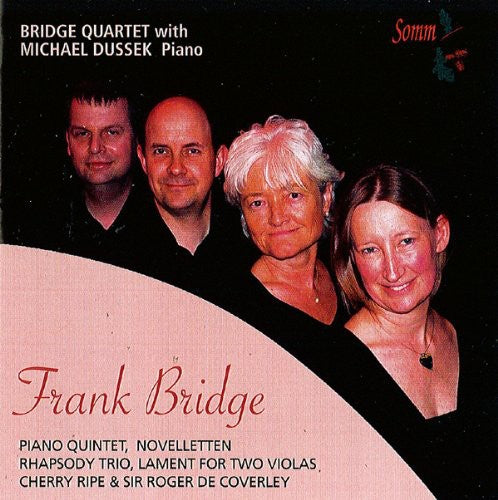
Frank Bridge: Chamber Music
Bridge: Orchestral Works
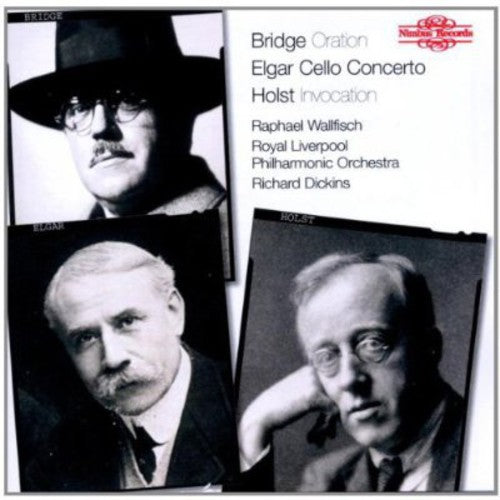
Bridge, F.: Oration, Concerto Elegiaco / Elgar, E.: Cello Co
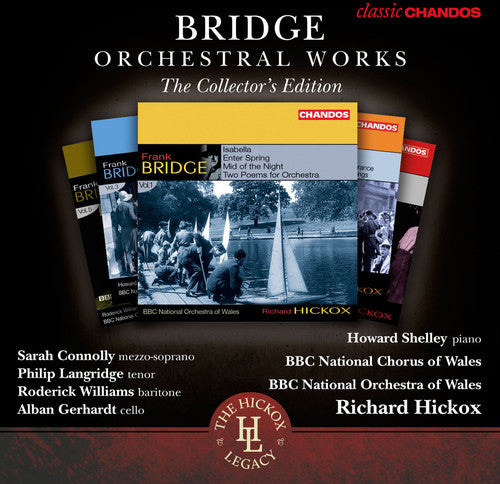
Bridge: Orchestral Works - The Collector's Edition
If, like me, you’re a little selective concerning which music by Bridge you really like, you couldn’t find a better advocate than Richard Hickox on this 6-CD set.
– Editor, MusicWeb International
This splendidly conceived, presented and executed Chandos series treats Bridge with authoritative style and sensitive musicianship. In this it matches Chandos banner series for Grainger, Schmidt, Enescu, Glazunov, Bax and Harty. Bridge’s music is getting to the stage where it will no longer need special pleading. The series appeared in an unhurried way – no gabble, no exploitative rush. Nothing wrong with that if the results are as good as this. Taking time can produce a better effect even if the loyal enthusiasts were chafing for each new release.
- Rob Barnett, MusicWeb International
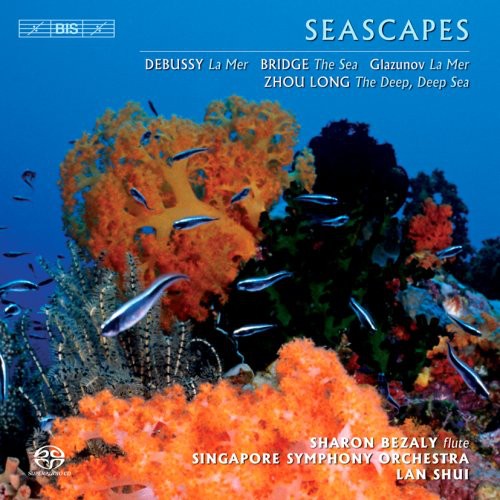
Seascapes - Debussy, Zhou Long, Bridge, Glazunov
The sea and Singapore are inextricably bound together - indeed, the first records of a settlement here give it the Javanese name Temasek ('sea town'). Ever since, these islands have provided a base for traders and fishermen, pirates and sailors. With the arrival of the British East India Company in 1819 Singapore quickly developed into one of the most important trading hubs of Asia and, indeed, the world. And although the patterns and methods of world trade and transport have changed, the sea still permeates the daily life of Singaporeans. This also applies to Lan Shui and the Singapore Symphony Orchestra, who on this disc perform four works inspired by the sea by composers as varied as Debussy, Glazunov, Frank Bridge and Zhou Long (b. 1953). The latter was the subject of Rhymes, the orchestra's previous and highly praised disc, of which web site Classics Today wrote: 'Zhou's is a personal, distinctive voice; and his beautifully crafted music achieves a remarkable synthesis of Western and Eastern musical traditions with musically rewarding results.' The reviewer at BBC Music Magazine agreed, calling the result 'utterly compulsive' with the addition: 'Here is orchestral playing of the highest calibre.' Zhou Long's The Deep, Deep Sea has as its title a quotation from Tang dynasty poet Li Bai, and was written for flautist Sharon Bezaly who performs it here. If the sea in Zhou Long's piece is an Asian one, Glazunov used a visit to Crimea and the Black Sea for his inspiration, adding a good pinch of Wagnerism to its not very salty water. Debussy and Bridge on the other hand most probably had the same sea in mind when they composed their works: Debussy finished his La Mer while visiting England in 1904, staying in Eastbourne on the south coast, and Frank Bridge (1879-1949) was born and grew up in Brighton, some thirty kilometres further west.
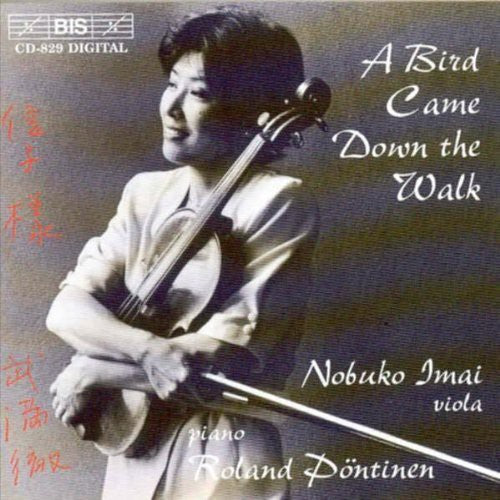
A Bird Came Down The Walk / Nobuko Imai, Roland Pöntinen
American Record Guide (11-12/97, pp.245-46) - "...A viola recital disc that is free of `violin envy'! Here we are treated to melancholy moods and dark, mysterious tone colors that are alien to the sound world of the violin....Imai is very adept at projecting the searching romanticiism of the Wieniawski and the ardent longing of the Liszt....Imai and Pöntinen are masters of their instruments and have developed a real rapport..."
Earth, Sea, Air - British Music for Cello & Orchestra
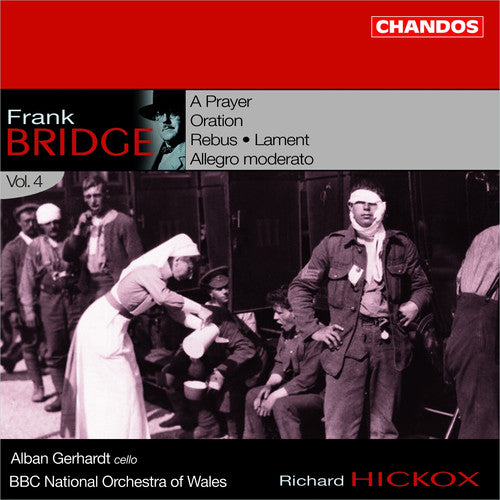
Bridge: Orchestral Works, Vol. 4 / BBC National Orchestra of Wales
Music for Viola & Piano by Schumann, Sibelius et al. / Piva, Filistovich
On this unique and originally programmed journey, the violist Massimo Piva takes the kind of fantasy journey (Fantasiereise) that forms one of the cornerstones of German Romanticism. It is in the context of highly wrought, fantastic tales that Schumann’s style is formed from a literary point of view: Hoffmann's short stories and Jean Paul's novels, inhabited by bizarre characters and surreal situations, are his polar stars. On the musical side, he had an 18th-century heritage of fantasies by composers such as Mozart or C.P.E. Bach to draw upon, in which the notion of the fantasy is still linked to the Baroque idea of improvisation.
This is the background to the Marchenbilder Op.113, which Schumann worked on feverishly in March 1851. As a masterpiece in his late style, the collection shivers with obsession and fevered dreams. Placing them side by side illuminates the degree to which Reinecke was inspired by Schumann’s example in his own Fantasiestucke Op.43. But this recital moves on into less familiar territory, where the viola’s personality as a melancholy guide takes us to repertoire by Vieuxtemps (an F minor Elegy), Wieniawski (Rêverie in F sharp minor) and Sibelius (Rondo in D minor) by composers much better known for their prowess as violinists, and as violinst-composers.
The recital reaches a natural chronological end with the pre-eminent poet of the viola in the early decades of the 20th century, Frank Bridge. No violist he, but inspired by the artistry of Lionel Tertis, Bridge came to write a good deal for the instrument such as the Two Pieces featured here, and found its mellow, soulful voice a natural fit for his own as a composer. As a former member of the Lucerne Festival Orchestra and Orchestra Mozart, Massimo Piva worked extensively with the conductor Claudio Abbado. As a member of the Quartetto Prometeo he has performed both modern and classic repertoire across Europe, working with composers including Sciarrino and Fedele, and recorded the complete works for string quartet by Hugo Wolf on Brilliant Classics (94166).
Bridge, Grime, Erod & Ginastera: Eros / Mithras Trio
Winner of the Trondheim International Chamber Music Competition (2019) and BBC Radio 3 New Generation Artists (2021–2023), Mithras Trio has gained recognition as one of the most engaging young piano trios. Its debut recording on Linn is a stimulating programme of works by Bridge, Grime, Eröd and Ginastera. Titled Eros, it invites several associations with the Greek god of love: the allure of the female form is heard in Helen Grime’s sparkling Three Whistler Miniatures, as is the beautiful maiden in Alberto Ginastera’s Danza de la moza donosa. Frank Bridge’s Phantasie Trio drips with hyperromantic indulgence, while Iván Eröd’s Piano Trio No. 1, a nod to the title, is a work that marries Haydn and post-Bartók Hungarian folk influence, with some French Impressionist harmonies and no small element of jazz!
Clarke, R. Schumann et al: Bridges - Music for Viola & Piano / Kim, Iermachkova
The South Korean Suhyun Kim (viola) studies concert performance at the Hochschule für Musik und Darstellende Kunst Frankfurt am Main, the Ukrainian Ievgeniia Iermachkova (piano) is a lecturer at the International Music Academy Anton Rubinstein in Düsseldorf.
BRIDGE: Pensiero exhibits that brooding melancholy mood characteristic of the composer's chamber music. The Allegro appassionato is dominated in its frame sections by a moment of rousing energy and rapturous sonority, which contrast with a nostalgic-sounding middle section.
ENESCU: His concert piece for viola and piano was written in 1906 for a competition. It is a lyrical rhapsody whose viola part, however, demands virtuoso skills from the player - Enescu himself had been a violinist (and pianist) prodigy. The one-movement work mixes elements of French impressionism with those of Romanian folklore.
R. SCHUMANN: Schumann composed the two-part work for "pianoforte and horn", published in July 1849 as Adagio and Allegro op. 70 by Friedrich Kistner in Leipzig, but already there he left the option of a version with "ad libitum violoncello or violin" as an alternative.
CLARKE: Rebecca Clarke is today considered one of the most important British composers of the interwar period. Trained as a violinist and especially as a violist - she was a pupil of Lionel Tertis, the most important violist of his era - she was one of the first women to be appointed to a professional orchestra, the Queen's Hall Orchestra, which opened the "Proms" concert series. She submitted her three-movement Sonata for Viola and Piano, written in 1919, to the composition competition in Berkeley for the "Coolidge International Prize" and won second prize among a large number of competitors, although it was probably only the unusual circumstance that she was a woman that led to the first prize being awarded to the composer Ernest Bloch.
Bridge, Britten & Debussy: Cello Sonatas / Mørk, Gimse
The great Norwegian cellist Truls Mørk makes a triumphal return to chamber music with his regular piano partner Håvard Gimse. The program features two English composers, Benjamin Britten and his teacher Frank Bridge, whose Cello Sonata was written during the First World War and is tinged with despair and searing emotional force. Britten composed his Cello Sonata in 1961, following his meeting with Mstislav Rostropovich, to whom he dedicated the work. Another person traumatized by the Great War was Debussy, who wrote: ‘It was cowardly to think only of the horrors being committed, without trying to react by rebuilding, insofar as my strength allowed, a little of that beauty which is currently under attack.’ His Cello Sonata (1915) was the first of a series of six sonatas for various instruments that he planned to compose, only managing to write three before his death. As a determined Moravian nationalist, Janácek did not entitle his three-movement work of 1910 ‘sonata’; he called it Pohádka (Fairy tale) and based it on a poem by Vasily Zhukovsky.
REVIEW:
What one notices from the very start of the Bridge sonata, with which the disc begins, is Mørk’s fulsome tone. He is partnered very well throughout by Gimse and the recorded sound is really present, upfront, so much so that it is best to lower the volume for a realistic perspective. That said, I have found much to like in these accounts.
This is an excellently programmed disc, admirably performed and well recorded. It should provide plenty of pleasure. Alpha are also to be commended for their cardboard product with sleeves for inserting both CD and booklet.
-- MusicWeb International
Four of the 20th century’s greatest works for cello and piano: three of them famously recorded back in the 1960s by Rostropovich and Britten – a hard act to follow. Yet the Norwegian duo, Truls Mørk and Håvard Gimse, rise fully to the challenge in close yet lucid recorded sound that achieves an exemplary balance between cello and piano. Marginally less juicy of tone and idiosyncratic of phrasing than Rostropovich, Mørk brings a classical poise and eloquence to his phrasing and a marvellous sensitivity to detail, while Gimse is fully alive to the very different styles of piano writing in these four works.
The qualities of the new recording are especially favourable to Frank Bridge’s big two-movement Sonata – composed athwart the outbreak of the First World War, which horrified him – where the old recording suffered from slightly cloudy piano sound. As Mørk soars through the fraught lyricism of its first half, one hears clearly how Bridge subtly inflected even the most seemingly conventional piano figuration with his own individuality. And if the new recording of Debussy’s war-time Sonata is less dark and rhapsodic than the Rostropovich-Britten, it exemplifies the more enduring characteristics of French culture he sought to uphold.
The fugitive flights of melody and figuration comprising the three whimsical movements of Janáček’s Pohádka (Fairy Tales) demand a glancing, mercurial response which they certainly receive here, while the Britten Sonata somehow emerges as a weightier, more substantial work than in the original recording by its dedicatee and composer – special though that will always remain.
-- BBC Music Magazine
The Piano Music Of Frank Bridge Vol 2 / Mark Bebbington
BRIDGE A Fairy Tale Suite. In Autumn. Miniature Pastorals, Set 1. Étude rhapsodique. Graziella. Dramatic Fantasia. 3 Pieces. A Sea Idyll. Miniature Suite. Characteristic Pieces • Mark Bebbington (pn) • SOMM 82 (77:26)
I wonder when Frank Bridge was first led astray by Scriabin, forsaking the Lisztian bravado of the Dramatic Fantasia for the dark, sensuous tendrils of Graziella and the lascivious impressionism of the Characteristic Pieces. Mark Bebbington’s second volume of Bridge piano works stresses the later achievements, from 1917 on, leading up to and away from the big Piano Sonata of 1924. Ravel is a strong presence in the Fairy Tale Suite and elsewhere, but the themes, early and late, are all Bridge, and mostly memorable.
Whatever its roots, whether outrage at the Great War or more personal passions, the best of these miniatures are very good indeed, and demand the very best players. The works, like the Sonata, are simply not well enough known yet, and they need a broader performing tradition. I hope Russian pianists start to pick up on In Autumn, Graziella , and the other late works. Bebbington, like Ashley Wass and Kathryn Stott, has gone far beyond the “mere” technical problems, which are not small, and the competing Bridge cycles complement each other. If you are going to get just one, then I’d go with Wass on Naxos, whose piano I also just prefer in the upper octaves. But Bebbington conveys most of Bridge’s range, and he’s especially good in the mini- Dante Sonata , which is the Fantasia, and in the 1921 Miniature Suite , with its Prokofievisms.
Ideally, I’d like to hear a hypersensitive Slavic Scriabin interpreter have a tilt at Graziella and “Water Nymphs” from the Characteristic Pieces. But all the pianists I’m thinking of are dead. Maybe Tharaud for “Fragrance” and “Bitter Sweet” from the same Ravelian late set. As you’ll gather, the serious competition for Bebbington and Wass is imaginary. The recommendation is real enough, though. Some of the music in this volume is more British and interesting than it is moving, but more than half of it is top-notch. Wass edges it for feel and expressive range, but Bebbington’s runs, trills, graded dynamics, and sweep are no disappointment.
FANFARE: Paul Ingram
Bridge: Works For String Quartet / Maggini Quartet
You may realize that my opening gambit is also the title of Anthony Payne’s succinct but very useful book on Bridge (Thames, London, 1994) emphasising the extraordinary change that came over his style approximately by the end of the First War. What is curious is that although he was never a strongly English composer in a pastoral sense, having always had a foot in the French and indeed in the Germanic, Romantic camps, after the war he became even more influenced by developments in Germany and central Europe. By time of the 3rd String Quartet (1925) you feel that Bridge has been feeding on a surfeit of Zemlinsky, Schoenberg’s 2nd Quartet and certainly Alban Berg with whom he seems to have had a very special affinity. He appears to all intents and purposes to be a completely different composer from the one we encounter here, who arranges ‘Sally in our Alley’ and ‘Londonderry Air’. And yet … and yet, there are moments in these early pieces, and this disc is totally devoted to his first phase, when one feels that the seeds of his later style are beginning to form. As Payne remarks “From the outset of his career Bridge had possessed an exceptionally enquiring mind and was alert to new developments of style and language”.
Many collectors will know that Naxos have recorded with Maggini Quartet two discs of Bridge’s Quartets Numbers 2 and 4 (8.557283) and 1 and 3 (8.557269). This disc of mostly slighter pieces was brought out in the mid-1990s at the time Anthony Payne prepared the new edition of his book. It has, I believe, been re-launched to fit with a complete Bridge String Quartets project.
It seems odd that during the very darkest days of World War I, Bridge was writing little arrangements of folk-songs for the parlour. As I have said, after the war he took on another hue, but before it we have several of these charming works which constitute a major part of his chamber music. I’ve no doubt that he was able to make a little money on them, but we should not overlook how well they are put together - composed in fact. For example in the ‘Londonderry Air’ the tune only gradually emerges. I was reminded of Bridge’s most important pupil Benjamin Britten whose ‘Lachrymae’ only exposes Dowland’s famous theme at the end. I wonder if that’s where Britten got the idea? ‘Sir Roger de Coverley’ has an extended counter-subject towards the end of ‘Auld Lang Syne’ to fight with. In ‘Sally in our Alley’ we hear the melody only in a fragmentary state before it finally appears at the end of its four minutes of clever counterpoint.
The three ‘Novelletten’ recall in their title Schumann and indeed are suitably miniature. These works foreshadow the Bridge of later years especially in the regular shifts of tonality in the first movement and in the chromatics of parts of the second. Sometimes Debussian harmonies also creep across the horizon.
It is, I suspect, these first three works (Phantasy Quartet, ‘Novelletten’ and ‘Three Idylls’) that make the disc particularly valuable.
There are three works by Bridge with the title ‘Phantasie’. The idea was that of W.W Cobbett who wanted contemporary composers to revive the Elizabethan Phantasy or Fantasy form and who put up a substantial prize for a competition. In Bridge’s case it stimulated an all-important approach to form which lived with him all of his life. As well as this quartet, his first attempt, we have the Phantasie Piano Trio which is quite a long work of 1907. It won the Cobbett prize. Then there’s the Phantasie Piano Quartet of 1910. I heard a rare performance of the trio recently at the Lake District Summer Music Festival played wonderfully by very young performers. For me it is the finest of the three, however the Magginis make out the best case for the Quartet that I have ever heard. It is in three fairly equal sections which should follow without a break although they are separately tracked on the CD. It starts with a bold Baxian gesture, followed by a March tune. By the finale the music has metamorphosed into a lighter mood. To me it lacks the necessary Phantasy elements, the continuous contrapuntal development which Cobbett really expected and which Bridge was so successfully to achieve in the other two works.
The ‘Three Idylls’ are often dark and intense but also very lyrical. Here Ravel is suggested especially the String Quartet. These are most attractive little pieces, three in all, which should be much better known.
The final work on the disc is the world premiere recording of ‘Three Pieces’ which I have to say are there mainly for those with a ‘completist’ sensibility.
This disc then is a fine supplement to the Maggini’s Bridge cycle. It seems to me that the players are in complete accord with the style and needs of the composer. They have, after all been living with this music for practically a decade. They throw another light on the composer. It all adds to the burgeoning view that he has been much neglected and that he ranks surely alongside his contemporary Holst as one of the finest British composers of the first half of the twentieth century.
-- Gary Higginson, MusicWeb International
Bridge: String Quartets No 3 & 4, Piano Trio No 2, Etc
Includes work(s) by Frank Bridge. Ensemble: Allegri String Quartet.
Bridge: String Quartets No 2 & 4 / Maggini Quartet
Bridge: String Quartets No 1 & 3 / Maggini Quartet
This album was nominated for the 2005 Grammy Award for "Best Chamber Music Performance."
Bridge: Piano Trio No 2, Phantasie Trio, Miniatures / Wass, Liebeck, Chaushian
BRIDGE Piano Trios: No. 1, “Phantasie”; No. 2. Miniatures: Set 1; Set 2; Set 3 • Ashley Wass (pn); Jack Liebeck (vn); Alexander Chaushian (vc) • NAXOS 8.570792 (72:47)
The half-hour Bridge Second Trio (1929) is one of the best things he ever wrote, some of the very strongest British chamber music of its time, along with Bridge’s own last two quartets. The opening is unforgettably bleak, and a ripe expressionist drama unfolds. It is not as “advanced” as the music Webern and Schoenberg were writing 20 years earlier, yet at the same time it almost prefigures Shostakovich. Sound here is very good, and the playing has great commitment, concentration, and fleetness of foot. But the very stiff competition includes a live 1963 version with Britten, Menuhin, and Gendron, as well as a fine, cheap Helios disc.
Compared to the Trio No. 2, the rest of the CD offers salon music. The “Phantasie” Trio is much like the other Cobbett Prize-winning pieces by various composers, and it sounds faded to my ears, though these players give it everything. The Miniatures are slight character studies in late-19th century style, but they may be the disc’s main selling point for Bridge collectors. The Dussek Trio’s 1995 version is good, but these Naxos players make a strong case for the Miniatures , and the sound is better. This performance of the Second Trio won’t disappoint you either, if you get the Naxos disc for the other repertoire; though if you already have the Lyrita or Helios recordings, rest easy. If you have no Bridge Second Trio, do get the Britten version on BBC, even if you buy none of the other CDs. The new disc is highly recommended to admirers of the composer—two different composers, really, early and late, as this CD vividly demonstrates.
FANFARE: Paul Ingram
Bridge: Piano Sonata, Pensées Fugitives, Etc / Ashley Wass
BRIDGE Piano Sonata. Lament for Catherine. Improvisations for Piano Left Hand. Sketches. Moderato. Pensées fugitives I. Scherzettino • Ashley Wass (pn) • NAXOS 8.557921 (67: 49)
Ashley Wass’s Bax recordings on the Naxos label have been almost universally welcomed (and rightly so). The present disc is actually the second volume of piano music by Frank Bridge on this enterprising label. In taking on the Piano Sonata, Wass also takes on Mark Bebbington on Somm, but his playing is of such strength that in reality one need not look elsewhere.
There is much that is granitic about the first movement of the sonata (composed between 1921 and 1924). This is music of huge contrasts and of harmonic ambiguities. Wass has no problems with either end of the expressive scale, projecting the more forceful passages with real power and the more intimate ones with real emotional maturity. His playing is fluent, and he possesses a right leg that is not overly glued to the sustaining pedal, to his credit. More, he can project the sense of vastness that characterizes the first movement well. The foreboding undercurrents of this quarter-hour movement are a musical outcome, perhaps, of the revulsion the composer felt to the First World War. Wass does not hide from the fact that this is fundamentally unsettling music, even imparting a late Lisztian mystic slant to the closing pages. The second movement, marked Andante ben moderato , begins with a real pianissimo (balance levels are such that it registers as such without one having to sprint to the volume button to hear it). Here the music revels in its own twilight, occasionally glinting (the passages around the five-minute mark) before the trials and tribulations return in the form of the troubled finale. Technical considerations really do take the back seat—Wass instead grips our attention by leading us through this dark thicket. At 35 minutes, this sonata is a major undertaking, and Wass emerges triumphant. The atmospheres he conjures up in the slow movement linger in the memory long after the music has stopped. Considering the overall strife of the sonata, by the way, it seems surprising that Naxos has chosen such a carefree painting to adorn the front cover of the disc ( The Little Faun by Charles Simms).
The Lament for Catherine was designed as a memorial for a casualty of the sinking of the Lusitania . Apparently it was composed within the space of a single day (June 14, 1915). Marked Adagio, con molto espressione , it seems entirely apposite after the sonata, almost like a brief, five-minute Requiem (the string orchestra version of this piece has attained somewhat greater currency). Wass gives it a doleful yet somehow affectionate reading. Dating from only three years later, the Three Improvisations was written for Douglas Fox, who had lost his right hand in the War. Two out of the three improvisations continue the mood of mourning; only the third and briefest of the set, called “A Revel,” really lets in any light at all.
The Three Sketches of 1906 are titled “April,” “Rosemary,” and “Valse capricieuse,” respectively. Andrew Burn, in his excellent liner notes, refers to them as “superior examples of Edwardian salon character pieces,” and I really cannot improve on this description. Wass plays with great warmth without for a second descending into schmalz . “Rosemary” is the highlight, exquisitely fragranced; the final piece is pure nostalgia.
Finally, three small pieces from 1902–03 round off the disc. The Moderato is rather workaday as a piece of music, while the Andante moderato is atmospheric in its loneliness. A nice idea to finish with a quicker work, the Scherzettino , Bridge’s answer to Mendelssohn. Again, it is superbly played.
Michael Ponder’s recording, made at Saint George’s, Brandon Hill, Bristol, U.K., is admirably clear. It is close, but not claustrophobically so, and given the intensity of much of the sonata and the dark mood of other pieces on this disc, this makes a lot of sense.
FANFARE: Colin Clarke
Bridge: Piano Music / Ashley Wass
Includes work(s) for pno by Frank Bridge. Soloist: Ashley Wass.