Friedrich Kuhlau
30 products
Kuhlau: Fantaisies & Divertissements for Solo Flute
Friedrich Kuhlau: The Piano Sonatinas
WORKS FOR FLUTE & PIANO
Kuhlau: Violin Sonatas
Duos Op. 102, Trio Op. 119
Variations & Divertimenti Vol.
Complete Sonatas For Flute And
Trois Grands Trios Op. 86
Early Works For 1, 2 & 3 Flute
Works For 3 And 4 Flutes
Trios For Flute, Cello And Pia
Complete Flute Quintets
Lulu
Variations & Divertimenti, Vol
Kuhlau: Rondeau d'une folie
Weber, C.M. Von: Flute Trio, Op. 63 / Ries, F.: Flute Sonata
Kuhlau: Grandes Sonates, Op. 71 & 83
Kuhlau & Schubert: In a Magic Hour / Luck, Linton-France
The album “In einer Zauberstunde” (In a Magic Hour) by the Australian-born flutist Xavier Luck and his compatriot Daniel Linton-France focuses on works for flute and piano that have been inspired by Lied or opera. The center piece is the Introduction and Variations on “Trockne Blumen” from Die schöne Müllerin, D 802, by Franz Schubert. This is contrasted by the Introduction and Variations on a theme from Carl Maria von Weber’s “Euryanthe” for Flute and Piano, Op. 63 by Friedrich Kuhlau, which was composed in the same year.
A contemporary take on this subject are the Fantasy on a theme by Franz Schubert (“Du bist die Ruh’”) and the eponymous “In einer Zauberstunde” by Daniel Linton-France, which are presented as world premiere recordings. The latter work was prompted by Xavier Luck and is a virtuoso work which picks up various themes and motifs from W.A. Mozarts “Zauberflöte”, from which the titel is derived. As concluding piece we find another Lied by Schubert, “Des Baches Wiegenlied”, once again from his song cycle Die schöne Müllerin, in an arrangement for flute and piano by Anton Diabelli.
Kuhlau: Piano Sonatinas Op 55 & 88 / Jeno Jandó
This release marks another disc in the lengthening series of Kuhlau’s compositions on Naxos.
Kuhlau, born in 1786 to a musician with the German Army, began his musical education in Lüneburg with piano, and also began to compose at that time. Around 1800 he studied with C. F. G. Schwenke, the man who succeeded C. P. E. Bach in the position as Hamburg Stadtkantor. By 1804, Kuhlau was in the process of launching his career as a pianist in earnest. Blind in one eye since childhood, Kuhlau fled to Copenhagen under an alias to avoid mandatory military service; his half-blindness evidently did not compel the authorities to exempt him. He eventually became a naturalised citizen of Denmark and established his base there for the rest of his life.
Known to this reviewer primarily for his compositions for flute — various discs have been released recently of his flute sonatas and trios on Naxos and other labels. Kuhlau also produced a number of other pieces, primarily for chamber ensembles.
The works on offer on the present disc are short and charming, with most movements lasting no longer than three minutes. Jandó does right, I think, in keeping the performances simple and straightforward. The object of these pieces is not to impress or give a listener a good deal of food for thought. These are meant primarily to entertain. They are likely to be familiar to piano students worldwide. There isn’t much here that would surprise the listener, but there are a few moments of particular interest, such as the unexpected similarity of the opening movement of the Sonatina in A minor, Op. 88 No. 3 to Beethoven’s 1810 Für Elise. Another standout is the opening Allegro maestoso of the Op. 55 No. 6 Sonatina in C which, with its length of just over seven minutes, allows for a bit more mulling over of its thematic material.
The recording aesthetic for this disc is just what one would expect from Naxos: warm ambience without losing presence or definition. Jandó gives these pieces a clean and clear performance. Quite a pleasant disc for casual listening.
-- David Blomenberg, MusicWeb International
Kuhlau: Piano Sonatas Op 59 & 20 / Jeno Jandó
KUHLAU Piano Sonatas, op. 59: in A; in F; in C. Sonatinas, op. 20: in C; in G; in F • Jen? Jandó (pn) • NAXOS 8.570709 (59:07)
Ill-fated Friedrich Kuhlau (1786–1832) suffered a number of life’s mishaps. The first, at age seven, was the loss of his right eye in a street accident. The second, many years later, was the loss of all his unpublished manuscripts in a fire that burned his house to the ground. But perhaps the greatest misfortune of all to befall him was Beethoven, or, more specifically, to have been born and lived in Beethoven’s shadow. Born in Germany, Kuhlau fled to Copenhagen in 1810 to avoid conscription in the Napoleonic Army. What? No 4-F exemptions for one-eyed musicians? He remained in Denmark for the rest of his life, never gaining much traction as a composer except for his Danish opera, Elverhøj ( Elf Mound ). He did, however, achieve some recognition as a concert pianist; as a great admirer of Beethoven, Kuhlau introduced a number of Beethoven’s works to Copenhagen audiences. Of Kuhlau’s manuscripts that escaped the flames and made it to publication, there are approximately 200, consisting mainly of chamber works, solo piano pieces, and enough pieces for flute to have earned him the nickname “the Beethoven of the flute.”
Kuhlau is said to have been most heavily influenced by Beethoven, and as one listens to these sonatas and sonatinas, it’s clear that he had at least the more superficial aspects of Beethoven’s early style down pat. I’m speaking here of the keyboard figurations, the harmonic progressions, and the gestural articulation. A perfect example is the Adagio e sostenuto movement of the G-Major Sonatina, op. 20/2. But here the comparison ends. Kuhlau is but a dinghy caught in the wake of an aircraft carrier. Had he lived 25 years earlier, these mostly slight works might have been seen as a significant advance in keyboard style, but he didn’t; and this is what I meant above when I said that Kuhlau’s greatest misfortune was to have been born and lived in the shadow of Beethoven. Consider that the op. 20 sonatinas on this disc are dated 1820; the op. 59 sonatas, 1824. By this late date, Beethoven was done with the piano sonata as a vehicle for expressing his musical ideas. The “Hammerklavier” and the three last sonatas were behind him.
The taxonomic division of the works on this disc into sonatas and sonatinas is a bit of a puzzler. Keith Anderson’s booklet note homes in on this very point, informing us that the three op. 59 works are often published as sonatinas rather than sonatas. The crux of the matter is that in musical lexicography a sonatina refers either to a small-scaled, modest sonata or, more properly, to a sonata-allegro movement without a development section. The op. 59 set on the disc does feature the requisite first-movement development sections to qualify as sonatas, but oddly, they are all relatively brief works and in only two movements. The op. 20 set, though called “sonatinas,” are all more extended three-movement works and, at least in one case—the F-Major—there is a short development section.
It is likely that most, if not all, of these pieces were written for students, as Kuhlau earned no small amount of his income teaching and publishing just such sonatas and sonatinas intended for young fingers. In a 2006 New York Times article I came across on the Internet (http: //www.nytimes.com/2006/07/02/arts/music/02holl.html), Bernard Holland acknowledges that “none of these sonatinas prepare the student for Beethoven at his most ornery,” and asks “Why play Kuhlau in the first place?” He answers his own question thus: “It is easy to dismiss this annoyingly perfect music as a product of mindless rote or a series of bad habits having outlived their time. But the sonatinas have their uses.” What they are, according to Holland, strike me as a bit misguided. “Really interesting composers like Haydn and Beethoven” he continues ( leaving Mozart and Schubert out of the equation —my italics), “violated the unwritten road maps with glee; but fully to understand the originality of the violators, it is nice to have a Kuhlau or a Muzio Clementi to show you just what is being violated.” Apart from the fact that the road maps of harmonic progression and sonata form were hardly unwritten by the late 18th century, what Holland seems to be saying is that Kuhlau’s only purpose is to provide us with a sextant by which to measure the degrees of deviation from true north practiced by the “really interesting composers.”
I have a rather different take on it. In the grander scheme of things, which we cannot know, it may be that neither Kuhlau nor any of the “really interesting composers” has any purpose at all, other than to afford us some pleasure and comfort while we wait to shuck off this mortal coil. Kuhlau is never less than harmonious, pleasing to the ear, attractive, and entertaining. As music, it’s a vacant sand lot, but one I’d rather trudge through than the barren dunes of some of what passes for music today.
Jen? Jandó is one of Naxos’s “house” pianists. He plays everything they throw at him smartly and stylishly. These pieces, of course, make no technical demands that a polished professional such as Jandó isn’t up to. The recording was made in 2007 with Jandó playing a modern grand piano. While recordings of Kuhlau’s keyboard works abound, the current CD appears to be the only one currently available containing these specific opus numbers. Buy, enjoy, and be happy.
FANFARE: Jerry Dubins
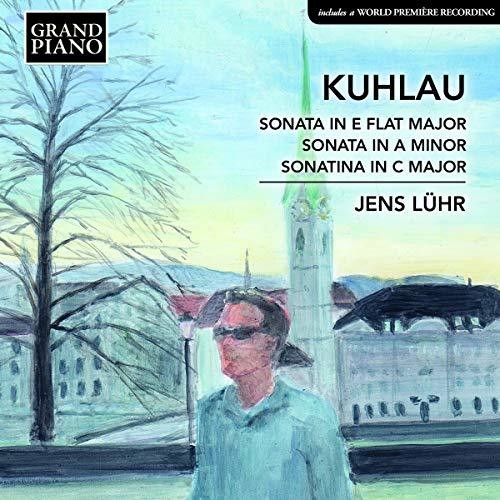
Kuhlau: Piano Sonatas / Luhr
Friederich Kuhlau was among the most important early Romantic composers in Denmark, becoming known as the ‘Danish Beethoven’ for his popular works for flute. The etude-like Piano Sonata, Op. 127 reveals a deep expressiveness reminiscent of Chopin’s studies, while the sophisticated Piano Sonata, Op. 8a shows Kuhlau’s contemplative, darker side before closing with typical virtuoso esprit. The charm and elegance of the Sonatina, Op. 21 No. 1 has delighted piano students for generations. Jens Luhr was born in the same town as Friedrich Kuhlau, Uelzen, in northern Germany. There at the local music school, Luhr played- along with many other young piano students- the Kuhlau Sonatinas. He went on to study at the prestigious conservatories of music in Hannover, Wurzburg, Basle, and Leipzig. Luhr is known as a soloist and chamber musician, as well as being an interpreter of contemporary music, playing or taking part in several premieres. In 2012 and 2014 he won second prize at the International Music Competition of France in the highest category for pianists.
Kuhlau: Piano Quartets 1 & 2 / Copenhagen Piano Quartet
Kuhlau: Flute Trios / European Flute Trio
Kuhlau is a composer whose name you might have heard, or whose music you might just have come across in one of those albums of teaching pieces. He came from a musical family in Germany, son and grandson of town and regimental musicians. He studied in Hamburg with a pupil of C.P.E. Bach.
In 1804, still in Hamburg, he started his career as a pianist. But in 1810 the city was invaded by Napoleon and Kuhlau avoided military service only because he was blind in one eye - the result of a childhood accident.
He fled to Copenhagen where he attempted to establish himself as a pianist and composer making his first appearance as a pianist at court in 1811. Naturalised in 1813, he received a court appointment, but this remained largely unpaid. He had some success with his singspiel Robber's Castle and made a name for himself as a pianist throughout Scandinavia. Joined in Scandinavia by his parents and sisters who were financially dependent on him; despite his successes, his life seems to have remained something of a financial struggle.
He visited Berlin, Leipzig and Vienna on occasions. In 1825 he managed to spend the evening with Beethoven and friends though the alcoholic haze meant that he had no strong recollections of this meeting.
In 1830 his parents died. The year after there was a serious fire at his house near Copenhagen and a large number of his unpublished compositions were destroyed. This seems to have had a deleterious effect on his health and he died in 1832.
His surviving body of music includes quite a bit of chamber music for flute; his Sonatas for Flute and Piano published in 1827, earned him the nickname 'the Beethoven of the Flute'. Kuhlau did not play the flute, but benefited from the advice of a flautist in the Copenhagen theatre orchestra. His flute pieces include duos, trios and quartets for unaccompanied flutes.
On this disc the European Flute Trio play five of Kuhlau's flute trios. The Grand Trio in B minor, op. 90 was published in 1828 and is the most virtuosic of all the pieces on the disc. The three trios op. 13, were published in 1815, and the Trio in E minor, op. 86 no. 1 was published in 1827.
Kuhlau wrote quite a bit of salon music and the salon is never very far away in these piece, no matter how classically and seriously they are constructed. The Grand Trio has a strong whiff of the virtuoso salon showpiece which was popular in the 19th century. The remaining trios are charming works, quite substantial in length. They were probably written for talented amateurs to play rather than as concert works.
The European Flute Trio (Antonio De Matola, Maxence Larrieu and Carlo de Matola) play these pieces as if to the manner born. They have no trouble at all with the virtuoso elements required and produce cascades of beautiful, liquid sounds. The three players balance nicely and create a good feeling of ensemble whilst remaining three distinct voices. Both De Matolas were pupils of Maxence Larrieu, which probably helps with the group's cohesion.
There were occasions when I thought that the recording was a little too close: we can hear slightly too much detail in the breath and beating in the flute tone. But this is a small point and does not prevent enjoyment.
Frankly, I was rather surprised at how much I enjoyed this disc. A whole CD of music for three unaccompanied flutes could be a little daunting. But Kuhlau's music has charm, lightness and strength of construction and this is brought out in these performances.
Do try the disc, you will hear some charming music and some superb flute playing.
-- Robert Hugill, MusicWeb International
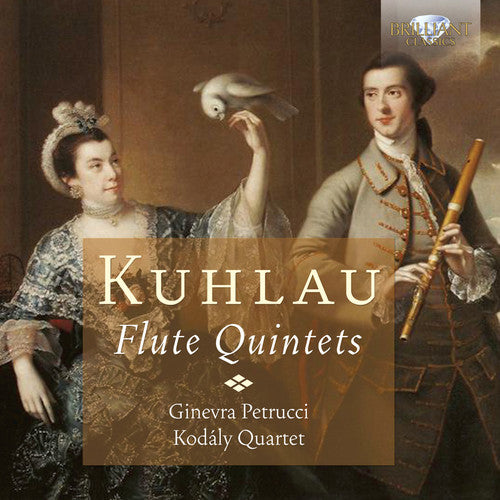
Kuhlau: Flute Quintets / Ginevra Petrucci, Kodaly Quartet
The unusual scoring of the flute quintets -- using flute, violin, two violas and a cello -- gives a great richness to the sound, due to the presence of the three lower-register instruments. The flute essentially takes the role of first violin rather than soloist, becoming an integral part of the structure and development of each of these elegant works. Flautist Ginevra Petrucci joins the internationally acclaimed Kodály Quartet for the recording.
Other information:
Recorded 27--29 December 2012, The Phoenix Studio, Budapest.
- Three delightful Flute Quintets by Friedrich Kuhlau, the "Beethoven of the flute", as his contemporaries called him.
- In 1828 Kuhlau met the great Beethoven, his lifelong inspiration and example. Though no composer can even think of imitating such a musical giant, Kuhlau's works contain certain Beethovenian features, such as structural strength, motivic development and a true expression of feeling.
- Excellent performances by Italian star flutist Ginevra Petrucci, and the internationally acclaimed Kodály Quartet.
- Contains liner notes on the works and performer biographies.
Kuhlau: Violin Sonatas, Vol. 1 / Astrand, Salo
The German composer Friedrich Kuhlau (1786-1832) fled to Denmark as a young man and with his strong cosmopolitan personality became a loner – and at the same time a key figure – in the Danish Golden Age. Kuhlau championed new tones in Danish music, and his melodically appealing violin sonatas were the first Danish sonatas in the Romantic style. With this recording Duo Åstrand/Salo lends new luster to music that has only rarely been performed in our time.