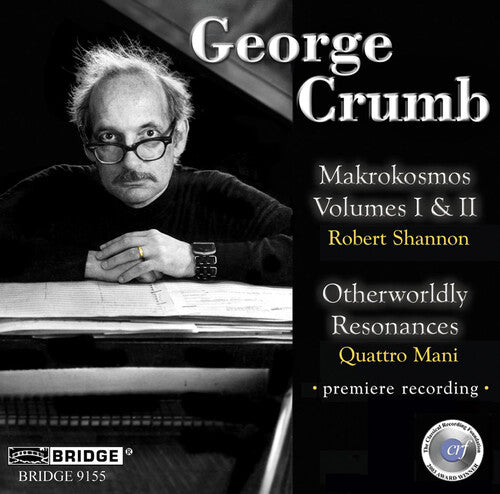
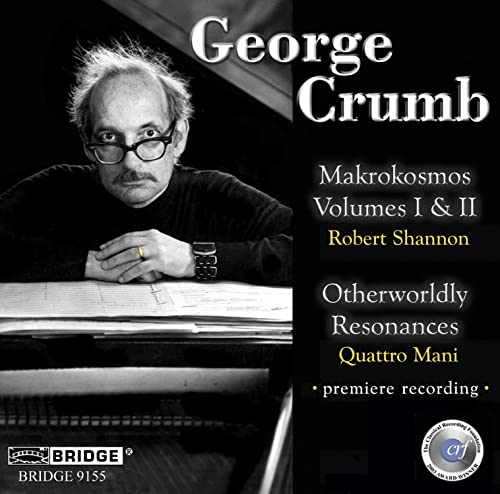
Complete Crumb Edition, Volume 8 George Crumb: Makrokosmos, Volumes I and II, for Amplified Piano (1972-73); Robert Shannon, piano; Otherworldly Resonances (2002), for Two Amplified Pianos (premiere recording), Quattro Mani
The latest volume in BRIDGE'S award-winning survey of George Crumb complete works presents a new recording of a major Crumb cycle and the premiere of a new composition for two pianos. Makrokosmos I and II have come to be regarded as landmark compositions in the piano repertoire, requiring the pianist to display a virtuoso's control of both the keyboard and the inside of the piano. In addition, the performer is asked to whistle, speak, and sing, while simultaneously playing some of the most dramatic and fantasy-filled piano music of the late twentieth century. Robert Shannon, a leading exponent of Crumb's music, gives the 67 minute cycle of 24 "zodiac" pieces a spectacular reading. The duo piano team, Quattro Mani, has also had a long association with Crumb's music, and can be heard playing Crumb's music on BRIDGE 9105, a disc that received ‘Best of Year' honors from Fanfare, and highest ratings from France's Repertoire, and the USA's ClassicsToday.com. In 2002, Crumb composed "Otherworldy Resonances", a 10 minute quasi-passacaglia for Quattro Mani. Based on a hypnotic four-note motif, this 10 minute composition marks Crumb's return to writing piano music after a hiatus of nearly 15 years. Both of these recordings, as with the rest of this series, were supervised by the composer.
R E V I E W S
Fanfare magazine Bridge’s essential Crumb series takes on one of the monuments in the composer’s canon with this release. The Makrokosmos I and II (1972–73) are two sets of 12 piano pieces each (based on the Zodiac), and are perhaps the definitive catalog of Crumb’s re-imagining of the instrument. All the trademark innovations of “extended techniques” are here, from rattling paper threaded through the strings, to interior pizzicatos, to glissando harmonics, to—well, the list just goes on and on. Every movement has surprises; each is a unique, mysterious landscape. There are also highly theatrical gestures, which involve the performer vocalizing with chants, whistles, shouts, whispers, and musically mimetic sounds. I’ll admit that while I believe Crumb is one of the most important American composers of the second half of the 20th century and the creator of some of the most beautiful and imaginative music of our time, these pieces remain somewhat problematic for me. At times, the desire to expand the expressive palette goes so far over the top as to verge on kitsch. This goes especially for the vocalizing, which can sound a little like the soundtrack of those live-action haunted houses that spring up on Halloween. Also, the music is so episodic that it can be hard to feel a formal motivation that is more than the astrological program.
That off my chest, I’ll say that for most of the time I can still sit back and enjoy Crumb’s fertile inventiveness, his desire to stretch boundaries and communicate directly, and the sheer sonic expansiveness of the whole set. One does have a sense of constant surprise and delight that an entire orchestra of colors is extracted from this single instrument. There’s also a genuine tenderness amidst the Grand Guignol moments, a nostalgia for the passage of past beauties (such as when a wisp of Chopin’s Fantasie-Impromptu suddenly emerges and submerges from the depths) that is strangely allied to that of another composer, Valentin Silvestrov. One more point to mention is that the second set seems much more focused and organic than the first. It seems to move faster, even though it is only four minutes shorter in this rendition.
Otherworldly Resonances (2002) is yet another of the wonderful pieces emerging from Crumb’s recent prolificity. His style hasn’t changed much at all—the techniques, the gestures, the melodic and harmonic formulas all remain similar to what they were two to three decades ago—but somehow the music has found a new calm and balance, and has become a little more abstract without losing any luster or poetry. Crumb, one of the most genuinely modest of great artists, would probably be the first to admit he’s not found something new after his great discoveries of the 1960s and 1970s. But that really doesn’t matter, because these new works are strong, individual, and memorable. In them, the composer seems able to accept who he is, and to share his gifts generously. This two-piano work is a compact epilogue to the grand cycles of Makrokosmos III (“Music for a Summer Evening”) and “Celestial Mechanics” (Makrokosmos IV), but extremely effective for its deliberately narrowed focus. A simple four-note ostinato is passed between the keyboards and surrounded with a constantly mutating garland of events—flashes of lightning, lullabies, delicate ornaments. The result is genuinely hypnotic. It should be simplistic, but instead it touches on something more profound.
All the performances are outstanding, but I must give special notice to Robert Shannon, who plays the Makrokosmos with a level of passion and authority that’s breathtaking. His precision and confidence in the inside-the-keyboard techniques makes this fiendishly difficult material sound quite natural, and will help future players codify the music’s performance practice and redefine virtuosity (and I say this with all respect and admiration for the pioneering premiere recordings of the works by their dedicatees, David Burge and Robert Miller; Shannon simply represents the next step of a new generation). His dazzling passagework in the fast sections reminds us how exciting fast Crumb can be, and that the composer is not all laid-back, glacial vistas.
In the end, an important release of enduring music. Where it bumps up against my aesthetic is probably more my issue than the music’s—it is a landmark of the literature, and I suspect it will be around for quite a while after I’m gone.
Robert Carl, FANFARE
{# optional: put hover video/second image here positioned absolute; inset:0 #}
Bridge Records
Complete Crumb Edition Vol 8 / Robert Shannon
Complete Crumb Edition, Volume 8 George Crumb: Makrokosmos, Volumes I and II, for Amplified Piano (1972-73); Robert Shannon, piano; Otherworldly Resonances (2002),...
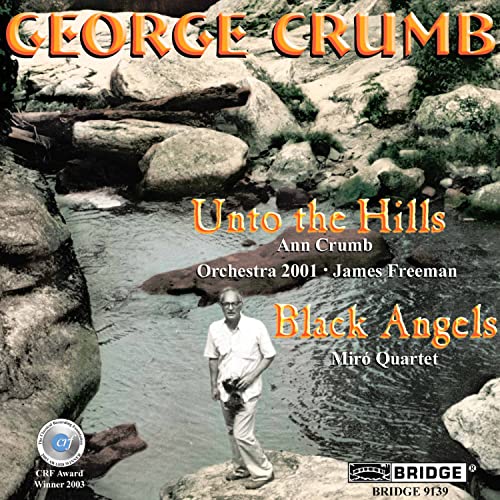
Complete Crumb Edition Vol 7 - Unto The Hills, Black Angels
Bridge Records
$18.99
December 30, 2003
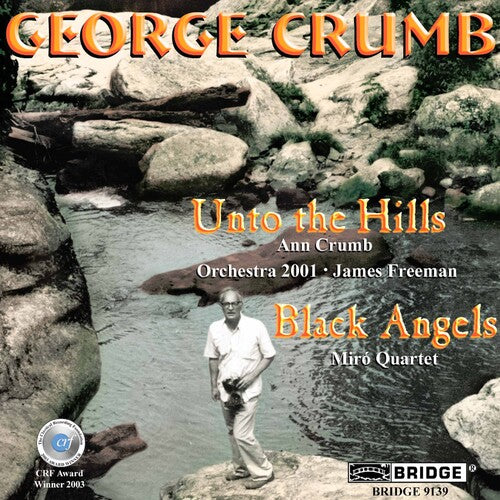
Complete Crumb Edition, Volume 7 Unto the Hills Black Angels Ann Crumb, soprano Marcantonio Barone, piano Orchestra 2001 James Freeman, conductor The Miró Quartet
Volume Seven of Bridge's Complete Crumb Edition features the world premiere recording of Crumb's new Appalachian folk song cycle, "Unto the Hills". Performed by Crumb's daughter, soprano Ann Crumb, and an ensemble of percussion quartet and amplified piano, the thirty-six minute cycle features spectacularly colorful (more than 75 percussion instruments) and moving renditions of such classic folk tunes as "Black, Black, Black is the Color", "Poor Wayfaring Stranger"," The Riddle", and "All the Pretty Little Horses". Also included on this CD is a stunning new reading of Crumb's classic "Black Angels" for Electric String Quartet. Performed by the brilliant, young Miró Quartet, this performance, supervised by the composer, features a combination of early 21st Century virtuosity and state of the art recording technology.
{# optional: put hover video/second image here positioned absolute; inset:0 #}
Bridge Records
Complete Crumb Edition Vol 7 - Unto The Hills, Black Angels
Complete Crumb Edition, Volume 7 Unto the Hills Black Angels Ann Crumb, soprano Marcantonio Barone, piano Orchestra 2001 James Freeman, conductor The...
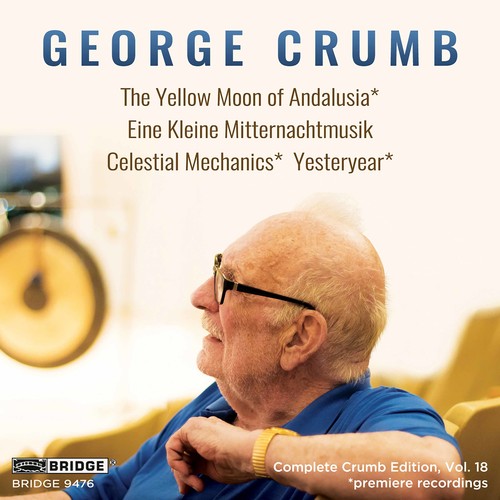
Volume 18 of Bridge's Complete Crumb Edition features premiere recordings of two recent works ("The Yellow Moon of Andalusia" and "Yesteryear") as well the premiere recording of the recently revised version of a Crumb classic, "Celestial Mechanics". Crumb returns to his favorite poet, Federico Garcia Lorca, for "The Yellow Moon of Andalusia", six settings of English translations of Lorca's work. The performance features the work's dedicatees, the brilliant American soprano Tony Arnold, and the superb pianist, Marcantonio Barone. Mr. Barone follows with Crumb's 'Thelonious Monk variations' for solo piano, "Eine Kleine Mitternachtmusik". Crumb was never satisfied with the ending of "Celestial Mechanics" and re-wrote it in 2012, recorded here for the first time. "Yesteryear" is a vocalise for soprano and three players, dedicated to Ms. Arnold. Pulitzer Prize and Grammy Award-winning composer George Crumb, now in his 88th year, continues to compose highly expressive, colorful and dramatic music. This new recording is a must-hear for all fans of a unique voice in contemporary music.
{# optional: put hover video/second image here positioned absolute; inset:0 #}
Bridge Records
Complete Crumb Edition, Vol. 18
Volume 18 of Bridge's Complete Crumb Edition features premiere recordings of two recent works ("The Yellow Moon of Andalusia" and "Yesteryear") as...
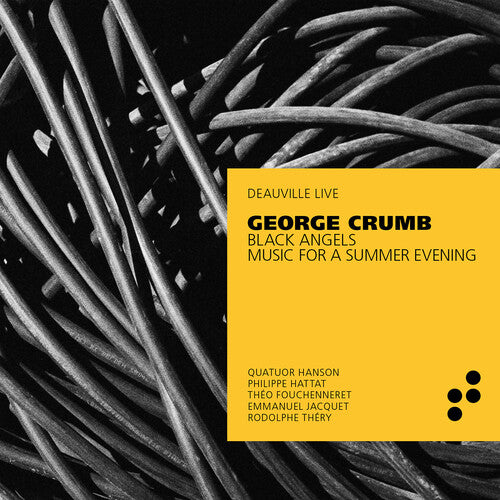
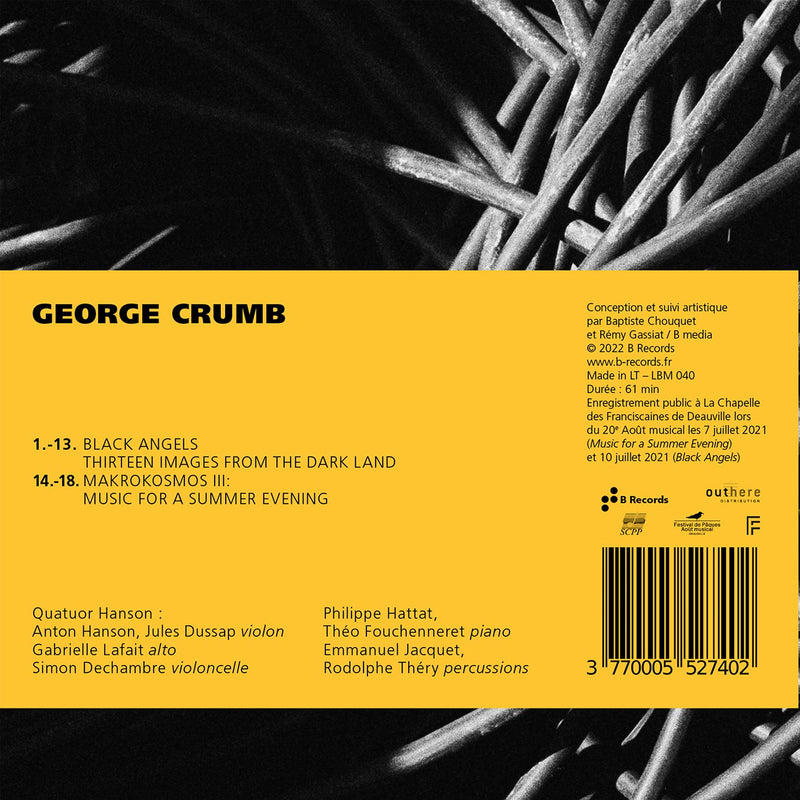
Crumb: Black Angels & Music for a Summer Evening / Quatuor Hanson
B Records
$20.99
May 13, 2022
This is ritual music filled with angels and demons, mystical incantations, amazing percussion and supernatural harmonies. The work of American composer George Crumb makes for a spectacular experience which remains etched in the memory of those who perform it as well as those who listen to it. With Black Angels and Music for a Summer Evening, B Records brings together on one album two great highlights of the Deauville Festival 2021, along with a whole host of renowned artists: pianists Théo Fouchenneret and Philippe Hattat; the members of Quatuor Hanson; and those of Trio Xenakis.
{# optional: put hover video/second image here positioned absolute; inset:0 #}
B Records
Crumb: Black Angels & Music for a Summer Evening / Quatuor Hanson
This is ritual music filled with angels and demons, mystical incantations, amazing percussion and supernatural harmonies. The work of American composer George...
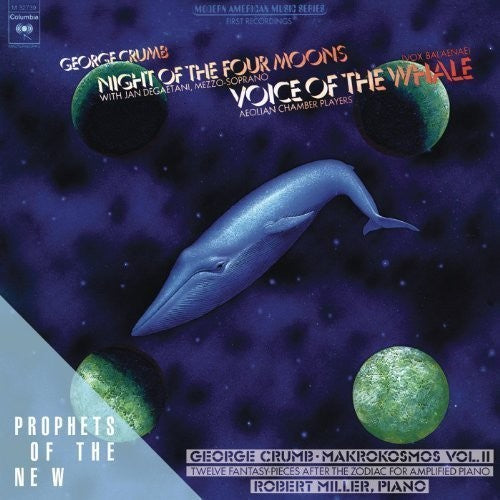
Crumb: Vox Balanae, Night of the Four Moons, Makrokosmos Vol 2 / DeGaetani, Miller
Sony Masterworks
$17.99
October 01, 2013
Night of the Four Moons [is] a typical example of [Crumb's] richly allusive style from that time, with references to Mahler's Das Lied von der Erde and Haydn's "Farewell" Symphony clothing settings of poems by Lorca... it's wonderful to hear again the late Jan DeGaetani's performance of Night of the Four Moons; nobody has sung Crumb's music of that period with more intensity or understanding than she did.
-- Andrew Clements, The Guardian [6/19/2008] reviewing Night of the Four Moons, previously reissued as part of Bridge 9253
I love Miller's performance of these crazy piano works. He is extremely animated and theatrical amidst the formidable obstacle course that the performer faces in this work. He is called to strum the strings inside the piano, scream, whoop and holler, preparing the strings, etc. In the 4th cut on side 1, the performer is instructed: "serene, desireless, like a Nirvana-trance!" O.K. Miller makes it work. it's really fantastic. I have become quite attached to these performances to the exclusion of all others.
-- WFMU reviewing Makrokosmos Vol 2 on LP
{# optional: put hover video/second image here positioned absolute; inset:0 #}
Sony Masterworks
Crumb: Vox Balanae, Night of the Four Moons, Makrokosmos Vol 2 / DeGaetani, Miller
Night of the Four Moons [is] a typical example of [Crumb's] richly allusive style from that time, with references to Mahler's Das...
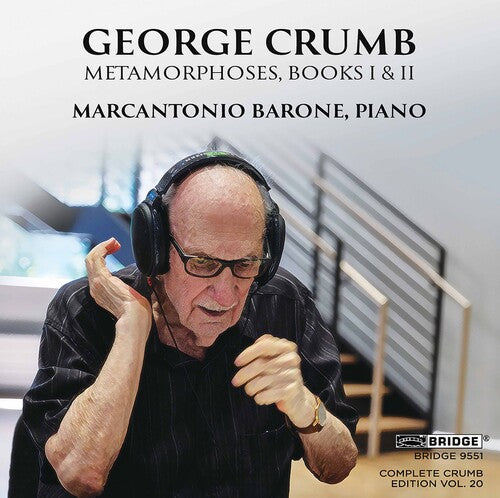
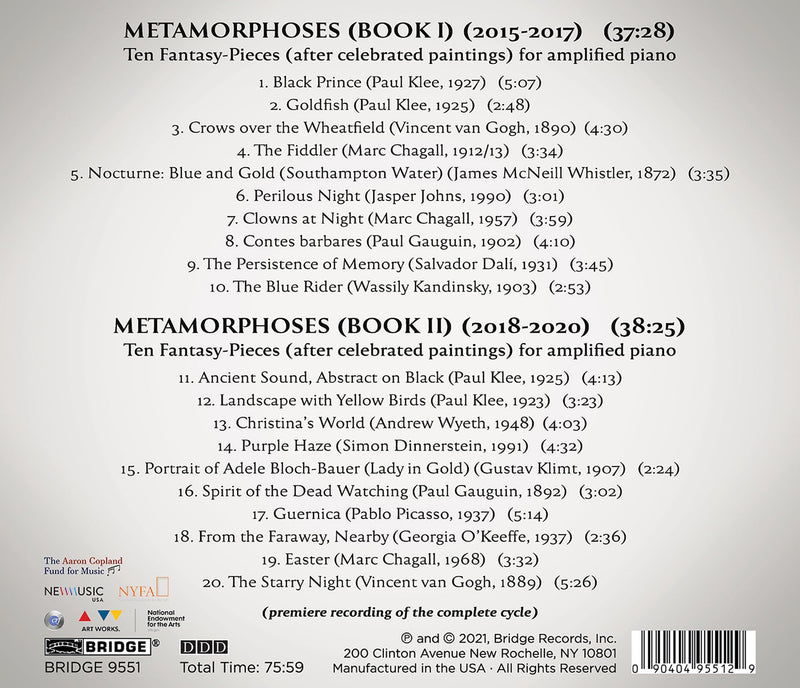
Bridge's Complete Crumb Edition reaches Volume 20 with the first complete recording of the great American composer's recently completed Metamorphoses cycle. The "20 Fantasy Pieces After Celebrated Paintings" are Crumb's "Pictures at an Exhibition"- aural interpretations of famous paintings from our recent past including works by Picasso, van Gogh, Chagall, and Dali. Critic David Hurwitz writes: "Bridge's decision to embark on a complete edition of George Crumb's music remains one of the most significant recording projects currently in progress, as well as one of the most artistically successful."
{# optional: put hover video/second image here positioned absolute; inset:0 #}
Bridge Records
Crumb: Metamorphoses, Books I and II / Barone
Bridge's Complete Crumb Edition reaches Volume 20 with the first complete recording of the great American composer's recently completed Metamorphoses cycle. The...
Crumb: Vox Balaenae / Robert Aitken, New Music Concerts
Naxos
$19.99
December 12, 2006
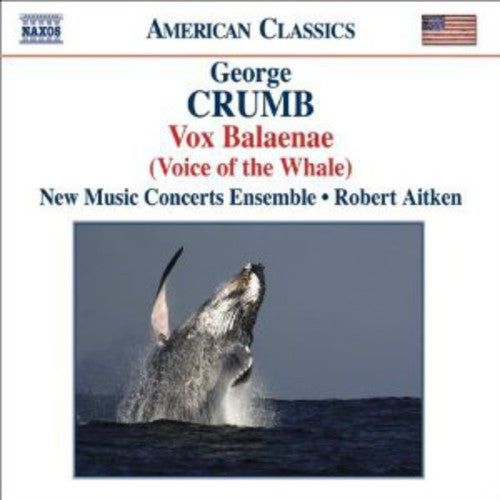
This fine collection offers impressive performances that reveal George Crumb's broad expressive range within his own personal idiom. Vox Balaenae (Voice of the Whale) and Eleven Echoes of Autumn are the two biggest pieces, the former curiously "Eastern" in its opening flute arabesques, and at times playful, the latter darker and more harmonically challenging, but no less evocative. Federico's Little Songs for Children (1986) continues the composer's involvement with the magical poetry of Lorca. It's wonderfully scored for flutes and harp, and beautifully sung by Teri Dunn, who manages to make all of the noises Crumb demands with an aptly seductive timbre. An Idyll for the Misbegotten, for amplified flute and percussion, is the shortest piece, but it packs a lot of brooding atmosphere into its scant 10 minutes.
The performances are all very good indeed. Robert Aitken directs and takes the flute parts in all four works, and his timbre acts as the program's unifying thread. All of this music has been recorded before, either by Bridge in its complete edition, or elsewhere on individual releases (you can find An Idyll and Vox Balaenae on a celebrated New World release containing Jan DeGaetani's performance of the four books of Madrigals), but you can certainly purchase this economical, well-engineered disc with complete confidence if the couplings suit your fancy. --David Hurwitz, ClassicsToday.com
{# optional: put hover video/second image here positioned absolute; inset:0 #}
Naxos
Crumb: Vox Balaenae / Robert Aitken, New Music Concerts
This fine collection offers impressive performances that reveal George Crumb's broad expressive range within his own personal idiom. Vox Balaenae (Voice of...
American Classics - Crumb: Songs, Drones, Refrains Of Death
Naxos
$19.99
$13.99
June 20, 2006
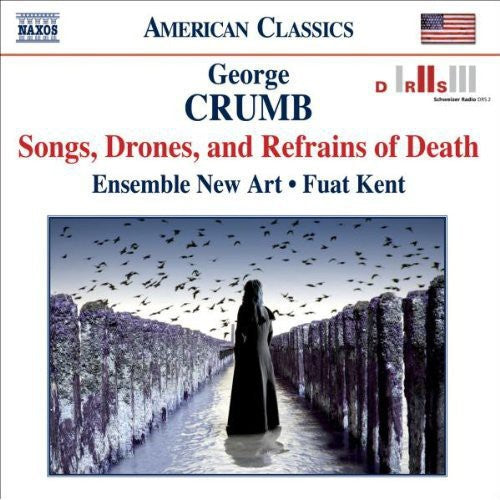
Songs, Drones, and Refrains of Death is one of the richest of George Crumb's brilliant and moving explorations of the poetry of Lorca, musically inspired by such pieces as Mussorgsky's Songs and Dances of Death and Mahler's Kindertotenlieder. Like so much of Crumb's mature music, it uses avant-garde performance techniques and unusual instruments (percussion especially) plus electronics to create a primal, elemental atmosphere. In this sense, the music stands in the tradition of Stravinsky's The Rite of Spring or Bartók's The Miraculous Mandarin, both works where an exceptionally refined and sophisticated technique is used unflinchingly to depict visions of mystery, evoke primitive rituals, and explore the ancient myths of our collective unconscious. In this respect, no poet is better suited to musical setting than Lorca, and no composer has ever responded to him more evocatively than Crumb.
The performance here under Fuat Kent is a very good one. Most Crumb recordings tend to be successful because either the players know what they are doing, or they don't, and faking it is not an option; the mere process of delivering what Crumb's highly detailed scores demand virtually guarantees a high level of achievement. But there are differences between this recording and Bridge's benchmark version with baritone Sanford Sylvan and Speculum Musicae (part of its complete Crumb edition). These primarily concern tempo: this newcomer is about four minutes slower overall, and this is particularly noticeable in the long final movement, Death-Drone III. Although Crumb's music relies heavily on sheer atmosphere, and absolute speed as such is rarely an issue, I marginally prefer the Bridge recording for its inevitably greater density of incident. The atmosphere basically takes care of itself. Still, this performance is very well played. The exciting bits (Song of the Rider and Cadenza appassionata for two drummers) are thrilling, and baritone Nicholas Isherwood certainly is as persuasive in his declamation of the text as Sylvan.
Quest--a remarkable sextet that includes important parts for guitar, harp, soprano saxophone, keyboards, and percussion (including a harmonica or concertina at the end)--was written for guitarist David Starobin. It's a watershed in Crumb's output for several reasons, not least of which is the fact that it permitted Crumb to work his way out of a serious writer's block in the 1990s. The piece also makes frequent reference to the song "Amazing Grace", thus anticipating the epic cycle of folk-song settings (four collections to date) that loom large in the composer's recent work.
Once again, this work is available on Bridge performed by its dedicatees, superbly, but this newcomer is hardly less accomplished or less favorably recorded, and in the final analysis if you want these two pieces (they are coupled differently on Bridge) then you can purchase this disc with complete confidence in its faithfulness to the composer's unique vision. It's good to see Crumb's music being performed and recorded regularly again. Without question, he is a great composer with a very special voice. --David Hurwitz, ClassicsToday.com
{# optional: put hover video/second image here positioned absolute; inset:0 #}
On Sale
Naxos
American Classics - Crumb: Songs, Drones, Refrains Of Death
Songs, Drones, and Refrains of Death is one of the richest of George Crumb's brilliant and moving explorations of the poetry of...


 {# optional: put hover video/second image here positioned absolute; inset:0 #}
Bridge Records
{# optional: put hover video/second image here positioned absolute; inset:0 #}
Bridge Records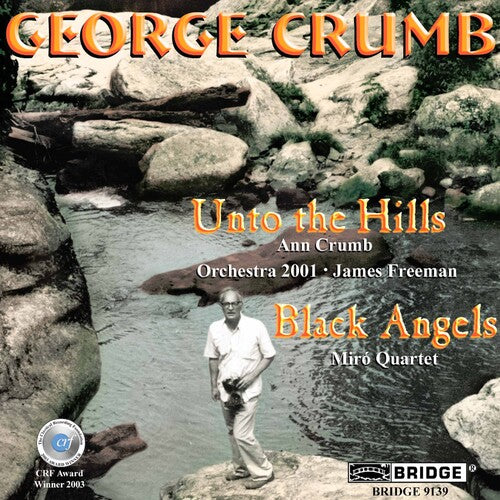 {# optional: put hover video/second image here positioned absolute; inset:0 #}
Bridge Records
{# optional: put hover video/second image here positioned absolute; inset:0 #}
Bridge Records {# optional: put hover video/second image here positioned absolute; inset:0 #}
Bridge Records
{# optional: put hover video/second image here positioned absolute; inset:0 #}
Bridge Records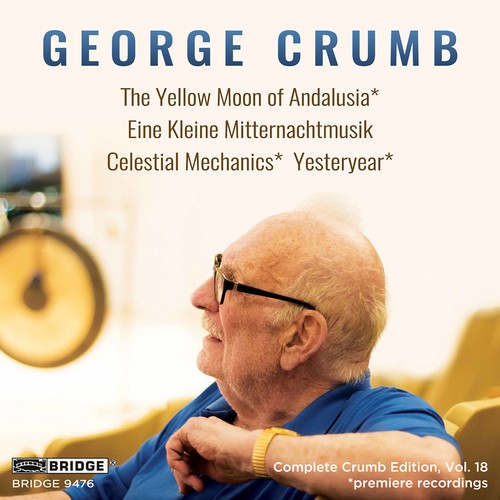 {# optional: put hover video/second image here positioned absolute; inset:0 #}
Bridge Records
{# optional: put hover video/second image here positioned absolute; inset:0 #}
Bridge Records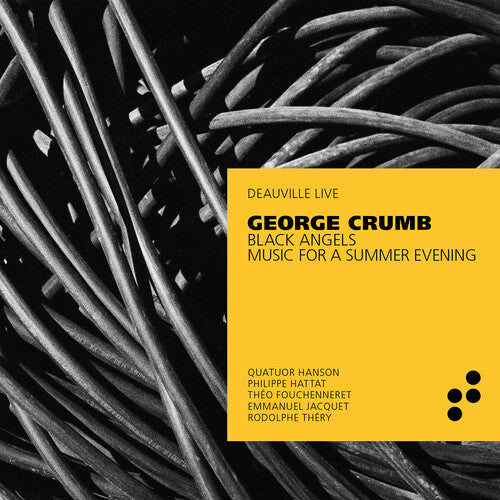 {# optional: put hover video/second image here positioned absolute; inset:0 #}
B Records
{# optional: put hover video/second image here positioned absolute; inset:0 #}
B Records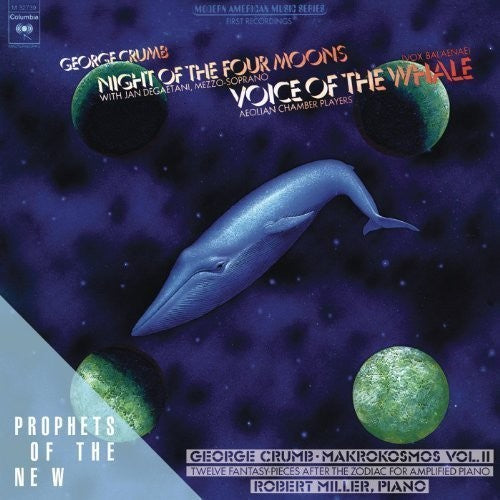 {# optional: put hover video/second image here positioned absolute; inset:0 #}
Sony Masterworks
{# optional: put hover video/second image here positioned absolute; inset:0 #}
Sony Masterworks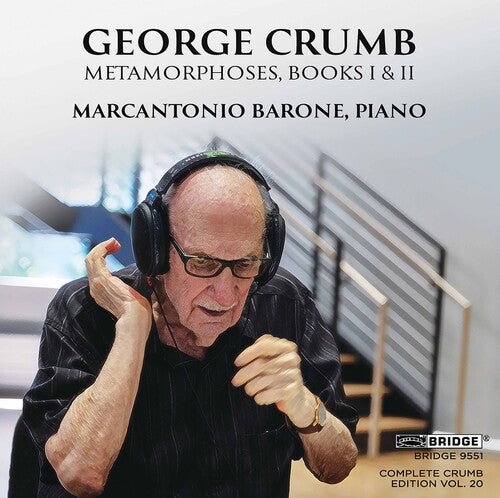 {# optional: put hover video/second image here positioned absolute; inset:0 #}
Bridge Records
{# optional: put hover video/second image here positioned absolute; inset:0 #}
Bridge Records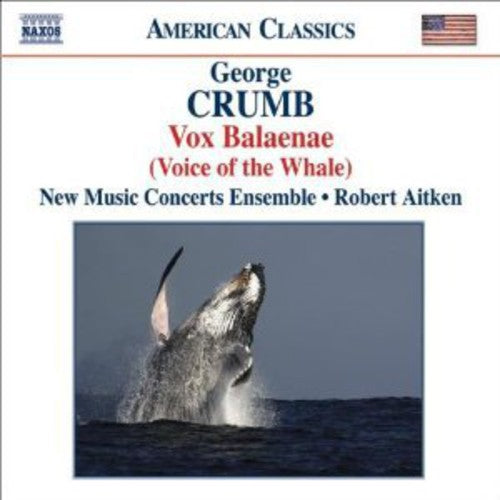 {# optional: put hover video/second image here positioned absolute; inset:0 #}
Naxos
{# optional: put hover video/second image here positioned absolute; inset:0 #}
Naxos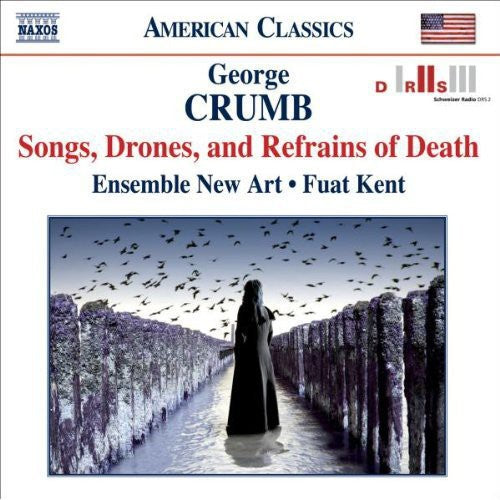 {# optional: put hover video/second image here positioned absolute; inset:0 #}
On SaleNaxos
{# optional: put hover video/second image here positioned absolute; inset:0 #}
On SaleNaxos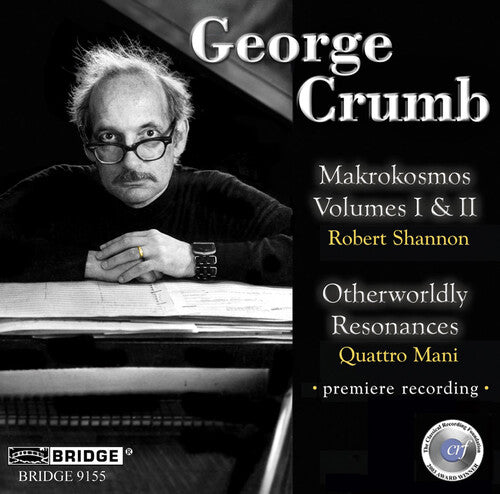


 {# optional: put hover video/second image here positioned absolute; inset:0 #}


 {# optional: put hover video/second image here positioned absolute; inset:0 #}
 {# optional: put hover video/second image here positioned absolute; inset:0 #}


 {# optional: put hover video/second image here positioned absolute; inset:0 #}


 {# optional: put hover video/second image here positioned absolute; inset:0 #}
 {# optional: put hover video/second image here positioned absolute; inset:0 #}


 {# optional: put hover video/second image here positioned absolute; inset:0 #}
 {# optional: put hover video/second image here positioned absolute; inset:0 #}


 {# optional: put hover video/second image here positioned absolute; inset:0 #}