George Walker
8 products
AFRICAN SOUNDS AT DUSK
Robin Walker: Orchestral Music
Walker: Complete Piano Works, Vol. 2 / Dossin
This second volume of George Walker's piano music joins its predecessor on Naxos 8.559916 (April 2024), together forming a unique complete piano works edition. On this new release, Steinway Artist Alexandre Dossin performs the cyclical Fourth Piano Sonata, which alternates between sections of virtuoso muscularity and lyrical repose, and the Piano Concerto, which integrates expansive Classical forms with inspiration derived from songs by Duke Ellington, something also cleverly hidden in Guido's Hand. The album closes with Walker's passionate Fifth Piano Sonata.
REVIEW:
Dossin makes much of the alternately moody and energetic first movement of the Piano Sonata No. 4. His ability to grasp the long line of Walker’s music is a really big factor in one’s enjoyment of his performances. The pianist's ability to use “space” in his interpretations makes these performances fascinating and ultimately rewarding.
— Art Music Lounge
An Hour to Dance
Walker: Complete Piano Works, Vol. 1 / Dossin
This is the first of two volumes of George Walker’s complete piano works, both featuring performances by Alexandre Dossin. The three sonatas heard here offer compelling contrasts. Sonata No. 1 (rev. 1991) is his longest and utilises folk tunes, No. 2 is darker and unified by tonal relationships, while No. 3 (rev. 1996) displays contrapuntal mastery and translucent elements. The album opens with the serene and majestic Prelude and Caprice, while both Spatials and Spektra are atonal. Bauble is heard in a world premiere recording.
REVIEW:
Judging by the compositions on this album, his piano music is communicative, colorful, expressive and, above all, characteristic. As a student of Rudolf Serkin, he was himself an outstanding pianist with an impressive career in Europe and the United States. This may have been conducive to his talent as a composer.
Pianist Alexandre Dossin shows himself to be an accomplished interpreter, making Walker’s tonal language his own with his flexible and sensitive playing.
-- Pizzicato
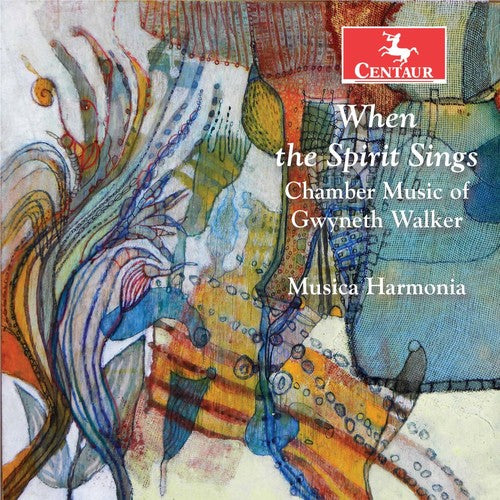
When the Spirit Sings: Chamber Music of Gwyneth Walker / Musica Harmonia
This release features the works of Gywneth Walker, one of the most important composers of our modern day. Widely performed throughout the world, the music of Gwyneth Walker is beloved by performers and audiences alike for its energy, beauty, reverence, drama and humor. Dr. Walker is a graduate of Brown University and the Hartt School of Music. Walker's catalog includes over 300 commissioned works for orchestra, chamber ensembles, chorus, and solo voice.
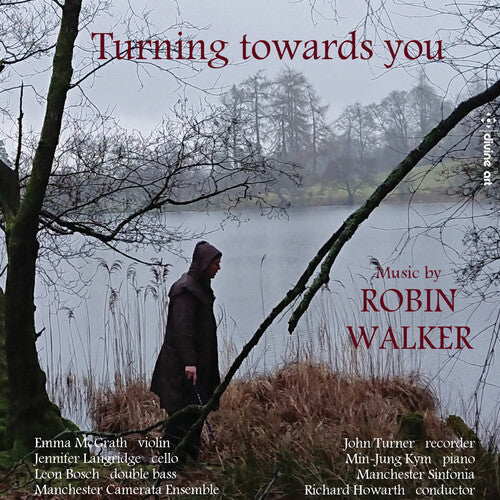
Turning Towards You: Music by Robin Walker / Various
Robin Walker began his musical life as Head Chorister at York Minster then studied under David Lumsdaine at Durham and Anthony Milner at the Royal College of Music. His early work was seriously modernist but since the 1980s he has worked on an ‘instinctual’ approach involving a relationship with Nature, a sense of Place and our position within it, even including ‘folk-style’ elements – also to some extent informed by studying the music and dance of India. Leading soloists and the award winning Manchester Sinfonia present a range of works for solo instruments and the remarkable and inspired Concerto for Violin, Recorder and Strings (‘A Prayer and a Dance of Two Spirits’); the album follows a purely orchestra set recently issued by Toccata. John Turner is one of the world’s leading recorder players with a long and distinguished career; Emma McGrath is currently concertmaster/principal violin of the Tasmanian Symphony Orchestra; Jennifer Langridge is a busy soloist and chamber musician and has been principal cello of Psappha for 24 years. Leon Bosch is an internationally renowned double bass virtuoso with over a dozen solo albums to his name, Min-Jung Kym is a Steinway Artist career, having already performed with many leading orchestras and she was pianist of choice of legendary violinist Ruggiero Ricci.
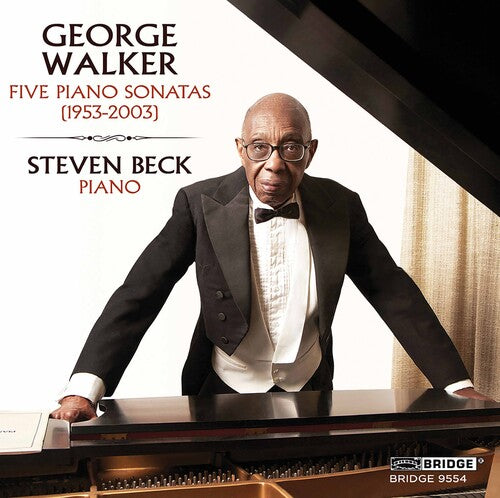
Walker: Five Piano Sonatas / Beck
George Walker is one of the few leading American composers of the 20th century to produce as many as five piano sonatas. Taken together, they securely chart a lifetime of stylistic change. Walker managed many other feats, a number of them connected to being the first Black person to break through various glass ceilings: the first to be accepted at the Curtis Institute of Music, the first to study with Nadia Boulanger, and the first to win the Pulitzer Prize in Music. Walker is also one of the only major composer-pianists to have recorded worthy performances of virtuoso standard repertoire including Beethoven’s “Emperor Concerto” and the Brahms second piano concerto.
REVIEW:
"This beautifully played (and beautifully recorded) set of George Walker's piano sonatas by pianist Steven Beck is especially valuable. The sonatas trace Walker's development as a composer, from a sort of post-Copland style through an approach to serialism (he only rarely adopted it wholesale, but the mark of Webernian economy is all over the second and third sonatas here), back to a broader free atonality deepened by rigor."
Walker generally resisted the use of African American vernacular material in his essentially modernist style, but he might then introduce it when it is least expected, in entirely original ways. Anyone interested in this giant of African American classical music but not knowing where to start could easily choose this release."
--AllMusicGuide.com (James Manheim)
There is a strong tradition of American piano sonatas. Off the top of my head I can think of examples by Ives, Copland, Barber, Sessions and Carter and there are, no doubt, others. To these we can add the five sonatas of George Walker, an impressive contribution to the medium, which fit neatly onto one disc.
I had not heard of George Walker until a few months ago, when he was composer of the week in the BBC Radio 3 series. I was impressed by what I heard and so was glad of this opporunity to hear these sonatas. He had a long and successful career in the USA, despite the difficulties caused by his being African-American. He always intended a life in classical music, which I note as some African-American musicians, despite being classically trained, gravitate towards jazz. There are occasional jazz references and references to spirituals and folk songs in his works, but no more than one might expect in any other American composer, Copland for example.
Despite these sonatas being composed over a period of fifty years, they have more in common than what sets any of them apart. Walker has a fondness for sinewy counterpoint and somewhat angular harmonies, rather in the Hindemith way. He also likes strong single lines and chord sequences. His idiom is clearly twentieth century but is not particularly dissonant, and he likes a good deal of rhythmic vitality.
The first two sonatas, the closest together in time, have much in common. The fondness for counterpoint and for variation form is common to them. However, the first is consistently more playful, even jaunty, while the second conveys a sense of disaster being just round the corner. The second is also the more compact, despite being in four movements rather than three, and its Scherzo is only one minute and twelve seconds long.
The third sonata has two brief movements before a longer one and here we find a new riuchness of harmonic vocabulary, even suggesting Scriabin at one point. The second movement, titled Bell, is simply a succession of slow chords. The finale features constant changes of mood and texture.
The fourth sonata, in two movements only, is more angular than the earlier works. there are many ideas, among which leaping single lines, bell-like chorales and a fugal toccata are noteworthy.
The fifth sonata is in one movement only and is a formidable work, tightly wrought and intense. Perhaps it is the finest of the five.
Steven Beck is a contemporary music specialist and offers committed performances. The recording is excellent. Walker’s music is well worth getting to know.
--MusicWeb International (Stephen Barber)