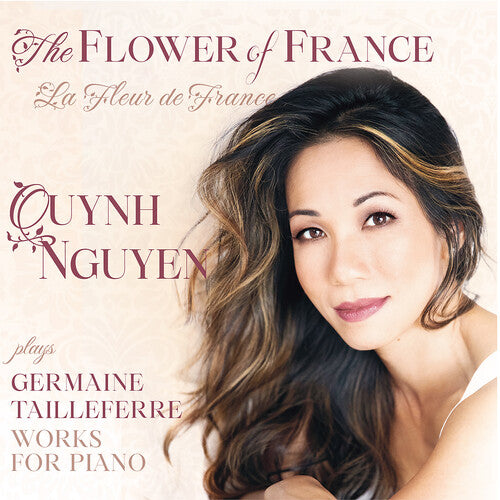
The Flower of France - Tailleferre: Works for Piano / Quynh Nguyen
Music and Arts Programs of America
Available as
CD
$18.99
Jul 07, 2023
Germaine Tailleferre (1892–1983) came of age in the explosively creative days of 1920s Paris. Well-known as the only female member of Les Six, the group of composers which included Darius Milhaud, Louis Durey, Georges Auric, Francis Poulenc, and Arthur Honegger, her circle of friends also included Charlie Chaplin, Picasso, Modigliani, Diaghilev, Ravel, Stravinsky, and Monteux. This recording features works originally for solo piano, as well as transcriptions and excerpts from ballets and film scores. The music spans 60 years and represents some of Tailleferre’s best and most significant work, some of it rarely played or recorded. Praised by The Boston Globe as “a musical and expressive player” who is “sensitive and poetic, and excels in everything that requires elegance, proportion, balance, taste, and wit,” the award-winning Vietnamese American pianist Quynh Nguyen was named one of the “19 Young Stars of Tomorrow” by Musical America. She has performed extensively throughout the United States, Europe, and Asia, to wide critical acclaim. The Flower of France marks her debut recording on the Music & Arts label.
The Flower of France - Tailleferre: Works for Piano / Quynh Nguyen
$18.99
CD
Music and Arts Programs of America
Jul 07, 2023
MA CD-1306
Tailleferre: Complete Piano Works, Vol. 1 / Horvath
Grand Piano
Available as
CD
$19.99
$9.99
Apr 08, 2022
Germaine Tailleferre is best known for being a member of the French circle of composers known as Les Six - the only woman in the group. Her stylish combination of neo-Classicism with a ready wit and energy can be compared to Poulenc and Milhaud. From the captivating Romance written while still a student, to her sparkling music for the 1937 Paris international exhibition, all of these pieces show Tailleferre as being very much at the heart of the contemporary French musical scene. This recording, described by the composer’s granddaughter as being ‘as though Tailleferre herself was performing these works’, is the first of three volumes presenting the complete piano music played by Nicolas Horvath.
REVIEW:
The Monaco-born Horvath’s discographical versatility lends itself to the chameleon Tailleferre: she switches from neoclassical to radical, tonal to bitonal, rhythmic and familiar to irregular and dissonant. Horvath is a great advocate.
-- The Guardian
On Sale
Tailleferre: Complete Piano Works, Vol. 1 / Horvath
$19.99
$9.99
CD
Grand Piano
Apr 08, 2022
GP891
Filter
Choosing a selection results in a full page refresh.
Press the space key then arrow keys to make a selection.


 On Sale


