Leonard Bernstein
77 products
Bernstein: Suite From Candide, Etc / Eiji Oue

This enterprising and exceptionally well-played CD contains the world premiere recording of a charming suite arranged from Candide, Bernstein's wittiest musical. When combined with the overture from the same show, as it is here, the result is a marvelous twosome that ought to appear together often. The Five Songs also are receiving their premieres in new orchestrations by Sid Ramin, a regular Bernstein collaborator. Mezzo-soprano Beth Clayton sings them beautifully. Add to these enterprising items a sparkling performance of the Divertimento (every bit as good as the composer's version) and the Three Meditations from Mass, originally arranged for Rostropovich (but here excellently played by cellist Anthony Ross), and the result is probably the most important Bernstein recording since Lenny's own. And of course, sonics are state of the art. Terrific. [10/19/1999] --David Hurwitz, ClassicsToday.com
Asplund meets Bernstein
Composer's Collection: Leonard Bernstein
Fleeting Castles
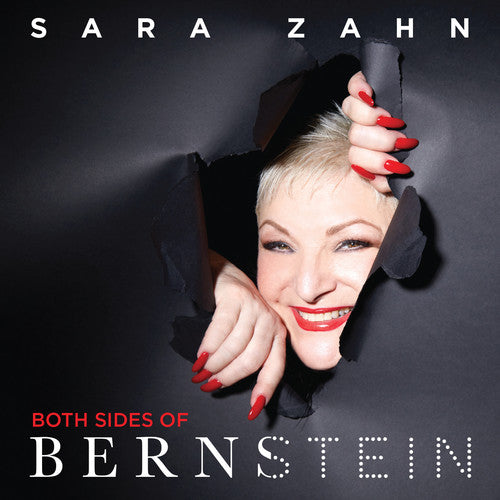
Both Sides of Bernstein
Bernstein: Piano Trio, Clarinet Sonata, 3 Meditations, 13 Anniversaries & Touches
Bernstein, C.H.: String Quartets Nos. 2 and 3 / String Trio,
Charles Harold Bernstein: Works for Solo Violin & Solo Cello
Young People's Concerts with the New York Philharmonic, Vol. 1 / Bernstein [Blu-ray]
Also available on standard DVD
“There had never been a communicator about music with anywhere near Bernstein’s brilliance, humor, energy, reach and importance.” (The New York Times) “Leonard Bernstein did this better than anyone. He was brilliant - as a musician and as an ambassador for music.” (Whoopie Goldberg) Young People’s Concerts Vol. 1 comprises 17 episodes of the legendary series, which remains unmatched until today. Awarded three Emmys and hailed by Variety as “a rare moment in the symbiosis of the arts and broadcasting”, Leonard Bernstein’s Young People’s Concerts left their mark on television history. Aired at prime-time on CBS from 1958 to 1972, 52 one-hour programs were written and hosted by Leonard Bernstein, “certainly the most influential American maestro of the 20th century” (The New York Times). With the New York Philharmonic and guest artists providing the live music, these programs brought musical concepts and music history to life for generations of viewers. Volume 1 includes 17 Episodes - The Concerts Nos. 1-14 plus Young Performers Nos. 1-3 (featuring Seiji Ozawa and Lynn Harrell)
Bernstein: West Side Story: Symphonic Dances / Fancy Free /
Copland & Bernstein: Clarinet Sonatas - Dankworth: Suite for
Bernstein: Transcriptions for Wind Band
AMERICAN PIANO MUSIC
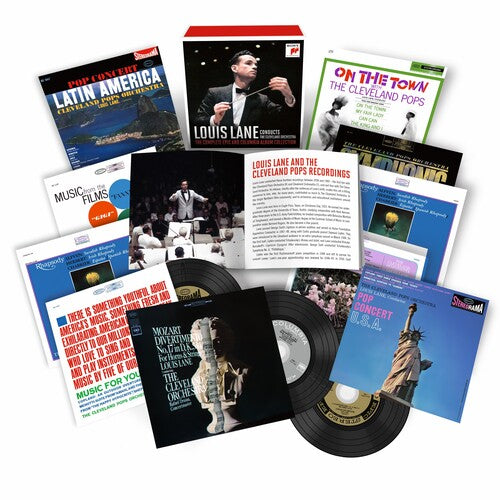
Louis Lane conducts the Cleveland Orchestra
He went on to head major orchestras in Dallas and Atlanta and to guest conduct leading ensembles all over the world. But before that, Louis Lane honed his craft while working in the shadow of one of the great masters: in 1947, legendary maestro George Szell chose the young, inexperienced Texan to assist him in Cleveland - "I think you will do" was the gruff maestro's verdict, exceptional praise indeed from that notorious perfectionist.
Between 1959 and 1972 - with the full Cleveland Orchestra, the somewhat smaller Cleveland Pops and the chamber-sized Cleveland Sinfonietta - Louis Lane made a series of critically acclaimed recordings for Columbia. They display the "exceptional breadth and impeccable taste" for which this gifted but perennially undervalued conductor was lauded in a tribute by the orchestra's executive director. Sony Classical is pleased to present them now - many for the first time on CD - in a new 14-disc set.
Reviewers were effusive in their praise when these albums were originally released on LP. Here is a sampling: Pop Concert U.S.A. (1959) - music by Copland, Gershwin, Bernstein and other American composers: "If only all the pops (or, for that matter, all the classics) were as good as this!. The orchestra plays splendidly" (Gramophone). On the Town with the Cleveland Pops (1960) - selections from On the Town, My Fair Lady, Oklahoma, The King and I and other Broadway musicals: "Scintillating. Under Lane's enthusiastic direction, the Clevelanders play these familiar musical comedy excerpts with such precision and virtuosity that they emerge with glistening freshness" (High Fidelity). Music from the Films (1961) - Henry V, Louisiana Story, Bridge on the River Kwai, Gigi, Exodus and other motion pictures: "This concert of music from the movies is so superior to most issues of it's kind that it calls for special commendation. Lane has coaxed some beautiful playing from the Cleveland orchestra, and the engineers have provided him with rich and glorious sound" (High Fidelity).
Symphony No. 1, "Jeremiah" / Concerto for Orchestra, "Jubilee Games"
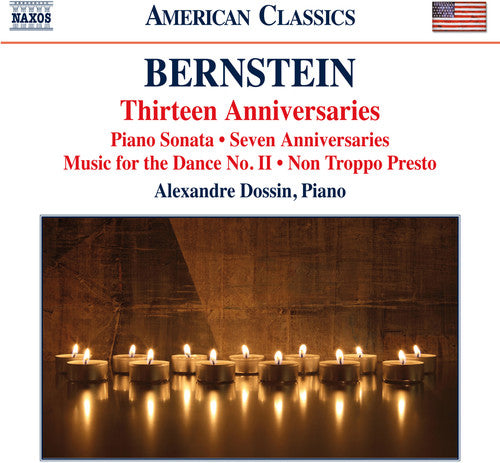
Piano Music – 13 Anniversaries / Piano Sonata / 7 Anniversaries / Music for the Dance No. 2 / Non Troppo Presto
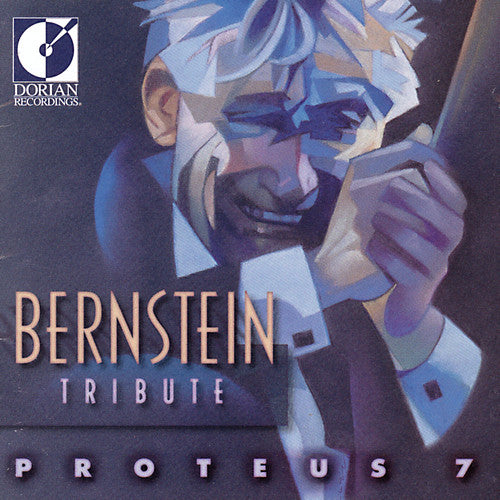
Leonard Bernstein Tribute / Proteus 7
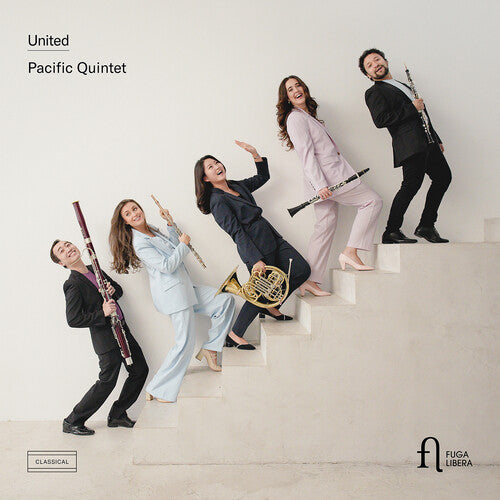
United
The Pacific Quintet have gone beyond the standard classical repertoire and have selected pieces that represent their diversity. Its musicians were born and raised all over the globe — Japan, Honduras, South Korea, Germany, and Ukraine/Turkey — and here present music from their home countries, transcending all differences of culture, language, and tradition. Two pieces, one by the Honduran composer Jorge Santos and the other by the South Korean female composer Soeui Lee, were commissioned especially for this album, which also includes Fazil Say’s quintet Alevi dedeler raki masasinda and a medley of Japanese folk songs; Hanns Eisler’s Divertimento represents Germany, the Pacific Quintet’s home base. The album ends with an arrangement of music from West Side Story and pays homage to Leonard Bernstein, the founder of the Pacific Music Festival in Sapporo where the players first met. As this project shows, they are truly United in music.
Schoenberg, A.: Kol Nidre / Bernstein, L.: Halil / Bloch, E.
Williams & Bernstein / Ehnes, Denève, St. Louis Symphony
The St. Louis Symphony and their music director Stéphane Denève present a program featuring two of the most accomplished American composers in history: Leonard Bernstein with his Serenade and John Williams with his Violin Concerto, both performed by star James Ehnes, one of the most exceptional North American violinists. John Williams himself was present at the recording of his violin concerto, working together with the St. Louis Symphony, Denève, and Ehnes.
Both works evolve around love: Bernstein’s Serenade was inspired by musings on love from Plato’s Symposium while Williams’s work was arguably inspired and eventually dedicated to his suddenly deceased wife. By combining these two concert pieces, this album puts the symphonic work of Bernstein and Williams at the center, two composers who weren’t afraid of crossing the boundaries between film music and “serious” classical genres at a time when these worlds were generally kept far apart. Especially in Williams' concerto, there are still hints of his work as a film composer; the slow movement brings to mind a scene of emotional gravity.
Widely considered one of the world's finest orchestras, the SLSO maintains its commitment to artistic excellence, educational impact, and community connections. The St. Louis Symphony, Stéphane Denève, and James Ehnes all make their Pentatone debut.
REVIEWS:
Dutch label Pentatone continues to champion American orchestras with the Saint Louis Symphony’s recording of violin concertos by John Williams and Leonard Bernstein. Williams dedicated the 1974 Violin Concerto No. 1 to his late wife, the actress Barbara Ruick. It’s a serious-minded, sometimes bleak affair, and Williams has called it atonal, though it seems harmonically straightforward enough.
With a 30-minute, three-movement sweep, Williams's concerto is expansive too. Canadian violinist James Ehnes is the thoughtful soloist, investing the music with deserved gravitas and fully on top of its technical challenges. Stéphane Denève leads a weighty reading, darkly dramatic in the opening “Moderato,” consoling in the glowing slow movement (which Ehnes plays like an angel), and incisive in the intermittently clangorous finale.
Bernstein’s Serenade has been recorded many times, but this astute interpretation is a welcome reminder of both its wistful profundity and its headstrong vigor. Ehnes and Denève open the debate spaciously with an expressive account of the “Phaedrus” movement. “Aristophanes” seems to channel graceful elements out of Candide, while a weighty “Socrates” gives way to the jazzy joie de vivre of “Alcibiades.” The violin sound is clean and clear, offset against a slightly resonant orchestra.
-- Musical America (Clive Paget)
Violinist James Ehnes’ discography is so extensive that it was only a question of when he’d get around to recording Leonard Bernstein’s Serenade, not if. What’s more striking about his new recording with Stéphane Denève and the St. Louis Symphony Orchestra (SLSO) is that it pairs Bernstein’s 1954 effort with John Williams’ Violin Concerto No. 1.
The Williams dates from the mid-‘70s and was written right after the untimely death of his first wife, the actress Barbara Ruick. Its brooding, volatile aspect perhaps owes something to that context – the central “Slowly in peaceful concentration” unfolds like an elegiac barcarolle – though this is hardly funereal music.
In fact, the Concerto marked a turning point in Williams’ concert music, allowing him to cultivate what he called the “Romantic [Atonal], but in an American way”-style he’d long been striving for...there’s a motivic rigor here that’s straight out of the Brahms-Schoenberg line and the writing for violin and orchestra is thoroughly idiomatic...[here, it is] exceptionally well played and draws out the tight thematic relationships between each movement. The Canadian violinist makes the most of the introspective spots – the middle movement, the reflective episode in the center of the finale, especially – while also suffusing its bravura passagework with purpose and direction.
Denève and the SLSO are right with him, teasing out the music’s gentle echoes of Hollywood and sometimes mercurial shifts of character with surety and ease.
They make for an impressive combination, too, in the Bernstein. Take or leave the score’s programmatic allusions to Plato’s Symposium: the Serenade is one of the American composer’s freshest and most satisfying concert works.
Here, Ehnes plays with gorgeous tone – the clarity of his bow arm is just marvelous, as is his left hand’s ability to cleanly and purposefully get the music’s knotty double and triple stops to sing. Over the Serenade’s first three movements, too, there’s a strong sense of shape and propulsion: this is well-focused, graceful, spry Bernstein.
-- The Arts Fuse
I hate music, but I like to sing
Martin: Ballade for Flute & Orchestra
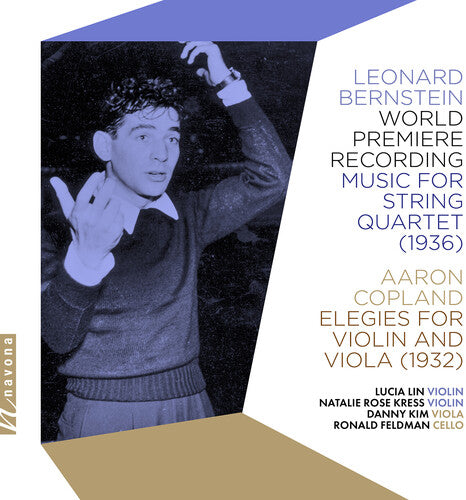
Bernstein: Music for String Quartet; Copland: Elegies / Lin, Kress, Kim, Feldman
Navona Records is proud to present MUSIC FOR STRING QUARTET; the world premiere recording of renowned composer Leonard Bernstein’s long-lost work. Composed by an 18-year-old Bernstein during his studies at Harvard; the piece has been steadfastly shepherded from its re-discovery to this historic release by former Boston Symphony Orchestra Librarian John Perkel; and is performed here by Lucia Lin; Natalie Rose Kress; Danny Kim; and Ronald Feldman. “Movement I” and the newly-discovered “Movement II,” which was found within the U.S Library of Congress; are accompanied here by the seldom-recorded duo piece Elegies for Violin and Viola by composer Aaron Copland; a musical mentor; collaborator; and dear friend of Bernstein’s.
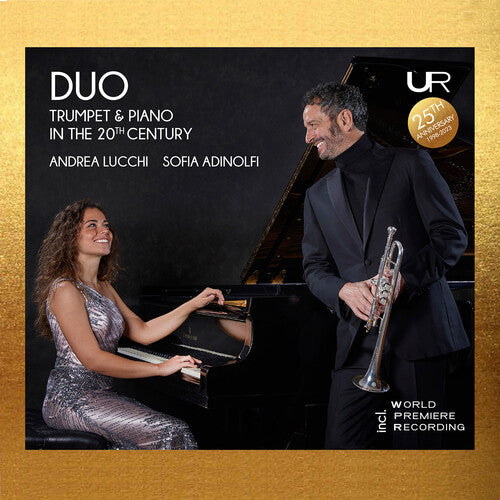
Duo - Trumpet & Piano in the 20th Century
This CD is devoted to some of the most significant pieces for trumpet and piano, a formation that was born, literally, at the beginning of the last century. No prominent nineteenth–century composer has left us chamber pieces, let alone duo pieces, that involve the solo use of the trumpet; and it might be worth briefly questioning the reasons for the instrument’s nearly total absence from the repertoire. With this Album With this publication we will try to identify the reasons and to dis-cover some of the most evocative passages dedicated to it.
Bernstein, Dessner, Farias & Verdery: A Giant Beside You
Guitarist Ben Verdery and the Ulysses Quartet release an album of music for guitar and string quartet that displays the versatility and accessibility of the combination. With music by Bryce Dessner, Javier Farías, Verdery's arrangement of Leonard Benstein's 1942 Clarinet Sonata, and two works by Verdery himself for electric guitar with quartet, A Giant Beside You presents persuasive and committed performances of several new works that provide new options for concert programming for this engaging and eminently viable instrumentation.