Conductor: Leif Segerstam
11 products
Verdi: Messa da requiem / Segerstam, ORF Vienna Radio Symphony
Verdi’s Messa da Requiem – an “opera in ecclestiastical robes”, as conductor Hans von Bülow called it – recorded in October 1980 at Stiftskirche Herzogenburg with Julia Varady, Alexandrina Milcheva, Alberto Cupido, Nicola Ghiuselev, ORF Choir and ORF Vienna Radio Symphony Orchestra under the baton of Leif Segerstam. The Messa da Requiem is a musical setting of the Catholic funeral mass (Requiem) for four soloists, double choir and orchestra by Giuseppe Verdi. It was composed in memory of Alessandro Manzoni, an Italian poet and novelist whom Verdi admired. The first performance, at the San Marco church in Milan on 22 May 1874, marked the first anniversary of Manzoni's death. The work was at one time referred to as the Manzoni Requiem. Considered too operatic to be performed in a liturgical setting, it is usually given in concert form of around 90 minutes in length. Musicologist David Rosen calls it 'probably the most frequently performed major choral work composed since the compilation of Mozart's Requiem'.
Sibelius: Swanwhite - Complete Incidental Music / Segerstam
Sibelius never made a suite out of The Lizard, and for good reason. It would have been nearly impossible. The score consists of two movements: a three-minute Adagio followed by a twenty-two minute Grave, both scored for strings. There’s very little actual music here: it’s all atmosphere and repetition of brief melodic patterns. It is, in short, background music, probably perfect for its intended use, and pretty good at home too if you need something moody that never forces you to pay attention. And as always with Sibelius’ string writing, Segerstam’s performance is gorgeous. It’s not often recalled that Segerstam was himself a violinist of considerable ability in his youth, and he pays a great deal of attention to the orchestral string sections in all of his recordings, to excellent effect.
A Lonely Ski Trail and The Countess’ Portrait are both poetic recitations for narrator and strings. I truly loathe spoken text over music, but Riho Eklundh has a very pleasant, mellow voice, and I find Swedish fun to listen to because it sounds like it ought to be in English but, obviously, it isn’t and you’re left wondering why what you are hearing makes no sense. For example, the opening line of A Lonely Ski Trail, “Ett ensamt skidspar” (with a little circle thing over the “a” in “skidspar”), sounds just like someone saying in English “And in some cheap sport.” It’s fun. So is this beautifully played and recorded ongoing series more generally.
-- David Hurwitz, ClassicsToday.com
Leif Segerstam directs all this material with unhurried authority, abundant perception and heaps of character. Likewise, his willing Turku colleagues are with him every step of the way. Admirable production values and useful notes, too. A job well done.
- Gramophone Magazine
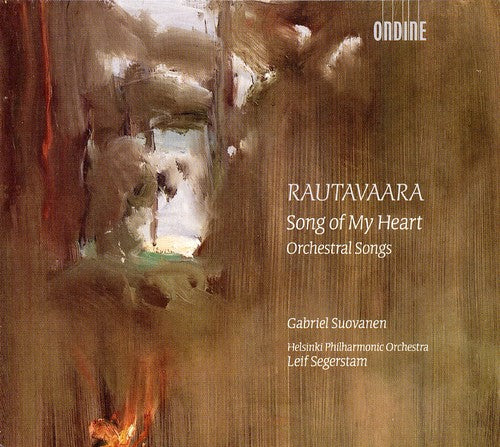
Rautavaara: Song of My Heart - Orchestral Songs / Suovanen

The most wonderful thing about Rautavaara's songs is that no matter what the technical basis of his compositional method, he understands that "song" means an evocative text set to a singable melody. You may not go away humming all of the tunes here, particularly in the brief, powerful, and oddly disturbing cycle God's Way (to poems by Bo Setterlind), but there's no questioning the fundamental rightness of Rautavaara's reaction to the words, or his ability to project his feelings into an expressive vocal line. That's not something to be taken for granted nowadays, when grateful and effective writing for the voice is no longer the basis of most composers' techniques, whether writing for people or for instruments.
The remaining four sets of songs on this disc all employ texts of the highest quality, by Shakespeare (in English, by the way), Rilke, and Finnish poet Aleksis Kivi. The Rilke settings are particularly moving, nowhere more so than The Lovers, whose third song, "Woman Loving", ought to be a recital classic by now. The three songs taken from the opera Aleksis Kivi also deserve to find a life of their own away from the larger work. They stand among the most hauntingly beautiful of Rautavaara's latest creations. Baritone Gabriel Suovanen sings all of this music with warm tone and great musical intelligence, and he couldn't be better accompanied than by Segerstam and the Helsinki Philharmonic. Ideally balanced sound rounds out this most enticing picture of Rautavaara's generously lyrical art.
--David Hurwitz, ClassicsToday.com
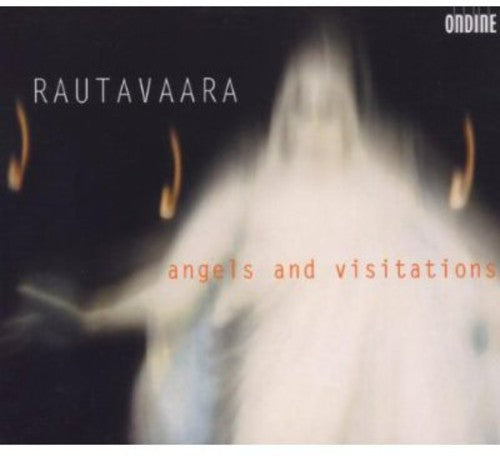
Rautavaara: Angels & Visitations
The magical world of Einojuhani Rautavaara is one that evokes other realms. Angels figure particularly heavily, especially those angels that deal with death and destruction. As Rautavaara himself says, “My angels are not those like in the altarpieces of Raphael...my angels are powerful.”
As well as with angels, many mystics have been preoccupied with the language of the birds (Messiaen in music, but think also of Saint Francis of Assisi preaching to the birds). One of the most popular Finnish works of recent years has been the Cantus arcticus, for prerecorded bird sounds and orchestra. It is a hugely impressive three-movement soundscape marked by a timeless feel and by beautiful, glowing lines. The taped birds could easily have sounded like a cheap effect, so it is telling that they emerge as an integral part of the work’s emotional vocabulary. Segerstam’s performance is excellent, as one would expect from this fine musician.
The very title Autumn Gardens seems to invite comparison with Takemitsu—all we need is a descending flock of the birds from the Cantus arcticus. It is certainly easy on the ear, so much so that the acerbic, percussive dissonances of the third movement of the First Piano Concerto come as something of a relief. Gothóni is an excellent pianist here; his way with some rhythms makes me suggest he has links to jazz. Back to pure atmosphere for the Clarinet Concerto, though—truly excellently played by Stoltzmann.
The second disc begins with an Adagio celeste for string orchestra. The strings of the Belgian National Orchestra play really sumptuously in this gently pulsating score; the much more abrasive Flute Concerto excerpt that follows (complete with agile low bassoon and menacing percussion) acts as a necessary corrective, although it is not long before it, too, shows its delicate side.
True and False Unicorn is a reminder of Rautavaara’s stature as a composer of choral works. The second movement, “Young Sagittarius,” is full of delightfully light rhythmic play, as is In the shade of the willow. Anadyomene , subtitled “Adoration of Aphrodite,” evokes more of a sense of the massive, using expansive, coloristic writing and including moments of real light.
The final work, Angels and Visitations , has a deliberately ambiguous title. “Visitations” may indeed refer to the Annunciation, but it may equally invoke something more sinister. Climaxes, therefore, tend towards the darkly hued. There are shades of Sibelius during the course of the piece, but Rautavaara transforms the material so that it glows in a most un-Sibelian way. This tense score (with its Pétrouchka -like mêlée of sounds) is one of the most impressive on either disc here, and is an apt way to close.
Although other companies are championing the Rautavaara cause, most notably Naxos, Ondine has a certain authority. Both sides of Rautavaara’s personality—the meltingly beautiful and the near violent—are given a chance to make their mark here.
-- Fanfare
Sibelius: Kuolema, King Christian II & More / Segerstam, Turku Philharmonic
Kuolema (“Death”) gave us the Valse triste, played with hypnotic slowness Segerstam and the Turku strings. The remainder of the score strikes me frankly as dull, at least until we get to the last couple of movements, where things perk up (at least a bit). The Two Songs from Twelfth Night are well sung by baritone Waltteri Torikka, and very atmospheric. Texts and translations are also included in the booklet–not something to be taken for granted these days. Finally, the Overture in A minor is a brief chip off of the workbench that Sibelius threw together for the premiere of the Second Symphony. It’s fun, and typically Sibelius, but the music goes nowhere and ends very oddly.
Segerstam’s conducting, as you might have noticed, is lovingly shaped, occasionally a bit slow, but always attentive the music’s colors and moods. The engineering is odd though: the brass at the start of the Overture are backwardly placed, and the strings have a metallic edge. Still, if you haven’t already sprung for the BIS complete edition, this disc offers a sensible way to plug a few gaps in your Sibelius collection.
– David Hurwitz, ClassicsToday.com
These are two exceptional Sibelius discs containing a number of rarities coupled with performances of Kuolema, King Kristian II and Belshazzar’s Feast that are as good as any available. I hope that Naxos will continue with further instalments from this team of superb Sibelians.
– John Whitmore, MusicWeb International, reviewing this disc and another
"Segerstam has his Turku Philharmonic playing with both idiomatic, long-focused energy and poignant understatement; the first movement of the music for Järnefelt’s play Kuolema, later published separately as the Valse Triste, has rarely waltzed as sadly or as profoundly as this. The music for Adolf Paul’s play King Christian II centres on an expansive and genial Nocturne that sounds almost cinematic." – The Guardian (UK)
Sibelius: Belshazzar's Feast… / Segerstam

This releases continues Segerstam’s so far excellent survey of Sibelius’ complete incidental music coupled to other rare works. Belshazzar’s Feast works better in its complete form than many other such pieces: it has eleven short movements, including “Song of the Jewish Girl” setting the familiar lament “By the waters of Babylon.” A couple of the dances return at the end giving the work a semblance of form, and there are a few extra bits that didn’t make it into the more familiar suite, such as the exotic number simply marked “Allegretto”. In short, this is worth hearing.
The remaining items also are of unusual interest. The Overture in E major and Scène de Ballet both date from 1891 and comprise Sibelius’ earliest orchestral works. Both are worth hearing, not so much because they sound like the later composer (they have moments), but because despite their immaturity, they still don’t sound like anyone else. Scène de Ballet, in particular, features very curious scoring for castanets and suspended cymbal, while the overture is a surprisingly big work–almost twelve minutes–with some attractive if relatively anonymous melodic invention.
The Wedding March is all that Sibelius wrote as incidental music to play called The Language of the Birds. Its date, 1911, signals a fully mature piece, and the music is not really a march at all–more a miniature tone poem with some of the harmonic strangeness of The Bard and the Fourth Symphony, which come from the same period. You might feel that the Cortège also needs a new name: it’s actually an ebullient Polonaise in triple time, and again, surprisingly substantial. This music found a later home in both the Scènes historiques and The Tempest.
Sibelius used bits of the Menuetto in the King Christian II music, but this larger orchestration from 1894 is absolutely delightful. What a great encore this would make in concert. Segerstam concludes the program with the Processional, Op. 113, No. 6, a piece that eventually found its way into the composer’s collection of Masonic music (yes he wrote some, even if no one knows it). It’s suitably dignified and brings the program to a very satisfying close.
As with previous releases in this series, the performances are just about as good as it gets. Segerstam plays all of the music with evident care and invests it with plenty of character. He has the Turku Philharmonic responding to his every whim, and if some of these “chips off of the master’s workbench” remain rather “chippy,” well, that’s the composer’s fault. At least they leave us wanting more. Pia Pajala is the attractive soprano soloist in her single song, and the engineering is rich, warm, and atmospheric. Worth your time and attention, no doubt about it.
-- David Hurwitz, ClassicsToday.com
Wagner: Opera Choruses / Segerstam
Includes work(s) by Richard Wagner. Conductor: Leif Segerstam.
Sibelius: Pelleas et Melisande / Segerstam, Turku
No sooner had Sibelius moved to the town of Järvenpää in 1904 than he was commissioned by the Swedish Theatre to write incidental music for Maeterlinck’s Pelléas et Mélisande. At the time it was his most ambitious undertaking in the genre of incidental music and his setting included ten scenes, only one of which was cut when he adapted the piece as a concert suite. Dating from the same year, Musik zu einer Szene was originally intended to accompany a tableau and is full of striking contrasts. The two waltzes of 1921 are transcriptions of piano pieces, and reveal the potent influence of Tchaikovsky.
Sibelius: Jedermann / Segerstam, Turku
Much of the music is athematic, and aside from being exceptionally slow it’s also exceptionally repetitious. You could make the case that Sibelius is anticipating much contemporary music–Arvo Pärt at his droopiest has nothing on this – but what would be the point? And it has to be said that Segerstam and his Turku players make a meal of it. The performance is gorgeous, unflinchingly dark and anguished, and if you’re going to do it at all you might as well revel to the max in the music’s wrist-slitting despondency.
The couplings are particularly well chosen. The Two Serious Melodies, Op. 77, for violin and orchestra, are lovely, virtually unknown, and positively riotous after Jedermann. In memoriam is a funeral march inspired by the more lugubrious music of Liszt, and it too sounds almost uplifting here despite Segerstam’s measured tempo. It was smart of Naxos and Segerstam to find all of Sibelius’ most miserable music and stick it on one convenient CD, with wonderfully apt cover art so that you know exactly what you’re in for. If you feel depressed, your life is a mess, and you’re sunk in an abyss of despair, by all means try this disc. It will convince you that you have a long way to go before you hit bottom.
-- David Hurwitz, ClassicsToday.com
Segerstam's often daringly spacious conception absorbingly complements Vanska's splendid Lahti accont - diehard Sibelians will, I fancy, want to have both - while Turku PO member Mikaela Palmu responds with big-hearted dedication in the lovely Two Serious Melodies for violin and orchestra.
- Gramophone
Opera Explained - Wagner: Tristan und Isolde
A guide to Wagner's transformative music drama, with introduction and explanation written and read by expert author Christopher Cook.
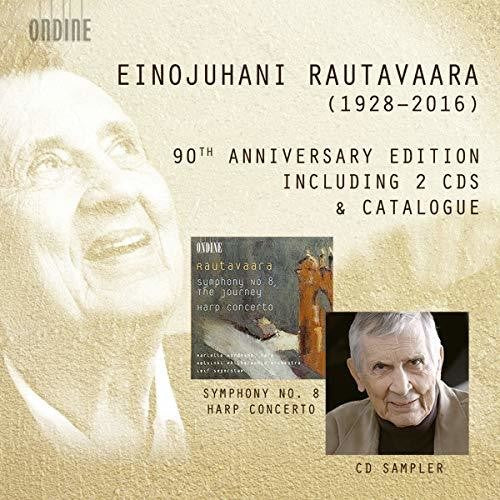
Einojuhani Rautavaara 90th Anniversary Edition
Einojuhani Rautavaara (1928–2016) would have turned 90 on October 9th, 2018. During his long career as a composer spanning seven decades from the late 1940s until his very last days, the composer created a wide list of works in various music genres, including 8 symphonies, several concertos and operas as well as a large amount of vocal and chamber music – the majority of these works have been recorded by Ondine. The recordings released by the label played a key role in bringing the composer to international attention during the 1990s. This anniversary release includes a re-issue of his 8th Symphony, commissioned for the centenary of the Philadelphia Orchestra, and his Harp Concerto, written for the Minnesota Orchestra, as well as a sampler of selected moments from Ondine’s extensive and award-winning Rautavaara discography.