Conductor: Marin Alsop
56 products
-
-
-
-
-
-
-
-
-
-
- My First CLASSICAL MUSIC Album
- My First MOZART Album
- My First BEETHOVEN Album
- My First TCHAIKOVSKY Album
- My First PIANO Album
- My First VIOLIN Album
- My First BALLET Album
- My First LULLABY Album
- My First ORCHESTRA Album
-
-
-
-
-
-
-
-
-
-
-
-
-
-
-
-
-
-
-
-
-
-
-
-
-
-
-
-
-
-
-
-
-
-
-
-
-
-
-
-
-
-
-
-
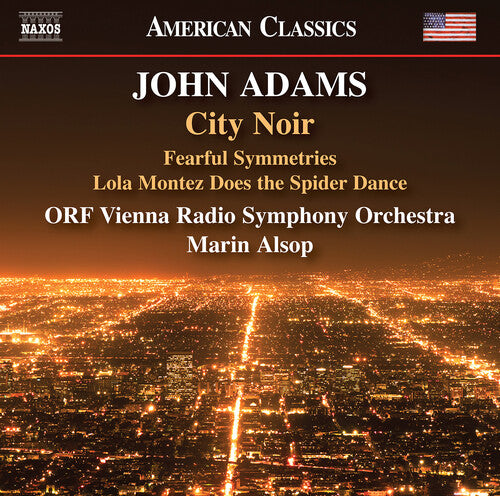
Adams: City Noir & Other Orchestral Works / Alsop, ORF VRSO
John Adams’ City Noir was inspired by the cultural and social history of Los Angeles, with the composer himself calling it ‘an imaginary film score’, while Fearful Symmetries exemplifies his steamroller motor rhythms. The album ends with a capricious ‘Spider Dance’ of memorable rhythmic drive – a work dedicated to Marin Alsop who leads the ORF Vienna Radio Symphony Orchestra in these performances.
REVIEWS:
Marin Alsop has been quietly championing John Adams abroad—and now at the Met Opera conducting his El Nino— for decades. A new Naxos recording with the ORF Vienna Radio Symphony Orchestra demonstrates her flair and feeling for his distinctive idiom. City Noir, premiered by the LA Phil in 2009, is a vivid, multi-textured score inspired by mid-20th century urban California. With its jazz inflections and brooding canvases, the debt to the City of Angels and film noir are equally clear. This is the work’s third recording but well worth acquiring for Alsop’s theatrical bite and detailed interpretation. Punchier than Robertson and livelier than Dudamel (though Robertson’s ravishing sonics make for essential listening), she holds the attention with a sure eye for the work’s architectural twists and turns. The companion piece is Fearful Symmetries from 1988, one of Adams’s most infectious scores and yet only receiving its second outing on disc. Alsop takes the chugging basic pulse a tad faster than the composer’s own recording without sacrificing any of the infinite variety to be found in Adams’s orchestral details. It’s a joyous, carefree work and beautifully recorded. The same goes for the recorded premiere of Lola Montez Does the Spider Dance. Happily rehabilitated after getting the chop from Girls of the Golden West, this six-minute essay in wriggling cross rhythms is laced with sardonic wit.
-- Musical America (Clive Paget)
John Adams’s City Noir has been pretty well represented on disc in the fifteen years since its 2009 premiere: Marin Alsop’s new recording of the score with the ORF Vienna Radio Symphony is the work’s fourth. In general, this celebration of the city of Los Angeles benefits from her approach. It’s swift and characterful...its structure emerges nicely intact in Alsop’s hands. The central “The Song is for You” boasts a series of idiomatic solos (especially from alto saxophone and trombone), at times seeming to channel Gershwin. [The] ORF’s woodwinds, trumpets, and jazz drummer really shine here. By about any measure, this is some brash and chill Adams.
Even more welcome is the pairing’s account of Fearful Symmetries, a half-hour-long study in rhythm and texture that’s only been recorded once before. Granted, that earlier release was led by the composer and it’s aged well. But Alsop’s new take is downright invigorating. The conductor brings a strong sense of drive to the music, drawing out a beautiful blend of colors – from invitingly swooning saxophone quartet playing to unexpected synthesizer colors – from her forces. What’s more, hers is a reading that manages to vigorously illuminate the sophistication of Adams’s compositional language, circa 1988. It’s a keeper.
-- The Arts Fuse
Gershwin: Porgy & Bess (Highlights) / Alsop, Philadelphia Orchestra
The Philadelphia Orchestra and conductor Marin Alsop present a live recording with highlights of Gershwin’s self-proclaimed American “Folk Opera” Porgy and Bess, together with a stellar cast and the Morgan State University Choir.
Since its premiere in 1935, Porgy and Bess has been one of the most significant early attempts to create American classical music inspired by African American styles such as jazz, Spirituals, and the blues. The hard-knock life at a Charleston waterfront tenement is presented here by an outstanding cast including Lester Lynch (Porgy), Angel Blue (Bess, Clara, and Serena), Chauncey Packer (Sportin’ Life) and Kevin Short (Crown and Jake).
Marin Alsop is one of today’s most acclaimed conductors, and the first woman to serve as the head of a major orchestra in the United States, South America, Austria and Britain. The Philadelphia Orchestra is one of the world’s preeminent orchestras. Multi-award-winning soprano Angel Blue is one of the most promising voices of her generation, while Chauncey Packer is arguably one of the greatest and sought-after Sportin’ Life interpreters today. Lester Lynch and Kevin Short each enjoy a flourishing stage career, as well as a vast PENTATONE discography.
REVIEW:
Soprano Angel Blue has already shown she can meet—and exceed—the vocal and dramatic demands of playing Bess in the recent Metropolitan Opera production, and so it's not surprising that her lovely voice is the highlight of this disc of excerpts from George Gershwin's emotionally powerful opera. Not only does Blue own Bess' classic songs but she also sings Clara's "Summertime" and Serena's "My Man's Gone Now" with equal parts power and finesse and an ability to grab the listener from the get-go. Lester Lynch's Porgy and Chauncey Packer's Sportin' Life provide superb vocal support and Marin Alsop conducts an expertly-chosen group of excerpts, strongly performed by the Philadelphia Orchestra and Morgan State University Choir.
-- The Flip Side
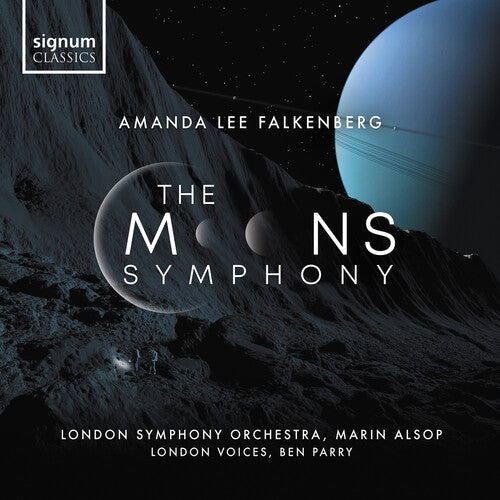
Falkenberg: The Moons Symphony / Alsop, London Symphony Orchestra
International award-winning composer Amanda Lee Falkenberg has composed a dynamic new work that merges music and science. The seven-movement symphony dramatizes past, present and future moon explorations, and highlights discoveries that have been made in our search for other worlds that could possibly sustain life.
Through seven exhilarating movements, concertgoers will experience a stunning space adventure that focuses on the stories of these fascinating moons. But what uniquely defines this symphony is its planetary core message which culminates in the 7th movement, dedicated to Earth-Moon. This final movement offers a discovery of a different kind and provides a unique opportunity to view our planet united and whole, from the surface of the Moon, a breathtaking, life-changing experience referred to as THE OVERVIEW EFFECT. The impact of such a privileged sight has inspired a call to action from Astronauts and as a result has propelled them to share this profound perspective shift with all of us here on Earth.
Through the persuasive and powerful forces of music, the symphony offers Earthlings a chance to contemplate who and where we are in the universe. In 42 minutes they will be taken on an emotional journey, marveling at the wonders of these moons, the beauty of our planet, and possibly even experience their own perspective shift as crew-mates aboard this spaceship we cruise, Earth. This is the story of THE MOONS SYMPHONY.
Learn more through the project's YouTube channel!
REVIEWS:
Growing up in the Barossa Valley, composer Amanda Lee Falkenberg had a better view of the starry night sky than most. Such a view doubtless inspired this seven-movement choral symphony, a majestic evocation of three moons circling Jupiter, two orbiting Saturn and one from Uranus, as well as our own moon.
An inquisitive and intrepid explorer, Falkenberg involved astronomers and astronauts in her quest to summon up each moon as vividly and accurately as possible. This research is reflected not only in the music but in the economically expressive sung texts which she also composed.
Out of hundreds of moons, Falkenberg’s choice illustrates enormous diversity: from Jupiter’s volcanic Io to oceanic depths of its sister Europa, then to the vast expanses of Saturn’s Titan, the mighty geysers of tiny Enceladus, the enormous canyons of Uranus’ Miranda and the magnetic force of Jupiter’s Ganymede. Finally, and most importantly, the symphony celebrates earthrise as seen from the surface of the moon, issuing a heartfelt call for all humanity to unite.
Unabashedly cinematic in style, Falkenberg’s score naturally pays homage Holst’s ground-breaking depiction of the planets, while also echoing film music great John Williams and occasionally Bernard Herrmann.
Falkenberg’s passionate and creative adaptation of the film music genre is firmly embraced by the committed artistry of the London Symphony under Marin Alsop and the warm cohesion and crystalline diction of the London Voices directed by Ben Parry, who recorded the choral music separately due to COVID restrictions.
The Moons Symphony offers a precious and timely perspective on our own fragile planet that we would do well to heed.
-- Limelight
Jandali: Concertos / A. McGill, Barton Pine, Alsop, ORF VRSO
Clarinetist Anthony McGill and violinist Rachel Barton Pine are featured soloists on a new recording of two concertos composed in response to societal injustices by Syrian composer Malek Jandali, performed by the ORF Vienna Radio Symphony Orchestra and led by Marin Alsop, a champion of the composer’s work.
Malek Jandali, called “deeply enigmatic” by Gramophone, has been praised for writing “heart-rending melodies, lush orchestration, clever transitions and creative textures” (American Record Guide). His repertoire, which ranges from chamber music to large scale orchestral works, integrates Middle-Eastern modes into Western classical forms and harmony. Rachel Barton Pine, “an exciting, boundary-defying performer” (The Washington Post), performs Jandali’s Concerto for Violin and Orchestra (2014), a work that honors “all women who thrive with courage” according to the composer. Jandali’s concerto is in recognition of the women of Syria, continuing his aim to preserve the cultural heritage of his homeland.
The Violin Concerto incorporates Syrian melodies and idioms into Jandali’s Western-inspired harmonies and forms. Jandali calls upon an array of Syrian and Arabic music forms and folk melodies including multiple sama’i and bashraf (instrumental pieces), and longa (dances), from different maqam (modes). He also makes use of the oud (Arabic lute) in his symphonic scoring to infuse the work with the authentic sound and feeling of Syria. A particularly notable sama’i inspired by traditional Syrian folk music from the area along the Silk Road Is used for a “Women’s Theme.” This theme is representative of the folk music that is a source of comfort and healing for unjustly detained, peaceful Syrian activists and other women and mothers living in fear.
Jandali’s Concerto for Clarinet and Orchestra (2021) is dedicated to its performer Anthony McGill (“the total package… stylish, passionate and limitlessly fluent on the clarinet,” Bachtrack), “in memory of all victims of injustice.” McGill says of the work, ”In the midst of the pain and the violence and injustice in the world all we are left with is the ability to pour our hearts and our souls into something more beautiful, into something more powerful, so it can communicate throughout all time and live on.” Like all of Jandali’s works, the clarinet concerto is infused with ancient themes from Jandali’s homeland as a means of preservation. Jandali explores variations on themes from old and traditional Syrian musical forms and modalities, with striking musical effects and wide ranging highs and lows in the orchestral writing.
Watch our Live Roundtable with Marin Alsop, Malek Jandali and Anthony McGill!
REVIEW:
The soloists shine, and Alsop and her Vienna Radio Symphony Orchestra accompany them faithfully through every mood.
Jandali’s Violin Concerto has a long and thoughtful opening moment, an introspective middle section and a dancelike finale. He uses the Arabic oud in conversation with the violin, as plaintive voices crying out with dignity and restraint. (Kudos to oud soloist Bassam Halaka.) And maybe that buoyant feeling in the finale represents not exuberance but defiance, as a protest against suppression.
The 25-minute clarinet concerto operates mostly on a mysterious plane, one we associate more obviously with Arabic elements. Some of the subtle, sinuous playing and percussive rhythms would not be out of place in a good Hollywood soundtrack – that’s a compliment – as Jandali slowly brings us into his sound world.
-- WDAV (Classical Public Radio, 89.9FM, Lawrence Toppman)
My First Classical Albums
CONTENTS:
Camilla Nylund Sings Masterpieces from the Great American So
Baiba Skride Plays Benjamin Britten / Alsop, ORF Vienna Radio Symphony
The story of the discovery and resurrection of Britten's Double Concerto for Violin and Viola is one of those rare moments of musicological spice that can capture the interest of even the more casual music lover. Unlike it, the Violin Concerto Op. 15 found itself thrust onto the world stage of music right away, its genesis having been rather straightforward – if hardly smooth.
Winner of the first prize of the Queen Elisabeth Competition (2001) Baiba Skride displays a natural approach to music-making that has endeared her to many of today’s most prestigious conductors and orchestras worldwide. She performs the Double Concerto with violist Ivan Vukcevic, who has appeared in some of the most important venues and festivals in Europe. They are accompanied by the ORF Vienna Radio Symphony Orchestra conducted by Marin Alsop, whose performances won her many Gramophone Awards.
Bernstein: Symphonies Nos. 1 & 2 / Alsop, Baltimore Symphony
Leonard Bernstein’s legendary 1943 Carnegie Hall conducting début brought his name to national attention, and the event was followed a few months later by the triumphant reception of his Symphony No. 1 ‘Jeremiah.’ This major symphonic statement explores a crisis in faith and employs Jewish liturgical sources, its final movement, Lamentation, being an anguished cry at the destruction of Jerusalem. Sharing the theme of loss of faith, Symphony No. 2 ‘The Age of Anxiety’ takes W.H. Auden’s poem of the same name and follows its four characters in their spiritual journey to hard-won triumph.
REVIEW:
It’s great to see this music being played with such conviction. We all know that Alsop is a superb Bernstein conductor, and Naxos already has a terrific account of the First Symphony from James Judd and the New Zealand Symphony, but this newcomer is, if anything, even finer–certainly sonically–and conducted with even more pizzazz. In the central Profanation movement, Alsop really does outdo Bernstein himself; the playing of the Baltimore Symphony here is sensational, and in the finale Jennifer Johnson Cano sings with great sensitivity and a beautiful tone. The tragic climaxes hit you right in the gut.
In the Second Symphony, Jean-Yves Thibaudet offers a first class account of his solo part. The Masque is especially outstanding–virtuosic but at the same time nicely “cool.” Prior to that, in the opening variation sets, Alsop knits the music together expertly, ensuring that the glum bits never bog down, and that the entire first part builds inexorably to its exciting conclusion. The following Dirge is is a barn-burner, and somehow after all of this the Epilogue never turns hollow. Again, I don’t think that Bernstein could have done better, and as suggested above the engineering is also rock solid and brilliant by turns. A marvelous release by any standard.
– ClassicsToday (David Hurwitz, 10/10)
Bartok: Concerto for Orchestra; Music for Strings, Percussion & Celesta / Alsop, Baltimore Symphony
Béla Bartók’s Concerto for Orchestra, one of his greatest works, was written in the United States after the composer was forced to flee Hungary during World War II. It is not only a brilliant display vehicle for each instrumental section but a work of considerable structural ingenuity that unites classical forms and sonorities with the pungency of folk rhythms and harmonies. Music for Strings, Percussion and Celesta explores darker moods through a score of marvellously poised symmetry. This release follows Marin Alsop’s ‘riveting’ (Gramophone) Baltimore Symphony recordings of Dvorák’s symphonies.
REVIEW:
Marin Alsop leads a splendid performance of the oft-recorded Concerto for Orchestra, full of character, whether in the jocular “games of pairs” second movement, the ensuing spooky elegy, or the finale that begins (seemingly) a touch reserved but takes off like a shot in the coda. It’s a memorable and wholly successful effort, excellently engineered to boot.
– ClassicsToday.com (D. Hurwitz)
Great Composers in Words & Music - Tchaikovsky
Is there any music more instantly recognisable and beautifully scored than Tchaikovsky’s wildly popular ballet Swan Lake? These and other works have become enduring classics, yet they were not uncontroversial in Tchaikovsky’s day, and there are those that still wonder if his style is fundamentally European or ardently Russian. Find out more about Tchaikovsky’s childhood obsession with music, his turbulent relationships with friends and colleagues, and how he overcame the deepest of personal crises to transcend all with a creative ambition that has left us with some of the greatest music ever written. The narrative is illustrated with musical excerpts from Piano Concerto No. 1, Symphonies Nos. 4 and 6, the 1812 Overture,The Nutcracker, Swan Lake and The Sleeping Beauty, among others.
Bernstein: 1600 Pennsylvania Avenue Suite, Slava!, CBS Music & A Bernstein Birthday Bouquet / Alsop, Sao Paulo Symphony Orchestra
James P. Johnson: Harlem Symphony, Concerto, Jazz A Mine / Alsop, Concordia Orchestra
Bernstein: Symphony No. 3 "Kaddish" / Alsop, Baltimore Symphony
Three examples of Leonard Bernstein’s vocal art can be heard in this recording. His Symphony No. 3 ‘Kaddish’ shuns traditional symphonic ideas in favor of an eclectic theatrical and oratorio-like form with a prominent rôle for speaker. For this recording, Marin Alsop has returned to the work’s original narrative text, heard before the 1977 revision. The Lark – heard in a concert version with added narration – derives from Lillian Hellman’s adaptation of L’Alouette on the life of Joan of Arc, and it was this music that Bernstein reworked into his Missa Brevis many years later. Music Director of the Baltimore Symphony since 2007 and Principal Conductor the São Paulo Symphony since 2013, the NYC-born Marin Alsop is recognized across the world for her innovative programming as well as her bold, audience-expanding community and education outreach initiatives.
REVIEWS:
Under Alsop's baton, the Baltimore Symphony realizes Bernstein’s extraordinary orchestral effects in ways that will both scarify you and tug at your heartstrings; and while the text is still the embarrassment it always was, narrator Claire Bloom delivers it as if it were Shakespearian prose. She believes in the part and gives it a powerful reading. Soprano Kelley Nassief will melt your heart in her “Kaddish 2” movement solo, and both the boy and adult choirs are superb. I’m really glad to have this performance, especially since my Columbia LP has disappeared and this is now the only recording I have of the original 1963 work. It’s a fantastic performance and a spectacular recording.
– Fanfare
Kaddish is recorded here in a performance of great conviction from Marin Alsop, with the wonderful Claire Bloom achieving a happy medium between the declamatory and the confidential. There are instances of pure gold - a consoling lullaby at the heart of the piece (featuring limpid soprano Kelley Nassief) which Bernstein called his 'Pietà'.
- Gramophone Magazine
American Classics - Barber: Capricorn Concerto / Alsop
Includes work(s) by Samuel Barber. Ensemble: Royal Scottish National Orchestra. Conductor: Marin Alsop.
Weill: Symphony No 1 & 2, Etc / Alsop, Bournemouth So
Prokofiev: Symphony No. 7 & Other Orchestral Works / Alsop, Sao Paulo Symphony
Sergey Prokofiev’s final years were clouded by ill-health, and the Seventh Symphony was his last significant work, full of poignant nostalgia and restrained but deeply expressed emotion. The Love for Three Oranges consolidated Prokofiev’s reputation in the West in the 1920s, both this and the satirical tale of Lieutenant Kije producing two of his most popular suites. This is the final volume of the acclaimed cycle of Prokofiev’s Symphonies with the Sao Paolo Symphony Orchestra conducted by Marin Alsop.
-----
REVIEWS:
Alsop captures the lyrical aspects of the Seventh work really well. She also has the advantage of a superior recording in the acoustically friendlier Sala São Paulo. The orchestra is superb throughout, but special mention should be made of the woodwinds that have notable solos in the work.
– MusicWeb International
This is one of the most desirable Sevenths on disc. The Sao Paulo orchestra are in good shape, and continue with a display of their refined tonal quality through the remainder of the disc, the creamy double-bass solo at the opening of the Romance in the Kije Suite worthy of special mention. Commendable inner detail, but play the disc at a very high volume to bring it to life.
– David's Review Corner
Puts: Symphony No. 2, Flute Concerto & River's Rush / Walker, Alsop, Peabody Symphony
Listen to the Naxos Podcast to learn more about this release
Awarded the Pulitzer Prize in 2012, Kevin Puts now stands in the forefront of contemporary American composers. His powerfully conceived Symphony No. 2 is a musical illustration of the events of 9/11 and traces a movement from unsuspecting bliss and rhapsody through violent upheaval to a reflective epilogue that contains both uncertainty and hope. Possibly inspired by thoughts of the Mississippi, River’s Rush employs novel harmonies, while elegant transparency distinguishes the refined beauty of the Flute Concerto.
REVIEWS:
A fine introduction to a rising composer whose music is highly accessible, emotionally satisfying, and memorable.
– All Music Guide
LSO principal Adam Walker plays the solo flute part with exquisite grace and purity of tone, and Marin Alsop elicits an impressively polished performance from Peabody’s student orchestra.
– Gramophone
Harris: Symphonies No 5 & 6 / Alsop, Bournemouth
No. 6, subtitled "Gettysburg", despite the titles of its various movements (Awaking, Conflict, Dedication, Affirmation) is about as programmatic as Bruckner's "Romantic" symphony. It works extremely well as absolute music. The same observation applies to the three-movement Fifth, which shares a very similar sound world. Both works were composed between 1942-44 when Harris was working at the peak of his inspiration.
Acceleration shares some thematic material with the Sixth symphony, and the title is deceptive. The movement hardly changes pace at all once it gets going, but as a seven-minute chuck of typical Harris it gets the job done nicely. To say that this music never has been better performed or recorded isn't saying much, since it has received hardly any attention at all. Marin Alsop and the Bournemouth Symphony deliver heartfelt, sincere performances entirely in keeping with the spirit of the music, and they are very well recorded. I welcome this release with pleasure, and so will you.
--David Hurwitz, ClassicsToday.com
Dvorák: Symphony No 9, Symphonic Variations / Alsop, Baltimore Symphony
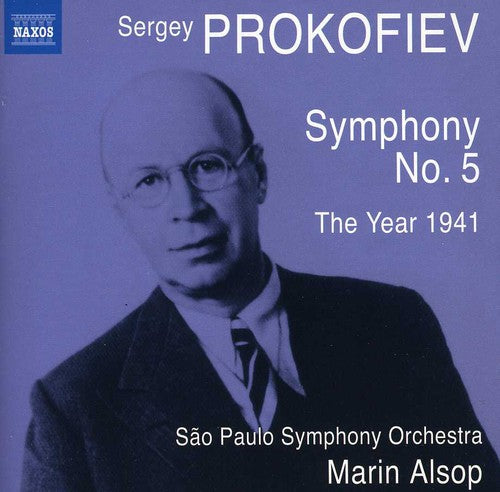
Prokofiev: Symphony No 5, The Year 1941 / Alsop, Sao Paulo Symphony
Written in 1944, Prokofiev’s Fifth Symphony is one of his greatest and most complete symphonic statements. At its première he himself called it “a symphony of the grandeur of the human spirit”. The first movement couples considerable strength with unexpected yet highly characteristic twists of melody. After a violent scherzo followed by a slow movement of sustained lyricism, with a fiercely dramatic middle section, the finale blazes with barely suppressed passion. The Year 1941 is another wartime work, a symphonic suite written in response to the German invasion of the Soviet Union. This is the first volume a of complete cycle of the Prokofiev Symphonies with the OSESP and Marin Alsop, the orchestra’s newly appointed principal conductor.
REVIEW:
Alsop is evidently a sympathetic interpreter of Prokofiev, because the tempo and pacing always feel spot-on, and the character of the music rings true. Naxos offers exceptional reproduction of the vivid instrumental colors with appropriately resonant acoustics, so this series starts off brilliantly, with worthy performances that sound terrific.
– AllMusicGuide.com
Orff: Carmina Burana / Rutter, Alsop, Bournemouth So, Et Al
Brahms: Symphony No 3, Haydn Variations / Alsop, London PO

Marin Alsop's recordings of Brahms' first two symphonies were good, at times very good, but not great. In particular, for all her basic musicality, the performances lacked a certain element of excitement, never mind actual risk-taking. So my expectations for this Third, the toughest of them all to conduct, were not that high. After all, some really great Brahmsians, including Toscanini and Furtwängler, have really screwed up this symphony. The latter's performances especially constitute some of the most hideously embarrassing documents ever left by a theoretically great artist. Indeed, in the entire history of the work on disc, there have been perhaps seven or eight truly great performances: Walter (Sony, stereo), Levine (RCA), Wand (his first one with NDR, on RCA), Klemperer (EMI), Jochum (EMI, with this orchestra), Dohnanyi (Warner/Teldec), and perhaps most surprisingly, Solti (Decca).
To this select list, add Alsop. This is not a judgment made lightly, but this is one hell of a fine performance of this most elusive symphony, perhaps closest in character to Dohnanyi's Cleveland version. It's interesting to note the dearth of German or central European orchestras in the above list, and this fact holds a clue to Alsop's success: her ability to keep the textures from becoming too heavy, and to keep Brahms' bass lines moving. Ordinarily, and particularly in the First and Fourth Symphonies, the typically dark, rich German bass is just the ticket, but not here. This symphony, with its obvious homage to Dvorák's Fifth in the same key, and its frequent recourse to syncopated rhythms in the middle registers of the orchestra, needs as much space around the notes as is consistent with lively tempos and well-sprung rhythms.
Part of the problem is of Brahms' own making. While the last three movements offer some of his finest orchestral writing, especially for the woodwinds, the first movement often comes across as a clogged-up mess. Conductors overcompensate for the lack of audible detail by playing the music too slowly. Alsop keeps the music moving, but also clarifies the underlying rhythm quite splendidly. As an example, consider the transition from the first to the second subject, and later on, the triplet accompaniments to the finale's heroic second subject. This is very good Brahms conducting: the tension never sags, no important details go unobserved (note the nicely touched-in contrabassoon just before the recapitulation), and nothing detracts from the evolving symphonic argument.
The Andante features beautifully blended wind playing in its serene outer sections and just the right touch of mystery in the central chorale. Alsop takes great care to observe the written dynamics, a big plus in the ensuing Poco Allegretto, which sounds so much better minus the usual excess of espressivo. Best of all, the finale is spectacular: swiftly exciting, with very present timpani and a tremendously explosive (but remarkably transparent) central climax. The coda captures that special, autumnal glow that Brahms builds into the scoring, but without sacrificing sufficient momentum to bring the work to a fulfilling (as opposed to a merely exhausted) conclusion.
The Haydn Variations makes an excellent coupling, and is equally well done. Alsop's excellent command of rhythm once again is very much in evidence, particularly in the Vivace fifth variation, and even without those darker, heavier bass lines the final passacaglia builds quite effortlessly to a joyous conclusion. Vividly detailed sonics seal the deal. The truth is that very few conductors manage to do all of the Brahms symphonies equally well, which is why the modern tendency to do them in fours is such a pity. This effort bodes well for the conclusion of Alsop's cycle, but at the same time it will be a tough act to follow. I hope she can do it; in the meantime, I'm more than happy to recommend this superb new recording as strongly as possible. [1/22/2007]
--David Hurwitz, ClassicsToday.com
Bernstein: Anniversaries, Fancy Free Suite, Overture to Candide & Overture to Wonderful Town / Alsop, Sao Paulo Symphony
The sparkling overture to Leonard Bernstein’s 1956 musical Candide immediately found a prominent place in concert programs all over the world and is now one of his most frequently performed pieces. Many of Bernstein’s best loved works drew inspiration from the city of New York, and this is true both of the three sailors pursuing female conquest in the ballet ‘Fancy Free,’ and of the rip-roaring swing rhythm and big tunes from the musical ‘Wonderful Town.’ Bernstein celebrated his friends and family with his ‘Anniversaries’- piano vignettes heard here for the first time in colorfully expanded orchestrations. Marin Alsop is an inspiring and powerful voice in the international music scene who passionately believes that “music has the power to change lives.” She became music director of the Sao Paulo Symphony Orchestra in 2012 and made history in 2013 as the first female conductor of the BBC’s Last Night of the Proms, which she returned to conduct in 2015. As a student of Leonard Bernstein, Alsop is central to his 100th anniversary celebrations, conducting Bernstein’s ‘Mass’ at the Ravina Festival, where she serves as musical curator for 2018 and 2019.
Hindemith: Nusch-Nuschi-Tänze - Sancta Susana - Mathis der Maler
Paul Hindemith’s life was dominated by the events of the two world wars. In 1917, his discovery of contemporary Expressionist poetry and drama transformed him from a talented student to Germany’s leading new composer. His one-act operas Sancta Susanna and Das Nusch-Nuschi date from this period. Sancta Susanna – Hindemith’s first masterpiece – combines religious and erotic symbolism into an eerie narrative that was shocking for its time, whereas the dance suite from Das Nusch-Nuschi emphasises the plot’s origin as a Burmese comedy. The three symphonic movements from the opera Mathis der Maler refer to the three panels of the Isenheim Altarpiece by Renaissance painter Matthias Grünewald, but also graphically reflect Hindemith’s own artistic struggles in Nazi Germany.
J.B. Robin: Time Circles / Alsop, Orchestre National de France et al.
There is a prevailing theme at the heart of Jean-Baptiste Robin’s work, one from which this album draws its name (Time Circles) and can only be translated by the language of sounds: that of time moving inexorably forward, gradually altering beings and things in its path, on into death and oblivion. The title of the first piece, Crop Circles (2012), refers to the man-made, symmetrical, geometric shapes found in crop fields. The slow introduction reveals two motifs: the first based on a symmetrical mode with a swirling melody, symbolizing the geometrical designs of the Crop Circles in question; the second introduces the human element into this semi-natural, semi-artificial world. In the Allegro, ‘the initial swirling becomes a whirlwind’ (J.-B. Robin), then in the slow central section the second theme appears on the solo violin, evoking man at the center of nature.
Following the example of Crop Circles, Zénith (2020) brings together man and passing time through two juxtaposing or overlaying themes. A first section introduces the pizzicato tick-tock of time, then later the human theme appears alone and rises to an intense lyricism. A brief coda on the tick-tock: the struggle between man and time inevitably ends in the latter’s victory. The theme of passing time is placed in a nocturnal setting in the three Poèmes de l'aube et de la nuit (Poems of the Dawn and the Night), wherein the unfolding of the night is ever perceived more slowly than the day. As such, there are no fast movements in these three poems, but instead alternating recitative sections and lyrical passages.
Prokofiev: Symphony No. 6 & Waltz Suite / Alsop, Sao Paulo Symphony
This fifth volume of the Prokofiev’s complete symphonies joins a series of acclaimed recordings from the São Paulo Symphony Orchestra with its principal conductor and music director Marin Alsop. Critics have warmly welcomed each release of this edition, from volume 1 with the Fifth Symphony from 2010, which “comes up trumps in a dramatic yet highly polished performance… an outstanding achievement” (BBC Music Magazine), to the “unfailingly good string playing, often more sensitively nuanced than that of her rivals…” (Gramophone) of volume 4’s Third Symphony.
REVIEWS:
Marin Alsop turns up with an excellent reading of the Sixth almost in spite of herself. Something in the work speaks, if not to her, then to the orchestra, which plays with fervor and intensity fully befitting the music and with considerable sensitivity to the many shades of darkness that Prokofiev here puts on display. Alsop seems more to be carried along with the music than to shape it—her overly fast finale, indeed, almost derails the movement’s effectiveness. But the performance as a whole turns out to be very successful indeed, with the gradations of Prokofiev’s anti-triumphalist writing coming through clearly and the sectional stability of the orchestra allowing the symphony’s many themes and unusual balances to emerge to fine effect. The reality must be that Alsop is responsible for shaping this very fine performance, but it almost feels as if the orchestra is playing without a conductor, with suppleness and sectional sensitivity that bring forth, all in all, a very impressive reading.
Alsop seems a stronger presence in the six-movement and altogether lighter Waltz Suite, in which Prokofiev recycled three pieces from Cinderella, two from War and Peace and one from an abandoned film project, Lermontov, into a half-hour suite that explores three-quarter time from a wide variety of angles and with numerous emotional high and low points. Again the orchestra delivers first-rate playing, and the result is a highly interesting juxtaposition of a 1945–47 symphony that is very serious indeed with a 1946–47 suite that remains determinedly on the frothy side.
– Infodad.com
Marin Alsop and the São Paulo Symphony Orchestra continue their Prokofiev series for Naxos with his sixth symphony, written as an elegy for the victims of the second world war but condemned as anti-Soviet and banned in 1948, a year after its completion. Alsop and her players handle the great climactic moments with elan but the central threnody lacks the compassion of, for example, Sakari Oramo’s recording with the Finnish Radio Symphony Orchestra. The vibrant Waltz Suite, however, really swings, with some stylish solo playing in all sections of the orchestra.
– Guardian
Glass: Symphonies Nos 2 & 3 / Alsop, Bournemouth Symphony
Elsewhere, the dark and brooding moods are never overplayed or undersold by Marin Alsop. This isn’t the world’s most virtuosic band, but they rarely, and only very slightly sound strained by Glass’s high-lying violin lines. More performances from the big-name orchestras would bring a more expressive, forthright performing tradition, and maybe a faster finale for the Third. Glass’s Indian roots are often on display (there’s an Eastern cut to his thematic jib, here), but expressive results are fruitful. There are some reminders of other symphonists. In the Second it sometimes seems Alan Hovhaness, Lou Harrison, and Bill Schuman have met up for a drink with Sibelius, who is playing the Widor Toccata over there in the corner. Glass’s individual symphonism works, though, in this 43-minute piece, thanks to the skillful manipulation of orchestral contrasts as a structural device, a legacy, maybe, of his film-score experience. The Third Symphony is closer to the Glass mainstream, in four short movements for strings alone. Here, Alsop’s patient approach brings out the meaning in the music, away from the talk of polyrhythm and process. There’s fear, anxiety, and dismay (the world) behind some of those sunny repetitions, and physicality in the dance rhythms. Well-caught pizzicatos in the second movement, too, and an expressive solo display from the violin in the edgy, pulsating third section, which is a major success in this tense, sensual reading.
I wholeheartedly recommend this release (the first of a cycle, I trust), and again salute Philip Glass for doing it his way. The music deserves the widest exposure and popularity, and it deepens with acquaintance. This Naxos CD transformed my opinion of these works.
Paul Ingram, FANFARE
Philip Glass' symphonies are unique among the composer's output for their relative harmonic and thematic complexity. Listeners put off by Glass' endlessly repeated arpeggios will be relieved to find scant evidence of them in these works. Instead, like his opera Beauty and the Beast, Glass spins long melodic lines that go through many harmonic permutations before they are inevitably repeated. Thus, Symphony No. 2's first movement creates an air of expectation, something that Glass maintains through shifting instrumental timbres and stimulating dynamic contrast as the movement builds, Bolero-like, to a grand climax. After the soothing, somewhat meditative sonic environment of the slow movement, the finale breaks in with its agitated dance rhythms. This movement has the least harmonic variety of the three, and listeners unsympathetic to Glass' method may experience repetition fatigue.
Symphony No. 3 is almost radical in its use of traditional forms, including chaconne and rondo. Glass replaces the expansiveness of the earlier work with a highly concentrated thematic process that packs substantially more musical ideas into only slightly more than half the former symphony's duration. The second movement is particularly interesting, with its compound meters and hints of Bartók. Marin Alsop brings her long familiarity with the composer's music to her convincing performances of both works, although she faces strong competition in the No. 3 from Glass specialist Dennis Russell Davies, who leads a slightly more compelling rendition with the Stuttgart Chamber Orchestra. For its part, the Bournemouth Symphony plays keenly, maintaining enthusiasm and rhythmic exactitude even in the more repetitious passages. Naxos' warm and spacious recording presents the music with a compelling impact. [12/03/2004]
--Victor Carr Jr, ClassicsToday.com
Daugherty: Route 66 / Marin Alsop, Bournemouth Symphony

Michael Daugherty manages to have his musical cake and eat it too. His music's eclectic "pop" elements rub shoulders with thoroughly modern compositional techniques. Time Machine, for example, requires three conductors, but its various textural layers and rhythmic complexities never sound confused. Indeed, its ticking woodblocks sound very much like Daugherty--something similar occurs at the start of Ghost Ranch, inspired by paintings by the always marvelous Georgia O'Keefe. Both this latter work and Sunset Strip are triptychs in the grand tradition of Ives (Three Places in New England) and Debussy (La mer).
Route 66, by contrast, is a seven-minute cross-country travelogue, and one of Daugherty's best-known works (after the expansive Metropolis Symphony). Marin Alsop has established herself as a champion of Daugherty's music, and performs all of it with obvious commitment. The Bournemouth orchestra, particularly its brass section (horns and trumpets), makes the most of the numerous solo opportunities that Daugherty offers the players. Naxos' engineers do an excellent job capturing the music's wide range of colors and, in Time Machine, its spacial elements. No reservations whatever--this is just excellent.
--David Hurwitz, ClassicsToday.com
American Classics - Barber: Knoxville - Summer Of 1915, Essays For Orchestra
-- Walter Simmons, Fanfare
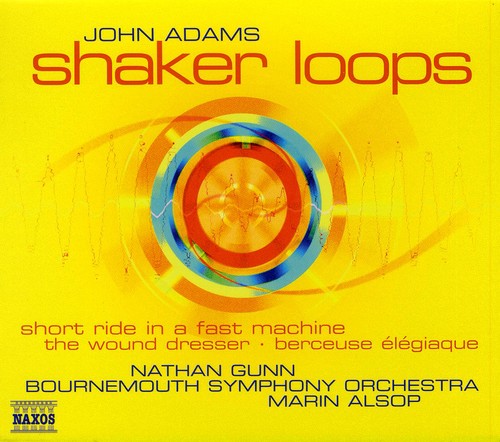
American Classics - Adams: Shaker Loops, Etc / Alsop, Gunn, Et Al
Alsop makes a good case for Short Ride and for the Berceuse élégiaque. The latter work is an arrangement for chamber orchestra of a work by Ferrucio Busoni—a fact that is not mentioned anywhere in Naxos’s documentation, shamefully enough. Adams, in his Nonesuch recording, is a little more weird and abrasive than Alsop in Shaker Loops—to good effect. All in all, the availability of the Nonesuch recordings does not make this Naxos release superfluous. Alsop is a fine conductor, the Bournemouth Symphony Orchestra plays well for her, and then there’s that Naxos price! If you’ve been curious about Adams’s music, but have not been willing to pay Nonesuch prices to hear it, here are four of Adams’s best works in competitive performances at a fraction of the cost.
Raymond Tuttle, FANFARE