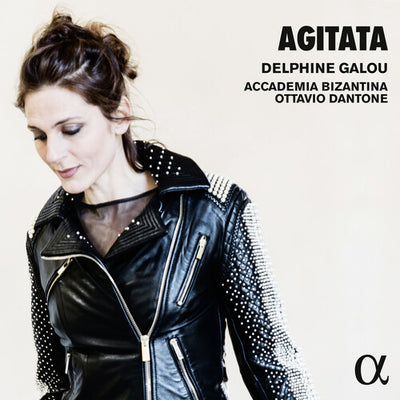
2018 Gramophone Magazine Recital Album of the Year
Delphine Galou is renowned and admired for her musicality and her appealing timbre. She has taken part in many productions of Baroque music and recordings of operas (notably by Vivaldi), but this is her first recital. It is a programme of sacred music, motets, cantatas and excerpts from oratorios, which in the course of the seventeenth and eighteenth centuries were influenced by the increasingly fashionable genre of opera. From the famous ‘Agitata infido flatu’ from Vivaldi’s oratorio Juditha triumphans, here counterpointed by an aria from another setting of the story of Judith composed by Jommelli, to Stradella’s Lamentations and Porpora’s magnificent motet ‘In procella sine stella’, Delphine Galou covers a wide range of spiritual emotions. She is accompanied by the excellent Accademia Bizantina under its director and harpsichordist Ottavio Dantone. A concerto byGregori and a sinfonia by Caldara complete this release, which includes several world premiere recordings.
-----
REVIEW:
This is a treasure trove of rare music, and Galou is the perfect singer to introduce us to it, thanks to an agile and comfortable technique (hear the way she sails effortlessly through her full compass in a single phrase in the first aria of the Porpora). The orchestral playing is keen as mustard and filled with typically telling detail by director Ottavio Dantone. A lovely disc of discoveries.
Ravel: L'Enfant et les sortileges; Ma Mere l'Oye - Complete Ballet
Naxos
CD · 1 disc
$9.99$19.99Save 50%Oct 09, 2015
Ravel’s opera L’Enfant et les sortilèges captures an imaginative child’s world in which the creatures and objects around him come to life. Wittily portrayed in Colette’s inventive libretto and by Ravel’s meticulous orchestration, furniture, crockery and animals alike are at first provoked by the child’s appalling behavior, finally helping him after he bandages the squirrel’s paw he had previously pricked with his pen. The unforgettably enchanting Mother Goose translates well-known fairytales into music, including the gently melodic Sleeping Beauty’s Pavane, her conversation with the gruffest of beasts, and a final blessing in The Fairy Garden. Leonard Slatkin, music director of the Orchestre National de Lyon and the Detroit Symphony, has made more than 100 recordings that in total have earned him seven Grammy® awards and 64 Grammy® nominations.
-----
Review:
The all-French cast articulate the text splendidly, with tenor Jean-Paul Fouchécourt doing his usual superb number as L'Arithmétique. Mezzo Hélène Hebrard as the Child sounds suitably young and fresh, soprano Annick Massis as the Fire negotiates her high coloratura with accuracy and élan.
Vivaldi: Il Farnace / Sardelli, Prina, Galou, Nesi, Castellano
Dynamic
CD · 2 discs
$24.99Jun 30, 2015
Il Farnace is the most re-written and re-proposed of Vivaldi’s operas. Versions of Farnace, two in 1727 and one each in 1730, 1731 and 1732, were conceived and adapted to the different circumstances for Venice, Prague, Pavia and Mantua, always with a cast to Vivaldi’s satisfaction and with the composer in control of the production. The greatest appreciation of Vivaldi’s operatic music was expressed in a letter by a spectator of the 1727 Carnival season. The abbot Antonio Conti wrote that of all the operas of the Venice season he liked best Farnace because its music was varied, “between the sublime and the tender,” and because Vivaldi’s pupil worked wonders. In 1738, for the Ferrara Carnival season, Vivaldi wrote a new score of the opera. This is the last Farnace, in two acts, as the third was lost.