Fall Into Classical Sale
Fall Into Classical with a collection made for the cozy season at ArkivMusic!
Explore over 150 titles at up to 25–30% off, featuring timeless works by Chopin, Debussy, Schubert, Brahms, and more. From intimate piano and chamber music to rich instrumental favorites, discover the perfect soundtrack for crisp mornings, quiet evenings, and everything autumn has to offer.
Shop the sale before it ends at 9:00am ET, Wednesday, September 16th, 2026.
172 products
-
Grand Piano - The Grand Piano Era / Bauer, Busoni, Et Al
Grand Piano (Nimbus) · Jul 20021 discCD$16.99 -
Prokofiev: Flute Sonata / Franck, C.: Violin Sonata (Arr. fo
Avie Records · Aug 20061 discCD$19.99 -
SaleCHOPIN: Piano Sonata No. 3 / Polonaise, Op. 61 / Scherzo, Op
Analekta · Aug 20081 discCD$20.99$15.99 -
Brahms: String Sextet No. 1, Op. 18 & String Quintet No. 2,
Haenssler Classic · Mar 20091 discCD$20.99
CHOPIN: Ballades / Fantaisie in F Minor / Galop Marquis
Naxos
CD · 1 disc
$13.99
$19.99
Save 30%
Sep 01, 1999
Chopin's four Ballades are among the greatest of his works, as is the Fantasia in F minor also included on this disk. The Ballades were composed between 1835 and 1843 and are generally believed to be based upon works by the Polish poet Adam Mickiewicz. This is music in the style of the medieval troubador, with singing lyrical sections alternating with music of wild passions, big chords, chromatic passages, and virtuosic runs. The first and fourth ballades, in G minor and F minor, tend to be more stormy and passionate while the second and third, in F major and A flat major are more reflective and lyrical. Biret gives a beautiful rendition of this music with beautiful, free rhythm, attention to dynamics and phrasing, and a full use of the resources of the piano. She captures magnificently the wild, virtuosic concluding passages in the first and fourth ballades.
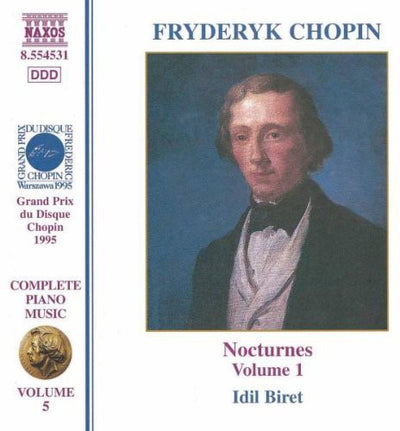
Chopin: Nocturnes, Vol. 1
Naxos
CD · 1 disc
$13.99
$19.99
Save 30%
Sep 01, 1999
Among forms that Chopin made his own was the Nocturne, at one time synonymous with the Serenade, but with the Irish pianist John Field and Chopin, his successor, a lyrical piano piece offering, nominally at least, a poetic vision of the night. Field wrote eighteen piano pieces with this title between the years 1814 and 1835 and these introduced a new form of piano music that was developed not only in the Nocturne but in other separate movements for piano throughout the century. Two nocturnes were published in 1840 by Eugéne-Thèodore Troupenas, who briefly replaced Schlesinger, whom Chopin now accused of sharp practice in disposing of one of his German copyrights, giving vent, in private correspondence, to his rooted anti-semiotic suspicions. The G minor Nocturne, Opus 37, No. 1, encloses a tranquil chordal E flat major section, and is followed by a G major Nocturne, with a lilting secondary episode. By 1841 disagreement with Schlesinger had been put aside and he published a set of two nocturnes, the first in C minor and the second in F sharp minor, dedicated to Chopin's pupil Laure Duperré. Opus 48, No.1, moves forward to a central C major section of gentler character, increasing in excitement as the opening material returns. The F sharp minor Nocturne that completes the set moves into a relatively sombre D flat major section of some harmonic complexity. Two more nocturnes were published by Schlesinger in 1844, dedicated to Jane Stirling, a middle-aged Scottish pupil of Chopin whose nuptial ambitions outweighed her musical talent. It was through her that Chopin travelled in 1848 to London and to Scotland and to an endless round of tedious social visits that lasted seven months, until he could escape back to Paris again, his health now much worse. In 1844, however, Chopin was still involved with George Sand, although their relationship had it's difficulties as her two children, Maurice and Solange, grew up and used him in their own rivalries and jealousies. The F minor Nocturne, Opus 55, No. 1, allows the opening material to re-appear in more elaborate form in conclusion. It is followed by a second, the Nocturne in E flat, marked by it's use of a second melodic voice, accompanying the first. Chopin wrote his last two nocturnes in 1846 and they were published in the same year by Brandus, who had bought Maurice Schlesinger's business and was later to acquire Troupenas. They were dedicated to another of the composer's piano pupils, Mlle. de Kînneritz. Opus 62, No.1, in B major, is introduced by two chords, the first suggesting another tonality. There is an A flat major central section and an elaborated return of the material of the opening section. The final work, the Nocturne in E major, has a secondary episode with a more energetic accompanying figure. The two nocturnes were written in the autumn of 1846 at Nohant, which Chopin only left in November to return alone to Paris, giving rise to rumors about a quarrel with George Sand, with whom he quarreled definitively the following year, after her daughter's marriage.
Childhood Christmas - Victorian Carols and Music
Gift of Music
CD · 1 disc
$18.99
Mar 01, 2002
Victorian carols and music. An old fashioned programme of Christmas songs and carols that children will love to listen to. From the story of 'Cock Robin' to well known Christmas carols, with a fascinating mix of sounds - bells, music boxes, accordions and piano.
Del Barroco Y Del Romanticismo Al Siglo Xxi / Prieto, Et Al
Urtext
CD · 1 disc
$16.99
Jan 01, 2004
Includes passacaglia(s) by George Frideric Handel. Soloists: Carlos Prieto, Edison Quintana, Juan Hermida, Juan Luis Prieto Reina.
Includes work(s) by various composers. Soloists: Carlos Prieto, Edison Quintana, Juan Hermida, Juan Luis Prieto Reina.