The surviving work of a mystery composer from the late French Baroque, in a new recording by a highly accomplished young early-music keyboardist. Nothing is known of Le Bret beyond the volume of keyboard pieces reproduced here, which analysis of both musical style and ancillary details has dated to the 1730s or 1740s. Whoever he was, Le Bret was clearly inspired by François Couperin and Jean-Philippe Rameau, and his style is comparable to that of the harpsichordists who followed in their footsteps between 1720 and 1740, such as Jean-François Dandrieu, François d'Agincourt, Joseph Bodin de Boismortier, Bernard de Bury and Jacques Duphly in his first two books. Like them, Le Bret alternates dances and character pieces. On the other hand, he makes no concessions to the taste for pastoral and country music, does not seem influenced by opera music, and does not overdo descriptive effects and virtuosity. All in all, Le Bret remains faithful to the subtle and poetic language of the harpsichord; as he says in his preface, he has 'always endeavored in composing them to adorn them with the most graceful songs, knowing from our most illustrious masters that this is the beauty of this instrument.' As Simone El Oufir Pierini observes in his booklet essay for this album, one evident example of Le Bret's knowledge of 'our most illustrious masters' arises in the piece titled L'Embarassante, a stylish homage to Les Cyclopes by Rameau. Born in Rome in 1996, Simone El Oufir Pierini studied piano at the conservatoire of the Accademia Nazionale di Santa Cecilia. Developing a particular interest in historically informed piano practice, he attended masterclasses led by Alexei Lubimov and Andreas Staier, before undertaking specialised study of harpsichord and basso continuo with such teachers as Andrea Coen and Giovanni Togni. He has made several wellreceived albums for Brilliant Classics, both solo and with colleagues.
Tessarini: Allettamenti da Camera for Violin Solo & Bass
Brilliant Classics
CD
$12.99Jul 12, 2024
Music for 'The Cardinal King': the only complete available recording of an engaging chamber-collection from 18thcentury Rome, written for the head of a renegade English Catholic family in exile. Several previous Brilliant Classics albums have given notice of the under-appreciated gifts of Carlo Tessarini (1690-1766). Collections of his violin and flute sonatas have revealed a consistently inspired and stylish voice, reliably well-turned melodies and shapely instrumental parts rewarding players and listeners alike. The same qualities illuminate this collection of five Allettamenti da Camera, composed in Rome in 1740 and dedicated to His Royal Highness Henry Duke of York. By that stage in his career, the Rimini-born Tessarini had worked for courts and aristocratic patrons in Venice and Urbino. He had lately moved south to Rome, perhaps in hope of currying favour with the Stuarts, who had lived in the city as celebrated exiles for some years. Surely no dedicatee, whatever their musical expertise, could fail to be delighted by music of such accomplishment and sunny elegance. Each of the five Allettamenti is cast in a tripartite quick-slow-quick form of sonata movements, and they are crowned by a virtuosic, two-part Capriccio which allots a starring role to the solo violin in a set of increasingly elaborate variations. All the same, Tessarini departed for Naples shortly after their composition, and continued on his travels across Europe, finding receptive audiences in France, England and the Netherland, where he died early in 1767. This new recording has been made by an ensemble of Italian early-music specialists who have gathered for the purpose under the banner of the Cappella Musicale Enrico Stuart. They are led by the violinist Gabriele Pro, who is joined by Andrea Lattarulo (cello), Michele Carreca (theorbo and guitar) and Simone El Oufir Pierini (harpsichord). Pierini has won glowing opinions for previous Brilliant Classics albums dedicated to the music of Cherubini (96246), de Montgéroult (96247) and Tinazzoli (96865).
Gottfried Grunewald was a successful opera singer in 18th-century Germany, based at the theatre in Hamburg for many years, but a familiar figure in German courts and theatres across Germany. When he died in 1739, the composer Christopher Graupner (his colleague in Darmstadt) destroyed most of Grunewald's music, according to an agreement they had apparently made. Only seven keyboard partitas are known to have survived to modern times, and they receive their first complete recording here in the spirited hands of Fernando de Luca, who has done so much to rescue forgotten names from obscurity with his albums for Brilliant Classics. The loss of Grunewald's output becomes especially regrettable once close attention is paid to these Parititas. They reveal a deep knowledge of the instrument's technique and a refined compositional taste. Stylistically close to German composers of the time such as Kuhnau and Fischer, they also bring to mind the suites composed in Germany by the young Handel (preceding the Eight Great Suites), and the music of the young Graupner. Grunewald shows some skill as a contrapuntalist within the restrictions of the suite genre. The preludes of these partitas are not uniform in form; for example, the Prelude in D minor incorporates broad arpeggiated chords, which begin and end a strict fugue but then dissolves into free motivic play. Another is purely figurative, a third mixes movement with short imitations. Grunewald's allemandes build up like intricate etudes, including one example constructed in an organistically contrapuntal manner. The courantes are interwoven with imitative passages, the sarabandes are melodically appealing, sometimes breathing in the spirit of Handel's nobility of gesture. The doubles and minuets almost give the impression of variations. Some pieces have strongly emphasised French rhythms, others avoid it completely. Potentially incomplete, but certainly striking, is the two-movement Fourth Suite, with it's spacious Allemande followed by an imposing Chaconne, presenting a complete contrast to the nine brief dances of the Fifth Suite, which find Grunewald at his most French-accented. Reviewing the recent set of the harpsichord music by Pierre-Thomas Dufour on Brilliant, Fanfare noted: 'De Luca does a fine job in his performance, with a good sense of phrasing and registration.' - Gottfried Grunewald (1673 -1739) was a German opera singer, harpsichordist and composer. Nothing is known about his youth and training. From 1703 he was a singer and composer at the Oper am Gansemarkt in Hamburg. From the beginning of 1709, he worked as Vice-Kapellmeister at the court of Johann Georg von Sachsen-Weissenfels, where he married Johann Philipp Krieger's daughter. From 1711, he worked as vice-chapelmaster at the court in Darmstadt as Christoph Graupner's deputy. Around 1717, several journeys as a pantaleon virtuoso are documented. He remained active at court until his death. - Of his works, only seven partitas for harpsichord have survived, written in the style customary for the time. The suites consist of the usual order of Prelude-Allemande-Courante-Sarabande-Gavotte-Menuet-Gigue. - "too many performers confine themselves to the standard repertoire. Fortunately, there are artists who look beyond the obvious; Fernando de Luca is one of them and we should be thankful for him. de Luca is a good interpreter; I very much enjoyed his performances, they are as differentiated as possible, also in his treatment of the tempi. He has the advantage of a fine instrument, a copy of a Blanchet of 1754. That is as 'authentic' as one could wish for." Thus wrote Musicweb International about de Luca's recording of harpsichord works by Foucquet.
Bernardini meets Dreyer: a distinguished period-instrument oboist explores the music of a little-known Florentine forebear. Domenico Dreyer was born in Florence in 1701 to an Italian mother and German father, at a time when Italy was experiencing a golden age for the oboe, led by technical innovations in the design of the instrument. The family was musical, but why he picked up the oboe is unknown, as is most of his early life. At any rate, these sonatas are preserved in manuscript form under his name - his only surviving music - and may have been published in 1727. What we do know is that Dreyer travelled with his brother, a singer and impresario, across Europe and as far as St Petersburg. In the early 1730s Dreyer was playing in Venice, where he most likely met Vivaldi, and a musical link between the two men is illustrated by these six appealing sonatas. At any rate, Bernadini is drawn to these sonatas, as he explains in a booklet introduction, 'because they combine ornamented and very expressive slow movements with fast movements of great virtuosity, using the possibilities of the two-key oboe to the extreme.' Bernadini draws out various thematic correspondences between particular movements of the sonatas and various parts of Vivaldi's output, while observing a more general Vivaldian flavour to the writing. We might know more but for Dreyer's sudden and unexplained death at the age of 34, 'due to an unfortunate event,' according to the best historical record available. The sonatas may be enjoyed on their own terms, however, as stylish examples of Italian Baroque chamber writing at it's zenith. They are performed here by Bernadini on a copy of a 1730 instrument by Giovanni Maria Anciuti (1674-1744), the most important Italian wind instrument maker of the time. Not only is this the closest available instrument to Dreyer's sonatas in terms of place and date, but it is also one of the few 18th-century oboes to feature the low C sharp, which Dreyer notates at the end of the Fourth Sonata. He is joined by a quartet of fellow Italian period- instrument specialists, who supply a richly varied continuo section. - Domenico Maria Dreyer (ca. 1680 - ca. 1740) was the son of the German tenor Johann Conrad Dreyer, born and raised in Florence. His life was closely linked to that of his younger brother Giovanni Filippo Dreyer, a castrato, impresario and opera composer. The brothers worked for a long time at the courts of Moscow and St. Petersburg and later in Italy. - Six oboe sonatas and two recorder sonatas have survived from his oeuvre. The oboe sonatas are of great musical beauty and stylistically belong to the Venetian High Baroque period of his contemporary Antonio Vivaldi. It is assumed that they were composed around 1725. - Each sonata typically follows a four-movement structure, alternating between slow, lyrical passages and lively, dance-like sections. This format allows for a rich exploration of the oboe's tonal capabilities, from it's warm, mellow low registers to it's bright, penetrating highs. Dreyer's sonatas often feature elaborate ornamentation and intricate melodic lines, demanding both technical proficiency and expressive nuance from the performer. - Played by the famous Italian oboist Alfredo Bernardini (founder of the Zefiro Ensemble) and a continuo group consisting of cello, archlute and harpsichord/organ.
18th-century sonatas by a pair of musical brothers, in stylish historically informed performances from 1994. Very little music by the brothers Groneman is known in modern times beyond the pieces on this album, which have survived simply because of their popularity with flautists of their day. Pleasing both to hear and to play, these sonatas exert an additional fascination today for the insights they give into the taste and technique of the 18th-century flautist. Johannes Albertus Groneman (c.1708-1781) and Johannes Fredericus Groneman (1711-1778) were both probably born in Cologne, where their father was a military-band musician. Albertus developed his skill as a violinist beyond mere proficiency, and left to ply his trade as a jobbing musician in what is now the Netherlands. Having settled in Leiden around 1731, he wrote virtuosic pieces for violin and flute which proved popular enough to be published and republished in London and Paris. He performed throughout Holland, and then moved from Leiden to The Hague, where he was awarded a lucrative and coveted position as church organist. This career of steady accomplishment and gathering renown came to a sudden and tragic end in 1756 when he was committed to an asylum, where he lived out his days in penury. Meanwhile Fredericus is a much more shadowy figure to us: the three books of his flute sonatas listed in contemporary publishers' catalogues have disappeared, as have any details of his life and career. Of his gifts as a musician, there can be no doubt, to judge from the sonatas presented here, showing as they do an up-to-date knowledge of the latest musical trends set by masters such as Tartini and Geminiani, and yet display an expressive style entirely their own. Likewise, the two flute duets by Albertus Groneman demonstrate why his music proved to be so popular during his lifetime: they are in turn gracious, surprising, virtuosic and sweetly-singing, and display the full range of the flute's possibilities. Like Telemann's duets of the same period, they are full of fantasy and.wit and testify not only to the worthiness of their creator, but also to the taste of the 18th century flutist who loved them so well. Originally issued on the Dutch label NM Classics, this reissue restores a valuable window into the vibrant culture of chamber music in 18th-century Holland, performed by specialists in the field. - Johannes Albertus Groneman (baptized 1711-1778) and his brother Johannes Fredericus were born in Hamm (Germany) into a musical family. They enjoyed an education typical of musician's sons in the 18th century, learning from their father the trade, playing several instruments and instructed in composition, harmony and singing. Through his teacher Carl Rosier Albertus was introduced in the Netherlands, where he settled in Utrecht in 1729, later moving to Leiden. It is during this Leiden period that most of Groneman's music which survived, and indeed probably all of the music of this recording, was composed. Upon his arrival in the famous university town, Groneman was able to establish himself with ease in the highest social circles, enjoying the friendship and patronage of patricians and professors, while wealthy merchants and musicians of international repute became godparents to his children. He bought a Stradivarius violin and an especially beautiful harpsichord made by famous Flemish harpsichord maker Ruckers. He published virtuoso music for violin and flute which proved popular enough to be published and republished in London and Paris. - The Flute Sonatas consist of three movements, brilliant allegros framing a melancholy and moving andante full of bold harmonies. The style is gracious and sweetly-singing, displaying the full range of the flute's brilliant possibilities. - Performed by Jed Wentz, a pioneer in the performance practice of notably French Baroque music for his instrument. His many recordings for Brilliant Classics (J.S. Bach and C.P.E. Bach, Blavet, Couperin, Boismortier, Braun, Roman) have established him as one of the foremost interpreters in this field. - Recorded in 1994, a reissue from the NM Classics catalogue, the label for music from the Netherlands.
Another discovery unearthed by Brilliant Classics, and another name to add to the library of French-Baroque masters, from the voraciously inquisitive mind and virtuoso hands of Fernando de Luca. Who was Hubert Renotte (1704-1745)? He was born and died in the Belgian city of Liege, and for the last decade of his life served as the titular organist of the cathedral there. Accordingly he wrote a good deal of church music, which remains as overlooked as his output for keyboard. This in itself encompasses not only organ music but the distinctively Franco-Italian style of the harpsichord pieces presented for the first time on record in the present album. The C major Suite is launched in dazzling style with 'Les Roulades et Harpeggio', living up to it's title with cascades of sequences up and down the keyboard. Renotte must have been quite the technician, as well as a composer of great taste and refinement. Perhaps he had a sense of humour, too, to judge from the third movement of the suite: 'Les Bagatelles Ou Les Folies de Liege & Menuet en Suite Des Bagatelles'. Again, true to the title, Renotte presents a series of sharply etched, fantastical sketches, which we might now hear as proto-Beethovenian in their oblique and disconcerting wit. The Suite concludes with, literally, 'Le Torrent', another sparkling cataract of notes. Whether or not Renotte ever intended them to be played in sequence this way - the music survives in manuscript, and there is no sign that they were published - the other pieces are also gathered up by key signature. There are 17 such pieces in D major, including a 'Pastorella' whose charming character belongs to the association of the key with country manners. On this new recording, Fernando de Luca plays a modern copy by Claudio Capone of a Blanchet harpsichord from 1754. While Jos van Immerseel recorded an LP-length selection of Renotte's works, this is the first time that the composer's surviving keyboard music has been recorded complete. The album represents another feather in the cap for a musician who has done a great deal to revive forgotten names from 18th-century music with complete surveys of their music on Brilliant Classics, among them Dufour, Foucquet, Jollage and Siret. '[De Luca] thinks outside of the box, and he clearly is a man with discerning tastes. These extend to his playing, which is clear-headed and disciplined, but never rigid. "Charm" is such an overused word, but I cannot think of a better one to describe this music and these performances.' (Fanfare on the Jollage album, January 2024)
Pachelbel: Hexachordum Apollinis & Chaconne for Harpsichord / Bissolo
Dynamic
CD
$18.99Aug 19, 2022
Johann Pachelbel is remembered today for his Canon in D major, but he was an outstandingly successful organist and composer whose musical legacy is in fact quite broad and varied. Of his keyboard pieces the Hexachordum Apollinis is regarded as the pinnacle of his oeuvre and was a work to which Pachelbel himself attached great importance. Consisting of six arias with variations, the collection brings together the influence of several schools of music, all filtered through the composer’s refined tastes and superlative technical skill. The splendid Chaconne anticipates Bach and is one of Pachelbel’s best-known keyboard pieces.
REVIEW:
The title work on this disc is a fascinating composition. A set of 6 arias with variations written for either harpsichord or organ. Mathematically complex with symbolism relating to numerology and the Kabbalah the booklet notes point out some interesting features and point to a work that should perhaps be more widely known and appreciated. The Chaconne is a more known work.
Baroque composer and violinist Giuseppe Tartini took up the violin after fleeing persecution by Cardinal Giorgio Cornaro. While seeking refuge at the monastery of St. Francis in Assisi, he heard Francesco Maria Veracini’s playing. After hearing such virtuosic talent, he fled to Ancona and locked himself away to practice, emerging an extraordinary violinist. Tartini’s Sonatas show the intimacy of the composer’s abilities, while the Concertos broadcast the musician’s big artistic personality. The works brilliantly complement one another on this release. For more than twenty years, violinist Crtomir Siskovic has dedicated himself to Baroque music. He performs with a violin and bow from the era, and has recorded multiple albums of Tartini’s music.
English Suites is the title traditionally given to Bach's splendid collection of dances, assembled by tonality and preceded by a Prelude, probably dating form the second decade of the 1700's, perhaps before 1717. Forkel states that the suites were composed for an English nobleman, but adds nothing more. Recently, scholars have made various suggestions: some think that the word English, for thes epieces which Bach defined Preludes avec les Suites, BWV 806-811 have always been considered the worthy counterpart of the French Suites BWV, 821-827. Alessandra Artifoni, who already recorded for Dynamic the latter, two years later proposes their twin collection, using an instrument built by Tony Chinnery after Mietke, and Neidhardt temperament.
Bach: 6 Trio Sonatas, BWV 525-530 (transcribed for harpsicho
Dynamic
CD
$14.99$18.99Save 20%Apr 12, 2019
This album features a new arrangement for harpsichord and guitar of Bach's six trio Sonatas for organ BWV 525-530. Extravagantia duo, two talented and learned young musicians, takes the challenge to confront themselves with Bach's organ masterpieces with a new and fresh approach which aims to explore from an unusual perspective a piece of traditional repertoire. Luigi Accardo and Francesco Molmenti dig deeply into Bach's historical background and create a musical language of their own. Francesco Molmenti began studying guitar at age 11. He went on to earn his diploma at the Conservatory of Trieste in 2003. He has won several national and international competitions since. Currently, he performs as a soloist, with the Res Intimae guitar trio, and the present ensemble, the Extravagantia Duo. Luigi Accardo was born in Cagliari. He graduated in Piano from the Conservatory of Cagliari and in Harpsichord from the Conservatory of Piacenza.
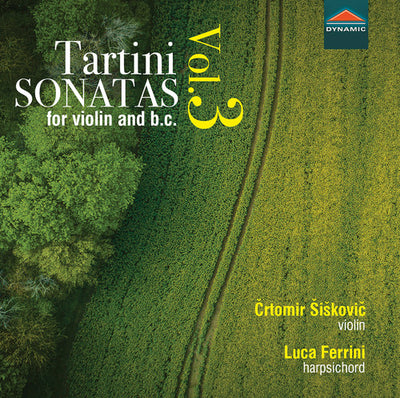
Tartini: Sonatas for Violin and Basso Continuo, Vol. 3
Dynamic
CD
$18.99Apr 12, 2019
This release features Vol. 3 of Tartini's works for violin and harpsichord, adding another significant piece to Dynamic's releases by the baroque composer. The works are performed here by the duo Crtomir Šiškovic (violin) and Luca Ferrini (harpsichord), who were also featured also in Dynamic's Vol.1 and Vol. 2. Both musicians are highly praised specialists for this kind of repertoire. Born in Trieste, Crtomir Šiškovic studied at "Glasbena Matica" and graduated from the G. Tartini" Conservatory of Trieste. He enjoys performing in various chamber groups as well as performing as a soloist with prestigious orchestras. Luca Ferrini studied at the conservatories Tartini in Trieste, and Tomadini in Udine, obtaining full marks for both piano and harpsichord. He is a renowned concert pianist, performing all over Europe as a soloist and member of chamber ensembles.
Franois Couperin’s Concerts Royaux (1722) and Les Nations (1726) use open scoring, indicating that they could be performed by whatever instruments were at hand. + He later confessed that he himself preferred to perform them on two harpsichords. + This suggestion had to wait for these two CDs to be taken up in a recording (the second CD is being readied for future release). + Also presented are a number of his Pices de clavecin, also in rarely heard realizations for two harpsichords.
Tilman Skowroneck writes: "This recording was initiated by Bengt Nassen, the owner of the harpsichord by Martin Skowroneck (1926-2014) that is featured here. Initially, I was planning to play music by Bach and Handel on this German instrument, which is based on early eighteenth-century models, but after acquainting myself with the instrument's possibilities, I was led in a different direction. It's sound is located somewhere between Italian brilliance and a more intimate vocal character. Some French builders of the seventeenth century made instruments whose characteristics were quite similar, even though they arrived at these results by different constructions. And so the idea was born to use this sound to retrace the connections between the Italian and French sound worlds of the late seventeenth century." Tilman Skowroneck was born in Bremen in 1959 and studied harpsichord in The Hague and Amsterdam. After his studies he established himself as a freelance harpsichordist in Germany and Holland. Since 1996, Tilman Skowroneck has participated at various early piano seminars at the University of Gothenburg and the Gothenburg organ centre GOArt. He is currently senior lecturer for musical performance at the Academy of Music and Drama, University of Gothenburg.
Leonarda: Solo & Duo Motets, Trio Sonatas, & Cantata morale / Crowe, Roddiger, Gandilyan
Toccata
CD
$20.99Sep 02, 2022
Isabella Leonarda (1620–1704) was a remarkable woman. At a time when female composers were a rarity, she was both prominent and prolific. Although she was cloistered (literally: she was a nun) in Novara in northern Italy, the dedications of her published compositions show her to have been extremely well connected. And her music demonstrates that she was well aware of the music of contemporaries like Carissimi or Corelli. These facts would be of merely historical importance, were her music not so engaging. Although most of the works recorded here are devotional, they are full of buoyant rhythms, colorful textures and a surprisingly dramatic approach to the texts she was setting – many probably written by Leonarda herself.
Bach: Concertos for Harpsichord, Vol. 2 / Masato Suzuki, Bach Collegium Japan
BIS
SACD
$21.99Jul 01, 2022
The concertos by Johann Sebastian Bach for solo harpsichord and strings are some of the earliest, if not the very first, keyboard concertos. In all likelihood Bach wrote them for his own use (or that of his talented sons) – probably to be performed with Leipzig’s Collegium Musicum. The concertos’ fresh and exuberant character reflects how much Bach enjoyed the opportunity to engage with his fellow musicians, a quality that also came across on Masato Suzuki’s first installment of Bach's harpsichord concertos together with his colleagues in Bach Collegium Japan: ‘sparkling performances... [Suzuki’s] remarkable virtuosity is beautifully projected by BIS’s excellent SACD recording’ (MusicWeb-International). Despite how idiomatic they may sound, many of Bach’s harpsichord concertos are almost certainly transcriptions of earlier works written for other instruments. Of the works presented on this second volume, BWV 1054 and BWV 1058 are adaptations of violin concertos composed while the composer was living in Cöthen. The model for BWV 1055 has been lost but it is believed to be a concerto for oboe or viola d’amore. BWV 1057, finally, is an adaptation of the well-known Brandenburg Concerto No. 4, transposed down one step but retaining the original’s two recorders. As examples of musical recycling, these works display Bach’s uncanny ability to re-use successful music ideas and give them a new meaning and significance.
REVIEWS:
Masato Suzuki proves an ideal keyboard soloist, balancing moments of zestful virtuosity with some elegant inequality in the passagework. Willem Kroesbergen’s copy of a contemporary Couchet harpsichord on which he plays is characterful with a pleasing range of timbre; and throughout, in these well-recorded performances, it blends attractively with the other instruments.
Nearly all Bach’s harpsichord concertos are arrangements of earlier works composed for entertainments in the relaxed environment of Gottfried Zimmermann’s Leipzig coffee house and garden where they were directed by the composer, presumably with a number of his sons as soloists. Two of the concertos recorded here are versions of Bach’s two familiar violin concertos, a third is of BrandenburgConcertoNo. 4, and the charming A major concerto derives from a concerto for oboe d’amore.
Unsurprisingly, with its appropriately modest orchestral forces, the Bach Collegium Japan goes in for brisk tempos, but without any sense of rushing or impatience. A prime example is the first movement of the D major Concerto, with carefully considered phrasing and excellent timing from the orchestra matched by dazzling harpsichord solo playing.
Johann Sebastian Bach's flute sonatas are chamber music repertoire of rare quality. The six sonatas are all very different from one another in both style and character, and they provide a musical material to explore in depth, to live with and to discover new elements to over a whole lifetime. It has taken a certain amount of courage for these three young musicians at an early stage in their careers to choose to record this particularly well-known repertoire. Their aim with this recording has been to play as they, at this point in their lives, feel that the music must be played. They want each moment, tone or phrase to exhibit complete conviction in it's interpretation, as a result of their ensemble's performance, based on impulses and inspiration between the musicians.
A busy schedule as music director of the Bach Collegium Japan and sought-after guest conductor doesn’t stop Masaaki Suzuki from returning to his first loves, the organ and the harpsichord. With the present release he adds yet another chapter to his series of Bach’s works for solo harpsichord. After acclaimed recordings of the Well-tempered Clavier, the Goldberg variations, the French Suites and other works the turn has come to the English Suites. Composed while Bach was in his thirties it precedes other sets such as the French Suites and the Toccatas, and in his liner notes, Bach scholar Yo Tomita draws attention to 'the stylistic traits of a youthful and ambitious composer wanting to make his mark through the use of counterpoint and virtuosity'. Despite its title, the collection has very little to do with England, at least musically: the six suites are instead rooted in the French tradition, and show certain striking similarities to the composer Charles Dieupart’s Six Suites pour le Clavessin from 1701. (Bach made a copy of Dieupart's set sometime between 1709 and 1716.) It was only in the 19th century that the suites became known as the 'English', based on a never substantiated claim that the set was commissioned by an English nobleman.
Telemann: The Recorder Sonatas / Laurin, Paradiso, Olofsson
BIS
SACD
$21.99Aug 05, 2022
Over the past decades, Dan Laurin has established himself as one of the most interesting recorder players of our time. His more than 30 critically acclaimed releases on BIS range from a seminal 9-disc set of van Eyck's Der Fluyten Lust-hof to contemporary concertos. The first recordings Laurin made for the label were of duets by Georg Philipp Telemann, and since then he has returned to the composer several times, recording chamber music and concertos. It is only now that he has set the complete sonatas on disc, however – works that he describes in his liner notes as forming part of most recorder players’ ‘musical DNA’. Performing them here with his regular chamber music partners Anna Paradiso and Mats Olofsson, Laurin revels in the wide technical and emotional scope of the sonatas as well as their stylistic diversity. In the C major sonata TWV 41:C5 Telemann looks backwards as he pays tribute to his illustrious forerunner Corelli, while the Empfindsamkeit of the Affettuoso of the D minor sonata is very much of its time – and throughout the collection there are traces of composer’s fascination for Polish folk music.
The Art of Fugue emerges as the central instrumental project of the last decade of Bach’s life, after a gradual development over several years: the exploration in depth and with an overflowing musical imagination of the contrapuntal possibilities inherent in a single musical subject. In this work, the theoretical component of Bach’s thinking is at its clearest: theory and practice merge, old and new stylistic elements and compositional techniques are integrated and demonstrate in an incomparable way his individual approach to composition.
Since Bach gave no indication of the instrument, nor does his writing shed any further light on the subject, one might even wonder whether this work is a purely theoretical work, intended solely for musical analysis. However, since the composer’s rediscovery in the nineteenth century, musicians have appropriated the work, whatever their instrument. It is now generally accepted that the work was composed for the keyboard. A second harpsichord part is added for three fugues, played here by Masato Suzuki.
After several acclaimed recordings of Bach’s works for keyboard instruments, Masaaki Suzuki finally takes on this immense work, the pinnacle of the cantor’s art and one of the absolute peaks of Western music.
REVIEW:
Although Masaaki Suzuki’s solo harpsichord Bach recordings span several decades, his technical and musical consistency seems to defy time, as borne out in The Art of Fugue. He continues to use a Willem Kroesbergen harpsichord modeled after a Flemish Baroque-style instrument, whose transparent timbres befit the vocal orientation governing his phrasing. For example, his tempos never move faster nor slower than one can comfortably sing. As a result, the contrapuntal lines accommodate Suzuki’s breath pauses, arpeggiations, agogic adjustments, and ritards at cadences.
In lieu of Bach’s completion, Suzuki follows the tradition of placing Bach’s valedictory chorale prelude Wenn wir in höchstein Nöten sein at the end. All in all, a fine Art of Fugue that complements my harpsichord reference versions. BIS’s superb sonics and Bach scholar Christoph Wolff’s in-depth annotations also deserve kudos.
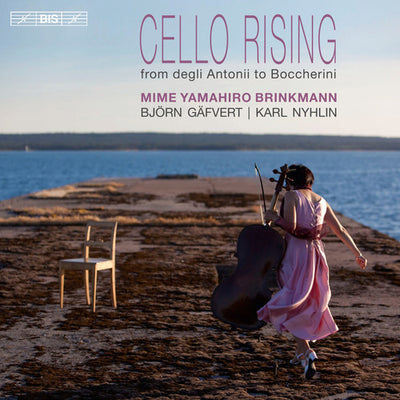
Well known for her performances with early music groups and acclaimed for her performances both as a soloist and a continuo player, cellist Mime Yamahiro Brinkman presents here her first solo disc. For this release, Brinkmann has chosen a programme which takes the listener on a journey through the rise of the cello, from its beginning as accompaniments in church music to the well-loved solo instrument that it is today. Harpsichordist Bjorn Gavfert joins Brinkmann throughout this recording, and baroque guitarist Karl Nyhlin joins the group for the two Boccherini sonatas making this an outstanding recording for any cello lover.
Johan Helmich Roman’s 12 keyboard sonatas, composed c. 1735-37, are veiled in mystery, as it is not known why he wrote them nor what instrument they were intended for. In 1746 he assembled the pieces, each consisting of between three and seven movements, into a single manuscript. They remained unpublished, however, and as Roman did not provide any titles to them, they have since been referred to both as ‘suites’ and ‘sonatas’. Whatever the label, this collection testifies to a period of great stylistic diversity and change, as observed by a composer who remained wide-open to new developments.
C.P.E. Bach: The Solo Keyboard Music, Vol. 37 / Spanyi
BIS
CD
$21.99Feb 01, 2019
Described in Gramophone as ‘one of the most needed and important recording projects in progress today’, this series has up until now featured the clavichord, the tangent piano, and the fortepiano. It is therefore something of an occasion when Miklós Spányi for his Volume 37 chooses to perform on a harpsichord. In doing so he reminds us of C.P.E. Bach’s own advice to keyboard players to have both a clavichord and a harpsichord in order to play ‘all sorts of things alternating’ (‘allerley Sachen abwechselnd’). But the album – which includes some of the composer’s earliest works – also features one of the very few, if not the only, compositions that Bach specifically dedicated to the harpsichord, namely the Sonata per il cembalo a 2 tastature. In it, Bach makes colorful use of the instrument by specifying various detailed and idiosyncratic harpsichord registrations. Spányi also performs two of the few fugues – in F and A major respectively – that Carl Philipp composed: besides the general shift in fashion away from intricate counterpoint to melodic simplicity, it is possible that he found father Johann Sebastian’s achievements in that particular genre too hard an act to follow.
J.S. Bach: Musikalisches Opfer / Suzuki, Bach Collegium Japan
BIS
SACD
$21.99Nov 03, 2017
Hybrid SACD: This SACD will play on standard CD players as well as SACD players.
Johann Sebastian Bach’s appearance on 7th May 1747 at the court of Frederick the Great is the best documented event in the composer’s otherwise unglamorous career. During the proceedings, Frederick provided Bach with an exceptionally difficult theme on which to improvise a fugue. The King is said to have been impressed with the improvisation, but Bach himself was less so, and announced that he intended to set the theme to paper "in a regular fugue". Several months later, the Musical Offering appeared in print – a collection of 13 pieces in diverse genres: fugues, canons and a trio sonata, all exploiting the "Royal Theme" in various intricate ways. Bach’s published score gives no firm idea about a playing order for the pieces, and in most cases no instrumentation is specified. Furthermore, some of the canons – the so-called "riddle canons" – are very sketchily notated, with just a few notes and some enigmatic clues in Latin. The performers are thus left with an unusual degree of freedom when it comes to the interpretation of the work – a freedom which Masaaki Suzuki, with his colleagues from Bach Collegium Japan, is singularly well-placed to explore. Following the Offering on this disc is another collection of riddle canons by Bach: the 14 Canons on the Goldberg Ground, which were discovered as late as 1974, in the form of a hand-written addendum to the composer’s own printed copy of the Goldberg Variations. The canons are all based on the first eight bass notes of the celebrated Aria from the Goldberg Variations, and are performed here as harpsichord solos, along with the Aria. The disc closes with another chamber work – the Sonata in G Major for Flute, Violin and Continuo, BWV 1038.
-----
REVIEW:
Suzuki’s readings of the ricercars find a workable balance between forward momentum and textural lucidity, the trio sonata is tasteful if cool, and the canons are played with exemplary clarity. BIS’s recorded acoustic is perhaps a little ‘big’ for such intimate music, though at no cost to transparency or attractiveness.
While usually associated with sacred music, the organ was also used during the Renaissance and early Baroque periods in noble mansions and courts for the purpose of secular music. This fantastic anthology peeks into the secular organ repertoire from royal courts across five countries. Francesco Cera is a celebrated Italian organist. He performs on a 1772 “Organo ottavino.” Liner notes include information on all pieces, as well as a photo of Cera’s organ.
Soler: 6 Concertos for 2 Harpsichords / Alvarez, Fernandez-Villacanas
Brilliant Classics
CD
$13.99Oct 28, 2016
Antonio Soler was a scholar, musicologist (he wrote about the history of Spanish music), composer and virtuoso keyboard player. He was in the service of the Spanish Royal family, and personal tutor of the Infante Gabriel de Borbon. Soler wrote a great quantity of solo keyboard sonatas for the use at the Royal court. They are one movement works, much in the style of the sonatas by Domenico Scarlatti (whom he knew personally). The sonatas abound in instrumental virtuosity, daring harmonies and attractive melodies in pre-classical style. Soler wrote the 6 Concertos for 2 Harpsichords for his royal pupil. Judging by the brilliance and vitality of these popular works the composer and his pupil must have hugely enjoyed themselves playing them. These important works are performed here by the harpsichord duo L’entretien dex clavecins, formed by Agustin Alvarez and Eusebio Fernandez-Villacanas, playing magnificent copies, build by Andrea Restelli, of a Taskin and Donzelague harpsichord.