Schoenberg: Kol Nidre - Shostakovich: Suite on Verses of Buonarroti / Muti, Chicago Symphony
CSO Resound
CD
$21.99Sep 30, 2016
This outstanding new live recording brings together groundbreaking works by Arnold Schoenberg and Dmitri Shostakovich, two of the twentieth century’s most monumental composers. Arnold Schoenberg’s Kol Nidre is set to the Jewish prayer which is said on the eve of Yom Kippur, the Day of Atonement. The work premiered in Los Angeles in 1938, four years after Schoenberg fled Europe, and one month before the anti-Jewish Kristallnacht took place across Nazi-occupied Germany. Philip Huscher described the work as a “stark, strong modernist statement.” Shostakovich’s Suite on Versees of Michelangelo Buona explores themes just as weighty, including love, morality, death, and the resilience of the human spirit, all shown through the poetry of Renaissance great, Michelangelo. The work was originally conceived to honor Michelangelo’s 500th birthday. The Chicago Tribune commented on these performances, “Such was his textual penetration that [Abdrazakov] was able to extract the full emotional weight of the words and music, abetted by Muti’s finely detailed exposition of the spare orchestral fabric.”
Although the music of Robert de Visee has transcended the ages, many scholars are still trying to unravel the mysteries surrounding the composer's life. Among them, Thibaut Roussel - accompanied by Perrine Devillers, Mathilde Vialle and Myriam Rignol - delights hearts with his own interpretation of the rich music of the greatest theorbist of the 17th century. Interwoven with pieces by contemporary composers, Robert de Visee's exquisite arias transport the listener to the pomp and splendour of the evenings at the court of Louis XIV.
Gong With Wind epitomises neatly the nature and purpose of this unique collaboration between evergreen veteran saxophonist Lee Konitz (supplying the wind) and master percussionist Matt Wilson (the man with the “gongs”).
The pair have known each other and played together intermittently for many years. Matt was part of Lee’s group in the early 1990s. Konitz had in mind for sometime to make an entire album with the sole assistance of the drummer for whom he has the highest regard.
(from Mark Gardner's liner notes)
Johann Sebastian Bach's works, known today as cello suites, intonate a polyphony that arises from the virtuosity of an instrumentalist - a complex play of intimation and execution, of foreground and background, reverberation and reverberation, hatching and large arches. And instructions for musicians whose redemption is not uncommon for them. The circumstances surrounding the creation of BWV 1007 - 1012 are hardly known, which means that there is an uncertain source at the beginning. It makes an authentic interpretation of the musical text impossible from the outset, and the right to be true to text cannot be maintained either: there is no autograph handwriting of the suites, which opens up a spectrum of new works, which above all harbors chances and suggests that the Suites have not necessarily been written for a specific instrument. The attraction for instrumentalists lies in balancing intention and interpretation. The renowned flutist Paul Meisen has pointed out the surprisingly natural playability of the cello suites by the flute. His former master class student Sabine Kittel, now solo flutist at the Saxon State Orchestra in Dresden, shows this potential here in a comprehensive way. The double album recorded in the Emmauskirche Dresden-Kaditz and the Jakobuskirche Freital-Pesterwitz is supplemented by the Partita in A minor BWV 1013.
Native of Umbria, Italy, pianist/composer Federico Bonifazi has become a highly acclaimed name both in national and international scene in recent years. For this his 3rd album Bonifazi composed a suite depicting the beauty of his beloved Umbria in the changing colors of autumn performed by Bonifazi’s handpicked elite Italian ensemble.
“.. an album worthy of special attention, conceived and created with a strong artistic personality and with a huge communicative generosity, … with the humility and discretion that only the great artists possess and that make this CD a real pearl in the musical production of the Umbrian pianist.” (Proposito di Jazz on SCCD 33125 “You’ll See”)
Cappelletti and Bamert's coupling is salutary in what little remains to apologize for in Respighi's music when played with real opulence and virtuosity. The fact is that the Concerto belies it's name: both have shrewdly perceived that Respighi's use of modality enables him to explore both early music and folklore... The lushness sounds much more natural in the context of a late-romantic violin concerto, with a big and bold performance of rich and dramatic gesture. Cappelletti, a striking and accomplished soloist, makes the most of the finale's punch and vigour, but also of the musing beauty of the slow movement. I now prefer this (version)... "romantic warmth is also a feature of Barra's Poema (suite), Respighi in neo-baroque lush harmonies with a baroque-size orchestra" (Gramophone)
The album provides a unique opportunity to get to know the oeuvre of forgotten masters of the mature Baroque era and to admire their talent and compositional craftsmanship. Thanks to it's exuberant production, the Altberg Ensemble, specializing in historically informed performance on period instruments, transfers listeners to the world of emotions, intrigue and entertainment of sixteenth-century European courts.
Boismortier: Six Suites de Pieces, Op. 11 / Nahajowski
Recart
CD
$10.49$20.99Save 50%Nov 15, 2019
The music scene of Paris during the reign of Louis XV could be defined as truly cosmopolitan. The change in aesthetic preferences were already observed in the works written as early as the 1700s, when French composers started to assimilate more and more willingly some elements of Italian style into their pieces. What strikes is the fact that concepts concerning the creation of a mixed style (les goûts rèunis) were primarily developed by instrumental music composers. In contrast to opera, which was naturally connected with the morphology of the language and literature of a given country, compositions lacking the semantics of a text were more suitable for the creation of a universal musical language. The figure of Boismortier can be described as French Telemann. Similarly to his German counterpart, he favored the idea of a mixed style and experimented with unorthodox instrumentation solutions. Boismortier was also one of the first composers that did not have a wealthy patron or protector, living off his works solely. He owed that position to the royal prerogative (1724) to print and sell sheet music, which helped him to avoid the necessity of working as a teacher or seeking employment as an instrumentalist in one of numerous court ensembles. This new recording is the first complete album of Boismortier’s suites performed on the recorder solo.
The Rite of Spring's 1913 premiere created one of the most famous classical music riots in history. It's intensely rhythmic score, primitive scenery and radical choreography completely shocked the audience, who were accustomed to the elegant conventions of classical ballet. Almost 100 years later, the Rite of Spring still has the ability to shock - it still sounds fresh, pagan and new. On this Super Audio recording, Ivan Fischer and the Budapest Festival Orchestra offer a powerful and intense performance that reveals the underlying simplicity that forms the foundation of the work.
Gilbert Rowland is one of Europe's most senior and accomplished exponents of the harpsichord. Following his critically acclaimed 6-album series of the Harpischord Suites of Handel for Divine Art, he moved to the Athene imprint specializing now in baroque music and 'period' instruments for his well received album of Suites by Johann Mattheson. This 2-album set is the first volume in a projected complete survey of the Harpsichord Suites by Johann Jakob Froberger, whose organ and harpsichord music is individual in nature and ground breaking - he was one of the first composers to settle the 'dance-movement' style of Suite taken up by Couperin, Bach, and Handel among many others. There are 12 Suites in this collection. Gilbert Rowland plays a 2 manual French style harpsichord made by Andrew Wooderson after an instrument by Goemans (Paris, 1750).
Johann Abraham Schmikerer is only one of the vast number of shadowy figures from the annals of music whose life and activities are hardly known. Among other places, he is also known under the quite unflattering surname Schmierer, in no way deserved in light of his inventive compositions oriented towards the French tastes of the time. His Zodiaci musici of 1698, which is Schmikerer's only undisputed work, is now convincingly joined by the Musico-instrumentalische Gemuths-Lust of 1712 on this recording. It proves not only to be an equally enchanting collection as the "musical constellations", but is also in all likelihood the second part of the suite collection long thought lost, through which the name Schmikerer has been handed down to posterity.
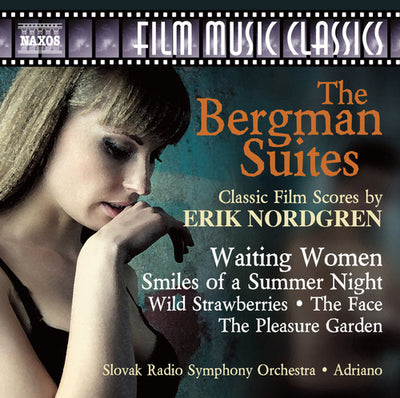
The Bergman Suites: Classic Film Music of Eric Nordgren
Naxos
CD
$19.99Apr 08, 2016
Erik Nordgren, whose compositions include major concertos and chamber music, wrote seventeen film scores for Ingmar Bergman. The finest examples of their close collaboration can be heard on this recording. They include the symphonically proportioned Waiting Women, the suggestive and mysterious score for Wild Strawberries and the exceptional economy of The Face. Conductor Adriano has prepared the scores directly from manuscripts and copies of the films, where available.
• This is a reissue of a Marco Polo disc, 8.223682. • On its original appearance Gramophone wrote “Performances and recording are among the best in this interesting series”.
Johann Sebastian Bach's Six Solo Cello Suites are some of the most iconic classical music works. They have inspired not only cellists and audiences but other artforms as well, and they have been featured in ballet and theatre productions, even in films. The Swiss cellist Maja Weber performs the complete cycle of six suites on an outstanding instrument: on the legendary Stradivari cello "Bonamy Dobrée-Suggia" (1717). Among those who have performed on this instrument is the English violoncellist Hancock, while it's owners include the English scholar Bonamy Dobrée, after whom the instrument is named. But the touching story of this valuable violoncello really begins with the mysterious and diva-like Portuguese violoncellist Guilhermina Suggia (1885-1950), whose playing on her favorite instrument combined technical perfection and great emotionality, allowing her to cast a spell on her listeners with her warm, deep tones. Outwardly eccentric and volatile, Suggia was essentially an intelligent, warm- hearted woman. The instrument was sold on her death and the proceeds used to support a scholarship at London's Royal Academy of Music. The Bonamy Dobrée-Suggia Violoncello is currently part of the collection of the Swiss Habisreutinger Stradivari Foundation. Maja Weber has played it all over the world at countless concerts during the last two decades.
Sibelius: Suites - Pelleas et Melisande, King Christian II, Swanwhite / Sakari
Chandos
CD
$13.99Jul 29, 2014
I cannot remember having enjoyed this music more. Petri Sakari’s performance is totally unaffected, plain and full of enthusiasm; the players sound as if they are enjoying this score and communicate their pleasure.
– Gramophone, reviewing original release
-----
This reissue features performances of incidental music by Jean Sibelius, recorded in 1992 by Petri Sakari and the Iceland Symphony Orchestra. Sakari’s recordings with this orchestra during the 1990s made a significant contribution to the discography of Scandinavian music, notably of works by Grieg, Sibelius, and Madetoja.
Sibelius composed the score for King Christian II, a play by his friend Adolf Paul, in 1898 and it anticipates the richly romantic sound of the First Symphony. Here the usual suite is expanded by the inclusion of two movements from the incidental music not usually heard: the Menuetto and "The Fool’s Song."
Maurice Maeterlinck’s much-performed yet complex psychological drama Pelléas et Mélisande inspired works by Debussy, Fauré, Schoenberg, and Sibelius, whose incidental music consists mainly of interludes in a uniquely dark, subdued, and typically Nordic vein.
Altogether sweeter is the delicate and poetic score for Swanwhite, August Strindberg's "idealistic play of pure beauty." Sibelius condensed the original music into a charming concert suite of seven movements, five of which are recorded here.
Tchaikovsky: The Queen Of Spades Suite; Voyevoda Suite / Breiner, New Zealand Symphony Orchestra
Naxos
CD
$19.99May 28, 2013
Slovak-born composer and conductor Peter Breiner has received considerable international acclaim for his adaptations, and his Tchaikovsky arrangements are particularly impressive examples of his art. He has already arranged The Seasons (8.553510) and Songs (8.555332) but here he turns to opera. With deftness and subtlety he has taken motifs from Tchaikovsky’s first opera Voyevoda to craft six richly scored movements, two of which have rôles for solo strings. The Queen of Spades was composed in 1890 and Breiner’s selections fully explore the music’s romance and drama in their new form.
Telemann: Don Quixote & Other Suites & Concertos / Sorrell, Apollo's Fire
Avie Records
CD
$9.99$19.99Save 50%Jun 01, 2016
Tilting at windmills. The long-suffering Sancho Panza. Sighs of love for Dulcinea. The familiar and fanciful themes of the Don Quixote legend are brought to life by Apollo’s Fire in Telemann’s imaginative portrayal. The Don Quixote Suite sits alongside other suites and concertos by the composer that reveal his cosmopolitan air and whimsical nature.
REVIEW:
Avie deserves credit for spotting this 2002 Koch International label disc and putting it back into circulation once again, as it remains a sterling release. The Cleveland-based Baroque orchestra Apollo's Fire and conductor Jeannette Sorrell pick a program that shows exactly why Telemann was so popular in his own day. They apply just the right level of broad gesture to the two representational suites, which reflect their subjects but are in no way overdone. A wonderful release that holds up to repeated hearings.