The Dixieland Rhythm Kings were formed in central Ohio in the late '40s and have recorded for many labels including Riverside, Red Onion, GHB, Audiophile and Jazzology. Gene Mayl, founder of the group, has played with Bob Scobey, Muggsy Spanier, Wild Bill Davison, George Brunies and many others. This album comes from a 1965 live concert originally issued on the Blackbird label as "Trip to Waukesha." the personnel is Dick Baars, cornet; Bill Coburn, trombone; Pat Patterson, clarinet; Clarence Hall, piano; Vic Tooker, banjo; Gene Mayl, tuba and Glenn Kimmel, drums. Contains previously unissued material.
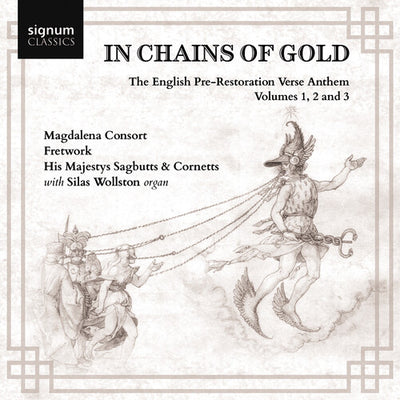
Leading performers of 17th-century music the Magdalena Consort, Fretwork and His Majestys Sagbutts and Cornetts combine forces under the artistic direction of William Hunt for the box set of their series 'In Chains of Gold'. "In Chains of Gold is a high-quality musical collective project that sheds light on these unknown masterpieces." - Sonograma Praise for Vol. 1 ? - "Subtle, seductively supple and sinuous singing and playing... Volume 2 from this dream-team will be eagerly awaited" - Choir and Organ Praise for Vol. 2 ? Performance ? Recording "An ear-tingling fulsomeness that guarantees the disc a splendiferous climax... It sets a marker for all that follows as 'chains of gold' are spun with disarming felicity" - BBC Music Magazine Praise for Vol. 3 "Nicolson's anthem stands as the epitome of all that is best in Bill Hunt's triumphantly successful project." - Early Music Review
The Teatro La Fenice opened in 1792 and is one of the most renowned and most beautiful theaters in the world. "Amid mirrors, flowers and confetti, New Year's Eve at La Fenice is a ritual" (MusicPaper). The Teatro Fenice's Concerto di Capodanno - one of the world's most celebrated New Year's concerts - welcomes Daniel Harding back to the podium. After the monumental opening with Beethoven's Fifth, soloists Mariangela Sicilia and Francesco Demuro perform beloved arias by Rossini, Leoncavallo, Puccini, Wolf-Ferrari, Bizet, Gounod and Verdi. Interwoven with the concert are scenes of Aterballetto dancers, choreographed by Marcos Morau, performing in Venice's most iconic locations. The soloists' "perfect vocal blend" in Libiamo ne' lieti calici truly stands out (MusicPaper).
Music from Diaghilev's Ballet Russes / Fischer, BBC National Orchestra of Wales
Signum Classics
CD
$41.99Jan 01, 2011
STRAVINSKY; POULENC; LIADOV BBC NATIONAL ORCHESTRA OF WALES; FISCHER (COND.) MUSIC FROM DIAGHILEV'S BALLET RUSSES- STRAVINSKY: THE FIREBIRD, THE RITE OF SPRING, PETRUSHKA, SCHERZO FANTASTIQUE; LIADOV: BABA-YAGA, THE ENCHANTED LAKE. KIKIMORA; POULENC: LES BICHES
'Claude Debussy is still the greatest musical enigma that has ever existed,' said Aldo Ciccolini. 'You never get to the bottom of his music. That is perhaps why he will never be forgotten: people will never give up trying to make sense of him. Debussy never fails to surprise you and his music has a charm that is quite indefinable.' Ciccolini, though born in Naples, confessed to having a French soul and he distinguished himself as a supremely subtle and illuminating interpreter of the composer who described himself as 'musicien francais'.
Few organists are as well known or highly praised for their Bach recordins as Joan Lippincott. Performing on the newly constructed Craighead-Saunders organ at Christ Church, Rochester, NY (closely modeled after a 1776 instrument by the central German organbuilder, Casparini), Lippincott brings a maturity of vision to Art of Fugue that is based on a lifetime of distinguished interpretations and insights into Bach's organ works.
Fruhlingsrauschen - Piano works by Schubert, Grieg, Mendelss
Haenssler Classic
CD
$20.99Apr 17, 2026
Each composer on this album encounters the season differently: Schumann with rapture, Grieg with grace, Schubert with introspection, Suk with radiant yearning, Sinding with luminous vitality. In "Fruhlingsrauschen", Nareh Arghamanyan brings together these diverse voices to celebrate not one single vision of spring, but a dialogue of many: an unfolding of human feeling in harmony with the turning of the seasons. Lieder are at the centre of the album: from Schumann's Spring Night to songs about spring by Schubert, transcribed for solo piano by Liszt, Godowsky, Frederic Meinders, and Nareh herself.
The Edward Petersen Quintet has been appearing weekly at Chicago's well known jazz club, The Green Mill, for about three years. The music on this album is a sampling of that which the group performs in a "live" situation. These recordings were done directly to a two track digital recorder and no elaborate production techniques (i.e. fixing mistakes) was possible. These are simply recordings of the band playing the way we play.
Barrie Kosky, one of the most innovative opera directors of our time, creates a new interpretation of Mozart's Le nozze di Figaro at the Vienna State Opera with a very young ensemble: Andre Schuen and Hanna-Elisabeth Muller in the roles of Count and Countess Almaviva, Peter Kellner as Figaro, Patricia Nolz as Cherubino. Susanna's role is interpreted by both Ying Fang (acting) and Maria Nazarova (singing), as Ying Fang could not sing due to a vocal cord illness. Philippe Jordan conducts the Orchestra of the Wiener Staatsoper and together they "deliver an ideal mixture of elegant lyricism and concentrated expression - each and every one" (Wiener Zeitung) // "Beauty and pointedness are combined in the noblest way. " (Der Standard) // "A triumph of Barrie Kosky's directorial brilliance - hilarious yet deeply engaging and thought-provoking. " (klassik-begeistert. De)
The work of Louis Vierne, organist at Notre-Dame de Paris and master of the symphonic instrument, is reflected here in all it's rich variety: from the poetic 'Pieces en style libre' to his final masterpiece, the monumental 'Sixth Symphony', via the virtuosic and world-famous 'Pieces de fantaisie'. All are performed here on the little-recorded instrument of the Parisian church of Saint-Francois-Xavier by it's organist Gaston Litaize, who studied with Vierne and went on to become a prolific composer himself. The recordings have been remastered in 24-bit/192kHz sound from the original tapes.
With this recording Dynamic brings to completion the project of recording Nicolo Paganini's entire output. Included in this programme are some absolute rarities, such as the Sonata Napoleon MS. 5, the splendid Maestosa Suonata Sentimentale MS. 51, the Sonata movimento perpetuo M.S 66 and La Primavera MS. 73, all performed faithfully following Paganini's original manuscripts. The set also features an exciting interpretation of the rare Concerto No. 3 in E major MS. 50, perhaps the less frequently performed of Paganini's concertos, and the Caprice No. 24 in an interesting version with piano accompaniment. Mario Hossen received his musical education in Sofia, Vienna and Paris. He made his debut as a soloist with an orchestra at the age of eight. Hailed for his incredible virtuosity and charismatic stage presence, Hossen plays a repertoire that ranges all the way from Renaissance music to Classic music to contemporary works and Jazz. As a concert soloist of international acclaim, Mario Hossen has performed with renowned orchestras such as the Academy of St. Martin in the Fields, the Vienna Chamber Orchestra, the English Chamber Orchestra, the Tchaikovsky Symphony Orchestra, the Bruckner Orchestra Linz, the Orchestra della Scala di Milano, the Royal Philharmonic, the Orquesta Sinfonica del Estado de Mexico, the Prague Radio Symphony Orchestra, the Sofia Philharmonic and the Nordwestdeutsche Philharmonie. Hossen's musicological and artistic endeavors are focused among other things on source research on Niccolo Paganini. Mario Hossen plays a violin by Giovanni Battista Guadagnini, 1749, on loan from the Austrian National Bank collection.
Gerhard: Don Quixote (Complete Ballet); Suite from Alegrias;
Chandos
CD
$21.99Aug 02, 2024
The Catalan Roberto Gerhard studied piano with Granados, and was the only Spanish composer to study with Arnold Schoenberg. It was, however, over twenty years before he committed himself to writing twelve-tone music. In the interim, his output brought a new focus and precision (owing more to Stravinsky and Bartok) to the Spanish style. All the works on this album were composed in that period. Dating from the early 1940s, his ballet Alegrias was originally conceived for two pianos, but soon evolved into the four-movement suite heard here. The flamenco-inspired movements are linked in pairs, and show Gerhard's brilliance and humour in equal measure. During this same period Gerhard decided to mark the centenary of his first teacher, Felipe Pedrell (who had also taught Albeniz, Granados, and de Falla), with a three-movement symphony, Homenaje a Pedrell (CHAN 9693). Gerhard failed to secure a performance of the work, but in 1954 was invited to re-work the final movement for a BBC Symphony Orchestra concert, which became Pedrelliana. Gerhard's ballet on episodes from Cervantes's Don Quixote evolved for almost a decade, from a work for chamber orchestra, for a touring company (abandoned because of the war), via a version for radio and an expanded orchestral suite, to the work recorded here, in it's full and final orchestration for performances at the Royal Opera House in 1950, choreographed by Ninette de Valois. Robert Helpmann danced the title role and Margot Fonteyn Dulcinea.
180-Gram Virgin Vinyl Limited Edition of 1000 copies - *AllMusic. Swingin' Easy finds the great Sarah Vaughan backed only by a rhythm section of piano, bass & drums, a format in which she only recorded a few times during this early period of her career. This is one of Sarah Vaughan's lesser known albums for Emarcy, combining two separate trio sessions from 1954 and 1957. The earlier date includes pianist John Malachi, bassist Joe Benjamin and drummer Roy Haynes. The second trio includes the same drummer, plus pianist Jimmy Jones and bassist Richard Davis. 180-gram VIRGIN VINYL LIMITED EDITION of 1,000 COPIES. The Complete Album + 5 Bonus Tracks.
The myth of Orlando Furioso, conceived by Ludovico Ariosto in the 16th century, is one of the most fertile for dramatic and musical imagination. Between chivalrous heroism, romantic torment and psychological turmoil, it explores the limits of passion and the fractures of the human soul, offering Baroque composers an ideal terrain for expressing the tension between reason and madness, order and chaos. This program bears witness to this, traversing the many faces of Orlando through excerpts from operas by Vivaldi, Handel, Steffani, Fux and Porpora, where recitatives, arias and instrumental movements mirror his inner world.