In these love songs in waltz style for chorus or solo voices accompanied by piano four hands, Brahms freely indulged his taste for Viennese folk music. The RIAS Kammerchor Berlin instills a wonderful inner life in these musical landscapes, sometimes cheerful, sometimes melancholy, punctuated here by a selection from the Hungarian Dances - also eminently popular in their inspiration.
Schumann & Bruch: Cello Concerto & Works for Cello and Orche
SWR
CD · 1 disc
$20.99Nov 13, 2026
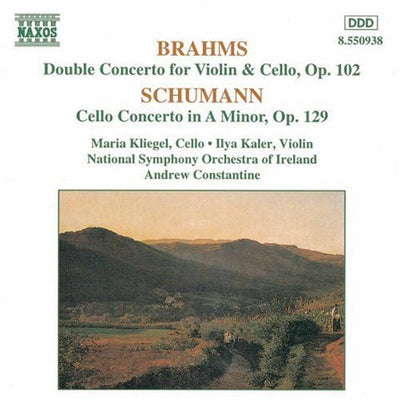
Sebastian Klinger and the Deutsche Radio Philharmonie under Marzena Diakun bring together a compelling selection of Romantic works for cello and orchestra: Schumann's deeply expressive Cello Concerto in A minor, Op. 129, alongside Max Bruch's lyrical pieces Kol Nidrei, Canzone, and Ave Maria. Schumann's concerto, born from a moment of creative exhilaration, unfolds with poetic intensity as it's movements flow seamlessly into one another, illuminated by the cello's warm, human voice. Bruch's works, by contrast, shine with heartfelt melody and emotional immediacy - music that speaks directly to the soul. Sebastian Klinger, one of the outstanding cellists of his generation, combines technical brilliance with a uniquely rich tonal palette. Together with the DRP, he brings Romanticism to life in it's most compelling form: intimate, passionate, timeless.
This programme forms a continuity with the album Brahms Berg Zemlinsky (released by Cypres - CYP8610), one that was distinguished notably by a Gramophone Choice. It continues the same reflection on the Vienna of the late nineteenth century and the passage towards modernity by exploring the ties uniting Johannes Brahms, Carl Frühling and Franz Schreker. These three works - the Trio with horn of Brahms, the Trio op. 40 of Frühling and the Quintet Der Wind of Schreker - form a fascinating journey through Austro-German music, illustrating with force the evolution of a mature romanticism into Viennese modernity. The first great axis of convergence lies in their unique, deliberately 'hybrid' instrumentations. Each composer rejects the standard formations, such as the string quartet or the classical wind quintet, in order expressly to create an aural texture that combines the strings, the piano and the wind instruments. We are witnesses to a subtle transmission of the tone-colours: Brahms's horn first brings a wooded, dark dimension that Frühling then replaces with the clarinet in velvety fusion with the cello. Lastly, Schreker brings together clarinet, horn, strings and piano within the same piece, achieving an unexpected synthesis of these acoustic worlds. Founded in 2006, the Ensemble Kheops has progressively asserted itself as one of the most outstanding chamber music groups in Belgium. With it's variable formation, it has forged an artistic identity that is based on curiosity, high standards and a dialogue between repertories, epochs and disciplines. This first instalment of a triptych celebrating it's twentieth anniversary marks an important stage on this route, the result of two decades of musical exploration undertaken with the same high standards regarding both the choice of the performers and the conception of each of it's projects.